Sandisk

Search documents
Bitcoin searching for its next big catalyst, plus how McDonald's is unlocking value for customers
Youtube· 2026-02-12 17:16
Group 1: Software Stocks - Retail investors are actively buying software stocks despite the current poor performance of the sector, with some analysts cautioning against this trend [2][11] - The sentiment around software stocks is mixed, with some believing the market has overreacted and presents buying opportunities, while others remain skeptical about the long-term viability of certain companies like Workday and Salesforce [11][14] - The AI trade is still in its early stages, causing anxiety among investors about potential job losses and market changes, but there is optimism about new job creation in the long run [12][19] Group 2: Consumer Staples - Consumer staples have been performing well, with companies like Coca-Cola reporting solid earnings, while Kraft's performance was disappointing [3][42] - McDonald's has seen strong US sales attributed to value offerings and marketing strategies, despite concerns about the impact of GLP-1 weight loss drugs on consumer behavior [46][61] - The company is focusing on value and affordability to attract lower-income consumers, which has been successful in recent quarters [49][52] Group 3: Memory Chips - Lenovo's CEO indicated that the memory chip shortage affecting hardware companies will continue into the year-end, echoing sentiments from Cisco's CEO [5][6] - This ongoing shortage is seen as beneficial for memory chip companies like Sandisk, which are experiencing stock price increases [6] Group 4: Economic Outlook - The economy is showing signs of strength, with corporate earnings exceeding expectations and a robust jobs report indicating private payroll growth [23][26] - Analysts suggest that the current economic conditions favor cyclical and defensive value stocks, with the value trade up 4.5% year-to-date compared to a 1.5% decline in growth stocks [24][25] - There is a belief that the economy does not require further rate cuts, as current conditions do not indicate a downturn [28][29]



A Wild Ride for Chip Stocks
Barrons· 2026-02-11 16:02
Core Viewpoint - The semiconductor sector is experiencing significant volatility, with notable movements in stock prices, particularly in the iShares Semiconductor ETF and individual companies like Sandisk, Micron Technology, On Semiconductor, and Western Digital [1]. Group 1: Market Performance - The iShares Semiconductor ETF increased by 1.9% [1]. - The chip stock index initially rallied at the market open but subsequently experienced a sharp pullback before making another upward push [1]. Group 2: Key Companies - Sandisk, Micron Technology, On Semiconductor, and Western Digital were highlighted as some of the top-performing stocks within the S&P 500 [1].
How High Can Micron Go In the Memory Supercycle? Here's What History Says
The Motley Fool· 2026-02-11 03:30
Core Viewpoint - Micron Technology has significantly benefited from the AI boom, with its stock price increasing over 300% due to a generational shortage of memory chips driven by high demand for high-bandwidth memory (HBM) chips used in AI applications [1][2]. Financial Performance - Analysts project that Micron's revenue will double to $75.4 billion for fiscal 2026, with adjusted earnings per share expected to quadruple to $33.38, resulting in a forward P/E ratio of 12 [2]. - Micron is estimated to achieve a net income of approximately $35 billion for the current fiscal year, with profits expected to continue rising at least through 2027 [8]. Market Dynamics - The memory subsector is experiencing a supercycle, which has also positively impacted other memory companies like SK Hynix, Samsung, and Sandisk [4]. - Memory chips are subject to boom-and-bust cycles, with prices fluctuating based on demand and inventory levels, leading to intense capital costs in the semiconductor industry [5]. Historical Context - Micron has experienced multiple cycles over the past decade, with net losses reaching nearly $8 billion during the post-pandemic downturn [6]. - Historical memory cycles for Micron have been relatively short, with trough-to-peak or peak-to-trough periods lasting just a couple of years [9]. Stock Performance - Historically, Micron's stock has gained about 600% from trough to peak during its cycles over the last 20 years [13]. - The most recent cycle shows a significant gain of 840% so far, exceeding typical trough-to-peak gains [14]. Unique Current Conditions - The current memory boom is characterized by unprecedented capital expenditures from major tech companies, with over $600 billion planned for AI infrastructure, indicating sustained demand for memory [15]. - The ongoing shortage of memory chips is expected to impact the smartphone industry significantly, with new capacity taking time to come online [16]. Future Outlook - While the memory cycle will eventually peak, it may take years, and Micron is positioned as a strong investment opportunity in the AI boom, with potential for the stock to double before reaching its peak [17].

SCHA and VB Offer Similar Small-Cap ETF Advantages, but Which Is the Better Buy?
The Motley Fool· 2026-02-10 01:39
Core Insights - The Vanguard Small-Cap ETF (VB) and Schwab U.S. Small-Cap ETF (SCHA) are both designed for diversified access to U.S. small-cap stocks through a passive, index-tracking approach, with subtle differences in cost, performance, and risk influencing investor choice [1] Cost & Size Comparison - VB has an expense ratio of 0.03%, while SCHA has a slightly higher expense ratio of 0.04% [2] - As of February 9, 2026, VB's one-year return is 12.49%, compared to SCHA's 16.27% [2] - VB offers a dividend yield of 1.27%, slightly higher than SCHA's 1.19% [2] - Assets under management (AUM) for VB is $169 billion, significantly larger than SCHA's $20 billion [2] Performance & Risk Comparison - Over five years, VB has a max drawdown of -28.16%, while SCHA has a deeper max drawdown of -30.79% [3] - The growth of $1,000 invested over five years is $1,292 for VB and $1,221 for SCHA [3] Holdings & Sector Focus - SCHA aims to mirror the Dow Jones U.S. Small-Cap Total Stock Market Index, holding 1,730 stocks with a focus on technology, financial services, and industrials [4] - VB tracks the CRSP US Small Cap Index, holding 1,324 stocks, with a focus on industrials, technology, and financial services [5] - Notable holdings for SCHA include Sandisk, Lumentum, and Rocket Companies, while VB's notable holdings are Rocket Lab, Sandisk, and Ciena [4][5] Investor Implications - Both ETFs provide diversified exposure to the small-cap segment, with over 1,000 holdings each, but differ in sector allocation and risk profile [6] - SCHA's focus on technology may contribute to its higher volatility, reflected in a higher beta and deeper max drawdown compared to VB [6] - Despite SCHA's turbulence, it has outperformed VB over the past 12 months, while VB has a slight edge in five-year total returns [7] - VB's larger AUM provides greater liquidity, making it easier for investors to buy and sell larger amounts without affecting the ETF's price [8] - Investors seeking greater tech exposure may prefer SCHA, while those looking for more liquidity may benefit from VB's larger asset base [9]

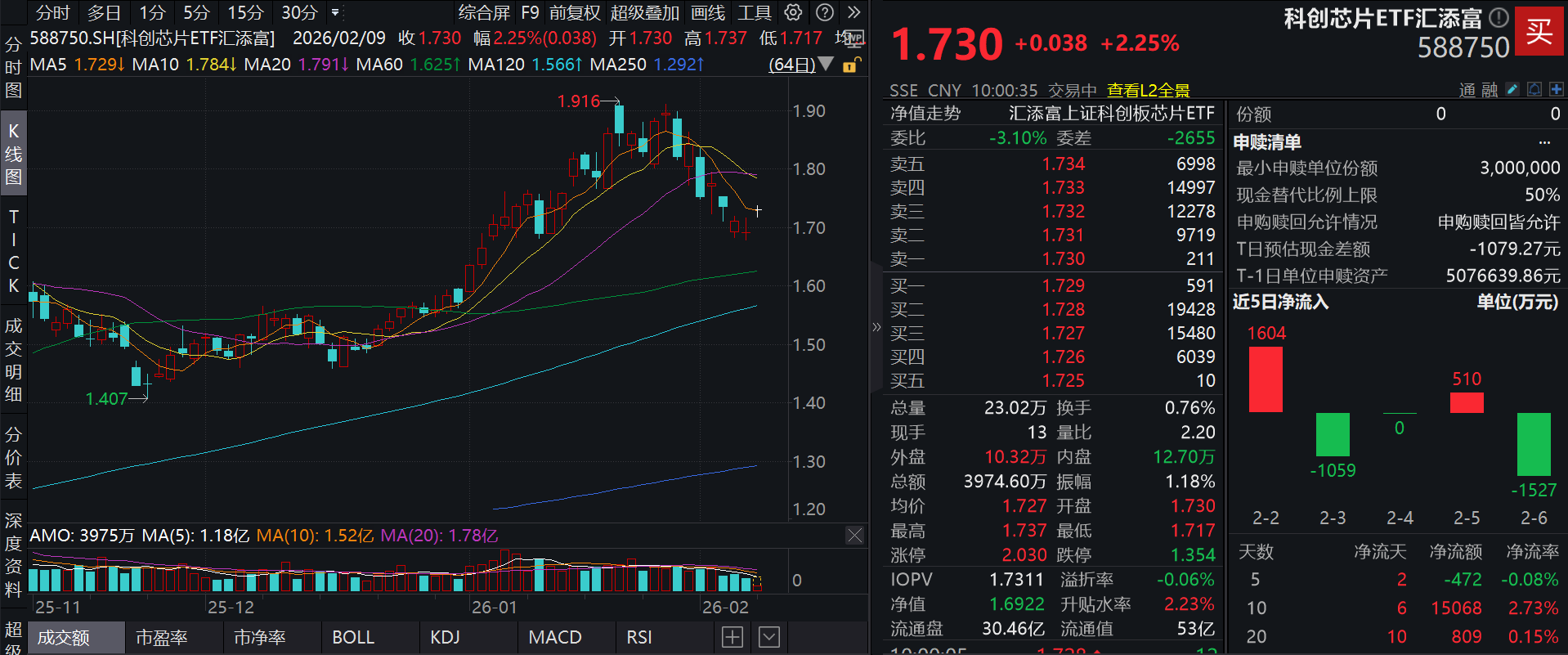
科创芯片强势反弹,芯原股份一度涨超10%,科创芯片ETF汇添富(588750)涨超2%!存储芯片巨头重构合约规则,“超级周期”持续演绎
Xin Lang Cai Jing· 2026-02-09 02:24
Core Viewpoint - The semiconductor sector, particularly the Sci-Tech Innovation Board chip index, is experiencing significant growth, driven by strong demand for AI infrastructure and a shift in contract frameworks among major memory chip manufacturers [4][5]. Group 1: Market Performance - As of February 9, 2026, the Sci-Tech Innovation Board chip index (000685) rose by 2.19%, with notable gains from component stocks such as Xinyuan Co. (up 9.11%) and Zhongchuan Special Gas (up 6.19%) [1]. - The Huatai-PineBridge Sci-Tech Chip ETF (588750) increased by 2.25%, reaching a latest price of 1.73 yuan, and has seen a cumulative rise of 6.42% over the past three months [1]. - The ETF's trading volume showed a turnover rate of 0.76%, with a total transaction value of 39.74 million yuan [1]. Group 2: Fund Size and Flow - The latest size of the Huatai-PineBridge Sci-Tech Chip ETF reached 5.155 billion yuan, ranking 2nd among comparable funds [3]. - Over the past six months, the ETF's shares increased by 1.422 billion shares, marking significant growth and ranking 2nd among comparable funds [3]. - The ETF experienced a net outflow of 15.2731 million yuan recently, but in the last 10 trading days, there were net inflows on 6 days, totaling 151 million yuan [3]. Group 3: Industry Trends - Major memory chip manufacturers like Samsung, SK Hynix, and Micron are transitioning to short-term contracts with a price adjustment mechanism, reflecting a shift in market power towards suppliers [4]. - The Semiconductor Industry Association (SIA) projects total industry sales to reach $791.7 billion in 2025, with a 26% growth expected in 2026, indicating a rapid approach to the $1 trillion milestone [4]. - Tech giants such as Google and Amazon are significantly increasing their capital expenditures for AI infrastructure, with projections of $175-185 billion and $200 billion respectively for 2026, nearly doubling year-on-year [4]. Group 4: Investment Opportunities - The Sci-Tech Chip sector is positioned to benefit from both AI demand and domestic substitution trends, suggesting a favorable environment for index-based investments [5]. - The Sci-Tech Chip ETF focuses on the core segments of the semiconductor industry, with a high concentration in advanced upstream and midstream sectors, achieving a 96% representation [6]. - The index has shown a net profit growth rate of 94% for the first three quarters of 2025, significantly outperforming peers, with an expected annual growth rate of 97% [8].

Tech stocks have been shaky, but these 20 companies could still see rocketing sales growth
MarketWatch· 2026-02-07 12:00
Core Insights - Sandisk and Micron are projected to experience industry-leading revenue growth in the upcoming years [1] Company Summary - Sandisk is expected to capitalize on increasing demand for storage solutions, which will drive its revenue growth [1] - Micron is also positioned to benefit from the expanding market for memory products, contributing to its anticipated revenue increase [1] Industry Summary - The overall industry is likely to see significant growth, with both companies at the forefront of this trend [1] - The demand for advanced storage and memory technologies is expected to rise, further enhancing the revenue potential for Sandisk and Micron [1]

Lam Research (LRCX) Is the Future, Says Jim Cramer
Yahoo Finance· 2026-02-06 14:08
Core Viewpoint - Lam Research Corporation (NASDAQ:LRCX) is experiencing significant growth, with a 156% increase in share price over the past year and a 13% increase year-to-date, indicating strong market performance and investor confidence [2] Company Performance - Stifel raised Lam Research's share price target to $250 from $160, maintaining a Buy rating, reflecting optimism about the company's future growth [2] - RBC Capital set a higher share price target of $260 with an Outperform rating, also expressing confidence in the company's wafer equipment sales for 2026 [2] Market Dynamics - The company is expected to benefit from tailwinds in the memory market, which is crucial for its wafer fabrication equipment (WFE) sales [2] - Jim Cramer highlighted the potential for increased orders from major clients like Western Digital and Sandisk, suggesting that current low order volumes could lead to a surge in future demand [2] Industry Insights - Lam Research is recognized for its role in the semiconductor industry, particularly in manufacturing equipment for NAND and memory, which are essential for various tech applications [2] - The company has a strong market position, with a valuation that has grown significantly, indicating its importance in the future of semiconductor manufacturing [2]

美股存储芯片指数收跌约8.8%,Sandisk重挫约16%,美光跌超9%
Mei Ri Jing Ji Xin Wen· 2026-02-04 23:45
Core Viewpoint - The storage chip and hardware supply chain index experienced a significant decline of 8.77%, closing at 102.27 points, indicating a bearish trend in the market [1] Group 1: Market Performance - The U.S. stock market continued to decline in early trading, showing persistent low-level fluctuations since 00:00 Beijing time [1] - Notable declines were observed in major component stocks, with Sandisk dropping by 15.95%, Micron Technology falling by 9.55%, and Rambus decreasing by 8.83% [1] Group 2: Individual Stock Movements - Western Digital saw a decline of 7.18%, while Applied Materials dropped by 6.61% [1] - Seagate Technology experienced a decrease of 5.81%, and Teradata fell by 4.92% [1] - In contrast, Rambus recorded a gain of 2.43%, indicating some resilience amidst the overall market downturn [1]
Memory company stocks are seeing 1,000% gains from the AI boom
Yahoo Finance· 2026-02-04 19:25
Core Insights - The AI boom has significantly increased the market capitalization of Nvidia, making it the world's most valuable company, while also benefiting Google and Microsoft, and popularizing ChatGPT [1] - The demand for memory and storage chips has surged due to the AI data center build-out, creating a global shortage and driving up stock prices for memory companies [2][3] Memory and Storage Market Dynamics - AI data centers require memory and storage in addition to GPUs, leading to skyrocketing sales of memory and storage chips [2] - Companies like Sandisk have seen stock prices soar, with Sandisk's stock climbing 1,833% since its spin-off from Western Digital [3] - The memory and storage shortage has been exacerbated by increased demand during the COVID pandemic, followed by a decline, and then a resurgence due to AI [4] Company Performance - Western Digital experienced revenue growth of 11% in 2022, a decline of 34% in 2023, and a 51% increase in 2025 [4] - Micron's revenue jumped 29% in 2021, fell by 49% in 2023, and rebounded with a 62% increase in 2024 and 49% in 2025, as the company shifts focus to the enterprise market [5] - Analysts indicate that higher margins and consistent demand are now coming from hyperscalers and AI-related sectors [5] Supply Chain Factors - The global memory and storage shortage did not manifest until late 2025 due to companies having built up supply from the post-COVID slowdown [6] - The accelerating demand for compute power has outstripped the supply of memory chips, particularly driven by companies like Nvidia, Broadcom, and AMD [6]

Brookfield Asset Management Names New CEO, Offers for Warner Bros | Bloomberg Deals 2/4/2026
Youtube· 2026-02-04 19:14
Group 1: Major Corporate Deals - Elon Musk is merging SpaceX and X AI in a deal valued at $1.25 trillion, creating one of the largest private companies globally [2][5] - Texas Instruments is acquiring a company for $7.5 billion, marking its biggest deal in 15 years, amidst ongoing consolidation in the chip industry [2][3] - The acquisition will diversify Texas Instruments' portfolio by adding a ship specializing in wireless solutions, particularly Bluetooth for industrial applications [3] Group 2: SpaceX and X AI Valuation - SpaceX's valuation has surged from $21 billion in 2017 to $1 trillion, with significant increases in recent years, including a $24 billion valuation in May 2024 [8][9] - X AI's valuation has also seen substantial growth, increasing from $30 billion to $250 billion, reflecting the high stakes in the AI sector [10] Group 3: Brookfield Asset Management - Bruce Flatt, CEO of Brookfield, announced he will step down from his role while remaining as chairman, indicating a planned succession strategy [14][15] - Brookfield is focused on real asset investments and has seen growth in its business, with a strong emphasis on talent and infrastructure development [19][20] - The company is actively involved in partnerships with the U.S. government to build nuclear power plants, aiming to enhance the energy supply chain in America [27][28] Group 4: Market Trends and IPO Activity - The IPO market is experiencing a resurgence, with expectations of increased volume and confidence among CEOs, driven by a desire for transformational transactions [72][75] - There is a notable trend of regional bank mergers in the U.S., with companies like Santander making significant acquisitions to enhance their market position [12][13] - The regulatory environment is perceived as more favorable for mergers and acquisitions, with signs of a willingness to consider behavioral remedies for transactions [83][84]