
众擎机器人

Search documents
英伟达3499美元机器人“大脑”发售 宇树、优必选等已率先使用!关键财报前夕 华尔街急需新故事
Mei Ri Jing Ji Xin Wen· 2025-08-26 08:28
Core Insights - NVIDIA is extending its dominance in data centers to the physical world with the launch of the Jetson Thor robot computing platform, which features a significant performance leap of 7.5 times compared to its predecessor [2][3] - The release of Jetson Thor is seen as a critical move for NVIDIA to initiate its "second growth curve," with expectations of substantial growth in its automotive and robotics segments, projected to increase by 80% year-over-year [2][9] Product Launch - Jetson Thor, priced at $3,499, boasts an AI computing power of 2070 TFLOPS and is designed to run complex generative AI models locally on robots, enhancing their real-time perception and decision-making capabilities [2][3] - The platform introduces multi-instance GPU (MIG) technology, allowing for the safe operation of high-safety motion control tasks alongside non-critical AI applications, thereby improving reliability [3] Ecosystem Development - NVIDIA is building a comprehensive ecosystem around Jetson Thor, which includes a triad architecture: AI factories for training, digital twins for simulation, and the Jetson Thor for deployment in physical environments [4][5] - Major companies, including Boston Dynamics, Amazon Robotics, and OpenAI, are early adopters of Jetson Thor, signaling its importance in developing advanced robotics [5][6] Market Expectations - The upcoming Q2 earnings report is highly anticipated, with analysts predicting total revenue of approximately $45.8 billion, a year-over-year increase of about 52% [8][9] - The automotive and robotics sectors are expected to be the main highlights of the earnings report, with a projected acceleration in growth from 72% to 80% [9][10] Challenges Ahead - Despite the powerful capabilities of Jetson Thor, the broader robotics industry faces challenges in achieving human-like flexibility and functionality, which may delay widespread adoption [8] - The success of Jetson Thor as a growth engine depends on the scalability of robotics applications and the maturity of the physical environment [8][10]


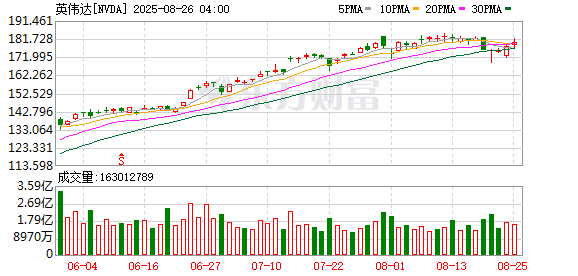
英伟达通用机器人芯片来了:AI算力提升7.5倍,宇树、银河通用已搭载
3 6 Ke· 2025-08-26 07:29
Core Viewpoint - Nvidia has launched its new generation of robot-specific chip, Jetson Thor, which significantly enhances computing power compared to its predecessor, Jetson Orin, to support advanced humanoid robots and other forms of embodied intelligence [3][12]. Group 1: Product Features - Jetson Thor features a new Blackwell architecture GPU with AI computing capabilities reaching up to 2070 FP4 TFLOPS, which is 7.5 times more powerful than the previous generation [3][6]. - The power consumption of Jetson Thor is 130W, with an energy efficiency improvement of 3.5 times compared to the previous model [3]. - Memory capacity has doubled to 128GB, and memory bandwidth is 273GB/s [3][6]. - The chip is designed for generative AI models and supports real-time operations with minimal reliance on cloud computing [6][9]. Group 2: Software and Ecosystem - Jetson Thor supports all major generative AI frameworks and inference models, enabling developers to conduct local experiments and run inferences efficiently [7][9]. - The product includes a developer kit priced at $3,499 and a module priced at $2,999 for bulk orders [10]. - Various domestic companies, including Yushu Technology and Galaxy General Robotics, have announced plans to adopt Jetson Thor for their robotics applications [12]. Group 3: Market Position and Future Outlook - Nvidia is positioning itself in the trillion-dollar markets of robotics and autonomous driving, with a significant portion of its revenue (40%) coming from major tech companies like Meta, Microsoft, Google, and Amazon [15]. - The company emphasizes its role in providing computational infrastructure and software support rather than manufacturing robots or cars [15].

更适合“中国体质”的AI芯片、小米和宇树都冲了!英伟达Jetson Thor现已发售,2万块批发价但半年交货
AI前线· 2025-08-26 05:20
Core Viewpoint - Nvidia has launched its latest robot chip module, Jetson AGX Thor, priced at $3499, which significantly enhances performance compared to its predecessor, aimed at supporting developers in creating advanced robotic systems [2][6][12]. Product Details - The first batch of Jetson AGX Thor developer kits will ship next month, including the Jetson T5000 module, a reference board with multiple interfaces, an active cooling fan, and a power adapter [4]. - The Jetson Thor chip boasts a performance increase of 7.5 times over the previous generation, with a 3.5 times improvement in energy efficiency, 3.1 times better CPU performance, and double the memory capacity [6][8]. - The chip is designed to run generative AI models and visual models that interpret the surrounding environment, crucial for humanoid robots [6][8]. Market Position and Applications - Nvidia's Jetson Thor is being utilized by various robotics companies, including Agility Robotics, Amazon, and Boston Dynamics, enhancing their robots' capabilities [9][10]. - The chip is also applicable in various robotic fields, such as surgical assistance, delivery robots, and industrial robotic arms, providing real-time inference capabilities for complex AI models [10]. Business Growth Potential - Nvidia's robotics business currently contributes about 1% of total revenue but is experiencing rapid growth, with a 72% year-over-year increase in quarterly sales [12]. - The company views the robotics sector as a significant growth opportunity beyond its traditional AI business, with plans to invest heavily in this area [13].

英伟达专为机器人设计的计算平台上市
2 1 Shi Ji Jing Ji Bao Dao· 2025-08-26 05:01
Core Insights - NVIDIA has launched the Jetson AGX Thor developer kit and production-grade module designed for physical AI and robotics, providing computational support for various industries including manufacturing, logistics, transportation, healthcare, agriculture, and retail [2] Group 1: Product Launch - The Jetson AGX Thor is specifically tailored for developers to create robotic systems that can interact with and even alter the physical world [2] - The product enables multiple generative AI models to run simultaneously on edge devices [2] Group 2: Market Adoption - Over 2 million developers are currently utilizing NVIDIA's robotics technology stack [2] - Companies such as United Imaging Healthcare, Wanji Technology, UBTECH, Galaxy Universal, Yushu Technology, Zhongqing Robotics, and Zhiyuan Robotics are early adopters of Jetson Thor [2] Group 3: Leadership Statement - NVIDIA's founder and CEO Jensen Huang emphasized the importance of Jetson Thor in empowering developers to build advanced robotic systems [2]
英伟达机器人“新大脑”售价2.5万元,算力提升7.5倍
Nan Fang Du Shi Bao· 2025-08-26 01:19
Core Insights - Nvidia has officially launched the Thor chip, referred to as the "new brain" for robots, priced at $3,499, aimed at enabling real-time intelligent interaction between embodied intelligent robots and the physical world [1] - The Thor chip significantly enhances computational power, offering up to 2070 TFLOPS, a 7.5 times increase over the previous Orin chip, addressing the computational limitations faced by robots [1][3] - The chip's performance improvements allow robots to process large amounts of sensor data and operate AI models at the edge, reducing reliance on cloud computing [3] Group 1: Product Launch and Features - The Thor chip is designed to support embodied intelligent robots with real-time processing capabilities, essential for autonomous operation in various environments [1] - It features a CPU performance increase of 3.1 times, 128GB of memory (a 2 times increase), and a 3.5 times improvement in energy efficiency [1][3] Group 2: Industry Adoption and Ecosystem - Notable companies such as Boston Dynamics and Figure AI, along with domestic firms like UBTECH and Galaxy Universal, have already begun deploying the Thor chip [3] - Nvidia has built a robust developer ecosystem in the robotics field, with over 2 million developers engaged across various industries since 2014 [4] Group 3: Financial Performance - Despite the advancements in robotics, the segment currently contributes a minimal portion to Nvidia's overall revenue, accounting for approximately 1.29% with a total income of $567 million, although it has seen a significant year-on-year growth of 72% [5]
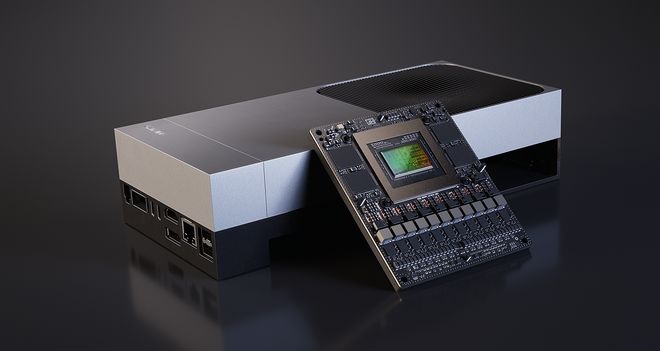
英伟达专为机器人设计的计算平台上市 公司:宇树科技、智元机器人等国内厂商都在用
Mei Ri Jing Ji Xin Wen· 2025-08-25 16:51
Core Insights - NVIDIA has launched the Jetson AGX Thor developer kit and production-grade module designed for physical AI and robotics, providing computational support for various industries including manufacturing, logistics, transportation, healthcare, agriculture, and retail [1] - The new Jetson Thor, based on NVIDIA's Blackwell chip, offers a 7.5x increase in AI computing power and a 3.5x improvement in energy efficiency compared to its predecessor, Jetson AGX Orin [1] - Over 2 million developers are currently utilizing NVIDIA's robotics technology stack, with several companies already adopting Jetson Thor for their products [1] Industry Impact - The Jetson Thor enables robots to achieve greater agility, faster decision-making, and higher autonomy, which are crucial for navigation and interaction in the real world [2] - Companies like Galaxy Universal have reported significant improvements in product performance, such as enhanced movement speed and action fluidity after adopting Jetson Thor [2]
英伟达宣布Jetson Thor已发售,宇树科技、银河通用已接入
Xin Lang Ke Ji· 2025-08-25 15:39
Core Insights - NVIDIA has launched the Jetson AGX Thor developer kit and production-grade module, designed to provide computational power for millions of robots across various industries including manufacturing, logistics, transportation, healthcare, agriculture, and retail [2] - The Jetson Thor is already being utilized by several industry leaders such as United Imaging Healthcare, Wanji Technology, UBTECH, Galaxy General, Yushu Technology, Zhongqing Robotics, and Zhiyuan Robotics [2] - NVIDIA's CEO Jensen Huang emphasized that Jetson Thor is built for millions of developers globally, enabling them to create robotic systems that can interact with and even change the physical world [2] Performance and Specifications - Jetson Thor is based on NVIDIA's Blackwell GPU and features 128GB of memory, offering up to 2,070 FP4 TFLOPS of AI computing power while operating within a power range of 130 watts [2] - Compared to its predecessor, the Jetson AGX Orin, the AI computing performance of Jetson Thor has increased by 7.5 times, and its energy efficiency has improved by 3.5 times [3] - Jetson Thor can run various generative AI models, including NVIDIA Isaac GR00T N1.5 and mainstream large language and vision-language models [3]
浅谈,「京东」在具身智能赛道布局
Robot猎场备忘录· 2025-08-25 07:27
Core Viewpoint - The article discusses the rapid development and investment in the field of embodied intelligence, highlighting key players in both global and domestic markets, and emphasizing the strategies of major companies like JD.com, Huawei, and Tesla in this emerging sector [2][3][4]. Investment Landscape - Major global companies such as Nvidia and Tesla, along with domestic leaders like Huawei and Xpeng Motors, are entering the embodied intelligence sector, with Huawei aiming to create a foundational development ecosystem similar to Nvidia's approach [2] - Since 2025, various tech giants have adopted a dual approach of "self-research + investment" to enter the embodied intelligence market, with Tencent, Huawei, JD.com, and Didi making significant investments in robotics startups [3] - JD.com has been particularly active, leading multiple rounds of financing for various robotics companies, including a nearly 6 billion yuan investment in Qianxun Intelligent and a 10 billion yuan investment in Zhongqing Robotics [4][3] JD.com's Strategy - JD.com is employing a comprehensive strategy involving investment, self-research, and ecosystem development to penetrate the embodied intelligence market [4] - The company has established a dedicated team for embodied intelligence research and launched the "JoyInside" platform to integrate its large model capabilities into robotics and other hardware [4][9] - JD.com announced plans to invest over 10 billion yuan in the intelligent robotics sector over the next three years, aiming to help 100 robotics brands achieve sales exceeding 1 billion yuan [11] Market Trends - The article notes a growing trend of collaboration between tech giants and robotics manufacturers, with JD.com providing both model and channel support to various robotics firms [5] - The WAIC2025 event showcased JD.com's advancements in large models and embodied intelligence, indicating a strong commitment to this field [7][9] - The article also highlights the launch of the "E-Town Robot Consumption Festival" by JD.com, aimed at promoting various types of robots to consumers [13] Future Outlook - The article suggests that the competition in the embodied intelligence sector will intensify as more companies, including traditional automotive manufacturers and tech giants, continue to invest and innovate [16] - It emphasizes the importance of understanding the current landscape of embodied intelligence, including the roles of major players and emerging startups [16][17]


10000台!全球人形机器人最大订单诞生,行业迈入“量产+融资”快车道
Zheng Quan Shi Bao Wang· 2025-08-21 12:07
Core Insights - The signing of a global order for 10,000 humanoid robots by Tiantai Robotics and its partners marks a significant milestone in the industry, indicating a shift from laboratory experiments to mass production [1][2][3] - The robots will primarily focus on home care applications, integrating features such as stair-climbing assistance, autonomous driving, health monitoring, and emotional companionship, aiming to become "warm family members" [2][3] - The industry is experiencing a surge in financing, with over 83 funding events reported globally, totaling more than 14 billion RMB, indicating strong investor interest in humanoid robotics [6][7] Industry Developments - The recent large-scale orders from leading companies like Zhiyuan Robotics and Yushutech reflect a broader trend of humanoid robots moving from concept validation to real-world applications, particularly in commercial settings [3][4] - The ability of Tiantai Robotics to fulfill the large order is attributed to its technological maturity, supply chain management, and ecosystem development capabilities [2][3] - The humanoid robotics sector is expected to enter a phase of "mass production + financing," with 2025 anticipated as a pivotal year for scaling up production [1][5] Financing Trends - Tiantai Robotics has secured multiple rounds of financing, with significant investments from various venture capital firms, highlighting the increasing financial backing for humanoid robotics [6][7] - The trend of "billion-level" financing rounds has become common, with companies like Zhongqing Robotics and Pashini raising substantial amounts recently [6][7] - The capital influx is seen as essential for overcoming the long development cycles and high technical demands of humanoid robotics, facilitating faster innovation and market entry [7]
宇树、优必选、智元领跑,人形机器人行业2025年订单与交付能力透视
3 6 Ke· 2025-08-20 07:54
Core Insights - The humanoid robot industry has seen significant order growth since 2025, shifting market focus from technology development to practical application and delivery capabilities [1][2] - There remains a gap between rapid order growth and actual delivery, with challenges related to supply chain capacity and technology maturity [1][3] - Major application scenarios for humanoid robots include industrial, guiding, research, education, and healthcare [1] Order and Market Dynamics - As of mid-2025, over 83 humanoid robot projects have been publicly disclosed in China, with a total contract value of nearly 330 million yuan, marking an increase from the previous year [2] - Leading companies such as UBTECH, Yushutech, and Zhiyuan Robot have captured 60% of the total transaction value, with Yushutech leading in the number of bids [2] - A notable contract of 124 million yuan was awarded to Yushutech and Zhiyuan Robot for humanoid biped robot manufacturing services for China Mobile [2] Commercialization and Delivery Challenges - Companies like UBTECH aim to deliver hundreds of humanoid robots this year, with expectations of increasing efficiency in industrial applications [4] - Zhiyuan Robot has achieved significant milestones, including the mass production of over 1,000 robots, with plans for thousands more in 2025 [5] - The industry is experiencing a surge in smaller contracts, with projects under 1 million yuan making up 60% of the total [3] Industry Trends and Future Outlook - The humanoid robot market is projected to see substantial growth, with global sales expected to reach 12,400 units by 2025 and 340,000 units by 2030 [13] - Companies are focusing on industrial applications first, followed by commercial and household uses, indicating a strategic approach to market entry [8] - The lack of standardization in the humanoid robot industry poses challenges for mass production and integration, which companies are actively working to address [14][15]