
欧派家居

Search documents
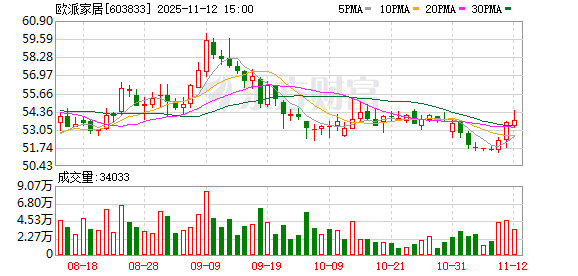
欧派家居跌2.01%,成交额1.15亿元,主力资金净流出1173.06万元
Xin Lang Cai Jing· 2025-11-17 06:53
Core Viewpoint - The stock price of Oppein Home has experienced a decline of 21.39% year-to-date, with a recent drop of 2.01% on November 17, 2023, indicating potential challenges in the company's market performance [1]. Company Overview - Oppein Home Group Co., Ltd. is located in Baiyun District, Guangzhou, Guangdong Province, and was established on July 1, 1994. The company was listed on March 28, 2017. Its main business involves personalized design, research and development, production, sales, installation, and interior decoration services for whole-home furniture products [1]. - The company's revenue composition includes: wardrobes and supporting furniture products (51.74%), cabinets (28.80%), wooden doors (6.00%), bathrooms (5.74%), and others (4.69%) [1]. Financial Performance - For the period from January to September 2025, Oppein Home reported operating revenue of 13.214 billion yuan, a year-on-year decrease of 4.79%. The net profit attributable to the parent company was 1.832 billion yuan, down 9.77% year-on-year [2]. - Since its A-share listing, Oppein Home has distributed a total of 7.234 billion yuan in dividends, with 4.249 billion yuan distributed over the past three years [3]. Shareholder Information - As of September 30, 2025, the number of shareholders for Oppein Home was 20,700, a decrease of 1.78% from the previous period. The average number of circulating shares per person increased by 1.81% to 29,382 shares [2]. - The top ten circulating shareholders include Hong Kong Central Clearing Limited, which holds 11.1909 million shares (a decrease of 488,600 shares), and several new institutional shareholders such as ICBC Value Selection Mixed A and E Fund Yuxin Bond A [3].

如何看2025年10月消费数据
2025-11-16 15:36
Summary of Conference Call Records Industry Overview - The furniture industry is currently in a bottoming phase due to declining real estate sales and the reduction of subsidies, with a focus on quality companies like Gujia and Xilinmen, as well as operational turning points for companies like Oppein and Sophia [1][2] - During the Double Eleven shopping festival, cultural office supplies, daily necessities, and tobacco and alcohol sales grew by 13.5%, 7.4%, and 4.1% respectively, with pet supplies performing exceptionally well [1][3] - The retail sales of consumer goods in October increased by 2.9% year-on-year, with commodity retail growing by 2.8% and the catering industry by 3.8% [1][6] Key Insights and Arguments - The furniture retail sector saw a year-on-year growth of 9.6% in October, but this was a slowdown compared to September. The decline in building materials and home appliances sales was significant, with drops of 8.3% and 14.6% respectively [2] - The hotel sector benefited from the release of business travel demand and strong cultural tourism demand, with October's RevPAR remaining flat year-on-year but exceeding expectations in the weeks following the holiday [1][9] - The overall retail sales of consumer goods in October reached 4.6 trillion yuan, with supermarkets growing by 4.7% and department stores by only 1% [6] Investment Opportunities - For 2026, there is a focus on opportunities in overseas manufacturing and brand expansion, with domestic demand expected to recover in a lower interest rate environment. Recommended stocks include Xiangxin, YK Medical, Meiyingsen, Zhongxing Co., and Jiayi Co. [1][5] - The retail sector is expected to see improvements in companies like Yonghui and Bubugao in the fourth quarter and next year [7] - The hotel sector is projected to have a favorable supply-demand relationship in 2026, with recommendations for stocks like Shoulv Jinjiang, Atour, and Huazhu [10] Other Important Insights - The duty-free sector has shown strong performance, with significant growth in sales and average transaction value following new policy implementations [1][11][12] - The automotive sector experienced a decline in retail sales in October, with a total of 425.5 billion yuan, down 6.6% year-on-year, while wholesale sales of passenger vehicles increased by 7.5% [13][14] - The white goods sector is currently facing challenges due to reduced subsidies, but there are still investment opportunities in leading companies like Midea, Haier, and Gree, which are expected to have strong performance in the medium to long term [23][24][26][27] Conclusion - The overall consumer data for the coming year is expected to show a positive trend, with structural growth in certain sectors like the three-wheeled vehicle business of Aima Technology contributing positively to overall consumption [28]




华中科技大学无锡研究院:“点线面”共振激荡科产融合“向新力”
Zhong Guo Jin Rong Xin Xi Wang· 2025-11-13 12:18
Core Insights - The article highlights the innovative achievements and strategic initiatives of Huazhong University of Science and Technology Wuxi Research Institute in advancing flexible manufacturing systems and high-precision measurement technologies [1][2][4] Group 1: Technological Advancements - The research institute focuses on overcoming key core technologies in digital and intelligent manufacturing, particularly in aerospace and energy sectors, with significant innovations in manufacturing processes [2][5] - The institute has developed nearly 40 proprietary technologies related to turbine manufacturing, addressing industry challenges such as low processing efficiency and quality consistency [2][5] Group 2: Institutional Innovation - Since joining Jiangsu Provincial Industrial Technology Research Institute in 2015, the institute has established a market-oriented framework that balances high-level technology development with efficient results transformation [4][6] - The creation of an innovation alliance involving universities, leading enterprises, and investment institutions has strengthened resource aggregation and innovation capabilities [4][6] Group 3: Collaborative Ecosystem - The institute has successfully incubated over 10 high-tech companies, including three national-level specialized "little giant" enterprises, by implementing a comprehensive results transformation system [6][7] - Collaborative projects with various enterprises have led to the development of advanced technologies and solutions, significantly impacting traditional industries [6][7] Group 4: Regional Innovation Optimization - The institute's efforts in integrating technology and industry aim to enhance urban competitiveness through innovation, focusing on the development of public service platforms and digital transformation tools for SMEs [7][8] - A strong emphasis on talent cultivation and integration with industry needs has resulted in the recruitment of over 320 graduate students and the establishment of a diverse evaluation system for talent [7][8] Group 5: Future Directions - The institute plans to continue focusing on technology research and industrialization in smart manufacturing, new materials, and industrial software, aiming to enhance innovation capabilities and accelerate the transfer of research outcomes [8]

欧派家居(603833) - 欧派家居关于使用闲置募集资金进行现金管理的进展公告
2025-11-13 08:45
重要内容提示: 基本情况 | 投资金额 | 万元 1,000 | | --- | --- | | 投资种类 | 单位大额存单 | | 资金来源 | 募集资金 | 已履行的审议程序:欧派家居集团股份有限公司(以下简称"公司") 于 2025 年 8 月 8 日召开了第四届董事会第二十六次会议、第四届监事会第十 七次会议,审议通过了《关于使用闲置募集资金进行现金管理的议案》,同意 公司使用总额度不超过人民币 3.5 亿元(含)暂时闲置募集资金适时进行现金 管理,决议有效期自 2025 年 8 月 19 日至 2026 年 8 月 18 日。本事项无需提 交公司股东会审议。 特别风险提示:公司使用暂时闲置募集资金进行现金管理的产品类型 虽然限定为安全性高、风险等级低且期限不超过 12 个月的保本型产品,整体 风险可控,但是相关产品仍可能受宏观经济及金融市场波动影响,存在市场 风险、流动性风险、信用风险等潜在风险因素。公司将根据市场环境动态调 整投资规模与时机,故短期投资收益存在波动可能。 证券代码:603833 证券简称:欧派家居 公告编号:2025-099 转债代码:113655 转债简称:欧 22 转债 欧派家 ...
欧派家居(603833):围绕“大家居”多管齐下优化运营
Tianfeng Securities· 2025-11-13 06:13
Investment Rating - The report maintains a "Buy" rating for the company with a target price not specified [5][4] Core Views - The company reported a revenue of 5 billion yuan in Q3 2025, a decrease of 6% year-on-year, and a net profit of 800 million yuan, down 22% year-on-year [1] - The custom home furnishing industry is facing growth pressures, with weak demand impacting profitability across the sector [1] - The company is implementing a "big home" strategy, focusing on marketing organization reform, supply chain reform, and an incentive mechanism to enhance operational efficiency [1][2] - Despite facing short-term pressure on net profit margins, the company demonstrates resilience and competitive advantages in a challenging market environment [1] Financial Performance Summary - For the first three quarters of 2025, the company achieved a total revenue of 13.2 billion yuan, a decrease of 5% year-on-year, and a net profit of 1.8 billion yuan, down 10% year-on-year [1] - The gross margin for the first nine months of 2025 was 37.19%, an increase of 1.65 percentage points, attributed to supply chain reforms and production efficiency upgrades [2] - The company anticipates pressure on both gross and net margins in 2025 due to fixed cost dilution and will focus on business model transformation to mitigate these impacts [3] Profit Forecast Adjustments - The profit forecast for 2025-2027 has been adjusted, with expected net profits of 2.47 billion yuan, 2.66 billion yuan, and 2.92 billion yuan respectively [4]
贝壳旗下品牌被窝胜诉 家装行业侵权乱象仍在
Bei Jing Shang Bao· 2025-11-12 15:47
Core Viewpoint - The case of trademark infringement and unfair competition involving Beike's brand "Beiwow" highlights the increasing challenges of brand protection in the home furnishing industry, with a growing number of similar disputes emerging in recent years [1][2][3] Group 1: Infringement Cases - The court ruled that Shangqiu Beiwow Mingsai Decoration Engineering Co., Ltd. must cease its infringing activities and pay economic damages of 50,000 yuan for violating Beike's trademark rights [2] - Similar infringement cases have been reported in the home furnishing industry, including a 3.8 million yuan compensation ruling against a defendant infringing on the "Jiumu" brand [3] - Other brands like Sophia, Shangpin Home, and Meike Home have also faced trademark infringement issues, indicating a rising trend in such disputes within the industry [3] Group 2: Causes of Infringement - The primary driver of frequent brand infringement is profit motivation, as counterfeit brands can quickly attract consumers and reduce market entry costs [4] - Some infringing companies directly copy the names and branding of legitimate brands, exploiting consumer trust for profit [4] - The unique business model of the home furnishing industry, which often involves extensive dealer networks, complicates brand management and increases infringement risks [4] Group 3: Consumer Awareness and Market Environment - Consumer lack of awareness regarding genuine brand identification exacerbates the issue, as many rely solely on brand names and appearances when making purchasing decisions [5] - The prevalence of counterfeit brands is particularly pronounced in smaller cities and offline markets, where consumers may unknowingly choose imitation products due to price considerations [5] - Industry leaders emphasize the need for a clean consumption environment and call for the expulsion of counterfeit sellers from retail spaces [5] Group 4: Regulatory and Industry Response - There is a call for enhanced regulatory measures to strengthen intellectual property protection, including improving trademark registration processes and increasing penalties for infringement [6] - The "Intellectual Property Protection System Construction Project Implementation Plan" aims to establish a comprehensive protection network by 2027 [6] - Companies are encouraged to proactively develop comprehensive brand protection strategies as part of their long-term development plans [6] Group 5: Collaborative Efforts - Addressing the issue of infringement requires a collective effort from consumers, industry associations, and the media to promote awareness and report violations [7] - The establishment of a secure payment system by Beike, in collaboration with CITIC Bank, aims to protect consumer funds during renovation projects [7] - Experts suggest that a collaborative approach among businesses, government, and society is essential to foster a fair competitive environment and promote high-quality economic development [7]
又一品牌维权胜诉 家装乱象如何破
Bei Jing Shang Bao· 2025-11-12 13:01
Core Viewpoint - The home furnishing industry is facing a significant challenge with frequent trademark infringement and unfair competition disputes, highlighting the need for stronger brand protection measures [1][4][8]. Group 1: Legal Cases and Outcomes - Beike's brand "Beiwow" won a trademark infringement case against Shangqiu Beiwow Mingsai Decoration Engineering Co., which was ordered to cease infringing activities and pay 50,000 yuan in damages [3][4]. - The court found that the defendant's use of the "Beiwow" mark in signage and advertising could confuse consumers, constituting trademark infringement and unfair competition [3][4]. - Other notable cases include a 3.8 million yuan compensation ruling against a defendant infringing on the "Jiumu" brand and a 300,000 yuan ruling against a company infringing on the "Oppein" brand [4]. Group 2: Industry Trends and Challenges - The frequency of trademark infringement cases in the home furnishing sector is on the rise, particularly in emerging fields like integrated and customized home furnishing [4][6]. - Factors contributing to this trend include the low cost and high profit potential of imitating established brands, as well as the challenges of managing brand identity across a wide network of distributors [5][6]. - The complexity of the home furnishing industry, with its diverse product categories, increases the risk of infringement due to insufficient cross-category trademark protection [6]. Group 3: Consumer Awareness and Behavior - Many consumers lack the knowledge to distinguish between genuine and counterfeit brands, often relying on brand names and appearances for their purchasing decisions [7]. - This information asymmetry allows counterfeit brands to mislead consumers, particularly in offline stores and smaller cities [7]. - Consumer awareness initiatives are necessary to help individuals recognize authentic brands and report infringements [9]. Group 4: Regulatory and Policy Recommendations - There is a call for enhanced regulatory measures to combat trademark infringement, including improving the intellectual property protection system and increasing penalties for violators [8]. - The government aims to establish a comprehensive intellectual property protection network by 2027, with a focus on cross-regional enforcement collaboration [8]. - Companies are encouraged to proactively develop brand protection strategies as part of their long-term business plans [9].
欧派家居:关于变更保荐代表人的公告
Zheng Quan Ri Bao· 2025-11-12 10:18
Core Viewpoint - The announcement from Oppein Home indicates a change in the designated sponsor representative for ongoing supervision of the company’s convertible bonds, ensuring continuity in oversight responsibilities [2] Group 1: Company Announcement - Oppein Home announced on November 12 that it received a letter from its sponsor, Guotai Junan Securities, regarding the replacement of the ongoing supervision representative [2] - The original representatives, Xia Qi and Li Ning, were responsible for the supervision of the company’s ongoing operations since September 1, 2022, until December 31, 2023 [2] - Due to a job change, Xia Qi will no longer fulfill his supervisory duties, and Zhang Li has been appointed to take over these responsibilities [2]
欧派家居(603833) - 欧派家居关于变更保荐代表人的公告
2025-11-12 08:01
欧派家居集团股份有限公司 关于变更保荐代表人的公告 本公司董事会及全体董事保证本公告内容不存在任何虚假记载、误导性陈述或 者重大遗漏,并对其内容的真实性、准确性和完整性承担法律责任。 证券代码:603833 证券简称:欧派家居 公告编号: 2025-098 转债代码:113655 转债简称:欧 22 转债 特此公告。 欧派家居集团股份有限公司董事会 2025 年 11 月 13 日 附件:张力先生简历 张力先生,中国国籍,保荐代表人;现任国泰海通证券投资银行董事总经理; 先后负责和参与了珈伟股份、欧派家居、深南电路、锐科激光、嘉必优、正弦电 气、特发服务、亿道信息 IPO 等项目;冀中能源可转债、深能源集团整体上市、 中兴通讯分离交易可转债、海南橡胶非公开增发、格林美公司债、欧派家居可转 债、深南电路可转债、明阳电路可转债等再融资项目;广州药业吸收合并白云山 (A+H)、深天马重大资产重组、珈伟股份重大资产重组、南华仪器重大资产重 组等财务顾问项目。张力先生在保荐业务执行过程中严格遵守《证券发行上市保 荐业务管理办法》等相关规定,执业记录良好。 欧派家居集团股份有限公司(以下简称"公司") 于 2025 年 ...
前9个月整体营收仍在下滑,上市家居企业“马太效应”加剧
Guan Cha Zhe Wang· 2025-11-12 03:41
Core Insights - The home furnishing industry is experiencing a pronounced "Matthew Effect," with leading companies outperforming while smaller firms struggle [1][8] - The top ten listed home furnishing companies reported a combined revenue of 1158.47 billion yuan for the first three quarters, reflecting a slight year-on-year decline of approximately 0.5% [2][3] - Despite some companies showing growth, the overall trend in the industry remains downward, with many firms facing significant revenue drops [4][6] Group 1: Revenue Performance - Dongfang Yuhong leads the industry with a revenue of 206 billion yuan, followed closely by Beixin Building Materials at 199.05 billion yuan [2] - Companies like Kuka Home and Oppein Home also reported revenues exceeding 100 billion yuan, indicating strong positions in their respective segments [1] - The revenue gap widens significantly after the top four, with the fifth-ranked Sanjiasu failing to reach the 100 billion yuan mark [1][2] Group 2: Industry Trends - The overall revenue of the top ten companies has decreased compared to the previous year, with six out of ten companies reporting a year-on-year decline [3][4] - The National Building Materials Home Furnishing Market Index (BHI) indicates a slight improvement in market conditions, but the year-on-year decline persists [3] - The sales revenue of large-scale building materials and home furnishing markets in September was 1308.38 billion yuan, showing a month-on-month increase but a year-on-year decline of 8.02% [4] Group 3: Strategic Adjustments - Companies are increasingly focusing on international expansion as a key strategy for growth, with Kuka Home planning a significant investment in Indonesia [5][6] - Dongfang Yuhong has also pursued overseas opportunities, including acquisitions in Hong Kong and Malaysia, indicating a shift towards global markets [6] - The differentiation between leading and trailing companies is becoming more pronounced, with top firms leveraging brand strength and market channels to capture greater market share [7][8] Group 4: Market Dynamics - The building materials sector is particularly affected by the downturn in the real estate market, with leading companies showing resilience while smaller firms struggle [7][9] - The disparity in performance among companies is attributed to differences in market positioning and channel strategies, with stronger firms benefiting from robust distribution networks [9] - The ongoing demand for home renovation and upgrades presents opportunities for growth, even amid overall market challenges [8][9]


