Scale AI

Search documents
扎克伯格发文正式告别“默认开源”!网友:只剩中国 DeepSeek、通义和 Mistral 还在撑场面
AI前线· 2025-08-02 05:33
Core Viewpoint - Meta is shifting its AI model release strategy to better promote the development of "personal superintelligence," emphasizing the need for careful management of associated risks and selective open-sourcing of content [3][5][11]. Group 1: Shift in Open-Source Strategy - Mark Zuckerberg's recent statements indicate a significant change in Meta's approach to open-source AI, moving from being a "radical open-source advocate" to a more cautious stance on which models to open-source [6][8]. - The company previously viewed its Llama open-source model series as a key competitive advantage against rivals like OpenAI and Google DeepMind, but this perspective is evolving [5][9]. - Meta is unlikely to open-source its most advanced models in the future, which could lead to increased expectations for companies that remain committed to open-source AI, particularly in China [10][11]. Group 2: Investment and Development Focus - Meta has committed $14.3 billion to invest in Scale AI and restructure its AI department into "Meta Superintelligence Labs," indicating a strong focus on developing closed-source models [11][12]. - The company is reallocating resources from testing the latest Llama model to concentrate on developing a closed-source model, reflecting a strategic pivot in its AI commercialization approach [12][14]. - Meta's primary revenue source remains internet advertising, allowing it to approach AI development differently than competitors reliant on selling access to AI models [11]. Group 3: Future of Personal Superintelligence - Zuckerberg envisions "personal superintelligence" as a means for individuals to achieve their personal goals through AI, with plans to integrate this concept into products like augmented reality glasses and virtual reality headsets [14]. - The company aims to create personal devices that can understand users' contexts, positioning these devices as the primary computing tools for individuals [14].



这家百人“作坊”,凭什么年入70亿,还成了OpenAI的“御用陪练”?
3 6 Ke· 2025-08-02 00:03
Core Insights - Surge AI, a company with only 110 employees, achieved over $1 billion in annual revenue in 2024, surpassing industry leader Scale AI, which has over a thousand employees and backing from Meta [1][21] - Surge AI is initiating its first round of financing, aiming to raise $1 billion with a potential valuation of $15 billion [1][3] Industry Overview - The data annotation industry is likened to a "feeding" process for AI models, where raw data is transformed into a format that AI can understand [4] - Traditional models, exemplified by Scale AI, rely on a large workforce to handle massive amounts of data, which can lead to quality issues and inefficiencies [5][6] Surge AI's Unique Approach - Surge AI focuses on high-quality data annotation rather than quantity, emphasizing the importance of human expertise over sheer manpower [3][10] - The company employs a selective hiring process, recruiting the top 1% of annotators, including PhDs and Masters, to ensure high-quality output [11][13] - Surge AI targets high-value tasks in AI training, such as Reinforcement Learning from Human Feedback (RLHF), which significantly impacts model performance [13] Technological Integration - Surge AI has developed an advanced human-machine collaboration system that enhances efficiency and quality, allowing a small team to process millions of high-quality data points weekly [15][17] - The platform integrates machine learning algorithms to detect errors and streamline the annotation process, resulting in a productivity rate nearly nine times that of Scale AI [17] Mission and Vision - The founder, Edwin Chen, emphasizes a mission-driven approach, stating that the company is not just about profit but about nurturing Artificial General Intelligence (AGI) [18][19] - Surge AI positions its annotators as "parents" of AI, fostering a sense of purpose and commitment among its highly educated workforce [19] Competitive Landscape - Surge AI's revenue in 2024 exceeded that of Scale AI, which reported $870 million, showcasing its competitive edge in the market [21] - The company has established a unique position by redefining the data annotation problem, focusing on quality and human insight rather than traditional labor-intensive methods [25]

Innodata Lifts 2025 Growth Outlook
The Motley Fool· 2025-08-01 18:33
Core Insights - Innodata reported a 79% year-over-year revenue growth in Q2 2025, reaching $58.4 million, and a 375% increase in adjusted EBITDA to $13.2 million [1] - The company raised its full-year 2025 organic revenue growth forecast from 40% to at least 45%, driven by large-scale project wins and increased demand from major tech customers [1][3] Financial Performance - Adjusted gross margin improved to 43% from 33% year-over-year, with net income rising to $7.2 million from a loss of $14,000 in the same period last year [2] - Cash reserves increased to $59.8 million, with an additional $8 million collected post-quarter, and the $30 million credit facility remains undrawn [2][3] Customer Dynamics - Revenue from the largest customer reached $33.9 million, while a new big tech customer is projected to contribute $10 million in the second half of 2025 [4] - Competitive shifts, particularly the acquisition of Scale AI by Meta, have created growth opportunities for Innodata among large technology clients [4][5] Strategic Investments - The company invested $1.4 million in new hires focused on delivery, product innovation, and talent acquisition, targeting opportunities in agentic AI and simulation data services [6] - Management plans to invest in high-return growth initiatives, including custom annotation pipelines and advisory services for enterprises building AI-native systems [7][8] Future Outlook - The company anticipates continued growth with a robust deal pipeline and expects adjusted EBITDA to exceed 2024 levels despite increased expenses [9] - The projected tax rate for upcoming quarters is estimated at 27%-28% [9]


又一位剑指AGI的华人理工男!这家百人“作坊”,凭什么年入70亿,还成了OpenAI的“御用陪练”?
混沌学园· 2025-08-01 12:06
Core Viewpoint - Surge AI, a company with only 110 employees, has achieved over $1 billion in annual revenue in 2024, surpassing industry leader Scale AI, which has thousands of employees [1][27]. Group 1: Company Overview - Surge AI is initiating its first round of financing, aiming to raise $1 billion with a potential valuation of $15 billion [2]. - The founder, Edwin Chen, emphasizes the importance of data quality over quantity, stating that true AGI requires human wisdom rather than cheap labeling [5][30]. Group 2: Industry Context - The data labeling industry has traditionally relied on a model where human labor equates to output, often leading to low-quality data due to the use of a large number of unskilled workers [8][12]. - As AI models evolve, they require more sophisticated data that reflects logic, culture, and emotions, exposing the limitations of traditional data labeling methods [9][12]. Group 3: Surge AI's Unique Approach - Surge AI has redefined competition by focusing on quality, elite teams, automation, and a mission-driven culture, creating a multiplier effect on their performance [15][29]. - The company employs a selective hiring process, recruiting the top 1% of data labeling talent, including many with advanced degrees, to handle complex tasks [17][19]. - Surge AI targets high-value tasks in AI training, such as RLHF (Reinforcement Learning from Human Feedback), which significantly impacts model performance and commands higher fees [19][20]. Group 4: Operational Efficiency - Surge AI has developed an advanced human-machine collaboration system that enhances productivity, allowing its small team to process millions of high-quality data points weekly, achieving nearly nine times the output of Scale AI [20][21]. - The company's mission is centered around nurturing AGI, with a focus on providing high-quality data as a means of fostering machine intelligence [24][30]. Group 5: Competitive Advantage - Surge AI has surpassed Scale AI in revenue, achieving over $1 billion compared to Scale AI's $870 million in 2024, while also gaining a reputation for superior quality [27][29]. - The company has established a trust barrier, attracting top AI labs seeking neutrality and quality, especially after Meta's investment in Scale AI raised concerns about independence [27][28]. Group 6: Industry Implications - Surge AI's success illustrates that redefining problems and creating new paradigms can lead to significant competitive advantages in the rapidly evolving AI landscape [30][31].

买买买!Meta又盯上了两家AI视频公司
硬AI· 2025-08-01 09:03
Core Viewpoint - Meta is actively pursuing partnerships and acquisitions in the emerging AI video generation sector to enhance its content ecosystem and support its vision of "personal superintelligence" [1][2][3]. Group 1: Potential Collaborations and Acquisitions - Meta is in discussions with AI video startup Pika for potential collaboration, including direct acquisition or licensing of technology [1]. - The company has also explored acquisition possibilities with Higgsfield, a video generation application focused on creators, although those talks have ceased [1]. - Pika, founded in 2023 by two Stanford dropouts, has raised approximately $135 million from investors, while Higgsfield completed a $8 million seed round last year [1]. Group 2: Strategic Importance of AI Video Technology - The acquisition of AI video companies is crucial for Meta's social applications, smart glasses, and VR business, aligning with Zuckerberg's vision of "personal superintelligence" [2][3]. - AI technology capable of generating and understanding video can significantly enrich Meta's content offerings and provide essential support for its virtual reality initiatives [2]. Group 3: Competitive Landscape and Internal Developments - Meta has introduced AI video editing features in its AI assistant, with early progress noted by Zuckerberg, who emphasized the potential for content improvement [4]. - The company is not starting from scratch in video generation, as its editing capabilities build on previous research, including the Movie Gen model showcased last October [4]. - Meta feels competitive pressure from OpenAI's Sora and Google's Veo, which have demonstrated impressive quality and realism in video generation [4]. Group 4: Broader AI Strategic Restructuring - The acquisition intentions are part of a broader AI strategic restructuring at Meta, which recently appointed Alexandr Wang, CEO of Scale AI, as its Chief AI Officer and invested $14.3 billion in the data labeling company [6]. - Meta has also recruited several researchers from competitors like OpenAI, Anthropic, and Google to bolster its new AI team, the Meta Superintelligence Lab [6]. - The company has acquired voice AI startup PlayAI to enhance its talent pool [6].

买买买!Meta又盯上了两家AI视频公司
Hua Er Jie Jian Wen· 2025-08-01 04:23
Core Insights - Meta is expanding its reach into the emerging AI video generation sector through potential acquisitions and partnerships, specifically discussing collaboration with AI startup Pika and previously with Higgsfield [1][2] - The company's CEO, Mark Zuckerberg, views these transactions as crucial to realizing his vision of "personal superintelligence," which focuses on entertainment, culture, and personal relationships [1] - Meta has recently introduced AI video editing features in its AI assistant, indicating early progress in this area, while feeling pressure from competitors like OpenAI and Google [2] Company Developments - Pika, founded in 2023 by two Stanford dropouts, has raised approximately $135 million from investors, while Higgsfield completed an $8 million seed round last year [1] - Meta's broader AI strategy includes the appointment of Alexandr Wang as Chief AI Officer and a $14.3 billion investment in Scale AI, alongside hiring key personnel from competitors [3] - The establishment of the Meta Superintelligence Lab aims to enhance the company's AI capabilities, with recent talent acquisitions from OpenAI, Anthropic, and Google [3]
Meta财报“炸裂”,扎克伯格发声
3 6 Ke· 2025-08-01 01:12
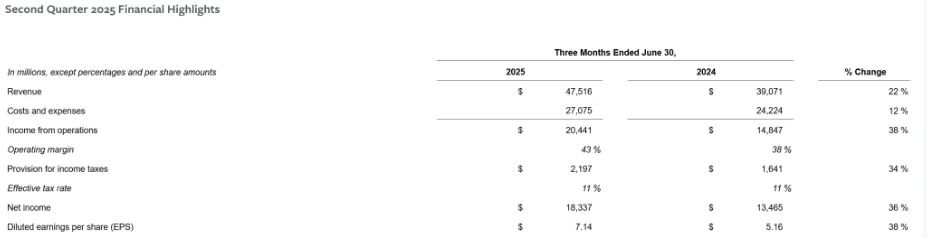
Core Viewpoint - Meta reported exceptional second-quarter financial results, with revenue and net profit significantly exceeding expectations, leading to a substantial increase in stock price [2][3]. Financial Performance - Revenue for the second quarter reached $47.52 billion, surpassing the expected $44.8 billion, and showing a year-over-year growth of 22% [3][5]. - Net profit increased by 36% year-over-year to $18.34 billion [3][5]. - Earnings per share (EPS) were $7.14, well above the expected $5.92, reflecting a 38% increase from the previous year [4][5]. Future Outlook - Meta anticipates third-quarter revenue to be between $47.5 billion and $50.5 billion, exceeding Wall Street's estimate of $46.14 billion [4]. - The company did not provide specific guidance for the fourth quarter but indicated that growth rates would be lower compared to the third quarter due to a stronger growth period in Q4 2024 [6]. Advertising Revenue - Advertising revenue for the second quarter was $46.56 billion, exceeding the forecast of $43.97 billion [6]. User Engagement - Daily active users across Meta's applications increased to 3.48 billion, surpassing analyst expectations of 3.45 billion [6]. Costs and Investments - Total costs and expenses for the second quarter were $27.08 billion, a 12% increase year-over-year [6]. - Meta's capital expenditures for the year are projected to be between $66 billion and $72 billion, with total expenses for 2025 expected to be between $114 billion and $118 billion [6][7]. AI and Innovation - CEO Mark Zuckerberg highlighted the efficiency and revenue improvements in Meta's advertising system due to AI technology [6]. - Meta's Reality Labs, focusing on virtual and augmented reality, reported sales of $370 million but incurred an operating loss of $4.53 billion, which was lower than Wall Street's expectations [6]. - Zuckerberg shared his vision for "personal superintelligence," emphasizing the potential of advanced technology to empower individuals rather than just enhance automation [8][9].
Innodata(INOD) - 2025 Q2 - Earnings Call Transcript
2025-07-31 22:00
Financial Data and Key Metrics Changes - Revenue for Q2 2025 reached $58.4 million, representing a year-over-year increase of 79% [6][16] - Adjusted EBITDA grew 375% to $13.2 million, reflecting an adjusted EBITDA margin of 23% compared to 9% in the same quarter last year [6][16] - Net income was $7.2 million, a significant improvement from a loss of $14,000 in the same period last year [16] - Cash increased from $56.6 million at the end of Q1 to $59.8 million at the end of Q2, with an additional $8 million collected shortly after the quarter close [7][17] Business Line Data and Key Metrics Changes - The company reported strong performance from its largest customer, generating approximately $33.9 million in revenue from this account in Q2 [33][34] - New projects with the largest customer are expected to significantly increase revenue, with forecasts indicating $10 million from another Big Tech customer in the second half of the year [10][33] Market Data and Key Metrics Changes - The company is experiencing strong demand across a diverse range of existing and new customers, positioning itself well for future growth [8][11] - The competitive landscape is shifting due to the acquisition of Scale AI by Meta, which may create new opportunities for the company [22][23] Company Strategy and Development Direction - The company is raising its full-year 2025 revenue growth guidance to 45% or more, up from 40%, based on a robust pipeline of new deals [8][57] - Investments will focus on custom annotation pipelines, agent development, and expanding global delivery capabilities, particularly for LLM testing and deployment [14][18] - The company aims to align with the growing demand for high-quality complex training data and agentic AI, which is expected to drive future growth [12][13] Management's Comments on Operating Environment and Future Outlook - Management expressed confidence in the business momentum, describing it as "nothing short of amazing" and indicating a strong outlook for the second half of the year [17][18] - The company is committed to investing in capabilities that will compound value over the next decade, despite incurring approximately $1.4 million in operating expenses viewed as investments in Q2 [14][18] Other Important Information - The company has not drawn on its $30 million credit facility, providing additional financial flexibility [7][17] - Management emphasized the importance of organic growth, distinguishing it from inorganic growth strategies employed by other companies [44] Q&A Session Summary Question: Impact of Scale AI's acquisition by Meta - Management congratulated Scale AI and noted that their success highlights the importance of data in model performance, suggesting that the shift in focus could accelerate market opportunities for the company [22][23] Question: Timing of business shifts post-acquisition - Management indicated that they are actively engaging with market participants and have stepped up outreach efforts, anticipating exciting opportunities in the coming months [24] Question: Variance in revenue expectations - Management clarified that previous guidance was cautious due to dependencies on engineering teams, but they are optimistic about the current pipeline and opportunities [31][34] Question: Go-to-market strategy for enterprises - Management stated that they are already targeting enterprises and finding receptivity across various markets, with a focus on integrating new technologies into workflows [36][38] Question: Future investment scale - Management plans to increase investments in sales and delivery capabilities by approximately $1.5 million in Q3, capitalizing on significant market opportunities [39][40] Question: Organic growth and competitive pressures - Management highlighted that while there is competitive pressure, the quality of their data and services is the primary focus for customers, making them less price-sensitive [46][47] Question: Revenue opportunities and customer relationships - Management confirmed that there is a larger pipeline of opportunities compared to the previous quarter, with many projects progressing well [48][49]
Meta 太能“抢钱”,难怪小扎有底气疯狂抢人
3 6 Ke· 2025-07-31 09:13
Core Viewpoint - Meta is undergoing a significant strategic shift towards AI, particularly focusing on the development of "personal superintelligence" through its newly established Superintelligence Lab, despite previous setbacks in its metaverse ambitions [1][20]. Financial Performance - For the second fiscal quarter of 2025, Meta reported revenues of $47.5 billion, a 22% year-over-year increase, and a net profit of $18.3 billion, up 36% [5]. - The company anticipates revenues of up to $50.5 billion for the upcoming quarter, exceeding expectations [5]. - Daily active users across Meta's applications grew by 6.4% year-over-year, reaching 3.48 billion [7]. Advertising Revenue - Advertising revenue constituted 98% of total revenue, amounting to $46.5 billion, driven by an 11% increase in ad impressions and a 9% rise in average ad prices [8]. - The introduction of new AI-driven ad retrieval and ranking models has significantly enhanced conversion rates, leading to increased advertiser demand and pricing [8]. Reality Labs - Reality Labs, responsible for Meta's metaverse initiatives, reported an operating loss of $4.53 billion for the quarter, with cumulative losses nearing $70 billion since late 2020 [9]. - Despite the losses, Reality Labs saw a 5% revenue increase, attributed to initial successes with AI glasses [9]. Talent Acquisition - Meta has aggressively recruited top talent from companies like OpenAI, Google, and Apple, with some individuals receiving salaries exceeding $200 million [12]. - The Superintelligence Lab currently has around 50 members and operates independently from other departments, overseeing broader AI initiatives [14]. Cost and Expenditure - Total costs and expenses for the second quarter were $27 billion, a 12% increase year-over-year, with projected annual expenditures between $114 billion and $118 billion [15]. - The primary drivers of cost growth are infrastructure and employee compensation [15]. Strategic Direction - The establishment of the Superintelligence Lab marks a critical pivot in Meta's strategy, moving away from open-source models towards a more closed approach [20]. - The company aims to create a small, high-density team to drive cutting-edge research, contrasting with its traditional operational model [16][18]. Internal Dynamics - Concerns have arisen regarding the internal dynamics and potential conflicts within Meta, as the new lab's structure may lead to dissatisfaction among existing teams [20].

刚刚,扎克伯克发文正式告别“默认开源”!网友:只剩中国 DeepSeek、通义和 Mistral 还在撑场面
猿大侠· 2025-07-31 04:09
Core Viewpoint - Meta CEO Mark Zuckerberg envisions "personal superintelligence," where individuals can leverage AI to achieve personal goals, while also indicating a shift in the company's AI model release strategy to better manage associated risks [1][12]. Group 1: Shift in Open Source Strategy - Zuckerberg's recent statements reflect a significant change in Meta's approach to open source AI, moving from a strong commitment to open sourcing models to a more cautious stance on what should be open sourced [2][6]. - In 2024, Zuckerberg expressed a commitment to open source AI, stating that Meta would create a long-term sustainable platform, but by 2025, he emphasized the need for careful management of risks associated with open sourcing [2][11]. - The shift from being a "radical open source advocate" to a "cautious selective open source" approach introduces uncertainty for the future of AI open sourcing, particularly benefiting companies that remain in the open source camp, especially in China [6][9]. Group 2: Financial and Strategic Investments - Meta has invested $14.3 billion in AI, marking a departure from the default open source model, as the company focuses on developing closed-source models to enhance commercial control [11][12]. - The company is restructuring its AI division into "Meta Superintelligence Labs" and has recruited top talent from leading AI firms, indicating a strategic pivot towards closed-source development [12][14]. - Reports suggest that Meta has paused testing of its latest open source model "Behemoth" to concentrate on developing a new closed-source model, reflecting a significant strategic shift [12][13]. Group 3: Future Directions and Product Integration - Zuckerberg's vision includes integrating "personal superintelligence" into consumer products like augmented reality glasses and virtual reality headsets, positioning these devices as primary computing tools for users [14]. - A company spokesperson reiterated that while Meta remains committed to open source AI, it also plans to train closed-source models in parallel, indicating a dual approach to AI development [15].