Perplexity

Search documents
深度|Perplexity CEO:我们的目标是打造一个新的生态:一种“agent浏览器”的全新产品
Z Potentials· 2025-08-20 04:19
Core Insights - The article discusses the launch and capabilities of the Comet browser by Perplexity AI, aiming to create an AI operating system that enhances user productivity through automation and integration with various applications [3][9][10]. Group 1: Comet Browser Features - Comet is designed to handle asynchronous and repetitive tasks, providing a seamless user experience by integrating with existing applications like iMessage and email [4][5]. - The browser aims to act as a central hub for managing various digital tasks, allowing users to automate workflows and access information across different platforms [9][10]. - The concept of "context engineering" is introduced, emphasizing the need for AI to autonomously gather and utilize context from various communication tools to enhance user efficiency [5][6]. Group 2: AI and User Interaction - The discussion highlights the importance of achieving a natural and fluid interaction between AI and users, focusing on both intelligence and contextual understanding [6][4]. - The browser is positioned as a next-generation tool that can evolve with advancements in AI models, enhancing its capabilities over time [8][9]. - The potential for AI to automate digital labor is compared to autonomous driving, suggesting that AI can free up time for users by handling complex tasks [4][6]. Group 3: Market Position and User Adoption - Since its launch, Comet has seen a steady increase in user adoption, with a waitlist nearing one million, indicating strong market interest despite its early-stage development [9][10]. - The company aims to create a new category of "agent browsers," differentiating itself from traditional browsers and focusing on building a unique ecosystem [9][10]. - The competitive landscape is discussed, with the expectation that larger players like OpenAI and Google will also enter the agent browser space, further validating the concept [9][10]. Group 4: Challenges and Future Directions - The article addresses the technical challenges of building a robust infrastructure to support the complex interactions required for the Comet browser [28][29]. - There is an emphasis on the need for continuous improvement and adaptation to user feedback, with a focus on maintaining a high-quality user experience [29][34]. - The potential for future hardware development is mentioned, but the primary focus remains on refining the software capabilities of the browser [21][22][25].







Meta’s AI App Has Persistent Flaws Months After Debut
Bloomberg Technology· 2025-08-19 16:48
Meta AI is a total mixed bag. The chatbot is plagued by brand trust issues, unfinished features, and unclear direction. But the potential is massive.Just ask its rivals, Chat GBT, Google Gemini, Perplexity, and Microsoft Copilot. They've all called Meta AI impressive in some ways, frustrating in other ways. And they're not wrong.Meta's assistant now reaches over a billion users thanks to integration across Facebook, Instagram, WhatsApp, and devices like Rayban smart glasses and the Quest headset. But it's s ...

领导者必读:Meta CEO扎克伯格的AI宣言有何启示?
Sou Hu Cai Jing· 2025-08-19 09:57
Core Insights - The AI competition among companies like OpenAI, Google, Anthropic, Perplexity, and Meta is intensifying, with Meta's recent revenue exceeding expectations and a significant recruitment push [2] - Mark Zuckerberg's new AI vision aims to create personalized "super intelligence" for everyone, distinguishing Meta's approach from competitors focused on enterprise-level AI [3][4] Group 1: Leadership Insights - Zuckerberg's AI manifesto serves as a blueprint for modern organizational development, emphasizing personalization and empowerment as essential cultural pillars for high-performance organizations [3][4] - The manifesto suggests that future-leading companies will not merely integrate AI into existing workflows but will redesign their operational methods to embed personalization and empowerment into their core DNA [3][5] Group 2: Personalization as Competitive Advantage - Meta's vision for AI emphasizes context-aware systems that adapt to individual preferences and workflows, contrasting with traditional rigid workplace structures [5] - Organizations aiming for situational awareness should continuously assess employee needs and adjust systems and processes to optimize performance and growth [5][6] Group 3: Empowerment as a Leadership Necessity - Zuckerberg envisions AI enhancing human capabilities rather than replacing them, advocating for workplace systems that enable decisive action without bureaucratic delays [6][7] - True empowerment requires a clear decision-making structure, open communication channels, and a culture that trusts employees to lead in their roles [7] Group 4: Leadership Pitfalls - Many organizations still operate under outdated paradigms, introducing new tools without altering underlying operational logic, which leads to inefficiencies and reduced morale [8] - The disconnect between innovation rhetoric and practical implementation can result in lost productivity and missed opportunities, highlighting the need for genuine integration of personalization and empowerment into organizational frameworks [8][10] Group 5: Future Organizational Culture - The core message of Zuckerberg's manifesto is to create adaptable, empowering systems that continuously optimize over time, which is crucial for shaping the next generation of organizational culture [8][9] - Successful organizations in the next decade will not only deploy new tools but will also understand the importance of restructuring their operational methods to foster a culture that adapts to individual needs [8][10]

X @TechCrunch
TechCrunch· 2025-08-18 13:21
Perplexity just offered Google $34.5B in cash for Chrome, which is way more than the startup has ever raised....so if anyone can just say they’re buying Chrome, @equitypod asks the obvious question: Why not us too? https://t.co/ryAA3VsCv9 ...
X @TechCrunch
TechCrunch· 2025-08-18 13:04
AI startup Perplexity is augmenting its Finance dashboard with the ability to transcribe Indian public companies' quarterly earnings calls live, as well as show schedules for post-results conference calls. https://t.co/QyjWNrr264 ...
Meta’s AI App Has Persistent Flaws Months After Debut
Bloomberg Television· 2025-08-18 11:52
Meta AI Overview - Meta AI 面临品牌信任问题、未完成的功能和不明确的方向,但潜力巨大 [1] - Meta AI 的竞争对手包括 Chat GBT、Google Gemini、Perplexity 和 Microsoft Copilot [1] - Meta AI 在某些方面令人印象深刻,但在其他方面令人沮丧 [1] User Reach and Investment - Meta AI 通过 Facebook、Instagram、WhatsApp 以及 Rayban 智能眼镜和 Quest 头显等设备覆盖超过 10 亿用户 [2] - Meta 投资 143 亿美元(14.3 Billion)给 AI 数据基础设施公司 Scale AI [2] Feature Set and Concerns - Meta AI 有用户生成的 AI 角色,例如刻薄的妈妈和自恋的治疗师,以及模糊的个性化工具 [3] - Meta AI 有时感觉过于娱乐化而不够实用 [3] - Meta AI 的底层模型 Llama 功能强大,但功能集的质量参差不齐 [4] - 对隐私的担忧,最近公开泄露的 Meta AI 私人查询没有帮助 [4] Strengths and Future - Meta AI 的语音交互流畅逼真,这归功于名人声音和强大的语音转文本技术 [5] - Meta AI 的图像生成速度很快,但感觉更像是被呈现而不是当场创建 [5] - Meta AI 不应被低估为一个真正的 AI 参与者 [5] - Meta AI 仍然需要清理体验,并为人们提供有意义的用例,以产生真正的影响 [5]

给AI砸了70亿之后,这家投资机构抛出了7个判断
3 6 Ke· 2025-08-18 11:37
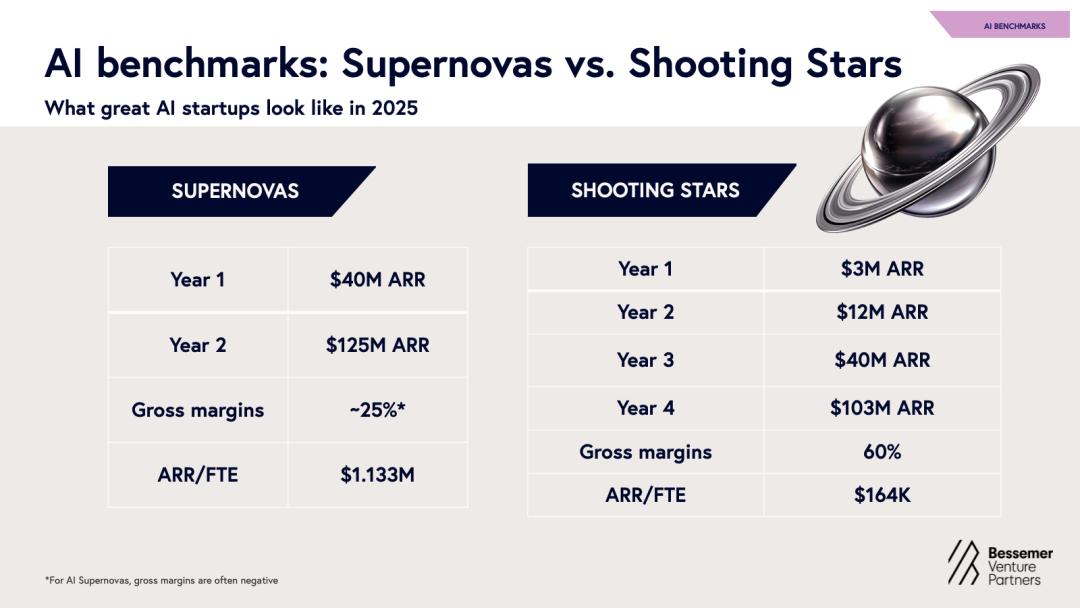
Core Insights - 2023 is seen as the "explosive year" for artificial intelligence (AI), while 2025 is anticipated to be a dawn of clarity for the industry, with clearer paths for startups and established companies [1][2] Group 1: Investment Trends - Bessemer, a renowned investment firm, has invested over $1 billion in AI-native startups since 2023, indicating strong confidence in the sector [1] - The report highlights that traditional SaaS companies are becoming the largest beneficiaries of AI technology [1] Group 2: Growth Patterns of AI Startups - Bessemer identifies two primary growth paradigms for AI startups: "supernova" and "meteor" [3] - Supernova companies can achieve $100 million in annual recurring revenue (ARR) within their first year, showcasing unprecedented growth in the software industry [6][7] - Meteor companies, while growing rapidly, maintain healthier profit margins and customer relationships compared to supernova companies, achieving $300,000 ARR in their first year and growing fourfold [8][9] Group 3: AI Industry Evolution - The AI industry is entering a second phase where defining problems becomes more critical than merely solving them, with a shift towards building systems that interact effectively with the real world [10][11] - Innovations in AI are leading to a reconfiguration of foundational infrastructure, focusing on integration and continuous learning [11][12] Group 4: Memory and Context as Competitive Advantages - Memory and context are emerging as new competitive advantages in AI, with systems that can remember and adapt becoming essential [13][16] - The Model Context Protocol (MCP) is gaining traction as a standard for AI systems to access external APIs and tools, simplifying integration for developers [14][15] Group 5: Disruption of Traditional Software Systems - AI is poised to disrupt traditional enterprise software systems, transitioning from record-keeping systems to action-oriented systems that can automate workflows [20][21] - New AI-native tools are emerging that not only store data but also act on it, significantly enhancing productivity and reducing implementation times [20][21] Group 6: Vertical AI as a Lever - Vertical AI is gaining traction, particularly in industries that have historically resisted technology adoption, with significant potential for market disruption [28][29] - Companies in healthcare, legal, and education sectors are rapidly adopting AI-native tools to automate workflows and improve efficiency [29][30] Group 7: Future Opportunities and Challenges - The next wave of AI applications will focus on deep integration into daily life, with opportunities in areas like travel and shopping [40][41] - Founders are encouraged to focus on specific trends, such as memory, action systems, and vertical AI, to navigate the evolving landscape [43][44]


记者、UP主、写手,谁能逃过这场“AI灭绝浪潮”?
Hu Xiu· 2025-08-18 11:25
Group 1 - The core viewpoint of the article highlights the transformative impact of AI on the news industry, emphasizing a shift in user experience and the potential displacement of journalists due to AI advancements [1][2][58]. - A study conducted by researchers from the University of Copenhagen and the University of Chicago focuses on the professions likely to be affected by generative AI, particularly in journalism [3]. - A significant portion of journalists, 57.2%, believe that AI will replace more jobs in the field, with over 70% anticipating that AI will take over their roles in the coming years [5][6]. Group 2 - The emergence of new technologies, characterized by automated content generation and AI-based social media monitoring, has raised awareness across the industry [8]. - Tech companies are intensifying their efforts to control information flow and transform the distribution of news [9]. - Perplexity, an AI search engine startup, made a bold acquisition offer of $34.5 billion to buy Google's Chrome browser, aiming to gain access to over 3 billion users and control a critical information channel [10][13]. Group 3 - Perplexity has introduced an AI news aggregation feature called "Discover," which compiles and presents news in an interactive Q&A format, allowing users to engage with current events [14][20]. - The "Pages" feature of Perplexity organizes content by topics, enabling users to quickly browse and explore in-depth information [16][21]. - Particle, another AI-driven news platform, offers AI-generated news summaries that allow users to grasp key content without reading full articles, enhancing the efficiency of news consumption [28][36]. Group 4 - AI is reshaping content creation beyond news, with platforms like Meta and YouTube encouraging AI-generated content, potentially reducing the need for human creators [43][44]. - The trend of AI-generated content is gaining traction, with some channels being entirely AI-driven, attracting significant viewership [46][47]. - The future may see a rise in "AI-generated idols" and series, with increasing acceptance from audiences, particularly younger generations [51]. Group 5 - AI is expected to redefine the roles within journalism, with journalists becoming "information architects" who focus on higher-level content creation and oversight while AI handles data organization and basic reporting [55][56]. - The reading experience for users is evolving, with AI news products providing more efficient, personalized, and interactive ways to access information [58][60]. - AI news aggregators can now compile multi-source information into cohesive narratives, allowing users to engage actively with the content rather than passively consuming it [65][66]. Group 6 - The article emphasizes the importance of finding a sustainable business model for AI news products, which must respect content value and benefit content sources to gain long-term industry support [68]. - The media ecosystem is expected to seek a new balance as human-AI collaboration becomes the norm in journalism [69]. - The ultimate goal is to enhance user experience by filtering redundant information and aggregating diverse viewpoints, making knowledge acquisition more accessible [70].

AI来了,记者、UP主、写手,谁能逃过这场“灭绝浪潮”?
3 6 Ke· 2025-08-18 10:51
Core Insights - The rise of AI is leading to a significant transformation in the journalism industry, with many journalists fearing job displacement due to AI advancements [1][2][5] - AI is redefining how information is accessed and consumed, offering a stark contrast to traditional news delivery methods [1][44] Group 1: AI Impact on Journalism - A study by researchers from the University of Copenhagen and the University of Chicago indicates that 57.2% of journalists believe AI will replace more jobs, with over 70% anticipating AI's impact in the coming years [2] - The emergence of AI-driven news products is changing user experiences, making information retrieval more efficient and personalized [44] - AI applications like Perplexity and Particle are leading the charge in automating content generation and enhancing news aggregation [11][18] Group 2: Company Developments - Perplexity has made headlines by proposing a $34.5 billion acquisition of Google's Chrome browser, aiming to control a major information flow channel with over 3 billion users [9][11] - Particle, founded by former Twitter engineers, offers AI-generated news summaries that allow users to quickly grasp key content without reading full articles [21][23] - Both companies are leveraging AI to create interactive and personalized news experiences, moving beyond traditional news aggregation methods [33][44] Group 3: Future of Content Creation - The integration of AI in content creation is not limited to journalism; it extends to social media platforms where AI-generated content is becoming increasingly prevalent [36][39] - AI's ability to produce diverse content formats, such as audio summaries and in-depth analyses, is reshaping how news is consumed [41] - The role of journalists is evolving, with a focus on higher-level content creation and oversight, as AI takes over data organization and basic reporting tasks [43][44]

人工智能“入侵”人类新闻网站腹地
创业邦· 2025-08-18 10:10
Core Viewpoint - The article discusses the ambitious plans of AI companies like Perplexity and Particle to redefine news consumption and production through AI-driven news aggregation and organization, highlighting a shift from traditional human editorial roles to AI as the primary organizer of news content [6][10]. Group 1: AI News Products - Perplexity proposed a $34.5 billion acquisition of Google Chrome, reflecting the ambition of AI companies to create new entry points for information [6]. - Perplexity's "Discover" feature and Particle's AI news application represent two distinct paths for AI-native news, focusing on interactive Q&A and comprehensive storytelling, respectively [7][12]. - Both products aim to enhance user experience by organizing news in a way that allows for deeper engagement and understanding of events, moving away from traditional article aggregation [9][10]. Group 2: User Experience Transformation - AI news products change the user experience by allowing users to grasp complex events quickly, reducing the need to sift through multiple articles [10][11]. - The new logic of news organization shifts from collecting articles to identifying events, aggregating sources, and presenting structured, personalized interpretations [10][14]. - AI acts as a "chief editor," automatically identifying hot topics and generating interactive interpretations, while human oversight remains crucial for quality control [11][12]. Group 3: Features of AI News Products - AI news products exhibit four key characteristics: multi-perspective aggregation, adjustable AI summaries, traceability of information, and a human-AI collaboration review mechanism [11]. - Perplexity focuses on providing consumable answer streams based on user interests, while Particle emphasizes presenting stories with multiple media perspectives [12][14]. - The integration of AI allows for dynamic reorganization of news content, adapting to different formats and user contexts [14][17]. Group 4: Future of News and Journalism - AI is expected to fundamentally alter the logic of information acquisition, emphasizing the need for verification and fair revenue-sharing with original media [14][15]. - The role of journalists will evolve, focusing on investigative capabilities and oversight of AI-generated content, positioning them as "information product designers" [15][17]. - The rapid growth of AI-generated content raises questions about the future of reading and the preservation of human insight and experience in journalism [17].