
强脑科技

Search documents
乌镇同台聚首 杭州“六小龙”共话未来科技图景
Zhong Guo Xin Wen Wang· 2025-11-08 15:31
Core Insights - The article highlights the rapid rise of Chinese tech startups, particularly in the field of AI, with a focus on the "Six Little Dragons" from Hangzhou, who are gaining significant attention in the industry [1] Group 1: AI and Embodied Intelligence - The concept of "embodied intelligence" has been recognized as a key area in AI, with applications extending from industrial sectors to daily life, healthcare, and disaster relief [1] - The term "embodied intelligence" was first included in the government work report for 2025, indicating its growing importance [1] - Companies like Yushutech are optimistic about the future of embodied intelligence, believing it will serve as a crucial engine for the robotics industry [2] Group 2: Challenges in Development - The development of embodied intelligence faces challenges primarily related to high-quality data and model algorithms, with a need for improved data utilization [2] - Despite these challenges, industry leaders remain optimistic about advancements in the robotics sector over the next two years [2] Group 3: Innovations in Robotics - Companies like Yushutech and Cloud Deep Technology are focusing on practical applications of robotics, such as using robotic dogs for power inspections and emergency firefighting [2] - The emergence of humanoid robots is also being pursued, with the aim of replacing human labor in hazardous environments [2] Group 4: Future Vision - Industry leaders envision a future where robots will significantly populate work environments, necessitating unified management and command of these machines through spatial intelligence technology [2] - The transition from automation to intelligence in robotics is seen as a gradual process that will not take long [2] Group 5: Brain-Computer Interface Technology - Brain-computer interface technology is transitioning from experimental stages to real-world applications, such as neuro-controlled prosthetics that allow disabled individuals to perform intricate tasks [3] - This technology is moving closer to making previously fictional scenarios a reality, enhancing human capabilities [3] Group 6: Awareness of Risks - Industry representatives emphasize the importance of risk awareness regarding the potential long-term impacts of AI, including job displacement and the concentration of technological advantages among a few companies [4] - The balance between AI's capabilities and the anxiety it may cause in the workforce is highlighted as a critical issue for future consideration [4]
在乌镇 “杭州六小龙” 聊了三件事
Zhong Guo Xin Wen Wang· 2025-11-08 14:08
中新网乌镇11月8日电(记者柴燕菲王逸飞)7日的2025年世界互联网大会乌镇峰会上,深度求索、宇树科 技、云深处科技、游戏科学、强脑科技、群核科技的代表刚刚登台,场下的手机、相机便已纷纷举起, 记录这并不多见的"同框"画面。 "当红小生"自曝"囧事" "世界互联网大会乌镇峰会已经举办十多年,它和'六小龙'的出现,是否存在一定的关系?" 在中国人工智能产业图谱中,将"杭州六小龙"视作"当红小生"并不为过。当日,面对主持人——中国工 程院院士、之江实验室主任王坚抛出的问题,这些明星企业讲述了各自的成长经历,其中就包括对诸多 创业"囧事"的大方分享。 专注于脑机接口的强脑科技,此前从美国波士顿迁回到杭州余杭。当日,企业创始人兼首席执行官韩璧 丞介绍了团队希望解决人类疾病困扰的初衷。他的一则小故事,则引得不少笑声。 "最开始很辛苦,我们(团队)一边读书一边创业,经常干到半夜两三点,一群留学生在地下室里头上戴 着软件设备,闪闪发光的测定脑电。有一天半夜,一位美国老奶奶在地下室里被我们吓了一跳,第二天 在小区里就传出一个'谣言'——很多中国留学生为提高成绩,每天半夜给自己的大脑充电。"他说。 今年初,"杭州六小龙"凭借各 ...
在水乡乌镇感受照耀未来的“互联网之光”
Xin Hua She· 2025-11-08 11:19
Group 1 - The World Internet Conference in Wuzhen focuses on building an open, cooperative, and secure digital future, emphasizing the concept of a community with a shared future in cyberspace [1] - The Leading Technology Award at the conference recognized 17 projects in cutting-edge fields such as large models, intelligent networks, embodied intelligence, and quantum computing [1] - The conference featured over 600 enterprises and institutions from more than 50 countries, showcasing new technologies and products in artificial intelligence [1] Group 2 - The main forum included discussions on overcoming challenges in entrepreneurship and the opportunities and challenges facing artificial intelligence development [2] - Participants expressed confidence in the unstoppable progress of artificial intelligence, highlighting the need for collaboration between technology and regulation to ensure safety [3] - The conference hosted 24 sub-forums on topics like global development initiatives, digital economy, and data governance, facilitating the exchange of cutting-edge ideas [3] Group 3 - The concept of a community with a shared future in cyberspace is seen as a guiding principle for the prosperous development of the global information landscape [4] - Emphasis was placed on transforming the "digital divide" into a "digital thoroughfare," advocating for shared benefits from digital infrastructure development among nations [4]
在乌镇,“杭州六小龙” 聊了三件事
Zhong Guo Xin Wen Wang· 2025-11-08 10:18
中新网乌镇11月8日电(记者 柴燕菲 王逸飞)7日的2025年世界互联网大会乌镇峰会上,深度求索、宇树 科技、云深处科技、游戏科学、强脑科技、群核科技的代表刚刚登台,场下的手机、相机便已纷纷举 起,记录这并不多见的"同框"画面。 "世界互联网大会乌镇峰会已经举办十多年,它和'六小龙'的出现,是否存在一定的关系?" 在中国人工智能产业图谱中,将"杭州六小龙"视作"当红小生"并不为过。当日,面对主持人——中国工 程院院士、之江实验室主任王坚抛出的问题,这些明星企业讲述了各自的成长经历,其中就包括对诸多 创业"囧事"的大方分享。 专注于脑机接口的强脑科技,此前从美国波士顿迁回到杭州余杭。当日,企业创始人兼首席执行官韩璧 丞介绍了团队希望解决人类疾病困扰的初衷。他的一则小故事,则引得不少笑声。 "最开始很辛苦,我们(团队)一边读书一边创业,经常干到半夜两三点,一群留学生在地下室里头上戴 着软件设备,闪闪发光的测定脑电。有一天半夜,一位美国老奶奶在地下室里被我们吓了一跳,第二天 在小区里就传出一个'谣言'——很多中国留学生为提高成绩,每天半夜给自己的大脑充电。"他说。 云深处科技创始人兼CEO朱秋国则回忆了创业初期,企 ...
“杭州六小龙”聚首,梁文锋缺席
财联社· 2025-11-08 07:40
Core Insights - The "Six Little Dragons of Hangzhou" are leading advancements in various cutting-edge fields such as brain-computer interfaces, robotics, spatial intelligence, game technology, and open-source AI, showcasing China's transformation from a follower to a leader in technology [3][4][7]. Group 1: Industry Trends - The brain-computer interface sector has experienced significant growth over the past decade, transitioning from a niche interest to practical applications, driven by supportive policies [7]. - The rapid development of the robotics industry is attributed to China's strong manufacturing capabilities and core component integration technologies, enabling the creation of cost-effective and high-performance robots [9]. - The gaming industry in China has seen substantial growth, with local teams producing high-quality content that resonates with domestic users, as evidenced by the success of titles like "Black Myth: Wukong" [8]. Group 2: Technological Challenges - The lack of unified data standards in the field of embodied intelligence poses challenges for the development and integration of robotic systems [11]. - The complexity of human brain signal interpretation in brain-computer interfaces presents significant technical hurdles, particularly in applications like prosthetics [12]. - The robotics sector faces dual challenges of computational power and scene adaptability, necessitating innovative approaches to reduce data and computational requirements [14]. Group 3: Strategic Shifts - Companies are shifting their business models from serving human clients to focusing on machine clients, anticipating a future where the number of machines may exceed that of humans [13]. - The introduction of Spatial AI and digital twin products aims to address market needs in industrial robotics, reflecting a strategic pivot towards advanced technological solutions [14]. - The emphasis on open-source models in AI development is seen as a way to democratize access to technology and mitigate risks associated with monopolistic practices [14].


“杭州六小龙”聚首乌镇对话,接棒互联网大厂成新主角
Feng Huang Wang· 2025-11-08 05:53
Core Insights - The "Six Little Dragons of Hangzhou" are recognized for their contributions to cutting-edge fields such as brain-computer interfaces, robotics, spatial intelligence, game technology, and open-source AI, marking a shift in China's tech narrative from following to leading [1][5][6] Group 1: Industry Transformation - The past decade has seen significant advancements in the brain-computer interface sector, transitioning from experimental stages to real-world applications, driven by policy support [5] - The rapid development of the robotics industry is attributed to China's strong manufacturing capabilities and core component integration technologies, enabling the creation of cost-effective and high-performance robots [7] - The gaming industry has evolved, with local teams producing high-quality content that resonates with Chinese users, as evidenced by the success of "Black Myth: Wukong" [6] Group 2: Technological Challenges and Innovations - The lack of unified data standards in embodied intelligence poses challenges for the robotics sector, with varying data collection methods across manufacturers [9] - The complexity of human brain signal interpretation in brain-computer interfaces presents significant hurdles, with AI being utilized to address these challenges [9][10] - Companies are facing dual challenges of computational power and scene adaptation in robotics, necessitating innovative approaches to reduce data and computational requirements [12] Group 3: Strategic Shifts - Companies are shifting their business models from serving human clients to focusing on machine clients, anticipating a future where the number of machines may exceed that of humans [10][11] - The introduction of Spatial AI and digital twin products aims to enhance collaboration with industrial robots, reflecting a strategic pivot towards advanced technology solutions [11] - The emphasis on open-source models and collaborative development is seen as a way to democratize access to advanced AI technologies, mitigating risks of technological monopolies [12]
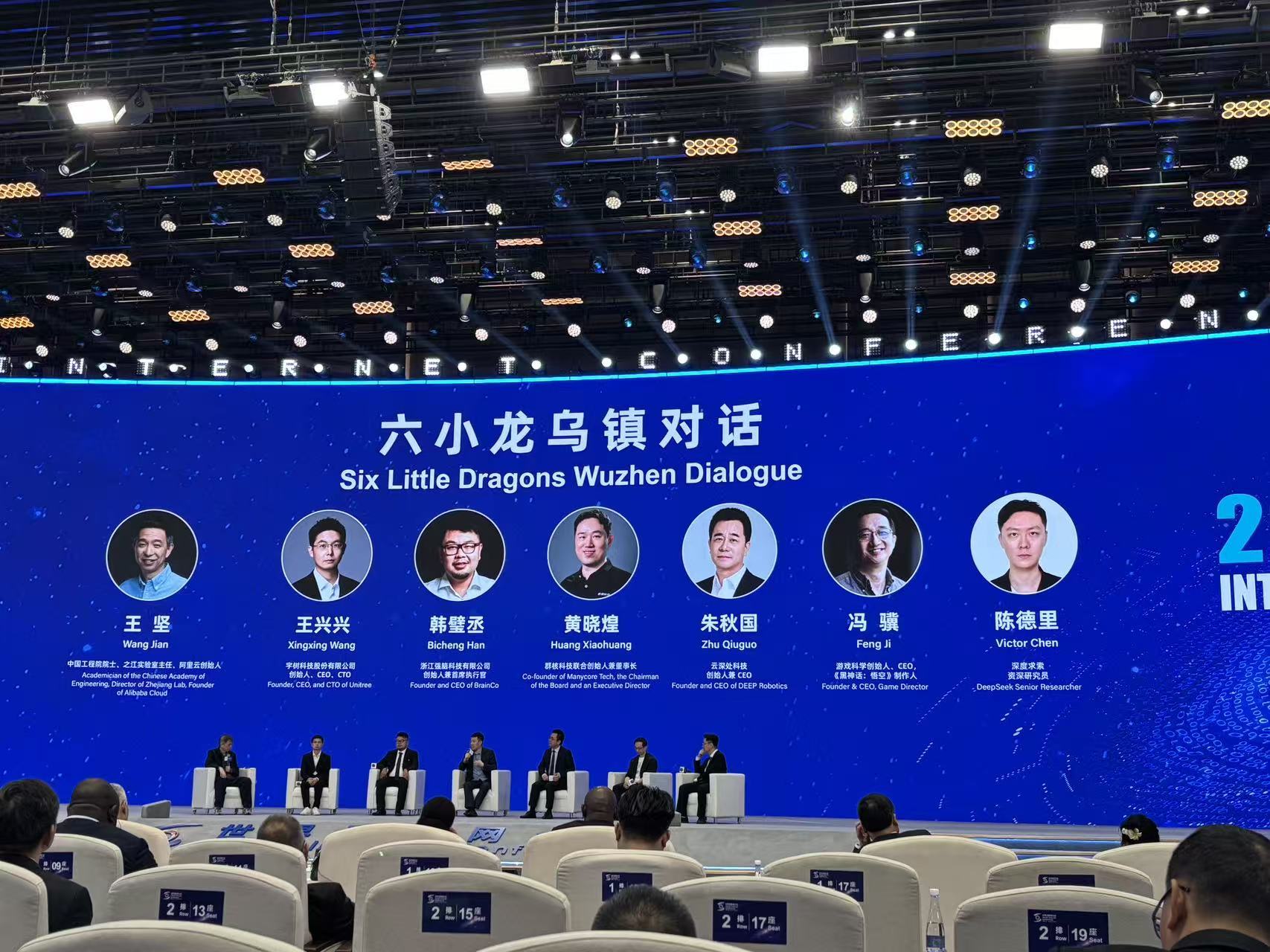
杭州六小龙,乌镇大会首次同框
2 1 Shi Ji Jing Ji Bao Dao· 2025-11-08 04:28
Core Insights - The "Six Little Dragons" of Hangzhou showcased their advancements and challenges in various tech sectors during the Wuzhen Internet Conference, highlighting the rapid development of AI and its implications for their industries [1][3]. Group 1: Industry Developments - Yushutech's CEO Wang Xingxing noted that AI is accelerating the development of the robotics industry, particularly in humanoid robots, which are relatively easier to advance compared to other cutting-edge technologies [3]. - Qiangnao Technology's founder Han Bicheng emphasized that brain-computer interfaces have transitioned from laboratory concepts to impactful products, such as aiding the visually impaired, with their second-generation sleep product aimed at improving sleep for those with insomnia [3]. - Qunke Technology's founder Huang Xiaohuang identified spatial intelligence as a significant field following large language models, applicable in robotics and video generation [3]. - Yundongchu Technology's CEO Zhu Qiuguo stated that robots will ultimately assist humans in addressing dangerous tasks in the workplace [3]. - Game Science's Feng Ji highlighted that China's gaming industry has the largest user base and market size globally, having developed significantly over the past decade [3]. Group 2: Challenges and Risks - The "Six Little Dragons" expressed concerns about the challenges posed by AI development. Wang Xingxing pointed out that while large language models have made significant progress, the training data for robotics cannot be decoupled from the robots themselves, leading to a lack of standardization [4]. - Han Bicheng mentioned that serious brain diseases like Alzheimer's and autism currently lack effective treatments, but AI could aid in data collection and analysis [4]. - Huang Xiaohuang warned that the rise of AI could lead to the replacement of traditionally stable creative jobs [4]. - Zhu Qiuguo noted that robotics faces power supply bottlenecks, and dexterous hands struggle with complex tasks in uncertain environments [4]. - Feng Ji raised concerns about the potential monopolization of technological advantages by fewer individuals and companies due to AI advancements, posing a significant risk [5]. - Chen Deli from Deep Exploration emphasized the need for effective and stable algorithms for AI, advocating for continuous learning in real-world environments [6].
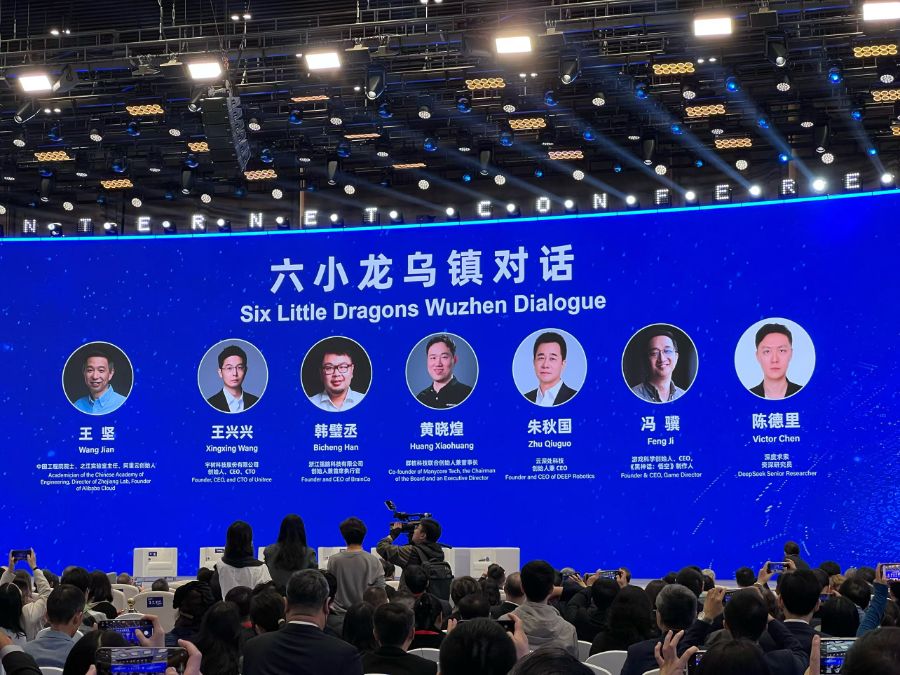
杭州“六小龙”首次齐聚乌镇同台对话!聊AI、机器人 谈未来
Mei Ri Jing Ji Xin Wen· 2025-11-08 00:19
Core Insights - The World Internet Conference in Wuzhen highlighted the growth of six innovative tech companies, referred to as the "Six Little Dragons," focusing on opportunities and challenges in artificial intelligence and technology breakthroughs [1][2][3] Group 1: Company Growth and Development - Yushutech has grown from a three-person team to over a thousand employees in nine years, leveraging China's entrepreneurial ecosystem and self-developed core components to export humanoid robots globally [1][2] - Strong Brain Technology's founder shared the journey from studying at Harvard to establishing a company in China, emphasizing the rapid development of brain-computer interface technology since relocating to Hangzhou in 2018 [2][3] - Qunke Technology's co-founder transitioned from working at NVIDIA in Silicon Valley to founding a company in China, reflecting the broader narrative of China's internet development [2][3] Group 2: Industry Trends and Future Outlook - The robotics industry is experiencing accelerated growth due to AI advancements, with expectations for significant developments in the coming years [4] - Brain-computer interface technology is evolving from experimental stages to impactful products, initially targeting individuals with disabilities and later expanding to general wellness products [6] - The gaming industry, exemplified by the success of "Black Myth: Wukong," is benefiting from a large user base and talent pool, with expectations for AI to play a significant role in future developments [7][8] Group 3: Technological Innovations - Companies are focusing on practical applications of robotics, such as using quadruped robots for various scenarios and humanoid robots for hazardous environments [6] - The gaming sector is leveraging technology to enhance cultural representation and user engagement, with a vision for AI to empower more individuals [7][8] - DeepSeek emphasizes the importance of stable learning algorithms for AI and the potential for significant advancements in the next decade [7][8]

“杭州六小龙”同台 乌镇峰会聚焦AI赋能美好生活
Shang Hai Zheng Quan Bao· 2025-11-07 19:10
Core Viewpoint - The 2025 World Internet Conference in Wuzhen focuses on building an open, cooperative, and inclusive digital future, emphasizing the importance of collaboration in the digital economy [2]. Group 1: AI Development and Impact - Alibaba's CEO, Wu Yongming, highlighted the rapid evolution of AI technology towards Artificial General Intelligence (AGI) and eventually Super Artificial Intelligence (ASI), expressing confidence in achieving significant milestones by 2035 [4]. - JD Group's founder, Liu Qiangdong, projected a tenfold growth in the global tourism market over the next five years, driven by advancements in technology that will create new job opportunities and reduce labor intensity [4]. - JD Logistics has developed automated equipment capable of large-scale deployment, with plans to establish the world's first fully unmanned delivery station by April next year [6]. Group 2: AI Accessibility and Inclusivity - Wu Yongming emphasized that the new generation of AI products will be accessible to various demographics, including the elderly and disabled, aiming to bridge the digital divide [6]. - Alibaba's "Mota" community has become the largest AI open-source community in China, with over 120,000 open-source models and 5,500 services, serving more than 20 million users [7]. Group 3: Future of Robotics and Technology - The "Hangzhou Six Little Dragons" discussed the rapid advancements in robotics, with expectations for significant developments in the coming years [8]. - Companies like Qiang Brain Technology are focusing on brain-computer interface technology to assist individuals with disabilities, while also planning to develop products for the general public [9]. - Cloud Deep Technology aims to replace human labor in hazardous environments with robots, showcasing the first humanoid robot capable of outdoor operations [10].


浙江社保科创基金的“长期主义”:以“耐心”陪跑创新
Zhong Guo Xin Wen Wang· 2025-11-07 17:56
Core Viewpoint - The establishment of the Zhejiang Social Security Science and Technology Innovation Fund, with an initial scale of 50 billion yuan, represents a significant capital investment aimed at fostering innovation and industrial development in Zhejiang province, aligning with national strategies for high-quality growth [1][8]. Group 1: Fund Overview - The Zhejiang Social Security Science and Technology Innovation Fund has completed its business registration in Hangzhou and is a collaboration between the National Social Security Fund Council, Zhejiang Province, and Agricultural Bank of China [1]. - The fund's first phase is set at 50 billion yuan, with the Zhejiang Provincial Innovation Investment Group acting as the manager [1][4]. Group 2: Historical Context and Development - Zhejiang has a long-standing commitment to venture capital, having established a provincial-level venture capital guiding fund as early as 2009, which has evolved into a comprehensive investment ecosystem [2]. - By mid-2025, Zhejiang will have 147 government investment funds with a total scale exceeding 320 billion yuan, leveraging social capital to create a vast innovation capital network [2][3]. Group 3: Investment Strategy and Impact - The Zhejiang Provincial Innovation Investment Group has supported over 1,600 projects and facilitated the successful listing of more than 100 companies, demonstrating its effectiveness in nurturing local enterprises [3]. - The fund emphasizes the integration of industry, academia, and research, focusing on early-stage technology projects and fostering collaboration with institutions like Zhejiang University [3][5]. Group 4: Future Prospects - The Zhejiang Social Security Science and Technology Innovation Fund aims to create a multi-layered fund system covering the entire lifecycle of technology enterprises, with a focus on artificial intelligence and life sciences [8]. - The fund will operate under a "mother fund + direct investment" model, combining national strategic advantages with local market insights to provide stable long-term capital for high-risk innovative sectors [8][9].