
Lumentum Holdings Inc.

Search documents
Is Invesco Russell 1000 Equal Weight ETF (EQAL) a Strong ETF Right Now?
ZACKS· 2025-10-27 11:21
Core Insights - The Invesco Russell 1000 Equal Weight ETF (EQAL) debuted on December 23, 2014, providing broad exposure to the Style Box - Large Cap Blend category [1] - EQAL aims to match the performance of the Russell 1000 Equal Weight Index, which is composed of securities in the Russell 1000 Index and is equally weighted across nine sector groups [5] - The ETF has accumulated over $690.63 million in assets, making it an average-sized ETF in its category [5] Fund Sponsor & Index - Managed by Invesco, EQAL seeks to replicate the performance of the Russell 1000 Equal Weight Index [5] - The index is designed to provide equal weight to each security within its sector, promoting diversification [5] Cost & Other Expenses - EQAL has an annual operating expense of 0.20%, which is competitive within its peer group [6] - The ETF's 12-month trailing dividend yield stands at 1.72% [6] Sector Exposure and Top Holdings - The ETF has the highest allocation in the Information Technology sector, accounting for approximately 13.7% of the portfolio [7] - The top 10 holdings represent about 6.15% of total assets, with Lumentum Holdings Inc (LITE) making up around 0.78% of total assets [8] Performance and Risk - As of October 27, 2025, EQAL has increased by about 10.42% year-to-date and approximately 9.63% over the past year [10] - The ETF has a beta of 1.00 and a standard deviation of 16.27% over the trailing three-year period, indicating medium risk [10] Alternatives - Other ETFs in the same space include iShares Core S&P 500 ETF (IVV) and Vanguard S&P 500 ETF (VOO), which track the S&P 500 Index [11] - IVV has assets of $714.21 billion and an expense ratio of 0.03%, while VOO has $775.39 billion in assets with the same expense ratio [11]
光库科技(300620):Q3业绩快速增长 持续并购提升竞争力
Xin Lang Cai Jing· 2025-10-24 06:37
Core Insights - The company reported a significant increase in revenue and net profit for the first three quarters of 2025, with total revenue reaching 998 million yuan, a year-on-year growth of 35.11%, and a net profit attributable to shareholders of 115 million yuan, up 106.61% year-on-year [1] - The company has made substantial progress in new product development and has established a strong reputation in the industry, recognized by major optical communication companies [1][2] - The company is actively pursuing acquisitions to enhance its competitive position in the industry, including the acquisition of Jabil Technology and plans to acquire Suzhou Anjie Xun [2] Financial Performance - For Q3 2025, the company achieved revenue of 402 million yuan, a year-on-year increase of 26.53% and a quarter-on-quarter increase of 21.22% [1] - The net profit for Q3 was 63 million yuan, reflecting a year-on-year growth of 149.09% and a quarter-on-quarter growth of 54.64% [1] - The gross margin for Q3 was 34.62%, with a quarter-on-quarter increase of 0.48 percentage points, while the net margin was 15.42%, up 3.32 percentage points quarter-on-quarter [1] Product Development and Market Position - The company has launched several new products, including all-optical switches and 800G silicon photonic integrated online isolators, and is focusing on R&D and talent acquisition [1] - The company has established strong relationships with well-known optical communication firms such as Cisco, Ciena, and Nokia, enhancing its market presence [1] Strategic Acquisitions - The company completed the acquisition of Jabil Technology (Wuhan) for a total consideration of 17 million USD plus net cash and transaction costs, enhancing its manufacturing capabilities and customer resources [2] - Plans are in place to acquire Suzhou Anjie Xun, which specializes in high-speed optical module components, further strengthening the company's product offerings and market position [2] Profit Forecast and Investment Recommendation - The company has revised its profit forecasts upward, expecting net profits of 151 million yuan, 252 million yuan, and 301 million yuan for 2025-2027, reflecting strong growth in optical communication components [3] - The company maintains an "overweight" rating due to its rapid growth and strategic acquisitions [3]

Lumentum Holdings Inc. (LITE): A Bull Case Theory
Insider Monkey· 2025-10-22 21:31
Core Insights - Artificial intelligence (AI) is identified as the greatest investment opportunity of the current era, with a strong emphasis on the urgent need for energy to support its growth [1][2][3] - A specific company is highlighted as a key player in the AI energy sector, owning critical energy infrastructure assets that are essential for meeting the increasing energy demands of AI technologies [3][7][8] Investment Landscape - Wall Street is investing hundreds of billions into AI, but there is a pressing concern regarding the energy supply needed to sustain this growth [2] - AI data centers, which power large language models like ChatGPT, consume energy equivalent to that of a small city, indicating a significant strain on global power grids [2][3] - The company in focus is positioned to capitalize on the surge in demand for electricity driven by AI, making it a potentially lucrative investment opportunity [3][6] Company Profile - The company is described as a "toll booth" operator in the AI energy boom, collecting fees from energy exports and benefiting from the onshoring trend due to tariffs [5][6] - It possesses critical nuclear energy infrastructure assets, making it integral to America's future power strategy [7] - The company is noted for its capability to execute large-scale engineering, procurement, and construction projects across various energy sectors, including oil, gas, and renewables [7][8] Financial Position - The company is completely debt-free and has a substantial cash reserve, amounting to nearly one-third of its market capitalization, which positions it favorably compared to other energy firms burdened by debt [8][10] - It also holds a significant equity stake in another AI-related company, providing investors with indirect exposure to multiple growth engines in the AI sector [9][10] Market Sentiment - There is a growing interest from hedge funds in this company, which is considered undervalued and off-the-radar, trading at less than seven times earnings [9][10] - The company is recognized for delivering real cash flows and owning critical infrastructure, distinguishing it from speculative stocks in the AI space [11][12]


巴克莱:美国AI产业链财报季前瞻,这家投行称:小心“利好出尽”,抱紧“英伟达、博通和AMD”
美股IPO· 2025-10-21 03:37
Core Viewpoint - Barclays indicates that while the AI investment cycle is still in its early stages, some stocks have fully priced in the benefits of AI deployment, suggesting investors should be more selective with AI concept stocks [1][3]. Group 1: AI Investment Strategy - Barclays recommends concentrating AI exposure on leading companies such as Nvidia, Broadcom, and AMD, while downgrading Marvell, Astera Labs, and Lumentum to neutral ratings [3][5]. - The firm warns of a potential "buy the rumor, sell the news" scenario during the upcoming earnings season, as current valuations are high [3][5]. - The Philadelphia Semiconductor Index has significantly outperformed the S&P 500 by approximately 15% since Q3, with AI and memory sectors showing even greater gains [3][5]. Group 2: Stock Ratings Adjustments - Marvell's rating is downgraded to neutral due to challenges in its ASIC and optical market shares, with a target price maintained at $80 [6][15]. - Astera Labs is also downgraded to neutral, with a target price of $155, as the company faces a significant product transition and lacks a clear growth path post-Trainium 3 [11][12]. - Lumentum's rating is lowered to neutral, with a target price of $165, as its recent stock price surge has fully reflected its short-term growth potential [15][16]. Group 3: KLA's Upgraded Rating - KLA's rating is upgraded to overweight, with a target price raised from $750 to $1200, based on its strong position in the process control market and high exposure to advanced processes [18][20]. - The company is expected to benefit from increasing process control intensity due to rising technological complexity [18][19]. Group 4: HBM Demand and Micron's Outlook - Barclays provides a detailed HBM demand forecast, projecting a potential demand of approximately 50.7 exabytes based on AI computing projects, significantly boosting Micron's long-term growth outlook [21][22]. - The estimated HBM market size for 2025 is projected to be around $652.4 billion, with Micron's potential annual HBM revenue reaching $25.1 billion, far exceeding the expected $6.8 billion for 2025 [22][24]. Group 5: Semiconductor Market Concerns - Barclays expresses caution regarding the analog chip sector, suggesting a potential structural contraction in the total addressable market (TAM) rather than just cyclical fluctuations [25][28]. - The firm maintains a cautious outlook on Texas Instruments, anticipating downward risks for revenue and profit margins in the upcoming quarter [30].
巴克莱在财报季前降级Lumentum(LITE.US)等三只半导体股
Xin Lang Cai Jing· 2025-10-21 02:21
Group 1 - Barclays has downgraded the ratings of Lumentum (LITE.US), Astera Labs (ALAB.US), and Marvell Technology (MRVL.US) from "Overweight" to "Hold" due to decreased attractiveness compared to other AI-focused companies [1] - Lumentum's stock price has increased by 60% over the past three months, significantly outperforming the S&P 500's 5% increase, but its risk-reward profile is no longer favorable compared to peers [1] - Astera Labs faces market penetration issues with its UALink product, lacking significant advantages outside of the Amazon Trainium 3 project, and risks being marginalized as the industry shifts towards Ethernet, ESUN, and SUE-T solutions [1] Group 2 - Marvell Technology's rating was lowered due to its specialized integrated circuit business underperforming initial expectations and additional market risks facing its data center business [1] - Barclays is not bearish on the semiconductor sector overall, having upgraded the rating of KLA Corporation (KLAC.US) to "Overweight," citing optimism about long-term growth prospects and KLA's leading position in process control [2] - KLA is expected to experience strong growth as revenue from markets outside of China is anticipated to increase with relatively low entry barriers [2]





巴克莱在财报季前降级Lumentum(LITE.US)等三只半导体股,转而“增持”科磊(KLAC.US)
智通财经网· 2025-10-21 02:16
Group 1 - Barclays has downgraded the ratings of Lumentum (LITE.US), Astera Labs (ALAB.US), and Marvell Technology (MRVL.US) from "Overweight" to "Hold" due to decreased attractiveness compared to other AI-focused companies [1] - Lumentum's stock price has increased by 60% over the past three months, significantly outperforming the S&P 500's 5% increase, but its risk-reward profile is no longer favorable compared to peers [1] - Astera Labs faces market penetration challenges with its UALink product, lacking significant advantages outside of Amazon's Trainium 3 project, and risks being marginalized as the industry shifts towards Ethernet, ESUN, and SUE-T solutions [1] - Marvell Technology's rating was lowered due to its specialized integrated circuit business underperforming initial expectations and additional market risks facing its data center business [1] Group 2 - Barclays has upgraded the rating of KLA Corporation (KLAC.US) to "Overweight," expressing optimism about the long-term prospects of process control strength and KLA's leading position in the industry [2] - The company is expected to experience strong growth cycles as revenue growth thresholds outside of China are relatively low [2]
OCP 会议要点:英伟达领先,但聚光灯聚焦于超威半导体,光学领域仍受限制-OCP Takeaways_ NVDA Ahead but Spotlight was on AMD, Optical Remains Constrained
2025-10-19 15:58
Summary of Key Points from the Conference Call Industry Overview - The semiconductor industry, particularly focused on AI deployments, is experiencing significant growth with hundreds of billions of dollars in commitments recently. [2][1] - The optical market remains undersupplied, with InP capacity fully sold out through at least the end of next year. [3][1] Company-Specific Insights NVIDIA (NVDA) - NVDA continues to be the clear leader in the AI space, with a growing moat as competitors struggle to catch up. [8][1] - The GB300 transition is reportedly happening smoothly, with expectations for a crossover in Q4 2025. [2][1] - NVDA is seeing traction from major clients like META and ORCL, particularly with their SpectrumX product. [8][1] Advanced Micro Devices (AMD) - AMD showcased the MI450X Helios rack and announced a significant deployment of 50,000 GPUs with Oracle (ORCL). [2][1][7] - There is positive sentiment around AMD's partnership with Meta, and the company is expected to gain market share in GPU servers. [2][1] - AMD is committed to UAL technology, emphasizing the performance differences between UAL tunneled over Ethernet and dedicated silicon. [6][1] - The MI4xx series is gaining interest, particularly in the existing 8 GPU configuration. [2][1] Optical and Copper Markets - The optical market is expected to remain tight until at least 2026, with strong pricing for 1.6T Tx products. [3][1] - Active copper technology is anticipated to see significant growth as 1.6T scale-out configurations are rolled out. [3][1] Other Important Insights - The ESUN announcement, while initially perceived as significant, is clarified to be a necessary step for AMD's UALink tunneling over Ethernet. [4][1] - The optical market's shift towards CW/SiPho technology is driven by supply chain flexibility and higher technical requirements for EML. [3][1] - The majority of connections in the active copper market are expected to be AECs, but ACCs will also play a role. [3][1] Conclusion - The semiconductor and optical markets are poised for growth, with AMD and NVDA leading the charge in AI and GPU technologies. The ongoing supply constraints in the optical market present both challenges and opportunities for companies involved. [1][1]


硬件与网络:云资本支出展望-2025 年增长率上调至近 + 60%;2026 年增长预期目前为 + 30%-Hardware & Networking_ Cloud Capex Outlook_ Growth Raised to Almost +60% in ‘25; ‘26 Growth Expectations Now Tracking to +30%
2025-10-19 15:58
Summary of J.P. Morgan's Cloud Capex Outlook Industry Overview - The report focuses on the **Cloud Capital Expenditures (Capex)** outlook for the **datacenter** sector, particularly among the **Top 4 U.S. Cloud Service Providers (CSPs)**, which include Meta, Google, Amazon, and Microsoft [1][3][8]. Key Points and Arguments 1. **Capex Growth for 2025**: - Datacenter capex growth is now projected to be nearly **+60% year-over-year (y/y)** in 2025, up from a previous forecast of **+40%** [1][3][8]. - This growth translates to an increase of over **$100 billion** in 2025, marking the largest annual increase to date, surpassing the previous record set in 2024 [1][3][8]. 2. **Capex Growth for 2026**: - For 2026, growth expectations have been revised to **+30% y/y**, representing an increase of more than **$80 billion** [1][3][8]. 3. **Investment Drivers**: - The surge in capex is primarily driven by investments in **AI** and related infrastructure, with robust double-digit growth across all U.S. hyperscalers [1][3][8]. - Additionally, investments from **Tier 2 CSPs** and **neoclouds** are expected to grow significantly, with estimates suggesting a rise to nearly **$80 billion** in 2026, up from less than **$60 billion** in 2025 [1][3][8]. 4. **Equipment Categories**: - While high-cost **servers** with advanced **XPUs** will dominate the expansion, there is also a notable increase in spending on **networking equipment** such as datacenter switches, optical transceivers, and DCI solutions [1][3][8]. 5. **Company Coverage**: - J.P. Morgan remains optimistic about companies that support AI infrastructure demands, particularly in networking. Companies highlighted include **Arista (ANET)**, **Celestica (CLS)**, **Ciena (CIEN)**, **Coherent (COHR)**, **Lumentum (LITE)**, and **Fabrinet (FN)**, all rated as **Overweight (OW)** [1][3][8]. Additional Important Insights - The report indicates that the **datacenter capex** from a sample of public Tier 2 U.S. CSPs and emerging neoclouds is expected to grow over **+100% y/y** in 2025, surpassing the average spend from the Top 4 CSPs prior to 2023 [4][34]. - The anticipated growth for Tier 2 and neoclouds in 2026 is projected at **+35% y/y**, again outpacing the Top 4 CSPs [4][34]. - The report emphasizes that the sample excludes many private companies, which are also expected to show robust spending intentions for 2025 and beyond [4][34]. This summary encapsulates the critical insights from the J.P. Morgan report on the cloud capex outlook, highlighting significant growth trends and investment opportunities within the datacenter sector.
行业聚焦:全球窄线宽DFB激光器市场头部企业份额调研(附Top 10 厂商名单)
QYResearch· 2025-10-17 09:57
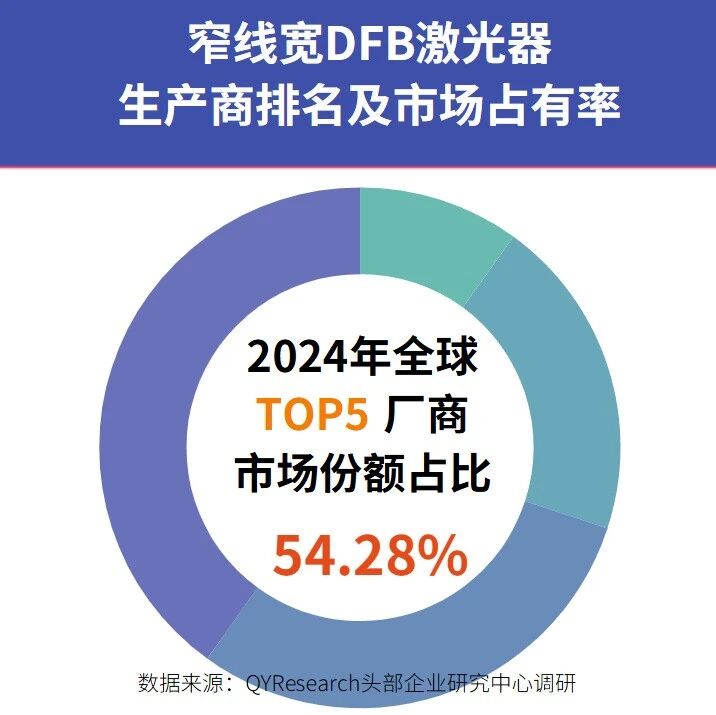
Core Viewpoint - The narrow linewidth DFB laser is a specialized semiconductor laser with significantly reduced frequency linewidth, making it essential for high-coherence applications such as high-speed optical communication, precision fiber sensing, and laser radar [1][2]. Market Overview - The global market for narrow linewidth DFB lasers is projected to reach $381.15 million by 2030, with a compound annual growth rate (CAGR) of 15.06% over the coming years [2]. - The dominant product type in the market is the 50-150mW narrow linewidth DFB laser, which holds approximately 46.65% of the market share [4][6]. Application Segmentation - The primary downstream market for narrow linewidth DFB lasers is optical communication, expected to account for about 29.87% of the market share in 2024 [8]. Key Manufacturers - Major manufacturers in the global narrow linewidth DFB laser market include Coherent, Lumentum, Anritsu, Thorlabs, and Macom, with the top five companies holding around 54.28% of the market share [11]. Market Drivers - The explosive growth of global data traffic driven by internet video, cloud computing, AI, and IoT applications is directly linked to the demand for DFB lasers [12]. - The evolution of large data centers from 100G/400G to 800G and higher speeds necessitates high-performance DFB lasers, making them critical for internal interconnects [12]. - The full deployment of 5G/6G networks requires extensive fiber optic upgrades, creating concentrated demand for DFB lasers due to their superior single-mode performance [13]. - Emerging technologies such as laser radar, silicon photonics, and quantum communication are expanding the application scenarios for DFB lasers, providing diverse growth drivers [13]. Challenges and Risks - The industry faces risks related to technological development and competition, requiring companies to make strategic decisions on various technology paths [14]. - Performance reliability and supply chain security are critical, as any inconsistencies can severely impact product quality and brand reputation [14]. - Cost pressures and cyclical fluctuations in the industry pose significant challenges, especially in large-scale markets like fiber-to-the-home and data centers [15].
硬件与网络-云计算资本支出展望:2025 年增速上调至近 60%;2026 年增长预期目前追踪为 30%-Hardware & Networking-Cloud Capex Outlook Growth Raised to Almost +60% in ‘25; ‘26 Growth Expectations Now Tracking to +30%
2025-10-17 01:46
Summary of J.P. Morgan's Cloud Capex Outlook Industry Overview - The report focuses on the **Cloud and Datacenter Capital Expenditures (Capex)** within the **U.S. Cloud Service Providers (CSPs)** industry, particularly the **Top 4 U.S. CSPs** which include Meta, Google, Amazon, and Microsoft [1][3][8]. Key Points Capex Growth Projections - **2025 Capex Growth**: The growth expectation for datacenter capex in 2025 has been revised upwards to nearly **+60% year-over-year (y/y)**, up from a previous forecast of **+40%**. This translates to an increase of over **$100 billion** in absolute dollar terms, marking the largest annual increase to date, surpassing the previous record set in 2024 [1][3][8][21]. - **2026 Capex Growth**: For 2026, the growth rate is now anticipated to be **+30% y/y**, which represents an increase of more than **$80 billion**. This is also an upward revision from the earlier forecast of **+20%** [1][3][21]. Investment Drivers - The primary driver of this growth is the **accelerated investment in AI and related infrastructure**. All major U.S. hyperscalers are expected to show robust double-digit growth in their capex [1][3][8]. - **Tier 2 CSPs and Neoclouds**: Investments from Tier 2 CSPs and emerging neoclouds are projected to grow significantly, with an expected capex of nearly **$60 billion** in 2025, which is more than double the average spend from the Top 4 CSPs prior to 2023 [1][3][35]. Equipment Categories - **Server Investments**: High-cost servers with advanced processing units (XPUs) will continue to dominate the capex expansion in 2025 and 2026. However, there is a notable increase in spending on networking equipment, including datacenter switches and optical transceivers [1][17][31]. - **Networking Investments**: The report indicates a ramp-up in investments in networking categories, which are expected to see substantial growth alongside server investments [1][17][31]. Company Coverage - J.P. Morgan remains bullish on companies that support AI infrastructure demands, particularly in networking. Companies highlighted include: - **Arista (ANET)** - **Celestica (CLS)** - **Ciena (CIEN)** - **Coherent (COHR)** - **Lumentum (LITE)** - **Fabrinet (FN)** [1][39]. Additional Insights - The report emphasizes that the **datacenter capex** figures exclude other equipment like HVAC and non-cloud business items, focusing solely on IT equipment [7]. - The anticipated growth rates for Tier 2 and neoclouds suggest a shift in the competitive landscape, indicating that these companies are becoming increasingly significant players in the datacenter investment space [35]. Conclusion - The outlook for cloud datacenter capex is exceptionally strong, driven by AI investments and a broader base of spending from both major and emerging players in the industry. The anticipated growth rates for 2025 and 2026 reflect a robust demand for cloud infrastructure, positioning the sector for continued expansion.