江阴银行

Search documents
投资收益超去年全年,非息收入“支撑”长沙银行半年业绩
Hua Xia Shi Bao· 2025-09-02 07:51
Core Viewpoint - Changsha Bank reported steady growth in its performance for the first half of 2025, with revenue increasing by 1.59% and net profit attributable to shareholders rising by 5.05%, marking the first interim dividend since its listing [2][3][10] Revenue and Profit Analysis - In the first half of 2025, Changsha Bank's operating income was 13.249 billion yuan, a year-on-year increase of 1.59%, while net profit attributable to shareholders was 4.329 billion yuan, up 5.05% [3] - The bank's net interest margin decreased to 1.87%, down 0.25 percentage points year-on-year, and net interest spread fell to 1.97%, down 0.30 percentage points [4] Income Structure - The contribution of net interest income to total revenue is declining, with net interest income at 9.659 billion yuan, down 1.74% year-on-year, accounting for 72.90% of total revenue, down from 75.37% in the same period last year [4] - Non-interest income reached 3.590 billion yuan, a year-on-year increase of 11.78%, driven primarily by investment income and net commission income, which grew by 118.82% and 14.60%, respectively [4][5] Investment Income - Investment income accounted for 88.69% of non-interest income, totaling 3.184 billion yuan, a significant increase of 118.82%, mainly due to gains from trading financial assets and other debt investments [5][6] - The balance of trading financial assets increased by 65.07% year-on-year to 182.429 billion yuan, with investment income from these assets rising by 62.31% [6][7] Market Conditions and Strategy - Despite a challenging bond market characterized by low interest rates and high volatility, Changsha Bank aims to enhance both investment scale and returns through strategic fund management [8][9] - The bank's investment strategy has shifted significantly since its listing, with investment income growing from 0.407 billion yuan in 2018 to 3.184 billion yuan in the first half of 2025, increasing its revenue share from 2.92% to 24.03% [8] Dividend Announcement - Changsha Bank's board approved a mid-term dividend plan, proposing a cash dividend of 2.00 yuan per 10 shares, totaling 804 million yuan, which represents 18.58% of net profit attributable to shareholders [10][11]

7家上市银行,首次公布!
Jin Rong Shi Bao· 2025-09-02 07:36
Core Viewpoint - The recent announcements of interim dividend plans by A-share listed banks highlight a significant trend towards enhancing shareholder returns, with major state-owned banks leading the way in dividend payouts exceeding 200 billion yuan in total [1][4]. Group 1: State-Owned Banks - Six major state-owned banks have announced their interim dividend plans for 2025, with a total proposed payout exceeding 200 billion yuan [1]. - Industrial and Commercial Bank of China (ICBC) leads with a proposed dividend of 1.414 yuan per 10 shares, totaling 503.96 billion yuan [1]. - Other state-owned banks, including Agricultural Bank of China, Bank of China, China Construction Bank, Bank of Communications, and Postal Savings Bank, have also outlined their respective dividend amounts [1]. Group 2: Joint-Stock Banks - China Merchants Bank, known as the "King of Retail," has announced its first interim profit distribution plan since its listing, proposing a cash dividend of 35% of its net profit attributable to ordinary shareholders for the first half of 2025 [2]. - Citic Bank plans to increase its interim dividend payout ratio to 30.7%, aiming to enhance investor returns and market confidence [2]. - Other joint-stock banks, including Ping An Bank, Minsheng Bank, and Huaxia Bank, have also confirmed their interim dividend plans with specific payout amounts [2]. Group 3: New Participants in Interim Dividends - Several banks, such as Changshu Bank, Ningbo Bank, and Su Nong Bank, have joined the ranks of those announcing interim dividends for the first time [3]. - Su Nong Bank plans to distribute 0.9 yuan per 10 shares, totaling 1.82 million yuan, marking its inaugural interim dividend [3]. - The focus on interim dividends is seen as a strategy to enhance shareholder satisfaction and align with regulatory expectations [3]. Group 4: Market Trends and Regulatory Influence - The introduction of the "National Nine Articles" has encouraged listed companies to adopt more frequent dividend distributions, with 23 A-share listed banks implementing interim dividends in 2024, totaling over 250 billion yuan [4]. - The trend towards interim dividends is viewed as a means to improve the stability and sustainability of dividend payouts, enhancing liquidity and cash flow certainty for investors [4][5]. - Analysts suggest that the shift towards interim dividends reflects a robust operational foundation and a commitment to shareholder returns, positively influencing market sentiment [5].


A股银行股逆势上涨,沪农商行、渝农商行涨超3%
Xin Lang Cai Jing· 2025-09-02 02:11
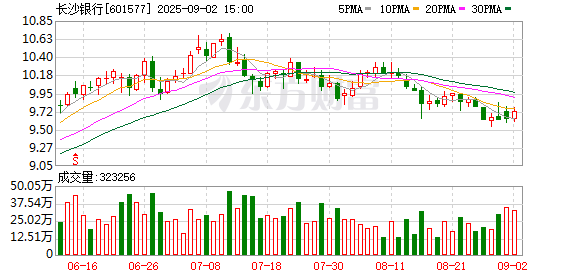
Group 1 - The main A-share indices experienced a general decline, while bank stocks showed an upward trend [1] - Notable gainers included Hu Nong Commercial Bank and Yu Nong Commercial Bank, both rising over 3% [1] - Other banks such as Qilu Bank, Ningbo Bank, Agricultural Bank of China, Nanjing Bank, Hangzhou Bank, China Merchants Bank, Chengdu Bank, Jiangyin Bank, and Changsha Bank all saw increases of over 1% [1]
银行半年报透视:经营业绩回暖 净息差降幅趋稳
Zhong Guo Zheng Quan Bao· 2025-09-01 23:20
Core Viewpoint - The overall performance of A-share listed banks in the first half of 2025 shows a significant recovery, with operating income and net profit attributable to shareholders both turning positive compared to the first quarter, supported by growth in non-interest income [1][3]. Financial Performance - A total of 42 A-share listed banks achieved operating income exceeding 2.9 trillion yuan and net profit attributable to shareholders exceeding 1.1 trillion yuan in the first half of 2025 [2]. - More than half of the banks reported growth in both operating income and net profit. Jiangyin Bank and Changshu Bank achieved double-digit year-on-year growth in both metrics [2]. - Jiangyin Bank reported operating income of 2.401 billion yuan, a year-on-year increase of 10.45%, and net profit of 846 million yuan, up 16.63%. Non-interest income, particularly investment income, significantly contributed to this growth [2]. - Changshu Bank reported operating income of 6.062 billion yuan, a year-on-year increase of 10.10%, and net profit of 1.969 billion yuan, up 13.51%. The bank's strong performance was also driven by substantial growth in non-interest income, particularly from fees and commissions [2]. Net Interest Margin Trends - The decline in net interest margin is stabilizing, with banks acknowledging ongoing pressure but expecting the rate of decline to narrow [4]. - The president of Citic Bank noted that while asset prices remain low, the replacement of high-yield loans will continue to exert downward pressure on net interest margins [4]. - The CFO of China Construction Bank indicated that the impact of previous interest rate adjustments has a lag effect, but improvements in monetary policy are expected to help stabilize net interest margins [4]. Anti-Competition Measures - Banks are implementing anti-competition measures to address excessive competition in loan pricing and deposit rates, which is seen as beneficial for both corporate health and asset quality [5][6]. - The general manager of the financial department at Industrial Bank highlighted that these measures present both opportunities and challenges, with a reduction in harmful competition observed in recent months [5]. - Long-term, these anti-competition initiatives are expected to improve supply-demand relationships, enhance corporate profitability, and direct financial resources towards high-end manufacturing and green economy sectors [5].
非息收入成重要“抓手”,上市银行中报业绩透露这些信号
Zhong Guo Zheng Quan Bao· 2025-09-01 15:16
Group 1 - The core viewpoint is that the performance of listed banks has significantly improved in the first half of 2025, with total operating income exceeding 2.9 trillion yuan and net profit exceeding 1.1 trillion yuan [1][2] - Non-interest income has played a crucial role in supporting the improvement of bank performance, with notable growth in banks like Jiangyin Bank and Changshu Bank, which achieved double-digit year-on-year growth in both operating income and net profit [1][2][3] - The net interest margin (NIM) remains a concern for the banking sector, with management from various banks indicating that while there is still downward pressure on NIM, the rate of decline is expected to gradually stabilize [1][4] Group 2 - Major banks such as Industrial and Commercial Bank of China, China Construction Bank, Agricultural Bank of China, Bank of China, and Postal Savings Bank of China reported the highest operating incomes in the first half of the year, with figures of 427.09 billion yuan, 394.27 billion yuan, 369.94 billion yuan, 329.00 billion yuan, and 179.45 billion yuan respectively [2] - In terms of net profit, the top five banks were also led by Industrial and Commercial Bank of China, with a net profit of 168.10 billion yuan, followed by China Construction Bank at 162.08 billion yuan, Agricultural Bank of China at 139.51 billion yuan, Bank of China at 117.59 billion yuan, and China Merchants Bank at 74.93 billion yuan [2] - Jiangyin Bank and Changshu Bank reported impressive growth rates in their financial performance, with Jiangyin Bank's operating income growing by 10.45% and net profit by 16.63%, while Changshu Bank's operating income increased by 10.10% and net profit by 13.51% [2][3] Group 3 - The "anti-involution" policy is seen as an opportunity for banks, with expectations that it will help stabilize the decline in net interest margins [4] - The policy is expected to alleviate the downward pressure on asset yields in the banking sector, although it may also present challenges due to varying implementation across different regions and banks [4] - Long-term, the "anti-involution" policy is anticipated to improve supply-demand relationships, benefiting corporate profitability and driving financial resources towards high-end manufacturing and green economy sectors, which could help banks optimize their asset and client structures [4]


银行分红热情高涨,这7家上市以来首次中期分红
Xin Lang Cai Jing· 2025-09-01 08:51
Core Viewpoint - Nearly half of the 42 listed banks in A-shares will implement mid-term dividends for 2025, with 17 banks already disclosing their dividend plans, marking a significant trend in the banking sector [1][4]. Group 1: Dividend Announcements - China Merchants Bank plans to distribute a cash dividend amounting to 35% of its net profit attributable to ordinary shareholders for the first half of 2025, with distribution scheduled between January and February 2026 [1]. - Changsha Bank's board approved a mid-term dividend plan, proposing a cash dividend of 2.00 yuan (including tax) per 10 shares, totaling 804 million yuan [1]. - Ningbo Bank announced a cash dividend of 3 yuan (including tax) per 10 shares, amounting to 1.981 billion yuan, which represents 13.41% of its net profit attributable to the parent company [1]. - Su Nong Bank plans to distribute a cash dividend of 0.09 yuan (including tax) per share, totaling 182 million yuan, which is 15.42% of its net profit for the first half of 2025 [2]. - Zhangjiagang Bank intends to distribute a cash dividend of 1.0 yuan (including tax) per 10 shares, with the total amount dependent on the total share capital at the time of distribution [4]. - Jiangyin Bank's mid-term dividend proposal was approved by its board, with details disclosed alongside its half-year report [4]. - Changshu Bank's mid-term dividend plan includes a cash dividend of 0.15 yuan (including tax) per share, totaling 497 million yuan, which is 25.27% of its net profit for the first half of 2025 [4]. Group 2: Market Analysis - Analysts believe that high dividends, low valuations, and stable Return on Equity (ROE) are key factors attracting long-term capital to bank stocks [4]. - Increasing dividend ratios or frequencies can effectively enhance investor confidence and promote valuation recovery for banks [4]. - Banks' dividend policies must balance regulatory capital adequacy requirements with their own business expansion needs [4].


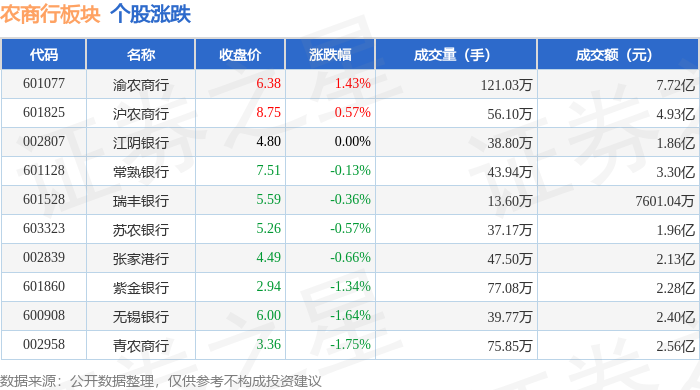
农商行板块9月1日涨0.17%,渝农商行领涨,主力资金净流入9858.03万元
Zheng Xing Xing Ye Ri Bao· 2025-09-01 08:46
Market Performance - On September 1, the rural commercial bank sector rose by 0.17% compared to the previous trading day, with Yunnan Rural Commercial Bank leading the gains [1] - The Shanghai Composite Index closed at 3875.53, up 0.46%, while the Shenzhen Component Index closed at 12828.95, up 1.05% [1] Individual Stock Performance - Yunnan Rural Commercial Bank (601077) closed at 6.38, with a gain of 1.43% and a trading volume of 1.21 million shares, totaling a transaction value of 772 million [1] - Shanghai Rural Commercial Bank (601825) closed at 8.75, up 0.57%, with a trading volume of 561,000 shares and a transaction value of 493 million [1] - Jiangyin Bank (002807) remained unchanged at 4.80, with a trading volume of 1.39 million shares and a transaction value of 186 million [1] - Other banks such as Changshu Bank (601128), Ruifeng Bank (601528), and Zijin Bank (601860) experienced slight declines [1] Capital Flow Analysis - The rural commercial bank sector saw a net inflow of 98.58 million from institutional investors, while retail investors experienced a net outflow of 119 million [1] - Shanghai Rural Commercial Bank had a net inflow of 60.40 million from institutional investors, but a net outflow of 66.99 million from retail investors [2] - Qingnong Commercial Bank (002958) reported a net inflow of 32.51 million from institutional investors, with a net outflow of 18.25 million from retail investors [2]
四大证券报精华摘要:9月1日
Xin Hua Cai Jing· 2025-09-01 00:01
Group 1: Technology Sector Performance - The technology sector in the A-share market has shown significant performance, with Industrial Fulian's market value surpassing 1 trillion yuan and the communication and electronics industries experiencing a monthly increase of over 20% [1] - Many technology companies reported impressive earnings in their semi-annual reports, reflecting the effectiveness of increased R&D investments [1][5] - The overall trend indicates that Chinese technology enterprises are solidifying their technological foundations, contributing to the economic transformation [1] Group 2: Overall Market Recovery - As of August 31, 5424 A-share companies disclosed their semi-annual reports, achieving a total revenue of approximately 34.9 trillion yuan, a year-on-year increase of 0.03% [2] - The net profit attributable to shareholders reached about 2.99 trillion yuan, marking a year-on-year growth of 2.45% [2] - A significant portion of companies, 2908, reported a year-on-year increase in net profit, indicating a recovery across various industries, including agriculture, steel, and electronics [2][3] Group 3: Mid-Year Dividend Trends - A record high of 810 companies announced mid-year cash dividend plans, with a total proposed payout of 6428.08 billion yuan, reflecting a year-on-year increase of 9.56% in dividend amounts [6] - Among companies with dividends exceeding 1 billion yuan, state-owned enterprises account for about 30% [6] - The banking sector has also seen a notable increase in mid-year dividends, with 17 banks disclosing dividend plans, including seven banks that are implementing dividends for the first time since their listings [7] Group 4: R&D Investment - A-share companies reported over 810 billion yuan in R&D investments in the first half of 2025, with several industries, including software development and biopharmaceuticals, showing high R&D intensity [12] - Six companies, including BYD and China Mobile, each invested over 10 billion yuan in R&D [12] Group 5: Mergers and Acquisitions Trends - The A-share market is witnessing a shift in mergers and acquisitions from "buying scale" to "acquiring technology," with a notable increase in transactions involving core technologies [11] - In 2025, there have been 21 merger and acquisition projects focused on core technologies, totaling 2.569 billion yuan [11]
“红包群”扩大!超20家上市银行预告中期分红,7位新成员加入
券商中国· 2025-08-31 07:39
Core Viewpoint - The article highlights the significant increase in mid-term dividends announced by various A-share listed banks, reflecting their commitment to returning value to investors amid a strong performance in the banking sector in the first half of the year [1][2]. Summary by Sections Mid-term Dividends Announcement - As of August 30, at least 21 A-share listed banks have announced plans for mid-term dividends for 2025, with 17 banks disclosing specific dividend proposals [2]. - Notably, seven banks, including China Merchants Bank and Changshu Bank, are implementing mid-term dividends for the first time since their listings [2][4]. Dividend Details - The total cash dividend amount from the major state-owned banks (ICBC, ABC, CCB, BOC, CMB, and PSBC) is 204.657 billion yuan [2]. - ICBC leads with a dividend of 1.414 yuan per 10 shares, totaling 50.396 billion yuan [2]. - China Merchants Bank, known as the "King of Retail," has a dividend payout ratio of 35%, amounting to 26.226 billion yuan [2][5]. - Other banks like CITIC Bank and Ping An Bank have also confirmed their mid-term dividends, with CITIC Bank's total reaching 10.46 billion yuan and a payout ratio of 30.7% [2]. Implications of Mid-term Dividends - The implementation of mid-term dividends is seen as a response to the new "National Nine Articles" and related requirements from the China Securities Regulatory Commission, aimed at enhancing investor confidence and stabilizing stock prices [5]. - Experts emphasize that while increasing the frequency of dividends is beneficial, the focus should be on maintaining a balance between short-term payouts and long-term growth [5]. Market Outlook - Analysts from CITIC Securities note that the banking sector is experiencing a gradual improvement in performance, with expectations for continued positive trends in subsequent quarters [6]. - The sector is undergoing a net asset revaluation process, and while there is potential for recovery, the market may experience volatility without sustained inflows of investment funds [6].

上市银行探路转型新增长极:扩资产规模 增非息收入
Zhong Guo Jing Ying Bao· 2025-08-29 19:36
Core Viewpoint - The 2025 A-share banking mid-year report reveals significant profit differentiation among banks, with some city commercial banks achieving double-digit profit growth while others face negative growth due to narrowing interest margins and market volatility [1] Group 1: Profit Growth of City Commercial Banks - City commercial banks have emerged as the main contributors to profit growth among listed banks in the first half of 2025, with Hangzhou Bank reporting a net profit of 11.662 billion yuan, a year-on-year increase of 16.66% [2] - Factors contributing to the rapid profit growth of city commercial banks include stable asset scale growth, continuous optimization of asset-liability structure, and a recovery in fee and commission income driven by low base and wealth management growth [2][3] - Other city commercial banks such as Jiangyin Bank, Qilu Bank, and Qingdao Bank reported net profit growth rates of 16.63%, 16.48%, and 16.05% respectively [2] Group 2: Challenges Faced by Some Banks - In contrast, some banks like Guiyang Bank experienced negative profit growth, with a net profit of 2.474 billion yuan, a decrease of 7.20% year-on-year, attributed to declining interest income and weaker bond market performance [4] - The differentiation in profit performance among banks is largely due to variations in customer base, financing capabilities, risk preferences, and asset quality [4] Group 3: Interest Income and Margin Trends - The net interest margin for commercial banks narrowed to 1.42% in the first half of 2025, reflecting ongoing pressure on interest margins [7] - Strategies to manage interest margins include increasing the proportion of low-cost deposits and optimizing asset-liability management to improve net interest income [8][9] Group 4: Non-Interest Income and Business Diversification - Expanding non-interest income is seen as a crucial strategy for banks to mitigate the impact of declining interest margins, with a focus on enhancing middle business services such as custody, agency sales, and settlement [9] - Currently, non-interest income accounts for less than 30% of major listed banks in China, which is significantly lower than that of large international banks [9]