幻方量化

Search documents
财经早报:美国白宫宣布对特定半导体等加征25%关税,美国将暂停对75个国家的所有签证丨2026年1月14日
Xin Lang Cai Jing· 2026-01-14 23:44
Group 1 - The US White House announced a 25% import tariff on certain semiconductors and semiconductor manufacturing equipment starting from January 15 [2][51] - The Dutch court is hearing a case involving Nexperia and its Chinese parent company, Wingtech Technology, regarding control disputes that have led to a global shortage of automotive chips [3][52][53] - The Chinese automotive industry reported a production and sales volume of 34.53 million and 34.40 million vehicles in 2025, maintaining its position as the world's largest for 17 consecutive years [13][63] Group 2 - Goldman Sachs has raised its GDP growth forecasts for China to 4.8% and 4.7% for 2026 and 2027, respectively, marking the largest upward revision since 2019 [9][58][59] - The China Securities Regulatory Commission approved an increase in the minimum margin ratio for financing transactions on the Shanghai, Shenzhen, and Beijing stock exchanges from 80% to 100% [6][56] - Ctrip Group is under investigation for alleged monopolistic practices, with its stock dropping 6.49% to HKD 569.5 per share following the announcement [17][66][67] Group 3 - The Ministry of Finance and other departments announced an extension of personal income tax refunds for home purchases from January 1, 2026, to December 31, 2027 [7][56] - Several real estate companies are set to meet with relevant authorities to discuss changes in financing conditions amid ongoing policy support [8][57] - UBS has identified the human-robot interaction technology as a bottleneck in the development of humanoid robots, indicating potential growth areas in the surgical robot market [22][72] Group 4 - The Chinese automotive export market showed resilience, with exports exceeding 7 million vehicles, marking a new milestone [14][63] - The regulatory body in Zhejiang has launched an investigation into Sunflower Health Technology's restructuring plan for misleading statements [20][70] - The private equity firm Fantasia Quantitative achieved a return of 56.55% in 2025, ranking fifth among large private equity firms [21][71]



梁文锋旗下幻方量化,去年收益率56.6%,规模已超700亿元
Mei Ri Jing Ji Xin Wen· 2026-01-14 23:20
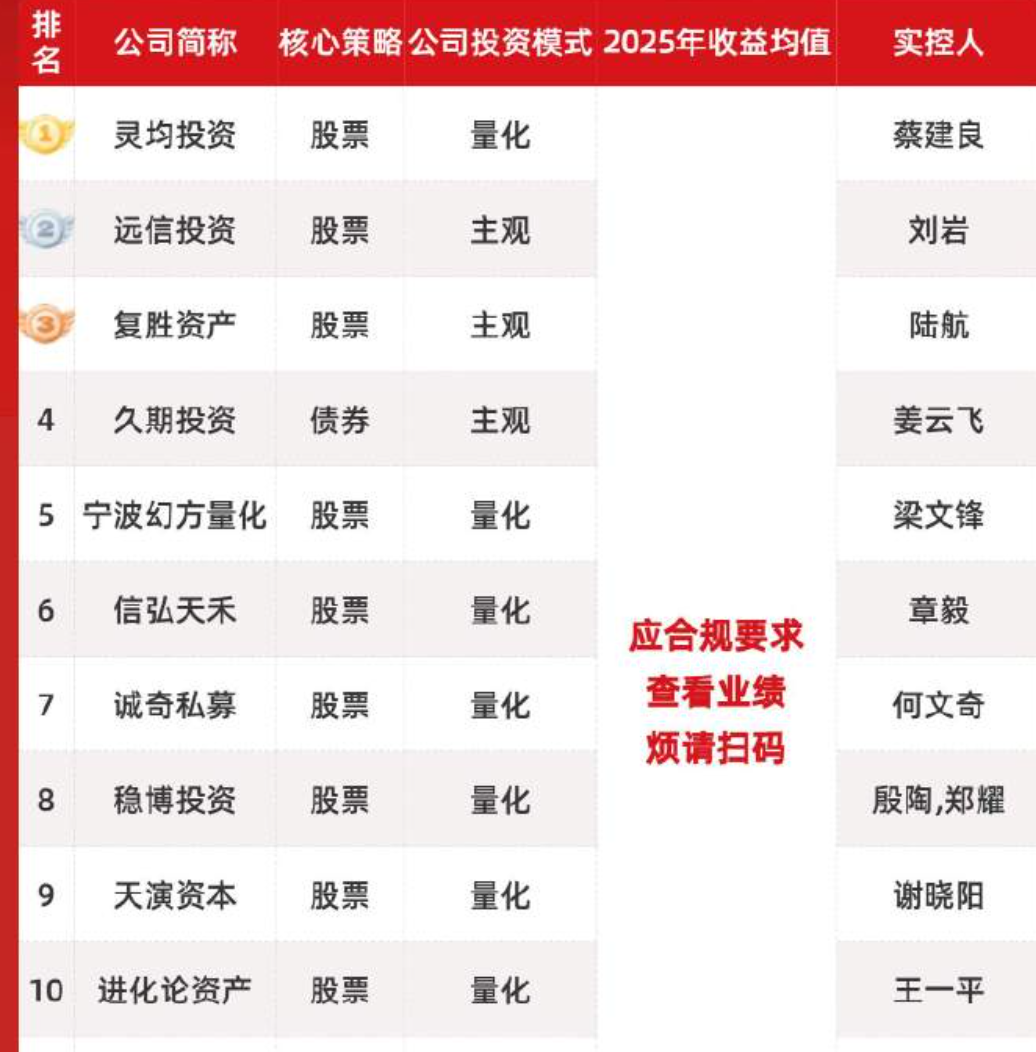
Core Insights - The A-share market in 2025 has shown significant performance, with the top three private equity firms achieving annual returns exceeding 70% [1][4][10] - Quantitative private equity firms have outperformed subjective strategies, with an average return of 37.61% compared to 25.80% for subjective firms [4][11] Performance Summary - The top three private equity firms in 2025 are Lingjun Investment with a return of 73.51%, Yuanshin Investment at 72.05%, and Fusheng Asset at 70.57% [1][4] - The average return for 75 private equity firms with reported performance was 32.77%, with 74 firms achieving positive returns, representing a positive return rate of 98.67% [4][10] - Among the 45 quantitative private equity firms, all achieved positive returns, while 22 out of 23 subjective firms also reported positive returns [4][11] Notable Firms - Huanfang Quantitative, led by Liang Wenfeng, achieved a return of 56.55%, ranking fifth among firms with over 100 billion in assets [1][5] - Huanfang Quantitative has shown strong long-term performance, with a three-year average return of 85.15% and a five-year average return of 114.35% [5][6] Market Dynamics - The bull market that began on September 24, 2024, has significantly enhanced the profitability of private equity firms, particularly in the context of a hot A-share market in 2025 [4][10] - The performance disparity among private equity firms is notable, with some firms like Lin Yuan Investment reporting a loss of 6.46%, making it the only firm with negative performance among the 75 firms [10][11] Strategy Analysis - Quantitative strategies have shown a clear advantage due to their adaptability to market conditions, leveraging AI technology for rapid trading and risk management [11] - Subjective strategies face challenges due to slower decision-making processes and limited coverage, which hinder their performance in fast-moving markets [11]
梁文锋旗下幻方量化,去年收益率56.6%,规模已超700亿元!林园旗下产品业绩亏损,但斌收益跑输大盘
Mei Ri Jing Ji Xin Wen· 2026-01-14 15:01
Core Insights - The A-share market in 2025 has shown strong performance, with the top three private equity firms achieving annual returns exceeding 70% [1][3] - Quantitative private equity firms have significantly outperformed subjective strategies, with an average return of 37.61% compared to 25.80% for subjective firms [4][8] Group 1: Performance of Private Equity Firms - Lingjun Investment topped the list with a return of 73.51%, followed by Yuanshin Investment at 72.05% and Fusheng Asset at 70.57% [1][4] - The average return for 75 billion private equity firms was 32.77%, with 74 firms achieving positive returns, representing over 98% [3][4] - Among the quantitative private equity firms, Huanfang Quantitative achieved a return of 56.55%, ranking fifth overall [1][4] Group 2: Strategy Analysis - Quantitative strategies have shown a clear advantage, with all 45 billion quantitative private equity firms achieving positive returns [4][8] - In contrast, 23 subjective private equity firms had an average return of 25.80%, with only 4 firms exceeding 50% returns [4][7] - The performance disparity is attributed to the adaptability of quantitative strategies to market conditions, allowing for rapid adjustments and efficient short-term trading [8][9] Group 3: Notable Firms and Trends - Huanfang Quantitative, founded by Liang Wenfeng, has rapidly grown to manage over 700 billion, leveraging AI technology as a core competitive advantage [5][6] - The market environment in 2025, characterized by fast-paced rotations and active small-cap stocks, favored quantitative strategies [8][9] - Some notable firms, such as Lin Yuan Investment, reported losses, highlighting the challenges faced by subjective strategies in a volatile market [7][8]
梁文锋旗下幻方量化,去年收益率56.6%
YOUNG财经 漾财经· 2026-01-14 13:08
Core Viewpoint - The article highlights the impressive performance of Huanfang Quantitative, which achieved a return rate of 56.6% in 2025, ranking second among Chinese quantitative private equity firms with over 10 billion yuan in assets under management [2] Group 1: Company Overview - Huanfang Quantitative is one of the most well-known quantitative private equity giants in China, founded by Liang Wenfeng in 2008 while studying information and communication engineering at Zhejiang University [2] - The company has a management scale that has exceeded 70 billion yuan [2] - Huanfang Quantitative's management scale surpassed 10 billion yuan in 2019 and once exceeded 100 billion yuan in 2021 [2] Group 2: Performance Metrics - In 2025, Huanfang Quantitative achieved an average return of 56.55%, placing it second in the performance rankings of quantitative private equity firms in China [2] - The top-ranked firm, Lingjun Investment, achieved a return of 73.51% [2]
梁文锋旗下幻方量化去年收益率56.6%,管理规模已超700亿元
Feng Huang Wang· 2026-01-14 12:50
Group 1 - The core viewpoint of the article highlights that Huansheng Quantitative achieved an average return of 56.55% in 2025, ranking second among quantitative private equity firms in China with over 10 billion yuan in management scale, only behind Lingjun Investment, which topped the list with an average return of 73.51% [1] - Huansheng Quantitative's management scale has exceeded 70 billion yuan [1] - The company was founded in 2008 by Liang Wenfeng while studying information and communication engineering at Zhejiang University, and is recognized as one of the most well-known quantitative private equity giants in China [1] Group 2 - In 2019, Huansheng Quantitative's management scale surpassed 10 billion yuan, and it briefly exceeded 100 billion yuan in 2021 [1]
梁文锋旗下幻方量化,去年收益率56.6%
财联社· 2026-01-14 12:43
Group 1 - The core viewpoint of the article highlights that Huafang Quantitative achieved an average return of 56.55% in 2025, ranking second among quantitative private equity firms in China with over 10 billion in management scale, only behind Lingjun Investment, which topped the list with a return of 73.51% [1] - Huafang Quantitative's management scale has exceeded 70 billion [1] - Founded by Liang Wenfeng in 2008 during his studies in Information and Communication Engineering at Zhejiang University, Huafang Quantitative is recognized as one of the most prominent quantitative private equity giants in China [1] - The firm broke the 10 billion management scale in 2019 and surpassed 100 billion in 2021 [1]
量化私募“清盘疑云”
华尔街见闻· 2026-01-14 10:40
以下文章来源于资事堂 ,作者资事堂 资事堂 . 华尔街见闻出品 作者崔峻阳 编辑袁畅 在私募行业,一家私募机构的创始人(或创始人团队)往往是整个组织的核心,支撑公司的发展和存续。 也因此,如果长期默契合作的核心团队突然"分家",往往很突然,很剧烈,引发强烈不确定性和外界关注。 在一年多前的私募行业里,S私募(化名,后同)的"拆伙"是最让人牵动心思的。 当时,这家百亿级的机构以一则人事变动公告,一段"和平分手"的解释,配合相对克制的语言叙事,迅速安抚了此次事件的冲击力,相关主体在公司的强力宣 慰下,也迅速回归平静。 但随着时间的推移,新的说法开始沉渣泛起,悄然流传…… 不可忽视的"提前清盘" S私募作为业内的一线私募机构,在许多场合都享有他们的名气和声誉。 但恰如所有上了规模的量化机构一样,这些机构从组织架构到内部分工,从策略到投资体系都处于"黑匣子",并没有太多讯息传来。 但它的核心"三人组"在2024年突然拆伙令人诧异,学历背景出众的创始人W悄然退出,但核心的Y和S仍然团队内继续管理,整个过程极为迅速,了无痕迹。 那么,该私募机构同时保留了很多产品又是什么意思?这期间还出现了创始人离场,又有什么关联么? 但 ...

梁文锋的幻方量化去年收益57%,跻身百亿级量化基金业绩榜第二!
21世纪经济报道· 2026-01-14 08:38
Core Viewpoint - The article highlights the impressive performance of Fantom Quantitative, which achieved an average return of 56.55% in 2025, ranking second among quantitative private equity firms in China, and emphasizes the financial support it provides to DeepSeek for AI model development [1][2]. Group 1: Company Performance - Fantom Quantitative's average return over the past three years is 85.15%, and over the past five years, it is 114.35% [1]. - The company currently manages over 700 billion yuan, maintaining its position in the top tier of China's private quantitative investment sector [1]. - Estimated revenue from management fees and performance commissions for the previous year could exceed 700 million USD, based on a 1% management fee and 20% performance commission [2]. Group 2: DeepSeek Development - DeepSeek, founded in July 2023, is focused on general artificial intelligence and is primarily funded by the research budget of Fantom Quantitative [2]. - The V4 model, an iteration of the V3 model set to be released around the Spring Festival in February, is reported to surpass current leading models in programming capabilities [3]. - DeepSeek's V3 model had a total training cost budget of 5.57 million USD [2]. Group 3: Industry Context - Competitors in the AI model space, such as Zhizhu and MiniMax, have reported significant R&D expenditures, with Zhizhu's cumulative investment reaching approximately 4.4 billion yuan and MiniMax's around 316 million yuan [3]. - The Italian antitrust authority concluded an investigation into DeepSeek regarding user warnings about potential misinformation, indicating regulatory scrutiny in the AI sector [4].
梁文锋旗下幻方量化去年收益率56.6%,位列百亿级量化基金业绩榜第二
Xin Lang Cai Jing· 2026-01-14 06:06
Group 1: Company Performance - The average return of Huansheng Quantitative for 2025 is projected to be 56.55%, ranking second among quantitative private equity firms in China with over 10 billion yuan in management scale, only behind Lingjun Investment at 73.51% [1][4] - Huansheng Quantitative has a management scale exceeding 70 billion yuan, with an average return of 85.15% over the past three years and 114.35% over the past five years [1][4] - The strong performance of Huansheng Quantitative has provided substantial research and development funding for DeepSeek, a company under the leadership of Liang Wenfeng [1][4] Group 2: Company Background and AI Development - Huansheng Quantitative, founded by Liang Wenfeng in 2008 while studying at Zhejiang University, is one of the most well-known quantitative private equity giants in China, with a focus on mathematics, computation, research, and AI [1][4] - The company broke the 10 billion yuan management scale in 2019 and surpassed 100 billion yuan in 2021 [1][4] - Huansheng Quantitative has been investing in AI since 2016, with its first stock position generated by deep learning algorithms going live in October 2016, and by the end of 2017, nearly all quantitative strategies were using AI models [1][4] Group 3: DeepSeek and AI Innovations - In April 2023, Huansheng Quantitative announced the establishment of an independent research organization, DeepSeek, to explore the essence of AGI, focusing on serving the common interests of humanity through AI technology [2][5] - DeepSeek's R1 model, released in January 2025, gained significant media attention and is noted for its industry-leading capabilities and cost advantages, with training costs an order of magnitude lower than competitors [2][6] - DeepSeek is set to release its next flagship AI model, DeepSeek V4, in February, which is expected to have strong programming capabilities and significantly impact the current AI competitive landscape [2][6] Group 4: Research Contributions - On January 12, DeepSeek published a new paper titled "Conditional Memory via Scalable Lookup: A New Axis of Sparsity for Large Language Models," co-authored with Peking University, featuring Liang Wenfeng as a co-author [3][6] - DeepSeek also open-sourced a related memory module named Engram on the same day [3][6]
DeepSeek母公司去年进账50亿,够烧2380个R1
猿大侠· 2026-01-14 04:11
Core Viewpoint - DeepSeek remains focused on AGI research without pursuing external financing or commercialization, supported by substantial revenue from its parent company, Huanfang Quantitative [1][2][36]. Group 1: Financial Performance of Huanfang Quantitative - Huanfang Quantitative earned 5 billion RMB last year, with nearly all its funds projected to yield over 55% returns by 2025 [4][6]. - The average return for Chinese quantitative funds was 30.5%, significantly outperforming global competitors [7]. - Huanfang Quantitative's average return of 56.6% ranks it second among large quantitative funds, only behind Lingjun Investment, which achieved 70% [8]. - With over 70 billion RMB in assets under management, the impressive returns translate to substantial profits for the company [9]. - Estimated earnings from management fees and performance bonuses could exceed 700 million USD (approximately 5 billion RMB) for Huanfang Quantitative in the past year [10][12]. Group 2: DeepSeek's Research and Development - DeepSeek's V3 training cost only 5.576 million USD, while R1 training cost 294,000 USD, indicating efficient use of funds [15][17]. - Based on last year's revenue, Huanfang Quantitative could fund the production of 125 V3 models and 2,380 R1 models [16][18]. - DeepSeek has maintained a strong research output, continuously publishing high-level papers and recently open-sourcing a memory module [3][35]. Group 3: Strategic Positioning and Market Dynamics - Unlike other major players like OpenAI, DeepSeek has not engaged in aggressive monetization strategies, focusing instead on pure AGI research [26][27]. - DeepSeek's lack of external financing allows it to operate without the pressure of short-term returns, fostering a pure research environment [40][52]. - The company has a unique position as the only AI lab that has not accepted external funding and is not affiliated with any major tech firms [36]. Group 4: Talent Retention and Team Stability - DeepSeek has experienced minimal talent turnover, with many core contributors remaining with the team, indicating a stable and committed workforce [53][58]. - The financial backing from Huanfang Quantitative enables DeepSeek to offer competitive salaries and resources, attracting idealistic researchers dedicated to AGI [58]. Group 5: Market Impact and Investment Opportunities - DeepSeek's technical papers have become valuable resources for investors, with many using them as investment guides [62]. - The release of new models often leads to stock price surges for companies adapting their hardware to DeepSeek's specifications, demonstrating the market's responsiveness to its research [71][72].