
银行

Search documents
国家外汇管理局:2025年12月银行结汇22446亿元 售汇15382亿元人民币
智通财经网· 2026-01-15 08:44
按美元计值,2025年12月,银行代客涉外收入8244亿美元,对外付款7109亿美元。2025年1-12月,银行 代客累计涉外收入79725亿美元,累计对外付款76704亿美元。 2025年12月,银行代客涉外收入58197亿元人民币,对外付款50186亿元人民币。2025年1-12月,银行代 客累计涉外收入569405亿元人民币,累计对外付款547906亿元人民币。 本文编选自"国家外汇管理局"官网,智通财经编辑:刘家殷。 智通财经APP获悉,国家外汇管理局统计数据显示,2025年12月,银行结汇22446亿元人民币,售汇 15382亿元人民币。2025年1-12月,银行累计结汇185227亿元人民币,累计售汇171314亿元人民币。按 美元计值,2025年12月,银行结汇3180亿美元,售汇2179亿美元。2025年1-12月,银行累计结汇25949 亿美元,累计售汇23983亿美元。 ...
金融业务创新 服务实体经济“最优解”
Jin Rong Shi Bao· 2026-01-15 01:31
近年来,金融服务实体经济取得突出成就。"十四五"期间,银行业保险业通过信贷、债券、股权等 多种方式,为实体经济提供新增资金170万亿元。与此同时,金融系统持续优化资金供给结构,将更多 金融资源精准配置到经济社会发展的重点领域和薄弱环节。 在这一过程中,银行业主动求变、深化创新,从数字化转型赋能普惠金融,到产品创新支撑科技创 新,再到生态重构服务产业升级,一系列破解服务瓶颈、精准对接需求的业务创新接连落地。 2025年12月召开的中央经济工作会议明确提出,引导金融机构加力支持扩大内需、科技创新、中小 微企业等重点领域。这为金融服务实体经济指明了方向。 在传统金融服务的模式下,轻资产科创企业因缺乏抵押物而融资困难,小微企业因信息不对称存在 融资贵、融资慢问题,乡村地区因服务半径大导致金融可得性不足。站在"十五五"开局的新起点上,面 对新形势新要求,银行业必须突破传统信贷思维的束缚,将创新贯穿于产品设计、服务模式、风险管控 全链条。 从实践来看,无论是国有大行的战略引领还是中小银行的特色业务深耕,创新已成为银行业提升服 务质效、助力经济转型的核心动能。接下来,业务创新成为破解实体经济融资痛点的关键抓手,更是银 行业 ...
银行“开门红”变奏:揽储氛围有点“冷”,财富业务有些“热”
Mei Ri Jing Ji Xin Wen· 2026-01-14 22:46
Core Viewpoint - The banking industry is shifting its focus from promoting deposit products to recommending wealth management products due to the ongoing pressure on net interest margins [1] Group 1: Industry Trends - Traditionally, banks would engage in "New Year Red" marketing campaigns with abundant gifts and promotions for deposit products [1] - Recent observations indicate that bank staff are no longer prioritizing deposits, instead suggesting clients diversify into wealth management products [1] - The areas that used to be filled with promotional gifts like rice and cooking oil are now noticeably empty, reflecting a significant change in strategy [1]
科技部:推动银行、保险公司等创新金融产品及服务模式
Sou Hu Cai Jing· 2026-01-14 08:23
在完善科技金融政策举措方面,推动银行、保险公司和创投机构创新金融产品及服务模式,加强对国家 重大科技任务和重点科技领域的金融支持。制定推动科技保险发展的政策,推广实施"创新积分制 2.0",持续提高科技型中小企业融资获得感。 在深化科技金融创新实践方面,央地协同,加强三大国际科技创新中心等重点地区综合金融服务,鼓励 各地开展科技金融政策先行先试,共同做好科技金融大文章。 在强化科金协同方面,发挥好科技金融统筹推进机制作用,强化政策落实、制定增量政策、开展总结评 估。建立健全重点科技领域融资对接机制。 1月14日,据新华社,科技部党组书记、部长阴和俊表示,2026年,我们将与金融管理部门和金融机构 紧密合作,持续加强对国家重大科技任务和科技型中小企业的金融服务。 ...
#马年纪念币预约#登上微博热搜第一!实测:多家银行纪念币、纪念钞预约均“秒没”
Xin Lang Cai Jing· 2026-01-13 14:54
Core Viewpoint - The reservation for the 2026 commemorative coins and banknotes began at 22:00 and 22:30 on January 13, leading to significant online interest and discussions on social media platforms, particularly Weibo, where topics related to the "Horse Year Commemorative Coin" quickly became trending [1][4]. Group 1 - The reservation window for the Horse Year commemorative coin was highly sought after, with over 2,917,180 reservations attempted [2][5]. - The topic "Horse Year Commemorative Coin Not Available" reached over 1,057,105 discussions, indicating a high level of frustration among potential buyers [2][5]. - Users reported issues with the reservation process, stating that the system showed "loading" and that by the time they accessed the reservation, the available quantities had already been depleted [3][6]. Group 2 - Multiple banks experienced a rapid sell-out of the commemorative coins and banknotes, with reports of them being "gone in seconds" during the reservation period [3][6]. - The trending topics on Weibo included hashtags such as 抢马币 (Grab Horse Coin) and 马币 (Horse Coin), reflecting the public's eagerness and the competitive nature of the reservation process [1][4].



瑞银大中华金融行业研究主管颜湄之:银行板块将迎基本面拐点,红利属性仍具防御价值
Xin Lang Cai Jing· 2026-01-13 10:25
Core Viewpoint - The banking sector is expected to perform steadily in 2025, driven by both funding and fundamental factors, with a turning point anticipated in 2026 [1][2]. Funding Factors - The banking sector, particularly Hong Kong banks, is expected to show strong performance in the first half of 2025, with high dividend yields attracting significant capital [1][4]. - A substantial number of Hong Kong bank stocks maintain dividend yields above 5%, making them appealing to investors [1][4]. - Insurance funds are identified as key buyers of bank stocks, with projections indicating over 600 billion yuan of insurance capital entering the market annually over the next two years, providing ongoing support for high-dividend sectors [1][4]. Fundamental Factors - 2025 is viewed as a "bottoming" year for the banking industry, with some large banks already reporting year-on-year revenue growth in the first three quarters, slightly exceeding market expectations [2][5]. - The positive performance of trading income and bond investment returns is contributing to revenue support for large banks [2][5]. - A forecast indicates that most banks will achieve year-on-year revenue growth in 2026, marking a shift from the previous five years of declining revenues [2][5]. - The pressure from narrowing interest margins is significantly easing, and state-owned banks are expected to continue capital injection arrangements, which may dilute earnings per share and dividends in the short term but will enhance capital strength and sustainability in the long run [6]. Market Dynamics - Bank stocks are characterized by their dividend and defensive attributes, often providing relative yield advantages in uncertain geopolitical or macroeconomic environments [6]. - However, there is a caution that bank stocks may underperform the market in the first half of the year due to shifts in market style [3][6].
20 bank stocks expected to rise as much as 17% during 2026
MarketWatch· 2026-01-12 13:43
Core Viewpoint - Regional-bank stocks are currently trading at lower valuations compared to the largest U.S. banks, indicating a potential disparity in market perception and valuation metrics within the banking sector [1] Group 1 - Regional banks are experiencing lower stock valuations, which may reflect investor concerns about their stability and growth prospects compared to larger banks [1] - The valuation gap suggests that regional banks may be undervalued, presenting potential investment opportunities for discerning investors [1] - The trend in stock valuations could impact the competitive landscape of the banking industry, influencing mergers and acquisitions among regional banks [1]

银行“开门红”,忙着卖保险
Xin Lang Cai Jing· 2026-01-07 08:56
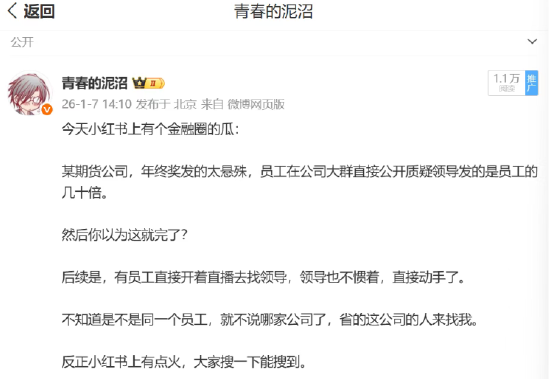
来源:投基摸狗 | く返回 | 青春的泥沼 | | --- | --- | | 公开 | | | | 1.1 万 青春的泥沼 Y = ) 同学 | | | 26-1-7 14:10 发布于 北京 来自 微博网页版 | | | 今天小红书上有个金融圈的瓜: | | | 某期货公司,年终奖发的太晨殊,员工在公司大群直接公开质疑领导发的是员工的 | | | 几十倍。 | | | 然后你以为这就完了? | | | 后续是,有员工直接开着直播去找领导,领导也不惯着,直接动手了。 | | | 不知道具不具同一个品工 新不说哪家公司了 给的过公司的人求找我 | 我跟大家说:元旦那几天基金圈的人也没闲着,1月4日是周日,#a股# 不开盘,按理来说基金公司的人 不用上班。 结果你也知道,发生了委内瑞拉这事#委美冲突# 一堆基金圈的人,当天晚上开始加班,准备黄金或是有色矿业,甚至石油相关的基金材料,结果股市这 又搞出一个脑机接口的概念。 以至于今天网上很火的某期货公司这个瓜,股民基民最好的评论是:领导打员工,导致"脑震荡"——利 好脑机接口概念股。这评论把我笑死。 还有基金公司的人,元旦假期,都没敢长途旅游,都是短途旅游休息一下 ...
国办:金融监管总局负责指导开展低温雨雪冰冻灾害相关保险工作
Bei Jing Shang Bao· 2026-01-05 11:33
Core Viewpoint - The State Council has issued an emergency plan for low-temperature rain, snow, and ice disasters, emphasizing the role of financial regulatory authorities in guiding insurance companies to manage disaster-related claims and services effectively [1] Group 1: Insurance Sector - The Financial Regulatory Authority is responsible for guiding the insurance sector in disaster-related insurance work, focusing on catastrophe insurance to enhance the disaster insurance protection system [1] - Insurance companies are urged to improve claims and payment services, ensuring that compensation is comprehensive, prompt, and reasonable [1] - A pre-compensation mechanism and claims process are to be established to facilitate efficient disaster response [1] Group 2: Banking Sector - Banks are encouraged to increase credit support for disaster-affected areas, enhancing financial assistance during emergencies [1] Group 3: Disaster Preparedness and Public Awareness - The National Disaster Reduction and Relief Committee will strengthen public education and training on disaster prevention and response, utilizing various media to promote relevant laws, emergency plans, and insurance knowledge [1] - Training for responsible personnel and rescue workers will be enhanced to improve societal awareness of disaster prevention and self-rescue capabilities [1]
看不见的“斩杀线”:600家银行退场背后
Xin Lang Cai Jing· 2026-01-05 08:24
Core Insights - The invisible "kill line" is increasingly dragging more banks into historical obscurity, with 312 out of 3529 evaluated banks classified as high-risk, representing only 2.1% of the total banking assets as of mid-2025 [1][12] - The overall operation of banking institutions in China is stable, with financial risks being generally controllable, largely due to continuous reforms over the past few years [2][13] - The banking industry is facing multiple challenges, including a low interest rate environment, insufficient effective demand, real estate risks, and local debt issues, marking the end of the "easy profit" era [3][14] Asset Quality Challenges - As of Q3 2025, the non-performing loan (NPL) ratio for commercial banks slightly increased to 1.52%, with the proportion of special mention loans rising to 2.20%, indicating structural risks [4][15] - Real estate risks are still being released, with one listed bank's real estate NPL ratio soaring to 21.32% in H1 2025, and some state-owned banks exceeding a 5% NPL ratio in real estate loans [4][15] - Retail credit risks are accumulating, with all six major state-owned banks experiencing rising personal housing loan NPL ratios, driven by slowing household income and fluctuating housing prices [4][16] Profitability Compression - The continuous narrowing of net interest margins is approaching a critical point for bank profitability, with the net interest margin at 1.42% as of Q3 2025, still at a historical low [5][17] - Business transformation efforts have not significantly altered the reality of a single income structure, with most small and medium-sized banks deriving over 80% of their net interest income [5][17] - The average interest rate for newly issued corporate loans dropped to around 3.1% in October 2025, complicating the balance between supporting the real economy and maintaining profitability [6][17] Digital Transformation Gap - Digital transformation has become a survival issue, with banks that fail to keep pace being rapidly eliminated by the "kill line" [8][18] - The six major banks have invested over 600 billion yuan in financial technology, while many small banks invest less than 100 million yuan annually, hindering their ability to upgrade infrastructure [8][19] - The gap in transformation quality is critical, with leading banks achieving large-scale application of innovative technologies, while most small banks remain at a basic level of digitalization [8][19] Industry Polarization - The trend of "capacity reduction" in the banking industry is becoming increasingly evident, with resource concentration trends favoring large banks [21][22] - As of H1 2025, the six major banks accounted for over 60% of new loans and over 55% of deposits, exacerbating the first-mover advantage [21][22] - Smaller banks are losing deposits significantly due to a lack of brand influence, while large banks dominate quality credit projects, forcing smaller banks into riskier areas [21][22]