宝洁公司

Search documents
Sue Nabi to Exit Coty and Be Succeeded by Markus Strobel
Yahoo Finance· 2025-12-22 13:01
Leadership Changes - Sue Nabi is stepping down as CEO of Coty, with Markus Strobel appointed as interim CEO and executive chairman of the board [1][3] - Strobel has a 33-year background at Procter & Gamble, where he held senior roles in beauty and grooming, including leading prestigious brands [2][3] Financial Implications - Shares of Coty closed down 3.5% to $3.15 following the announcement of leadership changes [2] - Strobel's annual base salary is set at $1.25 million, which will decrease to $1 million once he is no longer interim CEO, along with a one-time cash sign-on bonus of $940,000 [4] Executive Compensation - Nabi was the highest-paid beauty executive in the U.S. in 2023, with total compensation of $149.4 million [5] - Upon her departure, Nabi will receive approximately $1.74 million in cash and the vesting of about 2,083,333 restricted stock units [6] Strategic Challenges - Coty is facing significant challenges, including the impending loss of the Gucci license for fragrance and beauty in 2028, which currently contributes about 8% of Coty's sales and 11% of its profits [7]
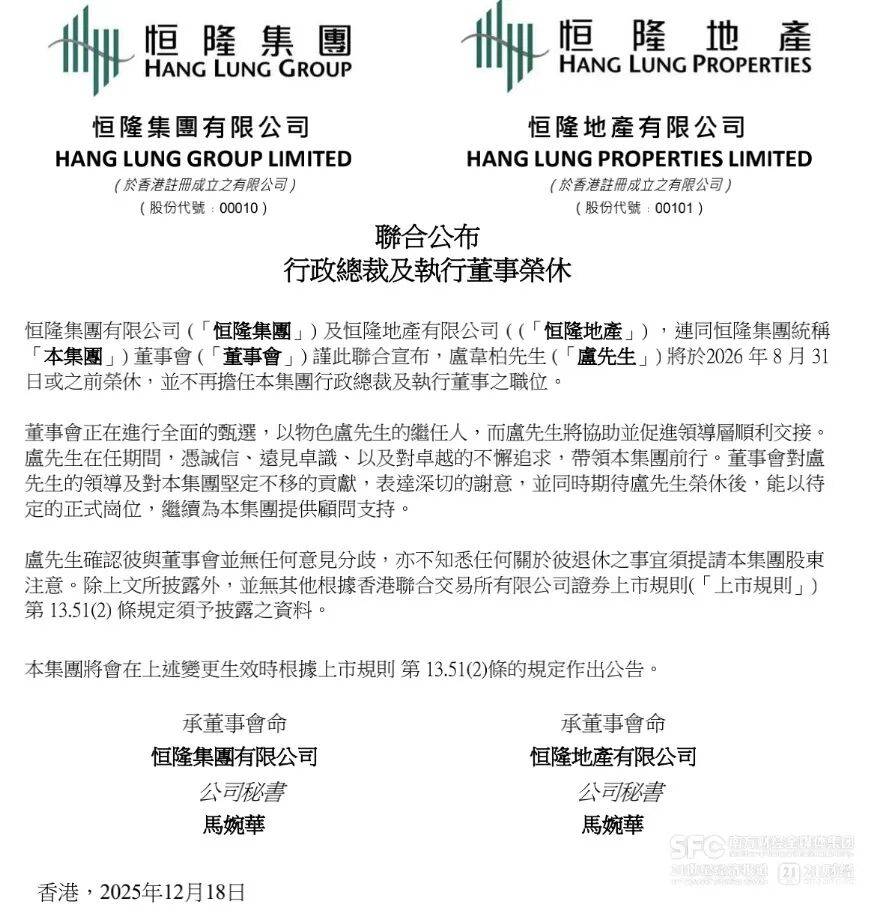
54岁香港地产豪门CEO官宣将退休,已执掌恒隆地产7年;毕业于香港大学,曾在宝洁、可口可乐、花旗集团任职
Sou Hu Cai Jing· 2025-12-22 12:46
Group 1 - The core announcement is that Weber Lu, the CEO of Hang Lung Group, will retire by August 31, 2026, and the board is currently conducting a search for his successor [1][6] - Lu has been with Hang Lung since May 2018 and previously held significant positions at Procter & Gamble, Coca-Cola, and Citigroup, where he served for 18 years [3] - Lu currently holds 1,128,542 shares of Hang Lung Properties, representing 0.02% of the total issued shares, and 460,000 shares of Hang Lung Group, representing 0.03% of the total issued shares [5] Group 2 - Under the leadership of Chen Wenbo, who took over as chairman in April 2024, the company is transitioning from "heavy asset expansion" to "stock optimization" as part of the "Hang Lung V.3" strategy [6] - Lu expressed gratitude for the support from the board and highlighted the achievements during his tenure, including strengthening the brand and launching significant strategies [6] - The company has faced challenges due to the adjustment in the Chinese real estate market and a decline in luxury consumption, with rental income from mainland properties dropping by 2% to HKD 3.199 billion in the first half of 2025 [7]



Coty taps Procter & Gamble vet as executive chair, interim CEO
Yahoo Finance· 2025-12-22 11:28
Core Insights - Procter & Gamble veteran Markus Strobel will join Coty as interim CEO and executive board chair on January 1, replacing Sue Nabi, who served for about five years [1][2]. Group 1: Leadership Changes - Strobel has over three decades of experience at P&G, managing a multibillion-dollar portfolio of more than 12 brands, including luxury fragrance labels [2]. - Strobel aims to leverage Coty's strong foundations to accelerate growth and enhance its position in both prestige and mass beauty sectors [2]. Group 2: Company Performance and Strategy - Under Sue Nabi's leadership, Coty focused on a turnaround strategy that included profit boosting, margin expansion, and cost-cutting measures, which involved laying off 700 employees [3]. - Coty has successfully reduced its financial net leverage to approximately 3x during Nabi's tenure [3]. Group 3: Recent Developments - Coty has sold its remaining 25%-plus interest in Wella, completing a long-term plan to divest from the hair care brand by the end of the year [4]. - The sale to investment firm KKR included an upfront cash consideration of $750 million, along with Coty receiving 45% of any future sale proceeds or IPO from Wella [5].


Who is Coty's new interim CEO?
Reuters· 2025-12-22 11:22
Core Insights - Coty has appointed Markus Strobel, a veteran from Procter & Gamble, as interim CEO, replacing Sue Nabi [1] - This leadership change is part of a broader trend among retailers and consumer goods companies refreshing their management teams [1] Company Summary - The appointment of Markus Strobel indicates a strategic shift for Coty as it seeks to enhance its leadership and operational effectiveness [1] - The transition comes amid a series of similar changes in the industry, suggesting a potential realignment in strategies among consumer goods firms [1]

为什么越来越多品牌开始故意做小众?
3 6 Ke· 2025-12-22 10:47
Core Insights - The article discusses the shift in consumer behavior and market dynamics, highlighting how niche brands are thriving in a saturated market by addressing specific consumer needs and preferences [5][25]. Group 1: Market Dynamics - The traditional approach of targeting mass markets is becoming less effective as competition intensifies and profit margins shrink in a saturated environment [6][7]. - Brands are increasingly focusing on niche markets that larger companies overlook, allowing them to establish stronger customer loyalty and pricing power [8][19]. Group 2: Consumer Behavior - Modern consumers, especially younger generations, prioritize self-expression and individuality over mere functionality in their purchasing decisions [12][14]. - Consumers are willing to pay a premium for niche products that reflect their values and identity, contrasting with the past when purchases were primarily driven by functional needs [12][14]. Group 3: Brand Strategy - Successful niche brands, such as Yeti and Lululemon, focus on creating high-quality products tailored to specific consumer needs, allowing them to command higher prices and maintain profitability [19][20]. - The marketing approach has shifted from trying to persuade everyone to recognizing and attracting the right audience, which enhances customer loyalty and reduces marketing costs [21][23]. Group 4: Industry Implications - The article suggests that the future of branding lies in defining differences rather than seeking commonalities, as the concept of a mass market is fragmenting into various interest-based communities [25][26]. - Brands that fail to adapt to this new reality risk becoming irrelevant and losing their competitive edge in an increasingly niche-focused market [25][26].

冒犯式营销:广告界的“流量渣女”为何屡教不改?
3 6 Ke· 2025-12-22 10:35
Core Viewpoint - The article discusses the rise of "toxic marketing" in the advertising industry, particularly targeting women, and questions whether such strategies are beneficial for brands or detrimental to their reputation [2] Group 1: Toxic Marketing Tactics - Tactic One: Using stereotypes to undermine women's value by portraying them as "inept" or "dependent" [3] - Tactic Two: Binding women's aesthetics to their life value, creating anxiety through a singular beauty standard [5] - Tactic Three: Using derogatory portrayals of women to generate controversy and attention [6] - Tactic Four: Objectifying women by reducing them to mere marketing tools, ignoring their individuality [9] Group 2: Reasons for the Proliferation of Toxic Ads - The repeated emergence of such ads is driven by short-term profit motives, low penalties for violations, and exploitable platform mechanisms [10] - Advertisers exploit the emotional response of anger, which leads to higher content sharing rates compared to positive emotions [10][11] - The ambiguity in legal definitions regarding gender discrimination allows companies to take risks with controversial ads [11] Group 3: Consequences of Toxic Marketing - The primary cost of toxic marketing is the long-term damage to brand reputation, as seen in the case of brands like 全棉时代 [12] - Women's awareness and activism against such marketing tactics are increasing, leading to a shift in consumer behavior [13] - The prevalence of offensive advertising is harming the overall health of the advertising industry, leading to a "race to the bottom" in creative quality [14] Group 4: Moving Towards Respectful Advertising - The advertising industry is urged to abandon toxic marketing strategies and embrace ethical practices that respect women as equal consumers [16] - Successful brands are beginning to shift their marketing strategies to reflect genuine respect for women, as evidenced by珀莱雅's campaign [16] - A healthy advertising ecosystem requires both industry accountability and consumer vigilance against offensive content [16] Group 5: Final Thoughts - The article emphasizes that advertising should focus on building value consensus rather than perpetuating gender conflict [17] - The ultimate goal is for advertising to recognize and celebrate women's independence and intelligence, fostering a win-win situation for brands and audiences [18]

Struggling Coty names P&G veteran as interim CEO as Nabi leaves
Reuters· 2025-12-22 07:23
Group 1 - Coty has appointed Markus Strobel, a veteran from Procter & Gamble, as chairman and interim CEO [1] - The company is facing challenges in its mass-market business and a significant decline in share price [1]

RLTY: A 9% Yield, An Attractive Discount, And Potential Recovery
Seeking Alpha· 2025-12-21 13:00
Group 1 - The primary goal of the "High Income DIY Portfolios" service is to provide high income with low risk and capital preservation for DIY investors [1] - The service offers seven portfolios, including three buy-and-hold, three rotational portfolios, and a conservative NPP strategy portfolio [1] - The portfolios are specifically designed for income investors, including retirees or near-retirees, aiming to create stable, long-term passive income with sustainable yields [1] Group 2 - The "Financially Free Investor" focuses on investing in dividend-growing stocks with a long-term horizon and employs a unique 3-basket investment approach [2] - This approach aims for 30% lower drawdowns, 6% current income, and market-beating growth over the long term [2] - The service includes a total of 10 model portfolios with varying income targets and risk levels, along with buy and sell alerts and live chat support [2]

Coty Completes Wella Divestment to Refocus on Fragrances
Yahoo Finance· 2025-12-21 12:40
Core Viewpoint - Coty Inc. has divested its remaining 25.8% stake in Wella for $750 million, aiming to focus on its fragrances segment amid declining demand for color cosmetics [1][2][3] Group 1: Financial Transactions - Coty Inc. sold its remaining 25.8% ownership in Wella to KKR for $750 million, while retaining 45% of any future sale or IPO proceeds after KKR's preferred return [1][2] - The company plans to use the cash from the transaction to pay off its debt [2] Group 2: Strategic Focus - The divestiture marks the end of a five-year program aimed at streamlining Coty's offerings and operations [3] - Coty is refocusing on its fragrances segment due to challenges in the mass beauty segment and declining demand for color cosmetics [2] Group 3: Market Position and Analyst Ratings - Citi has reduced Coty Inc.'s price target from $4.25 to $3.50 while maintaining a 'Neutral' rating, reflecting a revised outlook for the company [4] - Coty operates in the branded beauty products sector, with two main segments: Prestige and Consumer Beauty [4]
VDC vs. FSTA: Comparing Two Similar Consumer Staples ETFs
The Motley Fool· 2025-12-21 03:05
Core Insights - The Vanguard Consumer Staples ETF (VDC) has a larger asset base and a longer track record compared to the Fidelity MSCI Consumer Staples Index ETF (FSTA), making it a more established option for investors [1][10]. Cost & Size - FSTA has an expense ratio of 0.08%, while VDC's is slightly higher at 0.09%, indicating that FSTA is marginally more affordable [3][4]. - As of the latest data, FSTA manages $1.3 billion in assets under management (AUM), whereas VDC has $7.4 billion in AUM, highlighting VDC's significant size advantage [3][10]. Performance & Risk - Over the past year, FSTA has returned -2.7% and VDC has returned -2.4%, showing that VDC has performed slightly better [3][15]. - The maximum drawdown over five years for FSTA is -17.08%, while VDC's is -16.54%, indicating that VDC has experienced less volatility [5]. Portfolio Composition - VDC holds 107 stocks primarily focused on consumer defensive companies, with top holdings including Walmart, Costco, and Procter & Gamble [6]. - FSTA has a similar focus, with 98% of its holdings in consumer defensive stocks and also includes Walmart, Costco, and Procter & Gamble among its top holdings [7]. Historical Performance - VDC has been operational for nearly 22 years, while FSTA was launched in 2013, giving VDC a historical performance advantage [10]. - Since FSTA's inception, it has achieved a compound annual growth rate (CAGR) of 8.5%, while VDC has a CAGR of 8.7%, indicating comparable long-term performance [15].