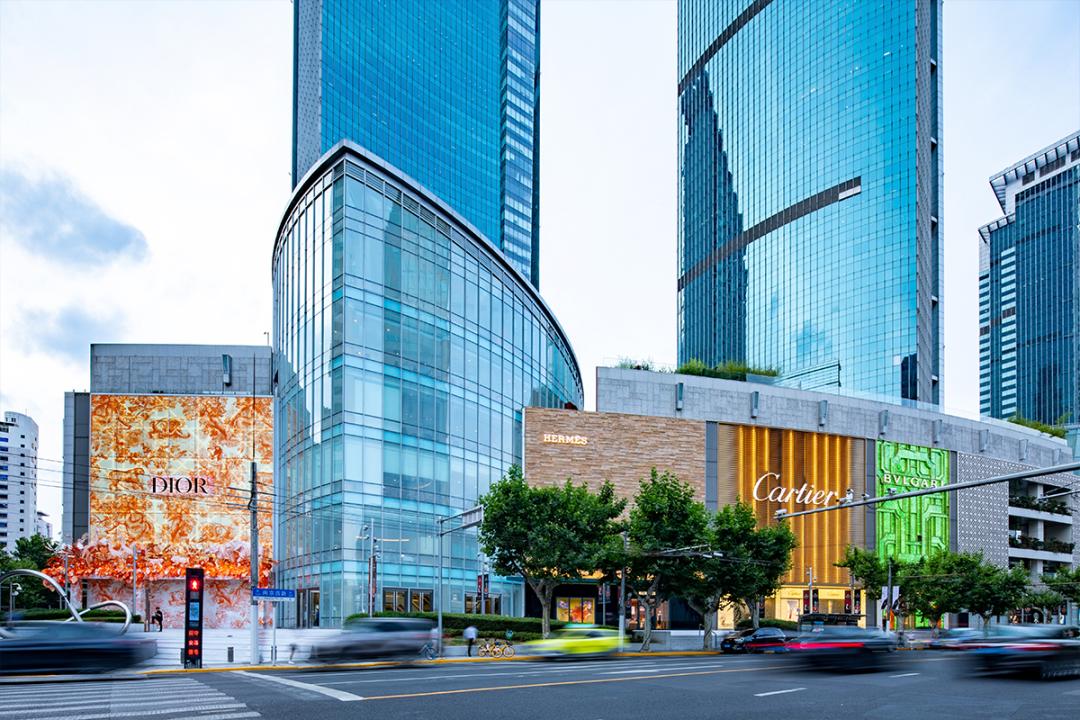
上海恒隆广场

Search documents
上海恒隆广场做对了什么?2025年商场收入和租户销售额逆势双增长
Sou Hu Cai Jing· 2026-02-14 05:12
Core Insights - Shanghai Hang Lung Plaza has demonstrated resilience in the luxury retail market, achieving a 1% increase in revenue and a 4% rise in tenant sales despite challenges in 2025 [3][4] - The annual "HOME TO LUXURY" event significantly boosted tenant sales by nearly 50%, showcasing the effectiveness of strategic marketing initiatives [3][4] Group 1: Business Strategy - The mall's strategy includes introducing high-end domestic brands like Laopuyuan, which enhances its traditional jewelry offerings and attracts affluent customers [6][10] - A focus on dining and experiential retail is aimed at increasing foot traffic and customer dwell time, with new high-end restaurants and trendy light dining options being introduced [6][10] Group 2: Target Audience - The mall is actively engaging younger consumers, with initiatives like the Murakami Ohana Hatake exhibition and Jellycat Café attracting a 23% increase in visitors under 30 years old [8][9] - The introduction of pop-up stores for designer brands allows for mutual exploration between the mall's clientele and new brands, enhancing customer engagement [9] Group 3: Expansion and Innovation - The ongoing Phase III expansion will add 13% more leasable space, aiming to redefine the mall's spatial logic and functionality to create a more inviting lifestyle environment [10][12] - The new outdoor space will facilitate community experiences and events, enhancing the mall's appeal as a social destination and allowing for a wider range of activities [11][12]


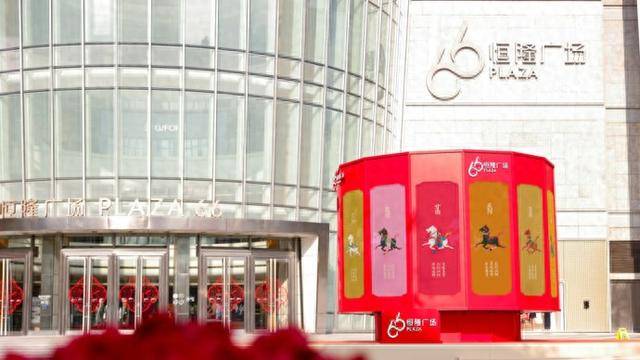
评论 | 稳住了2025年业绩,恒隆下一张王牌在哪里?
Xin Lang Cai Jing· 2026-02-12 12:13
Core Insights - Henglong Real Estate reported a total revenue of HKD 99.50 billion for the year ending December 31, 2025, reflecting an 11% year-on-year decline, primarily due to a significant drop in property sales. However, rental income from mainland shopping malls increased slightly by 1% to HKD 48.71 billion, indicating resilience in this segment [2][19][18] Financial Performance - Despite the overall revenue decline, the company's net profit attributable to shareholders rose by 3% to HKD 32.02 billion, showcasing a complex performance where rental income remains the mainstay, contributing over 94% to total revenue [2][18] - The overall rental income saw a minor decrease of 1%, yet rental income from mainland malls experienced a 1% increase, highlighting a contrasting performance within different segments [2][19] Rental Market Dynamics - The rental income from key projects such as Shanghai Henglong Plaza and Hongqiao Henglong Plaza grew by 1% and 2% respectively, together accounting for nearly 60% of the total rental income from mainland malls [19][3] - The overall occupancy rate for mainland malls increased by 2 percentage points to 96%, with tenant sales rising by 4%, indicating a recovery in the malls' operational performance [21][5] Strategic Adjustments - The company is adapting to changing consumer trends, shifting focus from luxury goods to more popular dining and sports brands, which are now seen as growth drivers. This has led to a strategic adjustment in tenant mix, reducing supermarket space to accommodate more dining options [22][6] - Henglong is also enhancing customer experience by learning from successful experiential retail models, aiming to transform malls into more engaging spaces for consumers [22][6] Office Space Challenges - In contrast to the retail sector, the office rental income in mainland China fell by 8% to HKD 10.05 billion, with an overall occupancy rate dropping by 4 percentage points to 79%. The Shanghai Henglong Plaza office space faced significant pressure, with an 11% decline in rental income [24][8] - Management remains pragmatic, prioritizing tenant retention and negotiating lower rents to maintain occupancy during this challenging period, which is expected to last 18 to 24 months [24][8] Future Outlook - Despite short-term pressures, management expresses confidence in a potential market recovery within the next two years. The introduction of the "V.3" strategy marks a shift in focus towards existing projects rather than expansion into new cities, aiming for incremental growth through targeted investments [26][10] - Upcoming projects, such as the expansion of the Hangzhou Henglong Plaza, are anticipated to drive future growth, with a pre-leasing rate of 77% as of mid-2025 [30][14] Market Segmentation - Performance varies significantly across different cities, with strong results in Shanghai, Wuxi, Dalian, and Kunming, while cities like Tianjin, Wuhan, and Shenyang are experiencing declines in rental income exceeding 30% [28][10] - This disparity reflects local market conditions and competitive pressures, necessitating a tailored approach to each city's strategy [28][10]
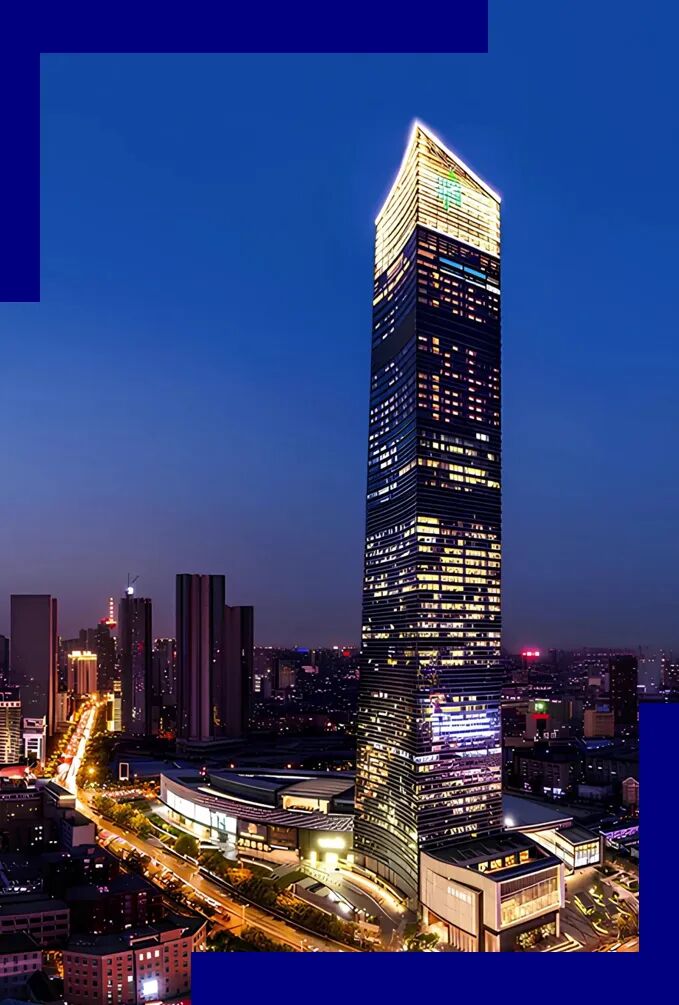
美银证券:维持恒隆地产“买入”评级 目标价10.4港元
Zhi Tong Cai Jing· 2026-02-02 07:59
Group 1 - Bank of America Securities reaffirms "Buy" rating for Hang Lung Properties (00101) with a target price of HKD 10.4 [1] - The expected core profit for the fiscal year 2026 is projected to decline slightly by 1%, primarily due to the offsetting effects of improved retail rental growth and development property profits against declining office income and significantly reduced capitalized interest [1] - The current dividend yield for Hang Lung is 5.5%, with a discount of approximately 60% to net asset value, indicating attractive valuation [1] Group 2 - Management noted that despite unfavorable comparisons due to the different timing of the Lunar New Year in 2026 versus 2025, sales for tenants in mainland China remained relatively stable in January [2] - Luxury retail is expected to decline by 1% from the estimates for fiscal year 2025, recovering to low to mid-single-digit growth in fiscal year 2026, while non-luxury categories are anticipated to perform better [2] - Shanghai's Hang Lung Plaza (Plaza66) is projected to improve retail growth from a year-on-year increase of 1% in the second half of 2025 to a year-on-year growth of 4% in fiscal year 2026 [2]
美银证券:维持恒隆地产(00101)“买入”评级 目标价10.4港元
智通财经网· 2026-02-02 07:58
Group 1 - Bank of America Securities reaffirms "Buy" rating for Hang Lung Properties (00101) with a target price of HKD 10.4 [1] - Core profit is expected to slightly decline by 1% in FY2026, primarily due to offsetting factors such as improved retail rental growth and development property profits against declining office income and significantly reduced capitalized interest [1] - The current dividend yield for Hang Lung is 5.5%, with a discount of approximately 60% to net asset value, indicating attractive valuation [1] Group 2 - Management noted that despite unfavorable comparisons due to the different timing of the Lunar New Year in 2026 versus 2025, sales for tenants in mainland China remained relatively stable in January [2] - Luxury retail is projected to decline by 1% from FY2025 estimates, recovering to low to mid-single-digit growth in FY2026, while non-luxury categories are expected to perform better [2] - Shanghai's Hang Lung Plaza (GG66) is forecasted to achieve stable rental growth of 3%, while retail growth at Plaza 66 is expected to improve from 1% year-on-year in the second half of 2025 to 4% year-on-year in FY2026 [2]
恒隆集团2025年收入跌11%,新战略聚焦核心城市做“再投资”
Xin Lang Cai Jing· 2026-01-31 12:21
Core Viewpoint - The company remains cautiously optimistic about the mainland office market in the medium to long term, despite facing challenges in the current economic environment [1] Financial Performance - For the fiscal year ending December 31, 2025, the company reported total revenue of HKD 10.414 billion, a decrease of 11% compared to 2024, with overall operating profit at HKD 6.836 billion [1] - Property sales revenue plummeted by 83% to HKD 264 million, while shareholder's basic profit increased by 3% to HKD 2.407 billion, resulting in basic earnings per share of HKD 1.77 [1] Rental Income - Total rental income for the company and its subsidiary decreased by 2% and 1% respectively, amounting to HKD 9.853 billion and HKD 9.389 billion [2] - Rental income from mainland properties was approximately HKD 6.757 billion, down 1%, while rental income from Hong Kong properties was about HKD 3.096 billion, down 3% [2] Retail Business Performance - The retail segment showed signs of recovery, with rental income from shopping malls reaching approximately HKD 4.871 billion, a year-on-year increase of 1% [3] - Key properties such as Shanghai Hang Lung Plaza and Hong Kong Plaza maintained stable performance, with rental income of HKD 1.661 billion and HKD 1.197 billion, reflecting growth of 1% and 2% respectively [3] Office Market Challenges - The office segment continues to face pressure, with total income from six office projects in mainland China declining by 7% to HKD 1.223 billion, and occupancy rates dropping by 4 percentage points to 80% [4] - The company is focused on maintaining occupancy rates and renegotiating lease terms with existing tenants due to increasing supply and lack of foreign investment in the office market [5] Strategic Initiatives - The "V.3" strategy aims to expand business in core cities and enhance customer experience with lower capital investment requirements [5][6] - Upcoming projects include expansions in Kunming, Hangzhou, and Wuxi, as well as a commercial operation project in Shanghai [5]

54岁香港地产豪门CEO官宣将退休,已执掌恒隆地产7年;毕业于香港大学,曾在宝洁、可口可乐、花旗集团任职
Sou Hu Cai Jing· 2025-12-22 12:46
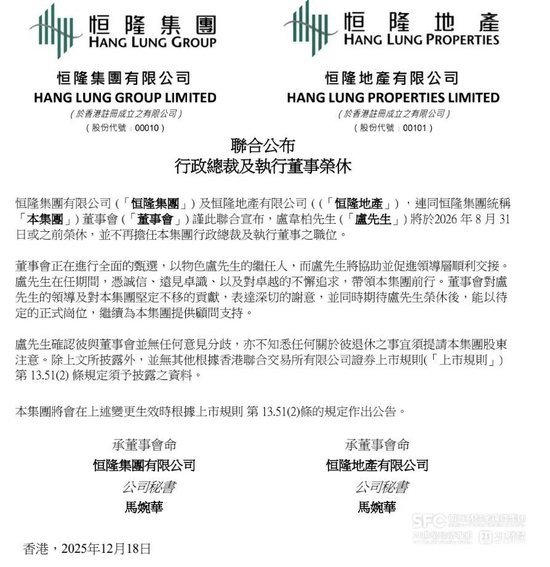
Group 1 - The core announcement is that Weber Lu, the CEO of Hang Lung Group, will retire by August 31, 2026, and the board is currently conducting a search for his successor [1][6] - Lu has been with Hang Lung since May 2018 and previously held significant positions at Procter & Gamble, Coca-Cola, and Citigroup, where he served for 18 years [3] - Lu currently holds 1,128,542 shares of Hang Lung Properties, representing 0.02% of the total issued shares, and 460,000 shares of Hang Lung Group, representing 0.03% of the total issued shares [5] Group 2 - Under the leadership of Chen Wenbo, who took over as chairman in April 2024, the company is transitioning from "heavy asset expansion" to "stock optimization" as part of the "Hang Lung V.3" strategy [6] - Lu expressed gratitude for the support from the board and highlighted the achievements during his tenure, including strengthening the brand and launching significant strategies [6] - The company has faced challenges due to the adjustment in the Chinese real estate market and a decline in luxury consumption, with rental income from mainland properties dropping by 2% to HKD 3.199 billion in the first half of 2025 [7]
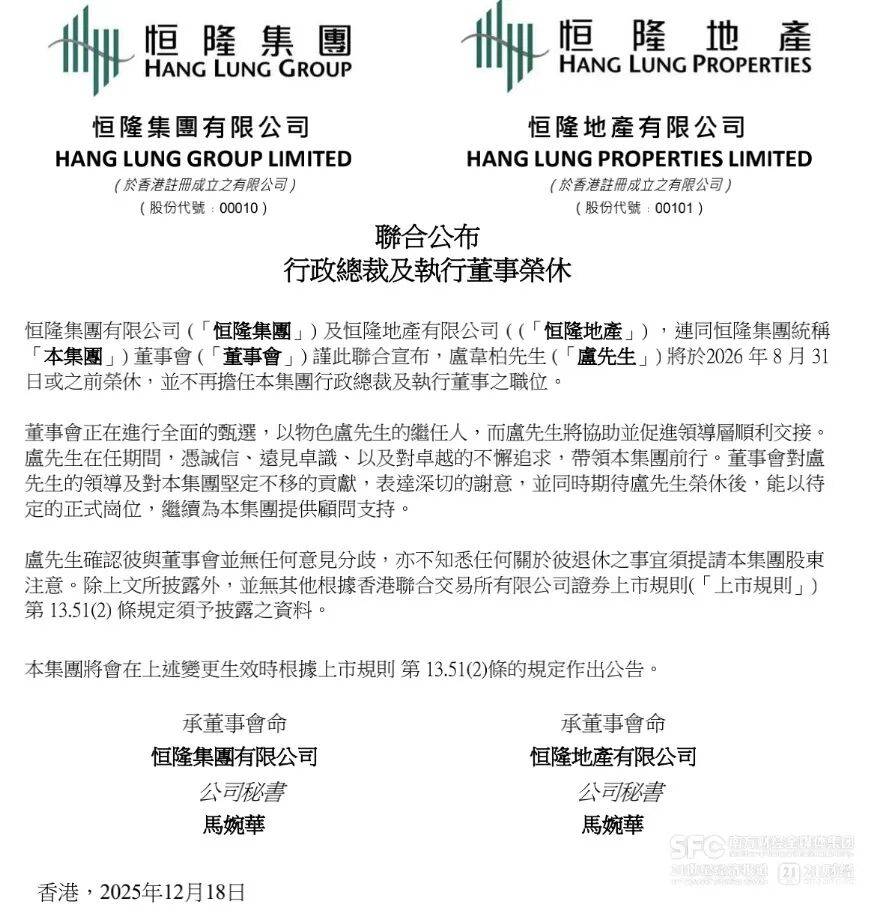
54岁香港地产豪门CEO,退休时间定了
Xin Lang Cai Jing· 2025-12-22 10:24
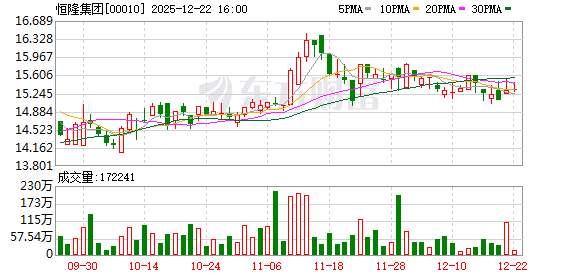
Core Viewpoint - The announcement of CEO Lu Weibao's retirement by Hang Lung Group and Hang Lung Properties marks a significant transition to a new management era led by Chen Wenbo, amidst challenges in the real estate market and a strategic transformation towards optimizing existing assets [1][2][4]. Management Transition - Lu Weibao will retire by August 31, 2026, and will continue to provide advisory support to the group [1][4]. - This change follows the recent transition to a third-generation management team under Chen Wenbo, who took over from the long-serving chairman Chen Qizong in April 2024 [3][4]. - The management change is seen as a natural progression in the company's strategic shift from heavy asset expansion to optimizing existing assets [4][5]. Financial Performance and Market Challenges - Hang Lung's stock price has significantly declined from over HKD 18 per share in 2019 to around HKD 8, reflecting the pressures from structural adjustments in the industry and the company's strategic transformation [2][4]. - For the first half of 2025, rental income from mainland properties fell by 2% to HKD 3.199 billion, with operating profit also declining by 2% [4][14]. - The flagship Shanghai Hang Lung Plaza's occupancy rate dropped from a long-term 100% to 98%, with sales down by 8% [4][14]. Strategic Initiatives - The company has initiated a strategic response to market pressures, including a shift away from distinguishing between "high-end" and "sub-high-end" shopping categories, indicating a more flexible approach to customer adaptation [5][14]. - Recent operational data showed a 15% year-on-year increase in total tenant sales during the National Day holiday period, with some properties like Shanghai Port International achieving a 50% sales increase [5][15]. - The V.3 strategy, led by Chen Wenbo, aims to expand core business areas through a light-asset model, with significant projects underway in Shanghai, Hangzhou, and Wuxi [5][15]. Future Outlook and Challenges - The new management team faces challenges, including uncertain retail consumption growth and a competitive office market, with a 5% decline in office income reported for the first half of the year [6][14]. - The transition to a light-asset model involves substantial investment in property renovations, raising concerns about cost overruns and maintaining the high-end brand image while attracting new customer segments [6][16]. - The upcoming selection of Lu Weibao's successor will be critical for maintaining strategic continuity and addressing the multifaceted challenges facing the company [6][18].
54岁香港地产豪门CEO,退休时间定了
21世纪经济报道· 2025-12-22 10:17
Core Viewpoint - The announcement of CEO Lu Weibao's retirement by Hang Lung Group and Hang Lung Properties marks a significant transition as the company enters a new era under the leadership of Chen Wenbo, the third-generation successor, amidst ongoing challenges in the real estate market and a strategic transformation towards optimizing existing assets [5][7][14]. Group 1: Management Transition - Lu Weibao will retire by August 31, 2026, and will continue to provide advisory support to the group [5][14]. - This change follows the retirement of former chairman Chen Qizong in 2024, indicating a shift to a management team led by Chen Wenbo [5][7]. - The transition is seen as a natural progression in the company's strategic transformation, with Lu having laid the groundwork for the "V.3" strategy [7][14]. Group 2: Strategic Transformation - The "V.3" strategy aims to shift from heavy asset expansion to optimizing existing assets, responding to the challenges posed by the real estate market and luxury consumption decline [7][10]. - The company has begun to adapt its operational logic by no longer distinguishing between "high-end" and "mid-range" shopping centers, indicating a more flexible approach to market demands [8][10]. - Recent operational data shows a 15% increase in total tenant sales for mainland properties during the National Day holiday, with significant sales growth in key locations [8][9]. Group 3: Market Challenges - Hang Lung's rental income from mainland properties fell by 2% to HKD 31.99 billion in the first half of 2025, with flagship projects experiencing a decline in occupancy rates [8][9]. - The office market remains under pressure, with a 5% drop in income from mainland office buildings in the first half of the year [10]. - The company faces challenges in balancing the introduction of new retail concepts while maintaining its high-end positioning to avoid losing its existing customer base [10][13]. Group 4: Future Outlook - The selection of Lu Weibao's successor will be closely watched, as the new CEO's ability to uphold strategic consensus and navigate multiple challenges will be crucial for the company's transformation [14]. - The core value of prime commercial locations remains a significant asset, supported by favorable policies and consumer potential in new first-tier cities [13][14]. - The successful execution of the "V.3" strategy and the management transition will be pivotal for restoring investor confidence and achieving sustainable growth [13][14].

任职香港地产豪门七年 恒隆集团CEO卢韦柏将退休
2 1 Shi Ji Jing Ji Bao Dao· 2025-12-22 08:13
Core Viewpoint - The announcement of CEO Lu Weibao's retirement by Hang Lung Group and Hang Lung Properties marks a significant transition as the company enters a new management era led by Chen Wenbo, amidst ongoing challenges in the real estate sector and a strategic shift towards optimizing existing assets [2][5]. Group 1: Management Transition - Lu Weibao will retire by August 31, 2026, and will continue to provide advisory support to the group [2]. - The transition follows the retirement of former chairman Chen Qizong in 2024, indicating a shift to a third-generation management team centered around Chen Wenbo [5]. - Chen Wenbo, who has been rapidly implementing the "Hang Lung V.3" strategy, is expected to lead the company through its transformation from "heavy asset expansion" to "asset optimization" [5][9]. Group 2: Financial Performance and Market Challenges - Hang Lung Properties reported a 2% decline in rental income from mainland properties to HKD 31.99 billion for the first half of 2025, with flagship project Shanghai Hang Lung Plaza's occupancy rate dropping from 100% to 98% [8]. - The company's stock price has halved from over HKD 18 in 2019 to around HKD 8, reflecting significant market pressure [5][8]. - The retail sector has faced compounded challenges since 2021, with a notable decline in luxury consumption impacting the company's performance [8]. Group 3: Strategic Shifts - The company has announced a strategic shift, no longer distinguishing between "high-end" and "mid-range" shopping centers, indicating a more flexible approach to market demands [8]. - Chen Wenbo's leadership has seen the acquisition of long-term rental projects in key cities, expanding retail space while focusing on existing assets rather than new city expansions [9][10]. - The V.3 strategy aims to leverage core business districts' value while addressing the need for renovation and modernization of older properties [10][13]. Group 4: Future Outlook and Challenges - The new management team faces challenges including uncertain retail growth and a competitive office market, with a 5% decline in office income reported for the first half of 2025 [9][10]. - The transition to a light-asset model will require significant investment in property renovations, posing risks related to cost overruns and project timelines [10]. - The ability of the new CEO to maintain strategic continuity and effectively respond to market dynamics will be crucial for the company's transformation and investor confidence [12][14].
恒隆联手上海九百,22亿爆改梅龙镇广场
3 6 Ke· 2025-12-15 07:38
Core Viewpoint - The luxury retail landscape in Shanghai is undergoing significant changes, with traditional players like Shanghai Hang Lung Plaza facing challenges from new entrants and changing consumer preferences. The partnership between Hang Lung Properties and Shanghai Jiubai to manage the Meilong Town Plaza is a strategic move to expand their market presence and adapt to these shifts [2][8][16]. Group 1: Strategic Moves - Hang Lung Properties has announced a collaboration with Shanghai Jiubai to take over the commercial operations of Meilong Town Plaza, expanding its retail footprint by approximately 96,000 square meters, increasing the total area of Shanghai Hang Lung Plaza by 44% to about 312,300 square meters [2][5]. - The partnership is described as having "epoch-making significance" by Hang Lung's CEO, indicating the importance of this move in the context of Shanghai's luxury retail market [2][5]. - The renovation of Meilong Town Plaza is set to transform it into a comprehensive commercial landmark, incorporating retail, hotel, and office spaces, with plans to introduce a luxury hotel for the first time [7][11]. Group 2: Market Challenges - The luxury retail sector in Shanghai has faced a downturn, with Hang Lung Plaza experiencing a 24% decline in tenant sales in 2022 and a further 8% drop in the first half of 2023 [9][10]. - The limited size of Hang Lung Plaza, at 53,700 square meters, is seen as a constraint on its ability to accommodate larger brand offerings and meet consumer demand [10]. - The competitive landscape is intensifying, with new luxury retail developments in Shanghai, such as the Louis Vuitton flagship and other high-end brands, challenging the traditional dominance of Hang Lung Plaza [16]. Group 3: Financial Performance - Hang Lung Properties reported a 6% decline in overall rental income for 2024, marking the first drop after 24 years of continuous growth, with mainland rental income down by 5% [12][13]. - The company is shifting its strategy towards a lighter asset model, focusing on existing projects rather than expanding into new cities, as indicated by its "Hang Lung V.3" strategy [13][14]. - Recent acquisitions, such as the 20-year operating rights for Hangzhou Department Store and Wuxi New World Department Store, reflect a strategic pivot to enhance existing market positions rather than aggressive expansion [15][16].