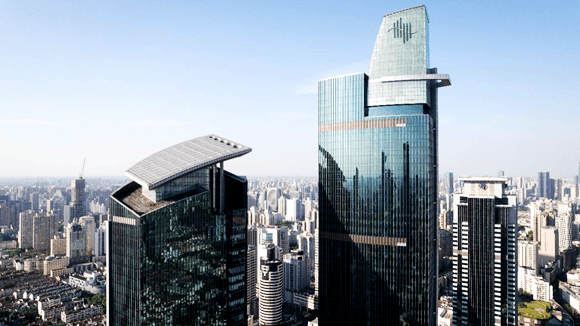
杭州恒隆广场

Search documents
恒隆地产(00101.HK):经营趋势持续向好 建议波动中逢低吸纳
Ge Long Hui· 2026-03-21 14:41
Company Overview - The company recently held a post-earnings roadshow in mainland China, updating its operational status [1] - The mainland shopping centers continue to show strong operational trends, with retail sales expected to accelerate further in the first two months of 2026 compared to 4Q25, which saw a year-on-year increase of 18% [1] Retail Performance - The growth in retail sales is primarily driven by a low base effect (1Q25 saw a year-on-year decline of 7%), adjustments in the overall merchant mix, and the introduction of key new merchants [1] - Specific categories such as sports goods, lifestyle, dining, and beauty products have shown particularly strong performance, contributing positively to growth [1] - The introduction of old gold shops has also played a role in boosting retail sales [1] Future Outlook - The company maintains a positive outlook for retail sales growth throughout the year, supported by base conditions and adjustments in store layouts [1] - The upcoming openings of Shanghai Hang Lung Plaza Phase III (scheduled for 3Q26, with a retail leasable area increase of 13%) and Hangzhou Hang Lung Plaza (opening in 2Q26) are expected to provide additional growth momentum for the year [1] - Although rental growth may not perfectly align with retail sales growth, the continuous increase in retail sales is anticipated to gradually drive rental growth [1] Investment Recommendation - The company's stock price has recently experienced a 12% pullback from previous highs, currently trading at a 5.8% expected dividend yield for 2026 [2] - Despite potential impacts on annual profit from interest costs and capitalization rate fluctuations, the core operational performance and sustainable growth in rental income are expected to recover [2] - Investors are advised to consider buying on dips during external market fluctuations [2] Earnings Forecast and Valuation - The earnings forecast remains unchanged, maintaining an outperform rating with a target price of HKD 11.6, corresponding to a 4.5% target dividend yield for 2026, an 18x core P/E for 2026, and a 29% upside potential [2] - The company is currently trading at a 5.8% expected dividend yield for 2026 and a 14.2x core P/E for 2026 [2]

港资守擂、内资突围、区域龙头割据,商业版图谁主沉浮?
Xin Lang Cai Jing· 2026-02-24 05:27
Core Insights - The retail commercial property market in 2025 is undergoing a profound structural adjustment due to macroeconomic headwinds and changing consumer habits, leading to varied survival scenarios among companies with different backgrounds and strategies [3][30] Group 1: Hong Kong Property Companies - Sun Hung Kai Properties remains the "rental king," recording net rental income of HKD 18.392 billion for the fiscal year 2025, demonstrating strong resilience [4][31] - The company maintains a high mall occupancy rate of 95% in Hong Kong by introducing popular mainland brands and optimizing public spaces [4][31] - Swire Properties reported a 20% year-on-year revenue increase in the first half of 2025, with retail sales in mainland China up 70% compared to 2019, but faced significant market differentiation [7][34] - Hang Lung Properties experienced mixed results, with overall income stable but significant city-level disparities, prompting a shift to more refined operational strategies [9][36] - Link REIT adopts a pragmatic approach to stabilize its operations amid structural changes in consumer behavior, enhancing its asset portfolio in Hong Kong and mainland China [11][38] - Kerry Properties shows financial discipline with a 22% drop in net profit but maintains a controlled debt ratio of 40% [13][40] - Shui On Land's resilience heavily relies on its Shanghai projects, which contribute 78% of rental income, highlighting the challenges in its national expansion [16][43] Group 2: Mainland Property Companies - Longfor Properties is focusing on revitalizing older projects, reducing interest-bearing debt by HKD 60 billion over three and a half years, and achieving a historical low financing cost of 3.58% [20][45] - China Resources' commercial segment reported a revenue of CNY 3.267 billion, a 14.6% increase, with a gross margin of 66.1% [21][48] - The average opening rate of new projects in the first half of 2025 exceeded 91%, with significant retail sales growth from third-party managed projects [22][49] Group 3: Regional Leaders - Hisense Plaza in Qingdao has maintained its status as Shandong's top luxury venue for 28 years, achieving annual sales exceeding CNY 6 billion [26][51] - Lihua Group represents a different path in regional commerce with its "department store + supermarket" model, facing challenges in national expansion and declining performance since 2019 [28][53]






评论 | 稳住了2025年业绩,恒隆下一张王牌在哪里?
Xin Lang Cai Jing· 2026-02-12 12:13
Core Insights - Henglong Real Estate reported a total revenue of HKD 99.50 billion for the year ending December 31, 2025, reflecting an 11% year-on-year decline, primarily due to a significant drop in property sales. However, rental income from mainland shopping malls increased slightly by 1% to HKD 48.71 billion, indicating resilience in this segment [2][19][18] Financial Performance - Despite the overall revenue decline, the company's net profit attributable to shareholders rose by 3% to HKD 32.02 billion, showcasing a complex performance where rental income remains the mainstay, contributing over 94% to total revenue [2][18] - The overall rental income saw a minor decrease of 1%, yet rental income from mainland malls experienced a 1% increase, highlighting a contrasting performance within different segments [2][19] Rental Market Dynamics - The rental income from key projects such as Shanghai Henglong Plaza and Hongqiao Henglong Plaza grew by 1% and 2% respectively, together accounting for nearly 60% of the total rental income from mainland malls [19][3] - The overall occupancy rate for mainland malls increased by 2 percentage points to 96%, with tenant sales rising by 4%, indicating a recovery in the malls' operational performance [21][5] Strategic Adjustments - The company is adapting to changing consumer trends, shifting focus from luxury goods to more popular dining and sports brands, which are now seen as growth drivers. This has led to a strategic adjustment in tenant mix, reducing supermarket space to accommodate more dining options [22][6] - Henglong is also enhancing customer experience by learning from successful experiential retail models, aiming to transform malls into more engaging spaces for consumers [22][6] Office Space Challenges - In contrast to the retail sector, the office rental income in mainland China fell by 8% to HKD 10.05 billion, with an overall occupancy rate dropping by 4 percentage points to 79%. The Shanghai Henglong Plaza office space faced significant pressure, with an 11% decline in rental income [24][8] - Management remains pragmatic, prioritizing tenant retention and negotiating lower rents to maintain occupancy during this challenging period, which is expected to last 18 to 24 months [24][8] Future Outlook - Despite short-term pressures, management expresses confidence in a potential market recovery within the next two years. The introduction of the "V.3" strategy marks a shift in focus towards existing projects rather than expansion into new cities, aiming for incremental growth through targeted investments [26][10] - Upcoming projects, such as the expansion of the Hangzhou Henglong Plaza, are anticipated to drive future growth, with a pre-leasing rate of 77% as of mid-2025 [30][14] Market Segmentation - Performance varies significantly across different cities, with strong results in Shanghai, Wuxi, Dalian, and Kunming, while cities like Tianjin, Wuhan, and Shenyang are experiencing declines in rental income exceeding 30% [28][10] - This disparity reflects local market conditions and competitive pressures, necessitating a tailored approach to each city's strategy [28][10]
美银证券:维持恒隆地产“买入”评级 目标价10.4港元
Zhi Tong Cai Jing· 2026-02-02 07:59
Group 1 - Bank of America Securities reaffirms "Buy" rating for Hang Lung Properties (00101) with a target price of HKD 10.4 [1] - The expected core profit for the fiscal year 2026 is projected to decline slightly by 1%, primarily due to the offsetting effects of improved retail rental growth and development property profits against declining office income and significantly reduced capitalized interest [1] - The current dividend yield for Hang Lung is 5.5%, with a discount of approximately 60% to net asset value, indicating attractive valuation [1] Group 2 - Management noted that despite unfavorable comparisons due to the different timing of the Lunar New Year in 2026 versus 2025, sales for tenants in mainland China remained relatively stable in January [2] - Luxury retail is expected to decline by 1% from the estimates for fiscal year 2025, recovering to low to mid-single-digit growth in fiscal year 2026, while non-luxury categories are anticipated to perform better [2] - Shanghai's Hang Lung Plaza (Plaza66) is projected to improve retail growth from a year-on-year increase of 1% in the second half of 2025 to a year-on-year growth of 4% in fiscal year 2026 [2]
美银证券:维持恒隆地产(00101)“买入”评级 目标价10.4港元
智通财经网· 2026-02-02 07:58
Group 1 - Bank of America Securities reaffirms "Buy" rating for Hang Lung Properties (00101) with a target price of HKD 10.4 [1] - Core profit is expected to slightly decline by 1% in FY2026, primarily due to offsetting factors such as improved retail rental growth and development property profits against declining office income and significantly reduced capitalized interest [1] - The current dividend yield for Hang Lung is 5.5%, with a discount of approximately 60% to net asset value, indicating attractive valuation [1] Group 2 - Management noted that despite unfavorable comparisons due to the different timing of the Lunar New Year in 2026 versus 2025, sales for tenants in mainland China remained relatively stable in January [2] - Luxury retail is projected to decline by 1% from FY2025 estimates, recovering to low to mid-single-digit growth in FY2026, while non-luxury categories are expected to perform better [2] - Shanghai's Hang Lung Plaza (GG66) is forecasted to achieve stable rental growth of 3%, while retail growth at Plaza 66 is expected to improve from 1% year-on-year in the second half of 2025 to 4% year-on-year in FY2026 [2]
2026年浙江要开42个新项目,恒隆、嘉里、香港置地顶级对决!
3 6 Ke· 2026-01-15 02:23
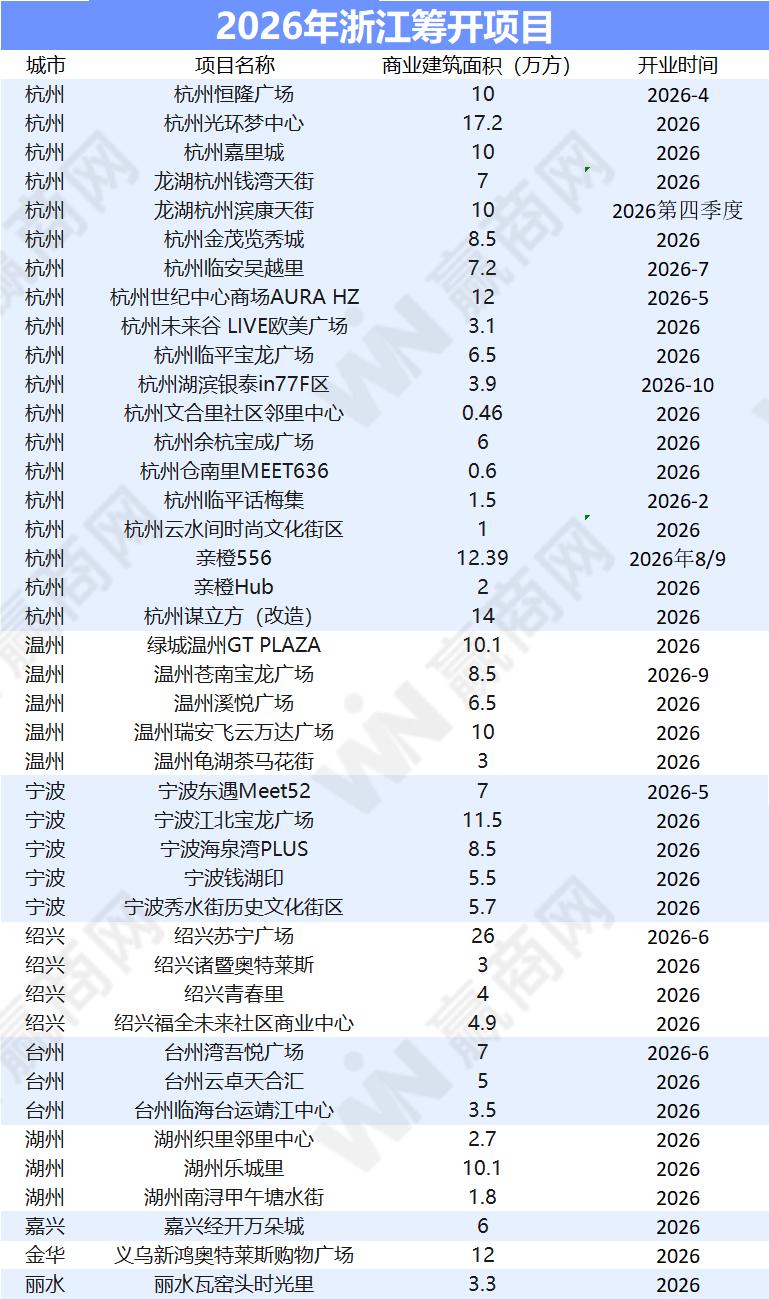
Core Insights - In 2026, Zhejiang's commercial market is set to experience a new wave of supply with 42 planned commercial projects totaling approximately 3 million square meters, a 6% decrease compared to 2025 [1] - Major operators such as Hang Lung, Kerry, Hongkong Land, and Longfor are competing fiercely, pushing Zhejiang into a new phase of "quality improvement" and "structural optimization" [1] Project Overview - The 42 commercial projects are distributed across cities including Hangzhou, Wenzhou, Ningbo, Jinhua, Huzhou, Taizhou, and Jiaxing, with Hangzhou contributing nearly half of the projects at 45.2% [4] - Notable projects in Hangzhou include: - Hangzhou Hang Lung Plaza (100,000 sqm) opening in April 2026 [16] - Hangzhou Aura HZ (26,000 sqm) opening in May 2026 [29] - Hangzhou Kerry City (254,000 sqm) focusing on a mixed-use urban complex [13] - Hangzhou Guanghuan Dream Center (172,000 sqm) emphasizing a nature-themed shopping experience [9] Market Dynamics - 27 of the projects are shopping centers and malls, accounting for 64% of the market, indicating a trend towards specialized commercial developments [5] - The introduction of new players such as Alibaba's "Qing Cheng 556" and ByteDance's "Cangnan Li MEET636" reflects a diversification in the commercial landscape [5] Size and Scale - Projects larger than 50,000 sqm dominate the market, with 27 such projects making up 64.2% of the total [6] - The largest project, the Su Ning Plaza in Shaoxing, will cover 260,000 sqm, setting a record for the region [38] Competitive Landscape - The competition is characterized by a "pyramid" structure, with numerous leading projects at the top and fewer smaller non-standard commercial offerings [6] - The focus on asset operation and content creation in smaller projects highlights a long-term competitive strategy [6] Notable Projects - Wenzhou GT Plaza (100,000 sqm) aims to create a park-style social commercial complex [32] - Taizhou Bay Wuyue Plaza (70,000 sqm) is designed as a central leisure living area [35] - Ningbo's Haiquan Bay PLUS and Xiushui Street historical cultural district are set to enhance the city's cultural tourism [4]
54岁香港地产豪门CEO官宣将退休,已执掌恒隆地产7年;毕业于香港大学,曾在宝洁、可口可乐、花旗集团任职
Sou Hu Cai Jing· 2025-12-22 12:46
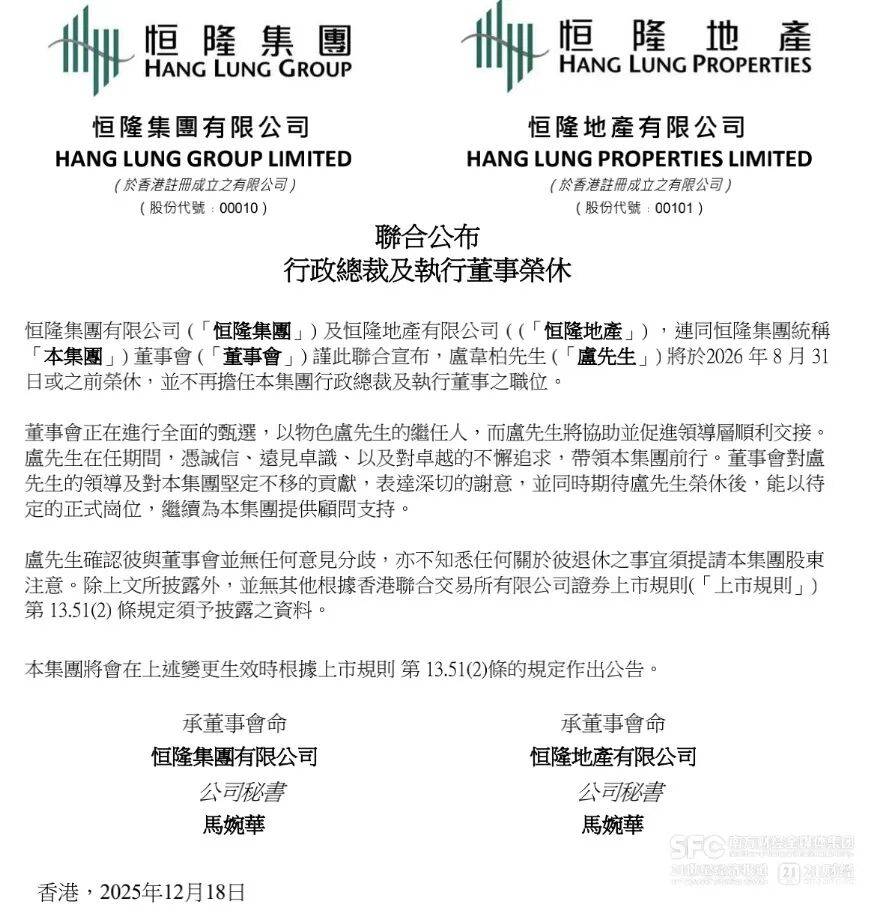
Group 1 - The core announcement is that Weber Lu, the CEO of Hang Lung Group, will retire by August 31, 2026, and the board is currently conducting a search for his successor [1][6] - Lu has been with Hang Lung since May 2018 and previously held significant positions at Procter & Gamble, Coca-Cola, and Citigroup, where he served for 18 years [3] - Lu currently holds 1,128,542 shares of Hang Lung Properties, representing 0.02% of the total issued shares, and 460,000 shares of Hang Lung Group, representing 0.03% of the total issued shares [5] Group 2 - Under the leadership of Chen Wenbo, who took over as chairman in April 2024, the company is transitioning from "heavy asset expansion" to "stock optimization" as part of the "Hang Lung V.3" strategy [6] - Lu expressed gratitude for the support from the board and highlighted the achievements during his tenure, including strengthening the brand and launching significant strategies [6] - The company has faced challenges due to the adjustment in the Chinese real estate market and a decline in luxury consumption, with rental income from mainland properties dropping by 2% to HKD 3.199 billion in the first half of 2025 [7]

54岁香港地产豪门CEO,退休时间定了
Xin Lang Cai Jing· 2025-12-22 10:24
Core Viewpoint - The announcement of CEO Lu Weibao's retirement by Hang Lung Group and Hang Lung Properties marks a significant transition to a new management era led by Chen Wenbo, amidst challenges in the real estate market and a strategic transformation towards optimizing existing assets [1][2][4]. Management Transition - Lu Weibao will retire by August 31, 2026, and will continue to provide advisory support to the group [1][4]. - This change follows the recent transition to a third-generation management team under Chen Wenbo, who took over from the long-serving chairman Chen Qizong in April 2024 [3][4]. - The management change is seen as a natural progression in the company's strategic shift from heavy asset expansion to optimizing existing assets [4][5]. Financial Performance and Market Challenges - Hang Lung's stock price has significantly declined from over HKD 18 per share in 2019 to around HKD 8, reflecting the pressures from structural adjustments in the industry and the company's strategic transformation [2][4]. - For the first half of 2025, rental income from mainland properties fell by 2% to HKD 3.199 billion, with operating profit also declining by 2% [4][14]. - The flagship Shanghai Hang Lung Plaza's occupancy rate dropped from a long-term 100% to 98%, with sales down by 8% [4][14]. Strategic Initiatives - The company has initiated a strategic response to market pressures, including a shift away from distinguishing between "high-end" and "sub-high-end" shopping categories, indicating a more flexible approach to customer adaptation [5][14]. - Recent operational data showed a 15% year-on-year increase in total tenant sales during the National Day holiday period, with some properties like Shanghai Port International achieving a 50% sales increase [5][15]. - The V.3 strategy, led by Chen Wenbo, aims to expand core business areas through a light-asset model, with significant projects underway in Shanghai, Hangzhou, and Wuxi [5][15]. Future Outlook and Challenges - The new management team faces challenges, including uncertain retail consumption growth and a competitive office market, with a 5% decline in office income reported for the first half of the year [6][14]. - The transition to a light-asset model involves substantial investment in property renovations, raising concerns about cost overruns and maintaining the high-end brand image while attracting new customer segments [6][16]. - The upcoming selection of Lu Weibao's successor will be critical for maintaining strategic continuity and addressing the multifaceted challenges facing the company [6][18].
54岁香港地产豪门CEO,退休时间定了
21世纪经济报道· 2025-12-22 10:17
Core Viewpoint - The announcement of CEO Lu Weibao's retirement by Hang Lung Group and Hang Lung Properties marks a significant transition as the company enters a new era under the leadership of Chen Wenbo, the third-generation successor, amidst ongoing challenges in the real estate market and a strategic transformation towards optimizing existing assets [5][7][14]. Group 1: Management Transition - Lu Weibao will retire by August 31, 2026, and will continue to provide advisory support to the group [5][14]. - This change follows the retirement of former chairman Chen Qizong in 2024, indicating a shift to a management team led by Chen Wenbo [5][7]. - The transition is seen as a natural progression in the company's strategic transformation, with Lu having laid the groundwork for the "V.3" strategy [7][14]. Group 2: Strategic Transformation - The "V.3" strategy aims to shift from heavy asset expansion to optimizing existing assets, responding to the challenges posed by the real estate market and luxury consumption decline [7][10]. - The company has begun to adapt its operational logic by no longer distinguishing between "high-end" and "mid-range" shopping centers, indicating a more flexible approach to market demands [8][10]. - Recent operational data shows a 15% increase in total tenant sales for mainland properties during the National Day holiday, with significant sales growth in key locations [8][9]. Group 3: Market Challenges - Hang Lung's rental income from mainland properties fell by 2% to HKD 31.99 billion in the first half of 2025, with flagship projects experiencing a decline in occupancy rates [8][9]. - The office market remains under pressure, with a 5% drop in income from mainland office buildings in the first half of the year [10]. - The company faces challenges in balancing the introduction of new retail concepts while maintaining its high-end positioning to avoid losing its existing customer base [10][13]. Group 4: Future Outlook - The selection of Lu Weibao's successor will be closely watched, as the new CEO's ability to uphold strategic consensus and navigate multiple challenges will be crucial for the company's transformation [14]. - The core value of prime commercial locations remains a significant asset, supported by favorable policies and consumer potential in new first-tier cities [13][14]. - The successful execution of the "V.3" strategy and the management transition will be pivotal for restoring investor confidence and achieving sustainable growth [13][14].

恒隆集团及恒隆地产共同宣布行政总裁及执行董事卢韦柏明年荣休
Sou Hu Cai Jing· 2025-12-18 08:19
Group 1 - The CEO and Executive Director of Hang Lung Group, Weber Lo, will retire by August 31, 2026, and the board is currently conducting a comprehensive selection process for his successor [2] - Chairman Chen Wenbo expressed gratitude for Weber's visionary leadership and contributions, highlighting the successful implementation of the V.3 strategy, which is expected to drive growth for decades [2] - Weber Lo stated that his retirement is part of a personal plan to explore new chapters in life, reflecting on his eight years at Hang Lung as a golden period marked by significant strategic initiatives and brand strengthening [2] Group 2 - The company has enhanced its brand '66' and launched major strategies, including expanding collaborations with luxury brands across multiple cities [2] - A comprehensive customer relationship management program has been implemented to improve customer service, and a strong team aligned with the company's vision and values has been established [2] - The opening of Hang Lung Plaza in Hangzhou is anticipated in April 2026, coinciding with the 66th anniversary of Hang Lung, indicating the company's readiness for its next development chapter [2]