有友食品

Search documents
休闲食品板块8月8日跌0.36%,立高食品领跌,主力资金净流入4932.15万元
Zheng Xing Xing Ye Ri Bao· 2025-08-08 08:26
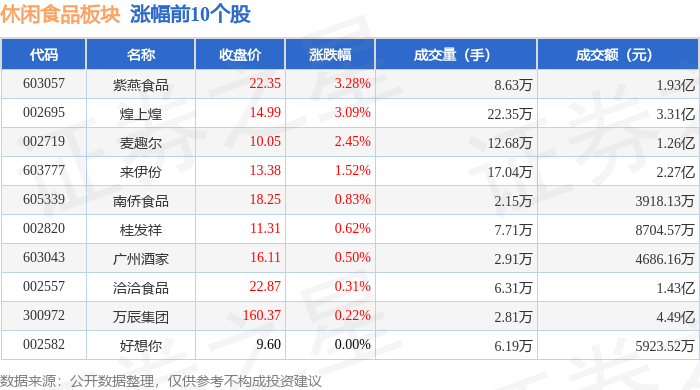
Core Viewpoint - The leisure food sector experienced a decline of 0.36% on August 8, with Lihigh Food leading the drop. The Shanghai Composite Index closed at 3635.13, down 0.12%, while the Shenzhen Component Index closed at 11128.67, down 0.26% [1]. Group 1: Stock Performance - Ziyan Food (603057) saw a closing price of 22.35, with an increase of 3.28% and a trading volume of 86,300 shares, amounting to a transaction value of 193 million yuan [1]. - Huangshanghuang (002695) closed at 14.99, up 3.09%, with a trading volume of 223,500 shares and a transaction value of 331 million yuan [1]. - Maichuer (002719) closed at 10.05, increasing by 2.45%, with a trading volume of 126,800 shares and a transaction value of 126 million yuan [1]. - Lihigh Food (300973) closed at 43.30, down 4.05%, with a trading volume of 32,800 shares and a transaction value of 143 million yuan [2]. - Yanjinpuzi (002847) closed at 70.82, down 2.77%, with a trading volume of 30,300 shares and a transaction value of 215 million yuan [2]. Group 2: Capital Flow - The leisure food sector saw a net inflow of 49.32 million yuan from main funds, while speculative funds had a net inflow of 8.76 million yuan. However, retail investors experienced a net outflow of 58.08 million yuan [2].



食品饮料周报:市场规模超1500亿元 酒企争喝光瓶酒
Zheng Quan Zhi Xing· 2025-08-08 07:17
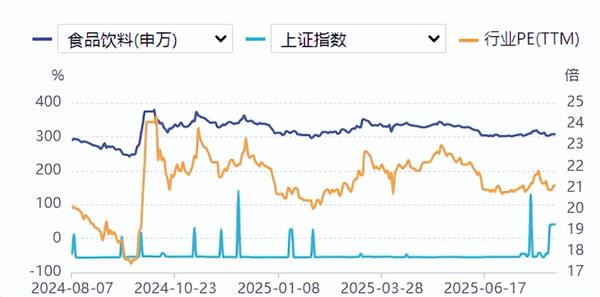
Market Performance - The Shanghai and Shenzhen 300 Index increased by 1.23%, while the Shenwan Food and Beverage Index rose by 0.68% during the period from August 4 to August 8, 2025 [1]. Institutional Insights - Guohai Securities maintains a "recommended" rating for the food and beverage sector, citing recent policy measures that are expected to improve macroeconomic expectations and enhance both valuation and performance in the sector [2]. - Zhongyuan Securities suggests focusing on investment opportunities in the white liquor, soft drinks, health products, baking, and snacks sectors, with a recommended stock portfolio including brands like Yingjia Gongjiu and Luzhou Laojiao [3]. Regulatory Developments - The State Administration for Market Regulation has drafted a regulation concerning food safety responsibilities for food sales chain enterprises, emphasizing risk prevention and management responsibilities at various levels [4]. - A joint reminder from the State Administration for Market Regulation and the China Consumers Association warns consumers against believing health claims made by ordinary food products [5]. Industry Trends - The market for light bottle liquor is projected to exceed 150 billion yuan in 2024 and is expected to surpass 200 billion yuan in 2025, with increased competition in lower-tier markets [8]. - The export value of Zunyi liquor (excluding Moutai Group) reached 39.81 million yuan, showing a year-on-year increase of 870.82%, driven by policies supporting international market expansion [9]. Company News - Moutai Group has announced the cessation of production for Taiyuan liquor to optimize its product structure and enhance market competitiveness [11]. - Tianyoude Liquor plans to invest 160 million yuan in building a winery in Tibet as part of its strategy to overcome current financial challenges [12]. - Yingjia Gongjiu has established a new biotechnology company with an investment of 8 million yuan, focusing on technology promotion and application services [13].





休闲食品板块8月7日涨2.84%,万辰集团领涨,主力资金净流入3.29亿元
Zheng Xing Xing Ye Ri Bao· 2025-08-07 08:27
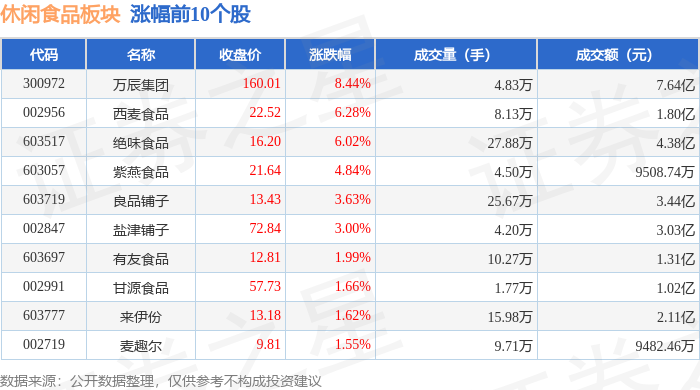
Market Overview - The leisure food sector increased by 2.84% on August 7, with Wancheng Group leading the gains [1] - The Shanghai Composite Index closed at 3639.67, up 0.16%, while the Shenzhen Component Index closed at 11157.94, down 0.18% [1] Key Performers - Wancheng Group (300972) closed at 160.01, up 8.44% with a trading volume of 48,300 lots and a transaction value of 764 million [1] - Ximai Food (002956) closed at 22.52, up 6.28% with a trading volume of 81,300 lots and a transaction value of 180 million [1] - Juewei Food (603517) closed at 16.20, up 6.02% with a trading volume of 278,800 lots and a transaction value of 438 million [1] - Ziyan Food (603057) closed at 21.64, up 4.84% with a trading volume of 45,000 lots and a transaction value of 9.51 million [1] - Liangpin Shop (603719) closed at 13.43, up 3.63% with a trading volume of 256,700 lots and a transaction value of 344 million [1] Capital Flow - The leisure food sector saw a net inflow of 329 million from main funds, while retail funds experienced a net outflow of 298 million [2][3] - Main funds showed significant net inflows in Wancheng Group (1.18 million) and Juewei Food (73.08 million) [3] - Retail funds had notable outflows in Wancheng Group (-1.33 million) and Juewei Food (-4.99 million) [3] Summary of Individual Stocks - Wancheng Group: Main fund inflow of 1.18 million, retail outflow of -1.33 million [3] - Juewei Food: Main fund inflow of 73.08 million, retail outflow of -4.99 million [3] - Liangpin Shop: Main fund inflow of 52.97 million, retail outflow of -4.61 million [3] - Ximai Food: Main fund inflow of 12.45 million, retail inflow of 721,530 [3]


山姆背后的中国供应商 有人业绩翻身 有人“失去姓名”
2 1 Shi Ji Jing Ji Bao Dao· 2025-08-06 23:13
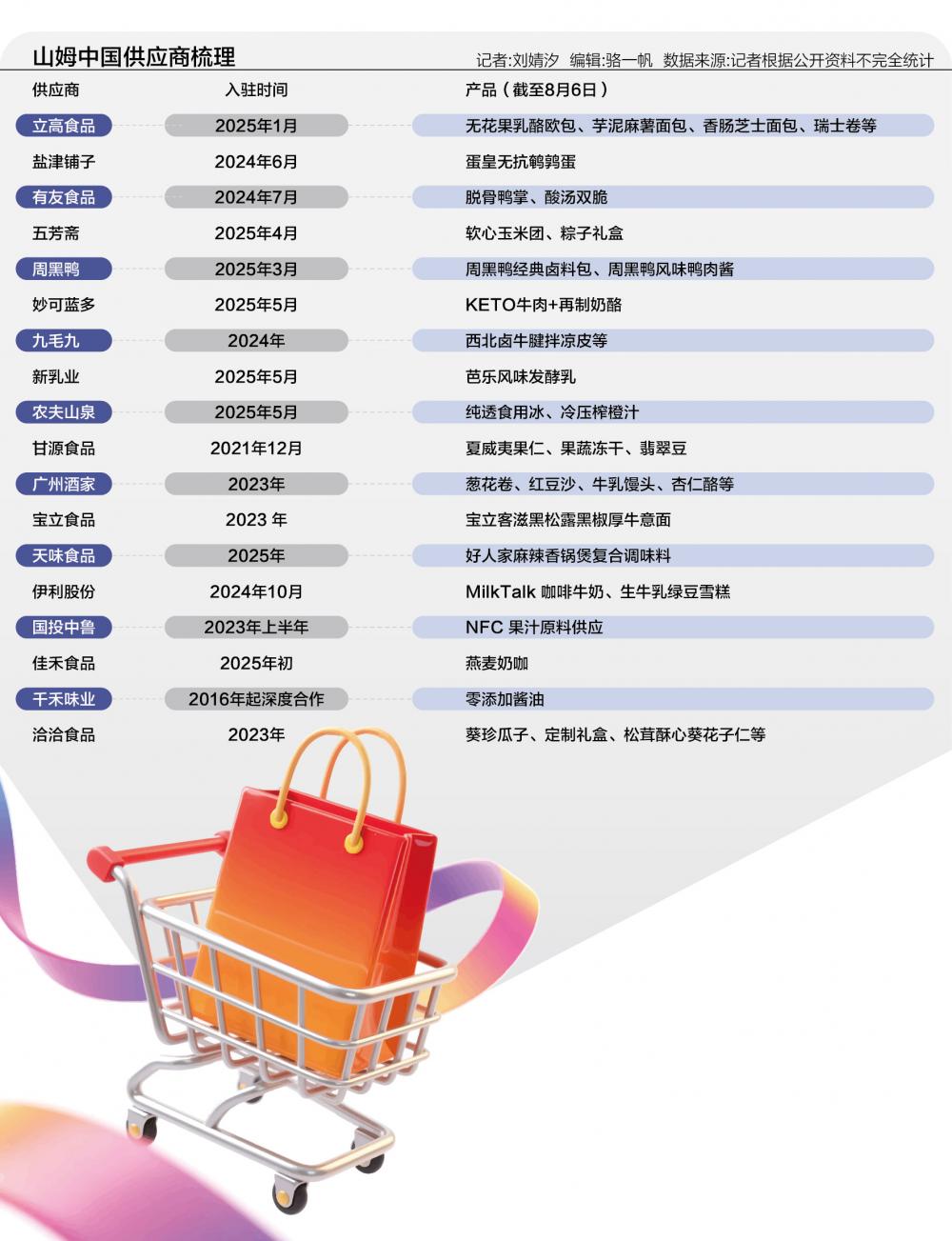
Core Insights - The article discusses the complexities and challenges faced by suppliers partnering with Sam's Club, highlighting both the potential benefits and risks associated with such collaborations [1][2][3]. Supplier Performance - At least 18 domestic listed food companies have partnered with Sam's Club, with many being recent entrants. Some suppliers, like Youyou Foods, have seen significant revenue increases after entering Sam's, while others have struggled with declining profits [3][5]. - Youyou Foods expects a revenue of 746 million to 798 million yuan for the first half of 2025, representing a year-on-year increase of 40.91% to 50.77% [5]. - Prior to joining Sam's, Youyou Foods experienced consecutive revenue declines in 2022 and 2023, with revenues of 1.024 billion and 966 million yuan, respectively [6]. Market Dynamics - The partnership with Sam's Club can serve as a brand endorsement, enhancing visibility and credibility for suppliers. However, the long-term success of products depends on customer feedback and repurchase rates [6][10]. - Suppliers face challenges such as long payment terms and the need to cover production and logistics costs upfront, leading to increased accounts receivable [7][8]. Profitability Concerns - Entering Sam's Club does not guarantee profit growth, as the retailer often pressures suppliers to lower prices, impacting profit margins [7][8]. - For instance, Qiaqia Foods reported a decrease in gross margin despite increased revenue from direct sales channels, indicating the financial strain of operating within Sam's [8][9]. Brand and Product Strategy - Some suppliers have faced branding challenges, with products being rebranded under different labels to create an "imported" perception, which can dilute brand identity [9]. - Sam's Club's stringent product entry requirements necessitate additional investment in product development, which may be burdensome for smaller suppliers [10].
山姆背后的中国供应商 有人业绩翻身,有人“失去姓名”
2 1 Shi Ji Jing Ji Bao Dao· 2025-08-06 23:08
Core Viewpoint - The article discusses the complexities and challenges faced by suppliers partnering with Sam's Club, highlighting both the potential benefits and risks associated with such collaborations [1][3][10]. Supplier Performance - At least 18 domestic listed food companies have partnered with Sam's Club, with many entering in the last two years [3] - Some suppliers, like Youyou Food, have seen significant revenue increases after entering Sam's Club, with projected revenue for the first half of 2025 expected to rise by 40.91% to 50.77% [4][6] - Conversely, other suppliers have struggled, with companies like Ganyuan Food experiencing a decline in net profit by 54.96% to 56.16% in the first half of the year [9] Market Dynamics - The entry of Youyou Food into Sam's Club marked a turnaround for the company, which had seen declining revenues in 2022 and 2023 [6][5] - Sam's Club's reputation for high quality and cost-effectiveness provides a branding advantage for suppliers, but long-term success depends on customer feedback and repurchase rates [6][10] Financial Implications - Suppliers face challenges such as long payment terms and increased accounts receivable, with Youyou Food's accounts receivable rising 18 times from the previous year [8] - The pressure to lower prices for Sam's Club can lead to reduced profit margins for suppliers, as seen with Qiaqia Food, which reported a decline in gross margin despite increased revenue from direct sales [7][9] Supplier Challenges - Suppliers must invest in product development to meet Sam's Club's stringent quality standards, which can be a burden for smaller companies [10] - Sam's Club's strict entry requirements and product exclusivity can limit suppliers' ability to sell similar products through other channels, creating dependency on Sam's Club [10]

上证主要消费红利指数下跌0.18%,前十大权重包含伊利股份等
Jin Rong Jie· 2025-08-06 15:59
Group 1 - The Shanghai Composite Index opened lower but rose throughout the day, with the main consumer dividend index (H50025) declining by 0.18% to 35142.84 points and a trading volume of 6.98 billion [1] - Over the past month, the main consumer dividend index has increased by 1.24%, by 2.42% over the last three months, and by 4.44% year-to-date [1] - The main consumer dividend index includes eleven primary industry dividend indices, which are weighted by dividend yield to reflect the dividend levels of various industries, with a base date of December 30, 2005, set at 1000.0 points [1] Group 2 - The top ten holdings of the main consumer dividend index are: Yuanzhu Co. (8.68%), COFCO Sugar (7.15%), Youyou Food (7.05%), Meihua Biological (6.51%), Haoyue Nursing (6.23%), Cuhua Co. (5.46%), Yili Co. (5.04%), Huakang Co. (4.93%), Beidahuang (4.71%), and Kuaijishan (4.67%) [1] - The sample of the main consumer dividend index is entirely composed of the consumer sector, with a 100% allocation [2] - The index sample is adjusted annually, with adjustments occurring on the next trading day after the second Friday of December, and specific conditions for dividend eligibility are set [2]

新消费&创新药框架培训——渠道+产品,双视角看休闲零食投资机会
2025-08-05 15:42
Summary of the Conference Call on the Chinese Snack Industry Industry Overview - The Chinese snack industry is transitioning from coarse processing to deep processing, with an increasing demand for functional snacks, indicating a new direction for product upgrades and differentiated competition [1][2][5]. Key Trends and Insights - **Market Dynamics**: The overall market size and growth rate of the snack industry have slowed since 2020, with Western snacks like candies and chocolates reaching a saturation point, while Chinese snacks are rapidly emerging [2][5]. - **Channel Evolution**: The snack industry has experienced rapid channel iteration, moving from traditional distribution to the rise of e-commerce, and now to the integration of online and offline channels, along with new hard discount models [1][3][4]. - **Membership-based Supermarkets**: Membership-based supermarkets like Sam's Club are growing quickly in China, significantly boosting sales for brands like Youyou Foods and Lihigh Foods, while traditional hypermarkets are declining [1][7]. - **Snack Wholesale Growth**: The snack wholesale sector has seen explosive growth, with over 40,000 stores as of 2024, and is expected to exceed 50,000 by the end of 2025, driven by supply chain reforms and efficiency improvements [1][8]. - **E-commerce Impact**: Traditional shelf-based e-commerce contributions to snack companies are weakening, but live streaming and content e-commerce are emerging as new opportunities, with significant investment in platforms like Douyin and Kuaishou [1][9][10]. Future Directions - The future of the Chinese snack industry will continue to focus on deep processing and increasing functional demands, such as health-oriented snacks with added nutritional value [5][11]. - The fragmentation of channels requires companies to diversify their strategies, as smaller firms often rely on single channels, which limits their growth potential [6][12]. Investment Considerations - Investors should focus on the dual opportunities of channel and category advantages, assessing situations where either or both are present to identify the best investment opportunities [3][12].
有友食品:实控人赵英减持428万股
Bei Jing Shang Bao· 2025-08-05 13:08
公告中提及,赵英的持股由5001万股减少至4573万股,变动前比例为11.69%,变动后比例为10.69%。 其一致行动人鹿有忠、鹿新、鹿有贵、鹿有明的持股比例保持不变。本次权益变动不会导致公司控股股 东、实际控制人发生变化,也不会对公司治理结构及持续经营产生重大影响。 北京商报讯(记者 郭秀娟 实习记者 王悦彤) 8月5日,有友食品发布公告称,公司实际控制人赵英于 2025年7月25日至2025年8月5日期间,通过大宗交易及集中竞价方式减持公司股份428万股,占公司总股 本的1.00%。此次权益变动后,赵英及其一致行动人合计持股比例由69.00%减少至68.00%。本次减持符 合此前披露的减持计划,不触及要约收购。 ...
山姆背后中国供应商曝光
2 1 Shi Ji Jing Ji Bao Dao· 2025-08-05 12:53
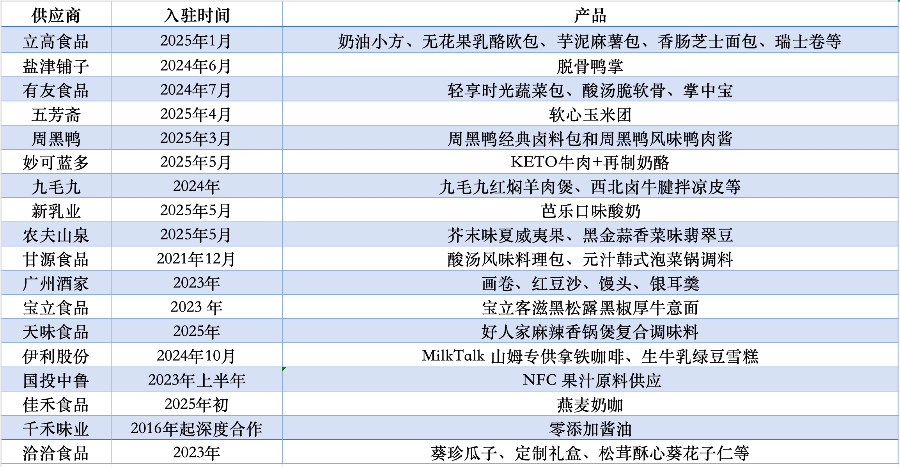
编辑丨骆一帆 不久前,山姆上架好丽友、溜溜梅、卫龙等产品引发舆论风波,被吐槽"选品不上心"(回顾→山姆上新,会员吵翻)。山姆背 后的中国供应商,也受到较大关注。 据21世纪经济报道记者不完全统计,目前与山姆有合作关系的国内上市食品类企业至少有18家,大部分企业为近两年新入驻。 | 供应商 | 入驻时间 | 产品 | | --- | --- | --- | | 立高食品 | 2025年1月 | 奶油小方、无花果乳酪欧包、芋泥麻薯包、香肠芝士面包、瑞士卷等 | | 盐津铺子 | 2024年6月 | 脱骨鸭掌 | | 有友食品 | 2024年7月 | 轻享时光蔬菜包、酸汤脆软骨、掌中宝 | | 五方向 | 2025年4月 | 软心玉米团 | | 周黑鸭 | 2025年3月 | 周黑鸭经典卤料包和周黑鸭风味鸭肉酱 | | 妙可蓝多 | 2025年5月 | KETO牛肉+再制奶酪 | | 九毛九 | 2024年 | 九毛九红焖羊肉煲、西北卤牛腿拌凉皮等 | | 新乳业 | 2025年5月 | 芭乐口味酸奶 | | 农夫山泉 | 2025年5月 | 芥末味夏威夷果、黑金蒜香菜味翡翠豆 | | 甘源食品 | 2021年12 ...
山姆背后中国供应商曝光
21世纪经济报道· 2025-08-05 12:41
Core Viewpoint - The article discusses the recent controversy surrounding Sam's Club's product selection, highlighting the impact on its Chinese suppliers, with at least 18 listed food companies collaborating with Sam's Club, most of which are recent entrants [1][2]. Supplier Overview - A list of suppliers and their products is provided, indicating the entry dates and specific items offered, showcasing a diverse range of food products [2]. - Some suppliers, like Youyou Foods, have seen significant revenue increases after entering Sam's Club, while others have struggled with declining profits [2][5]. Business Impact - Entering Sam's Club can be a double-edged sword for suppliers. While it offers exposure and potential sales growth, it also imposes challenges such as long payment terms and pressure to lower prices [3][10]. - Youyou Foods reported a projected revenue increase of 40.91% to 50.77% for the first half of 2025, largely attributed to the success of its "deboned duck feet" product [5][7]. - Conversely, companies like Ganyuan Foods have faced declining profits since entering Sam's Club, with a projected net profit drop of 54.96% to 56.16% for the first half of the year [13]. Strategic Considerations - Brands must evaluate their operational capabilities before entering Sam's Club to avoid losing control over their development in pursuit of short-term gains [3][10]. - The stringent quality management and product customization required by Sam's Club can create operational pressures for suppliers, particularly smaller companies [14]. Market Dynamics - The article notes that suppliers may experience increased accounts receivable due to the nature of Sam's Club's payment structure, as seen with Youyou Foods' accounts receivable rising 18 times year-over-year [10]. - The competitive landscape is further complicated by Sam's Club's strict product approval process, which can limit suppliers' ability to sell similar products through other channels [13][14].