
上海家化

Search documents
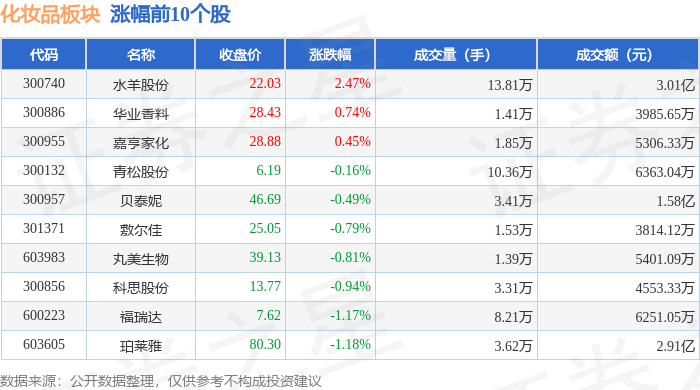
化妆品板块9月22日跌1%,芭薇股份领跌,主力资金净流出1.25亿元
Zheng Xing Xing Ye Ri Bao· 2025-09-22 08:53
Group 1 - The cosmetics sector experienced a decline of 1.0% on September 22, with Bavi Co. leading the drop [1] - The Shanghai Composite Index closed at 3828.58, up 0.22%, while the Shenzhen Component Index closed at 13157.97, up 0.67% [1] - Major stocks in the cosmetics sector showed mixed performance, with Water Sheep Co. increasing by 2.47% to a closing price of 22.03, while Bavi Co. fell by 3.63% to 18.33 [2][1] Group 2 - The cosmetics sector saw a net outflow of 125 million yuan from institutional investors, while retail investors contributed a net inflow of 118 million yuan [2] - The table of fund flows indicates that Water Sheep Co. had a net inflow of 13.54 million yuan from institutional investors, while Bavi Co. experienced a net outflow of 1.47 million yuan [3][2] - The overall market sentiment in the cosmetics sector appears cautious, with significant net outflows from major stocks [3]

研判2025!中国爽身粉产业链、发展背景、销售规模、竞争格局及发展趋势分析:成分安全成为消费者的首要关切点[图]
Chan Ye Xin Xi Wang· 2025-09-22 01:24
Overview - The demand for body powder has been increasing due to rising national income levels and health awareness, particularly among female consumers and the elderly [1][8] - In 2022, China's body powder sales reached 482 million yuan, a year-on-year increase of 1.69%, but in 2023, sales declined to 467 million yuan, a decrease of 3.01% [1][8] - The sales decline is expected to slow in 2024, with projected sales of 456 million yuan, a decrease of 2.40% year-on-year [1][8] Industry Chain - The upstream of the body powder industry includes suppliers of raw materials such as talc, corn starch, and packaging materials [4] - The midstream consists of body powder manufacturing companies, while the downstream includes sales channels like supermarkets, specialty stores, and e-commerce platforms [4] Consumer Demographics - The consumer age structure shows that infants (0-3 years) account for 50% of the market, adults (18-55 years) make up about 32%, and the elderly (55 years and above) represent around 10% [5] - Safety of ingredients is the primary concern for over 70% of consumers, with a strong preference for "talc-free" products [5] Regulatory Environment - The body powder industry is facing stricter regulations due to the "Healthy China" initiative, with various policies aimed at improving product safety and quality [6] Market Trends - The body powder market is shifting towards natural ingredients like corn starch and bamboo charcoal, with a growing demand for multifunctional products that offer additional benefits such as moisturizing and soothing [6][10] - The industry is expected to become more segmented, with customized products for different age groups and skin types [10] Competitive Landscape - The market is highly competitive, featuring both international brands like Johnson & Johnson and domestic brands such as Red Elephant and Shanghai Jahwa [9] - Shanghai Shangmei and Shanghai Jahwa are notable players, with significant revenue and product offerings in the body powder segment [9][10]


化妆品医美行业周报:双11大促预计国货持续高增,建议布局强阿尔法标的-20250921
Shenwan Hongyuan Securities· 2025-09-21 14:12
Investment Rating - The report initiates coverage with a "Buy" rating for the company Water Sheep Co., Ltd. [14] Core Insights - The cosmetics and medical beauty sector has underperformed the market, with the Shenwan Beauty Care Index declining by 2.5% from September 12 to September 19, 2025 [3][4] - The upcoming Double 11 shopping festival is expected to drive significant growth for domestic brands, with recommendations to focus on strong alpha stocks [9][10] - Water Sheep Co., Ltd. is highlighted for its dual business model of proprietary and CP brands, with stable revenue projections of 4-5 billion yuan from 2021 to 2024 and an expected gross margin of 63.01% in 2024 [10][11] Summary by Sections Industry Performance - The cosmetics and medical beauty sector has shown weaker performance compared to the market, with specific indices declining [3][4] - The Shenwan Cosmetics Index fell by 2.6%, while the Shenwan Personal Care Index decreased by 0.6% [4][6] Upcoming Events - The Double 11 shopping festival preparations are in full swing, with domestic brands like Up Beauty and Proya launching new products to capture market share [9] - Key influencers are negotiating promotional strategies to enhance sales during the festival [9] Company Focus: Water Sheep Co., Ltd. - Water Sheep Co., Ltd. is positioned as a leading tech-driven beauty company with a stable revenue forecast and improving profit margins [10][11] - The company has a well-structured brand matrix and is expanding its high-end product lines, with significant growth in its proprietary brands [11][12] - Expected net profits for Water Sheep Co., Ltd. are projected to be 258 million, 331 million, and 398 million yuan for 2025, 2026, and 2027, respectively, indicating substantial growth [14] Market Trends - The Chinese beauty market is witnessing a shift towards domestic brands, with significant market share gains for local players [27] - The overall retail sales of cosmetics showed a growth of 5.1% in August 2025, indicating a recovery in consumer spending [18][21] International Recognition - Chinese beauty brands performed notably at the IFSCC conference, showcasing their advancements in cosmetic science and securing significant awards [22][24]



2025年中国洗发护发行业产业链图谱、发展现状、线上交易额、企业格局及发展趋势研判:线上渠道主导行业增长,防脱与头皮护理赛道打开增量空间[图]
Chan Ye Xin Xi Wang· 2025-09-21 01:21
Core Insights - The Chinese hair care industry is experiencing steady growth, with market size projected to increase from 57.3 billion yuan in 2019 to 67.8 billion yuan in 2024, and expected to surpass 70 billion yuan due to the release of Z-generation scenario-based demands and technological advancements [1][6][7] - Online channels have become the dominant sales platform, with online transaction volume expected to exceed 34.037 billion yuan in the first half of 2025, reflecting a year-on-year growth of 20.67% [7][8] - The competitive landscape is characterized by international giants like Procter & Gamble, L'Oréal, and Unilever leading the market, while domestic brands are carving out niches through differentiated competition [1][6][9] Industry Overview - Hair care involves cleaning the scalp and hair while providing nutrition to maintain health and aesthetics, encompassing both washing and conditioning processes [2] - The industry is structured in three layers: upstream (raw materials and packaging), midstream (product manufacturing), and downstream (sales and consumption) [5][6] Market Dynamics - The market is driven by three main product categories: hair cleansing, care, and dyeing/perm, with men's hair care showing significant growth [1][8] - The market is witnessing a shift towards more precise consumer demands, with over 80% of consumers experiencing scalp health issues, leading to notable growth in functional segments like anti-hair loss and scalp care [8][9] Competitive Landscape - The market is dominated by international brands, which hold over 50% market share, while domestic brands are gradually increasing their presence through targeted strategies [9][10] - In the online market, domestic brands occupy 12 out of the top 20 positions, but international brands still account for 80% of market share, indicating a strong competitive edge for established players [10][11] Future Trends - The industry is expected to evolve around three main directions: technology-driven product upgrades, market segmentation, and the rise of domestic brands [12][13] - Technological advancements such as biotechnologies and AI will facilitate a shift from basic cleaning to precision care, enhancing product efficacy and customization [13] - The market will see further segmentation based on demographics and usage scenarios, with live-streaming e-commerce playing a crucial role in reaching consumers [14][15]

上海出台化妆品产业高质量发展新政 多维度发力助推“沪妆”走向世界
Zheng Quan Ri Bao Wang· 2025-09-19 13:45
Core Viewpoint - The Shanghai municipal government has approved measures to promote the high-quality development of the cosmetics industry, positioning it as one of the six key industries for development in the city, aiming to enhance the global competitiveness of "Shanghai-made" cosmetics [1][2]. Group 1: Policy Measures and Industry Impact - The newly introduced measures address critical gaps in the domestic cosmetics industry, with local brands holding 22 out of the top 50 but only capturing 39.98% of total retail sales [2]. - The measures emphasize multi-dimensional development paths, including market opportunity capture, product variety enhancement, quality improvement, and brand creation [2]. - The focus on technological empowerment and innovation aims to integrate traditional and modern cultural elements into "national trend products" [2][3]. Group 2: Local Company Initiatives - Shanghai Jahwa United Co., Ltd. is leveraging the new policies to enhance its brand "Herborist," which has successfully entered international markets, including flagship stores in Europe [2]. - On the other hand, Shanghai-based company Shiseido's Smart Manufacturing initiative is set to launch a smart factory with an investment of 300 million yuan, featuring AI-driven production capabilities [3]. Group 3: Industry Cluster Advantages - The "Oriental Beauty Valley" in Fengxian District hosts over one-third of Shanghai's cosmetics companies, contributing to a nearly 100 billion yuan industry scale and serving as the largest cosmetics import-export port in China [4]. - The Fengxian Customs has implemented measures to enhance efficiency in customs processes, with cosmetics import-export value reaching 905 million yuan in the first half of the year, a 7.18% increase year-on-year [4]. - The industry benefits from a combination of cluster advantages, innovation in research and development, and access to international resources, which are essential for enhancing global brand influence [4].
中国美妆科研“申奥”成功!2032年IFSCC大会将在上海举办
FBeauty未来迹· 2025-09-19 13:42
Core Viewpoint - The 35th IFSCC Congress, themed "The Future is Science," was held in Cannes, France, showcasing the advancements in cosmetic science and technology, with China winning the bid to host the 2032 Congress in Shanghai, marking a historic moment for the Chinese beauty industry [3][4][5]. Group 1: Event Highlights - The IFSCC Congress is recognized as the "Nobel Prize" of the cosmetics industry, with over 16,000 members from 81 countries [3]. - The 2032 Congress will be the first to take place in China, emphasizing the country's growing influence in global cosmetic science [4][5]. - The successful bid was achieved with a vote of 9 to 5 against the South Korean chapter, highlighting China's preparedness and recognition in the field [5][7]. Group 2: China's Performance in IFSCC - China's participation in recent IFSCC events has significantly increased, with impressive numbers in attendance and submissions, indicating a shift from being a "follower" to a "core player" in the IFSCC [8][9]. - In 2024, China had 145 attendees (11.6% of total) and ranked second in poster submissions, showcasing its growing research capabilities [9]. - The China-SCC, established in 2015, has seen membership grow to over 600, with expectations to exceed 1,000 by 2027, reflecting the rapid development of the Chinese cosmetic science community [10][12]. Group 3: Research Contributions - Chinese companies have made significant contributions to IFSCC, with a doubling of submissions in 2024 compared to 2023, and a record number of high-quality submissions in 2025 [16]. - In 2025, China submitted 335 papers, surpassing the host country France's 205 submissions, indicating a strong presence in the Asia-Pacific region [16]. - Notable achievements include the recognition of Pechoin, which has won multiple international awards and has a substantial number of research papers published [19][21]. Group 4: Future Implications - Hosting the 2032 IFSCC Congress is seen as a milestone for the Chinese beauty industry, showcasing its capabilities as a research powerhouse and enhancing global collaboration [13][15]. - The event will provide opportunities for Chinese companies to engage with global leaders, accelerating the globalization of the industry [15]. - The recognition of IFSCC awards and the rigorous selection process further validate the quality of Chinese research contributions, positioning them as influential players in the future of the cosmetics industry [24].
化妆品板块9月18日跌2.24%,拉芳家化领跌,主力资金净流出3.85亿元
Zheng Xing Xing Ye Ri Bao· 2025-09-18 08:59
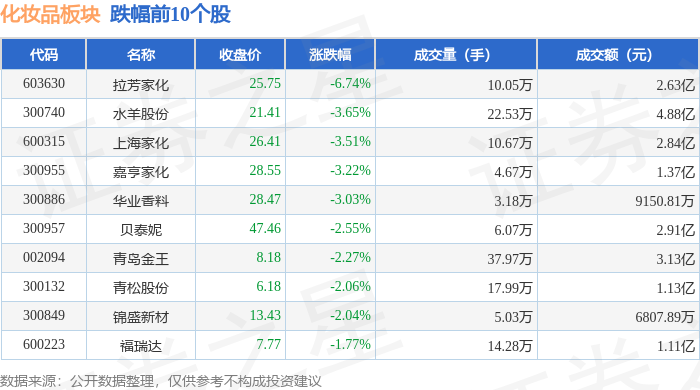
Market Overview - The cosmetics sector experienced a decline of 2.24% on September 18, with Lafang Jiahua leading the drop [1] - The Shanghai Composite Index closed at 3831.66, down 1.15%, while the Shenzhen Component Index closed at 13075.66, down 1.06% [1] Individual Stock Performance - Lafang Jiahua (603630) closed at 25.75, down 6.74% with a trading volume of 100,500 shares and a turnover of 263 million yuan [1] - Shuiyang Co. (300740) closed at 21.41, down 3.65% with a trading volume of 225,300 shares [1] - Shanghai Jahwa (600315) closed at 26.41, down 3.51% with a trading volume of 106,700 shares [1] - Other notable declines include Jiaheng Jiahua (300955) down 3.22% and Beitaini (300957) down 2.55% [1] Capital Flow Analysis - The cosmetics sector saw a net outflow of 385 million yuan from institutional investors, while retail investors contributed a net inflow of 363 million yuan [1] - The table indicates that retail investors were more active, with a net inflow of 21.49 million yuan in Lafang Jiahua despite its overall decline [2] - Notable net outflows from institutional investors were observed in companies like Beitaini and Furuida, with outflows of 15.90 million yuan and 20.48 million yuan respectively [2]

上海家化布局合成生物学创新研发中心,未来希望实现商业转化
2 1 Shi Ji Jing Ji Bao Dao· 2025-09-18 06:08
Core Insights - Shanghai Jahwa, a leading daily cosmetics company in A-shares, has established an innovative research and development center focusing on synthetic biology, disruptive innovation, and commercial value transformation [1] Group 1: Company Developments - The newly established Shanghai Jahwa Innovation R&D Center for Synthetic Biology marks a significant advancement in the company's R&D capabilities, shifting focus from product development to raw materials and beauty technology [1] - The center aims to enhance the company's emphasis on synthetic biology and disruptive innovation, indicating a strategic pivot in its research approach [1]
专访上海家化首席研发官贾海东:重押“中国成分”与合成生物
2 1 Shi Ji Jing Ji Bao Dao· 2025-09-18 06:08
Core Viewpoint - Shanghai Jahwa has successfully registered five new raw materials with the National Medical Products Administration, focusing on the development and application of Chinese characteristic plants, which is seen as a significant opportunity for the company to leverage its unique resources in the beauty industry [1][2]. Group 1: R&D Strategy and Achievements - The company reported a revenue of 3.478 billion yuan in the first half of 2025, representing a year-on-year growth of 4.75%, while the net profit attributable to shareholders was 266 million yuan, up 11.66% [1]. - R&D expenses increased by 26% during the same period, reflecting the company's commitment to innovation and development [1][11]. - The R&D structure is divided into three main areas: basic research, product development, and project support, covering the entire process from raw material development to product quality control [3]. Group 2: Focus on Chinese Characteristic Plants - The company aims to deepen the research and application of Chinese characteristic plants, which are perceived as complex systems with multiple components and mechanisms, rather than relying on single-target research approaches [4]. - Shanghai Jahwa has established a database for external beauty prescriptions based on traditional Chinese medicine, utilizing AI technology to explore the potential of "Chinese ingredients" [4]. Group 3: Collaboration and Innovation - The company has partnered with the Chinese Academy of Traditional Chinese Medicine to establish a joint laboratory focused on the skin health benefits of Artemisia annua and other Chinese characteristic plants [7]. - A new innovation R&D center focusing on synthetic biology has been established, aiming to leverage gene editing and microbial engineering to create new cosmetic ingredients [9][10]. Group 4: AI and Digitalization - The company is exploring AI and digital capabilities, including an AI skin detection program developed in collaboration with Megvii Technology, which analyzes skin conditions based on facial data [11]. - R&D investments have steadily increased from 151 million yuan in 2020 to 179 million yuan in 2024, with a focus on enhancing the R&D system, medical research collaboration, and product innovation [11].
AI网络药理学,帮助打开中国特色植物研究的“黑盒子”
2 1 Shi Ji Jing Ji Bao Dao· 2025-09-18 06:08
Core Viewpoint - The application of AI network pharmacology is essential for understanding the complex systems of traditional Chinese plants, which consist of multiple components, targets, and pathways [1] Company Summary - Shanghai Jahwa (600315.SH) is pioneering the establishment of a database for external beauty formulas based on traditional Chinese medicine, aiming to explore and utilize "Chinese ingredients" [1] - The Chief R&D Officer, Jia Haidong, emphasizes that traditional research methods focusing on single targets and components are insufficient for explaining the efficacy mechanisms of these complex systems [1]