
青岛银行

Search documents
11.19犀牛财经早报:多家公募调整旗下产品风险等级 大疆“密会”百家投资机构
Xi Niu Cai Jing· 2025-11-19 01:37
Group 1 - Public funds are adjusting the risk levels of their products to better match investor suitability following the draft of the "Publicly Raised Securities Investment Fund Investor Suitability Management Guidelines" [1] - Over 90% of public funds have achieved net value growth this year, with 39 products exceeding 100% growth, particularly in the equity mixed fund category [1] - The A-share market's increased risk appetite has led to significant inflows into growth sectors, benefiting actively managed funds through sector rotation and stock selection [1] Group 2 - Several public institutions have warned about the premium risk associated with cross-border ETFs, particularly those tracking foreign indices amid a market correction [2] - The recent adjustments in deposit product structures by small and medium-sized banks indicate a trend away from long-term fixed deposits due to narrowing net interest margins [2] Group 3 - The international gold price has shown volatility, dropping below $4,000 per ounce after reaching a peak of $4,245.22, influenced by changing market sentiments and economic data uncertainties [3] - The "Two Heavy" construction projects are expected to boost infrastructure investment growth as they are prioritized in national strategic planning [4] Group 4 - The market for electrolyte additives is experiencing a recovery, with prices for key products like vinylene carbonate and fluoroethylene carbonate rising due to increased demand from energy storage and power batteries [4] - China's lithium battery shipments are projected to triple over the next decade, driven by strong demand in the power battery and energy storage markets [4] Group 5 - Executives from various local banks have been actively buying shares in their own institutions, indicating confidence in their companies' prospects [5] - DJI has held closed-door meetings with multiple investment institutions but has stated there are no current plans for financing or an IPO [8] Group 6 - The latest financial report from Yamafin Sports shows a 30% increase in revenue for Q3, with a significant 161% rise in net profit, particularly in the Greater China region [9] - China First Heavy Industries announced the arrest of its chairman for bribery, but the company's operations remain normal [9] - ST Lingda has been accepted for reorganization by the court, facing delisting risk while continuing to trade [9]
五载春秋共奋进,勇立潮头再起航 --青银理财成立五周年
2 1 Shi Ji Jing Ji Bao Dao· 2025-11-19 01:08
Core Viewpoint - Qingyin Wealth Management has successfully navigated its first five years by adhering to the principles of the Asset Management New Regulations, focusing on value creation rather than mere scale expansion, and aligning its strategies with the evolving needs of investors and the broader economy [1][2][9] Group 1: Company Development and Strategy - Qingyin Wealth Management was established as the first city commercial bank wealth management subsidiary in Northern China and the sixth nationwide, responding to market demands and the strategic transformation of its parent company, Qingdao Bank [1] - The company has transitioned from a focus on "scale expansion" to "value creation," emphasizing high-quality development and collaboration with its parent bank to enhance wealth management services [2][9] - Over five years, Qingyin Wealth Management has issued 2,820 products, raising a total of 25,283.59 billion yuan and generating 536.40 billion yuan in returns for clients [3] Group 2: Product Innovation - The product offerings have evolved from "single fixed income" to a diversified portfolio, including cash management, fixed income, "fixed income plus," and equity products, catering to the wealth upgrade needs of residents [4] - The "fixed income plus" products have been a strategic focus, achieving an average annualized return of 3.68% over a specific period, outperforming the market average by 69 basis points [4] - The company has launched the "Tianyuan series" of fixed income products aimed at retirement finance, raising over 6.9 billion yuan, with a focus on high-quality bonds and non-standard assets [4][5] Group 3: Service to the Real Economy - Qingyin Wealth Management positions itself as a strategic partner to the real economy, channeling funds into national strategic areas and supporting green finance initiatives [5][6] - The company has pioneered the issuance of carbon-neutral and ESG-themed products, aligning with national goals for sustainable development [5][6] Group 4: Technological Empowerment - The company has implemented a three-step strategy for digital transformation, focusing on online investment trading, data-driven operations, and intelligent management decision-making [7] - Qingyin Wealth Management has developed a proprietary investment trading platform and a big data management system to enhance investment efficiency and risk control [7][8] - The integration of AI technology into research and decision-making processes is being advanced through the development of an intelligent investment research platform [8] Group 5: Future Outlook - The company aims to transition from being a participant in the financial industry to becoming a key institutional investor, driven by policy support, capital market participation, and product innovation [9] - Qingyin Wealth Management will continue to prioritize high-quality development while maintaining steady growth, focusing on professional capabilities and customer needs [9][10]
五载春秋共奋进,勇立潮头再起航——青银理财成立五周年发展纪实
Zhong Guo Zheng Quan Bao· 2025-11-18 23:54
Core Viewpoint - Qingyin Wealth Management has successfully transformed from a scale-driven model to a value-driven approach, focusing on high-quality development and aligning with the asset management regulations since its establishment five years ago [3][12]. Group 1: Company Development - Qingyin Wealth Management was established in 2020 as the first wealth management subsidiary of a city commercial bank in Northern China, following the implementation of the "Regulations on Wealth Management Subsidiaries of Commercial Banks" [1]. - The company has adhered to its founding principle of "trust and manage wealth for others," responding to market demands and supporting the strategic transformation of its parent company, Qingdao Bank [1][3]. Group 2: Business Model Transformation - The company has shifted its business model from "scale expansion" to "value creation," emphasizing high-quality development and compliance with asset management regulations [3]. - Qingyin Wealth Management has expanded its distribution channels from 3 to 104, improving product structure and increasing the proportion of products with a maturity of one year or more by over 11 percentage points since the beginning of the year [3][4]. Group 3: Product Innovation - The product offerings have evolved from "single fixed income" to "diversified allocation," creating a product matrix that includes cash management, fixed income, "fixed income +," equity, and thematic products [5]. - The "fixed income +" products have been a strategic focus, with a controlled risk exposure and a dynamic management approach to enhance returns while managing risks [5][6]. Group 4: Commitment to Investors - Over five years, Qingyin Wealth Management has issued 2,820 products, raising a total of 25,283.59 billion yuan and generating 536.40 million yuan in returns for clients [4]. - The company has successfully managed low-volatility products, with 291 products maturing at a scale of 462 billion yuan, achieving returns that meet or exceed performance benchmarks [4]. Group 5: Service to the Real Economy - Qingyin Wealth Management has positioned itself as a strategic partner for the real economy, directing funds towards national strategic areas and supporting green finance initiatives [8]. - The company has launched various themed products, including carbon neutrality and ESG, with a total issuance of 144 products and a fundraising scale exceeding 18.3 billion yuan [8]. Group 6: Technological Empowerment - The company has implemented a three-step strategy for digital transformation, focusing on online investment trading, data-driven operations, and intelligent management decision-making [9]. - Qingyin Wealth Management has developed a proprietary investment trading platform and a big data platform to enhance investment management efficiency and risk control [9][10]. Group 7: Future Outlook - The company aims to transition from a "scale-first" approach to a focus on "high-quality development" during the 14th Five-Year Plan period, becoming a key institutional investor in the asset management industry [12][13]. - Qingyin Wealth Management will continue to innovate products and upgrade services while maintaining a balance between quality and steady growth, reinforcing its operational foundation and risk resilience [12][13].
地方上市银行高管频频增持自家银行股份
Zheng Quan Shi Bao· 2025-11-18 18:13
Core Viewpoint - The announcement from Hu Nong Commercial Bank indicates significant insider buying by top executives, reflecting confidence in the bank's future performance and aligning with a broader trend of regional banks experiencing similar increases in executive and institutional shareholdings [1]. Group 1: Executive Purchases - Five senior executives of Hu Nong Commercial Bank, including the president and several vice presidents, purchased a total of 259,100 shares from November 13 to November 17, 2025, at prices ranging from 9.02 to 9.08 yuan [1]. - This trend of executive share purchases is not isolated, as other regional banks such as Nanjing Bank, Wuxi Bank, and Suzhou Bank have also seen similar actions from their management teams [1]. Group 2: Institutional Purchases - Qingdao Bank reported that its major shareholder, Qingdao Guoxin Financial Holdings Group Co., Ltd., increased its holdings through the Hong Kong Stock Connect, raising its total stake to 15.42%, making it the largest shareholder of the bank [1]. - In addition, Su Nong Bank's executives plan to purchase at least 1.8 million yuan worth of A-shares within six months starting from November 11, 2025 [1]. - Qilu Bank disclosed that its management has already purchased approximately 3.15 million yuan worth of shares, achieving 90% of its planned increase since announcing its buyback plan in mid-September [1].



地方上市银行高管 频频增持自家银行股份
Zheng Quan Shi Bao· 2025-11-18 18:08
在机构增持方面,青岛银行透露,该行股东青岛国信产融控股(集团)有限公司近期通过港股通渠道增持 该行H股股份,总持股比例增加至15.42%,跃升至该行第一大股东。 今年以来,区域银行频获高管人员和机构股东增持,包括南京银行(601009)、无锡银行(600908)、 苏州银行(002966)、兰州银行(001227)、成都银行(601838)、重庆银行(601963)、青岛银行 (002948)、厦门银行(601187)等。仅11月以来,就有常熟银行(601128)、苏农银行(603323)、 青岛银行、齐鲁银行(601665)等披露了股东和高管团队的增持计划或进展。 11月18日,沪农商行(601825)发布公告称,行长汪明、职工董事应长明、副行长张宏彪、副行长顾贤 斌、副行长兼首席信息官沈栋,共计5名高管人员于2025年11月13日至11月17日期间,以自有资金从二 级市场买入公司普通股股票,合计买入25.91万股股票,成交价格区间为9.02~9.08元。 在管理层增持方面,据苏农银行披露,该行行长王亮、副行长费海滨、耿植计划自2025年11月11日起6 个月内增持该行A股股份不少于180万元。此外,齐鲁银 ...
金融工程日报:沪指震荡走低,锂电产业链回调、互联网电商概念逆势走强-20251118
Guoxin Securities· 2025-11-18 15:37
- The report does not contain any information about quantitative models or factors.
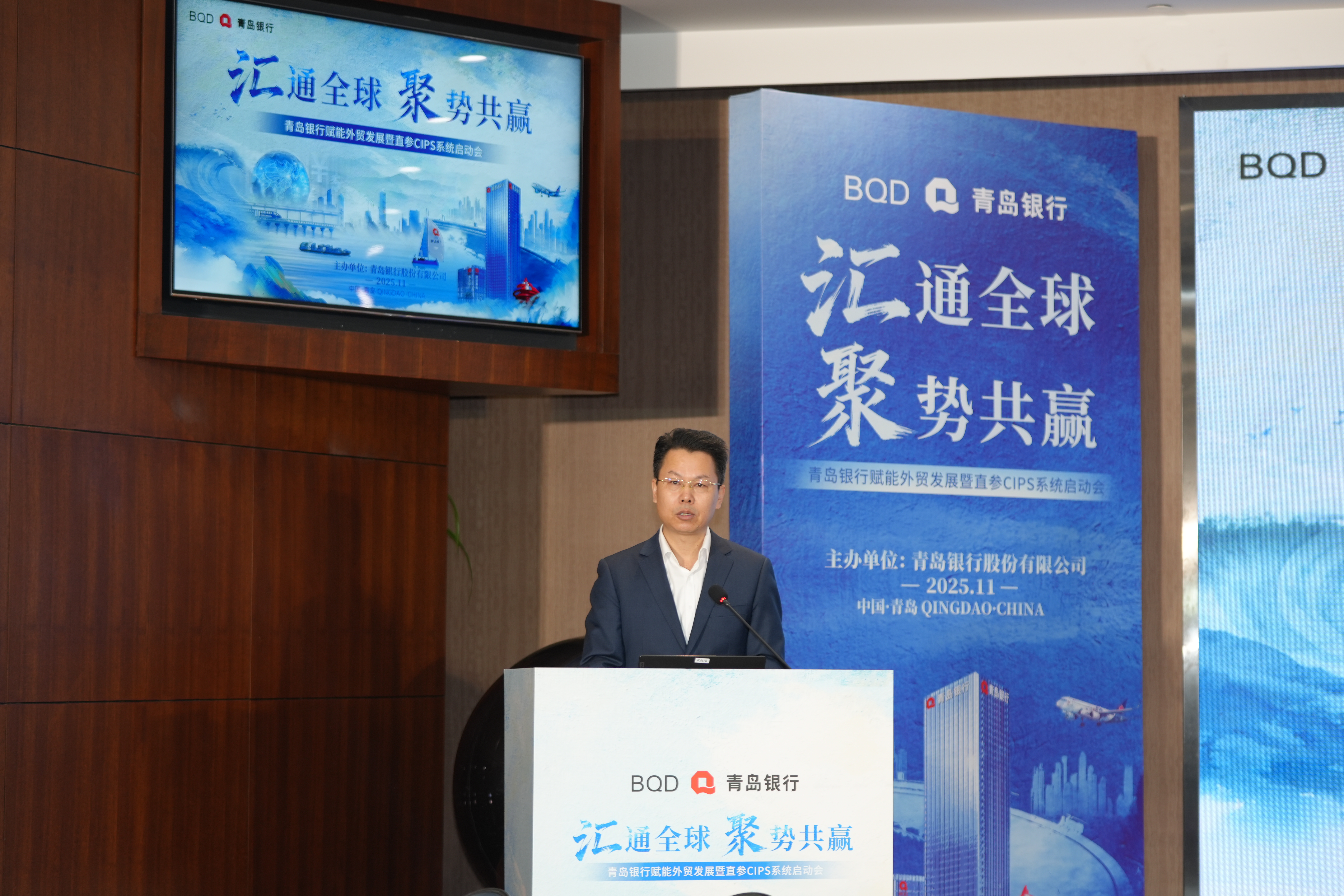
获批全省首家法人银行直参CIPS资格并上线运行,推出17条举措服务青岛高水平开放
Di Yi Cai Jing· 2025-11-18 13:22
Core Viewpoint - Qingdao Bank successfully launched the CIPS direct participation system, aiming to enhance support for foreign trade development and facilitate local brands' international expansion [1][6]. Group 1: International Business Development - Qingdao Bank's international business is projected to exceed $20 billion by 2025, representing a 40% year-on-year growth, serving over 5,000 enterprises [5]. - The cross-border RMB settlement volume is expected to surpass 50 billion yuan, with a year-on-year increase of 52% [5]. Group 2: CIPS System Launch - The CIPS system is a crucial infrastructure for RMB cross-border payment, providing secure, efficient, and low-cost settlement services [6]. - Qingdao Bank is the first legal entity bank in Shandong to obtain direct participation in the CIPS system, enabling point-to-point cross-border RMB clearing [6]. Group 3: Financial Products and Services - Qingdao Bank has developed a comprehensive service system for foreign trade enterprises, including products like "Qingyin Huaitong," "Qingyin Maodai," "Qingyin Huiying," and "Qingyin Chuhaitong" [5]. - The bank launched a white paper outlining 17 key measures to support foreign trade, addressing challenges such as financing difficulties and slow settlements [10]. Group 4: Collaborative Efforts - Qingdao Bank signed a joint action declaration with the Shandong branch of China Export & Credit Insurance Corporation and Qingdao Financing Guarantee Group to support high-quality development of foreign trade enterprises [10]. - The event was supported by CIPS and various financial institutions, highlighting a collaborative approach to enhance cross-border financial services [13]. Group 5: Future Outlook - Qingdao Bank plans to optimize cross-border financial products and services, leveraging the CIPS system to contribute to RMB internationalization and high-level opening-up [16].

银行业转型攻坚:以自身变革做好金融“五篇大文章”
Zhong Guo Zheng Quan Bao· 2025-11-17 20:12
Core Viewpoint - The article emphasizes the need for the banking industry in China to adapt to profound changes in the economic and social environment, focusing on risk prevention, regulatory strength, and high-quality development in line with the "14th Five-Year Plan" [1][5]. Group 1: Financial Industry Development - The total assets of China's banking financial institutions reached 474.3 trillion yuan by the end of Q3 [1]. - The banking sector is tasked with supporting China's modernization while pursuing its own high-quality development and structural transformation [1]. - The "14th Five-Year Plan" suggests a strong focus on developing technology finance, green finance, inclusive finance, elderly finance, and digital finance [1]. Group 2: Financial Services and Innovation - Financial institutions are encouraged to enhance their service capabilities to support the construction of a modern industrial system and new productive forces [2]. - The Industrial and Commercial Bank of China plans to refine its strategic planning and strengthen its risk management system [2]. - China Bank reported a technology loan balance of 4.7 trillion yuan, with over 83 billion yuan provided in comprehensive services [2]. Group 3: Competition and Regulatory Environment - The banking sector faces intensified competition from internet technology companies and internal industry rivalry [3]. - The "14th Five-Year Plan" calls for optimizing the financial institution system and promoting differentiated development to avoid homogenized competition [3]. - Regulatory authorities will guide banks to adopt differentiated development paths based on their resources and market positioning [3]. Group 4: Strategic Adjustments for Small and Medium Banks - Small and medium-sized banks are advised to adjust their strategic direction to embrace new economies and serve new driving forces [4]. - These banks should focus on strategic emerging industries and enhance their risk management capabilities [4]. Group 5: Strengthening Financial Regulation - The "14th Five-Year Plan" emphasizes comprehensive financial regulation and the establishment of a risk prevention and resolution system [5]. - Regulatory efforts will focus on proactive warning, comprehensive coverage, and precise measures to maintain financial stability [5]. - The rise of artificial intelligence is expected to enhance early identification and management of financial risks [5]. Group 6: Legal and Regulatory Framework - Financial legal construction is deemed essential for the development of the banking industry [6]. - Regulatory frameworks need to adapt to the rapid development of financial technology and the complexities of financial products [6].
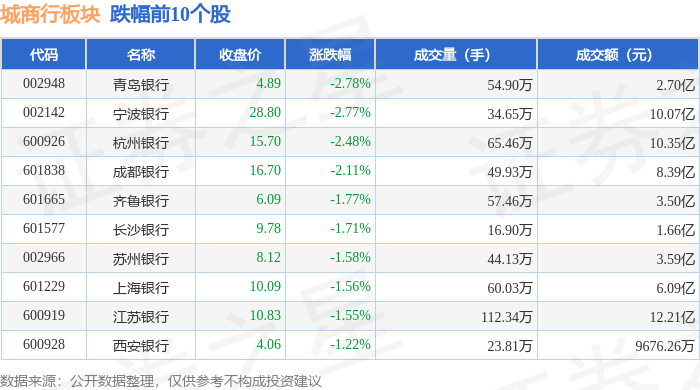
城商行板块11月17日跌1.61%,青岛银行领跌,主力资金净流出3034.02万元
Zheng Xing Xing Ye Ri Bao· 2025-11-17 08:49
Core Viewpoint - The city commercial bank sector experienced a decline of 1.61% on November 17, with Qingdao Bank leading the drop, reflecting broader market trends as the Shanghai Composite Index fell by 0.46% and the Shenzhen Component Index decreased by 0.11% [1] Market Performance - The closing prices and percentage changes for key city commercial banks are as follows: - Qingdao Bank: 4.89, -2.78% - Ningbo Bank: 28.80, -2.77% - Hangzhou Bank: 15.70, -2.48% - Chengdu Bank: 16.70, -2.11% - Qilu Bank: 6.09, -1.77% - Changsha Bank: 9.78, -1.71% - Suzhou Bank: 8.12, -1.58% - Shanghai Bank: 10.09, -1.56% - Jiangsu Bank: 10.83, -1.55% - Xi'an Bank: 4.06, -1.22% [1] Capital Flow - The city commercial bank sector saw a net outflow of 30.34 million yuan from main funds, while speculative funds had a net inflow of 176 million yuan, and retail investors experienced a net outflow of 146 million yuan [1] - Detailed capital flow for selected banks includes: - Qilu Bank: Main net inflow of 67.43 million yuan, speculative net outflow of 26.97 million yuan, retail net outflow of 40.45 million yuan - Suzhou Bank: Main net inflow of 30.20 million yuan, speculative net inflow of 16.46 million yuan, retail net outflow of 46.66 million yuan - Hangzhou Bank: Main net inflow of 27.96 million yuan, speculative net inflow of 61.97 million yuan, retail net outflow of 89.93 million yuan - Qingdao Bank: Main net inflow of 19.35 million yuan, speculative net inflow of 24.55 million yuan, retail net outflow of 43.90 million yuan [2]
年内十余家上市银行 获股东增持
Zhong Guo Ji Jin Bao· 2025-11-17 07:31
Group 1 - Over 10 listed banks have seen significant shareholding increases from shareholders and executives this year, indicating a broader scale of buybacks compared to previous years [1][2] - The increase in shareholding is characterized by a diverse range of stakeholders and a concentration of banks in specific regions [1][3] - This year's buyback activity is occurring during a market uptrend, contrasting with previous years when buybacks were initiated after stock prices fell below net asset value, signaling a shift from defensive to proactive investment strategies [1][4] Group 2 - Notable examples include Changshu Bank, which saw an increase of 561.93 million shares, raising its shareholder's stake to 3.98%, and Qilu Bank, where executives have collectively increased their holdings by approximately 315,000 yuan [2][3] - The participation of local state-owned enterprises has notably increased, with foreign investments also contributing, such as BNP Paribas increasing its stake in Nanjing Bank from 16.14% to 17.02% [3][4] - The overall performance of the banking sector has improved, with 42 A-share listed banks reporting over 4.3 trillion yuan in revenue for the first three quarters, and more than 60% of these banks showing year-on-year revenue growth [4]