跨境ETF溢价

Search documents
部分跨境ETF午后大涨,港股通50ETF涨停
Mei Ri Jing Ji Xin Wen· 2025-12-24 06:33
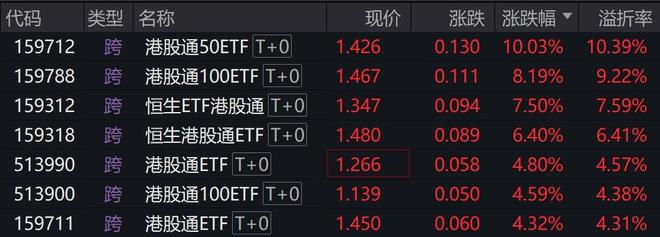
Group 1 - The core viewpoint of the news highlights a significant increase in cross-border ETFs, with the Hong Kong Stock Connect 50 ETF hitting the upper limit, while the Hong Kong Stock Connect 100 ETF and Hang Seng ETF saw gains exceeding 7%, albeit with substantial premiums [1] - Due to the Christmas holiday, the Hong Kong stock market will be closed from December 24 (Wednesday) afternoon, with trading resuming on December 29 (Monday) [1] Group 2 - Specific performance data shows the following ETFs: - Hong Kong Stock Connect 50 ETF (code: 159712) rose by 10.03% to a price of 1.426 with a premium rate of 10.39% [2] - Hong Kong Stock Connect 100 ETF (code: 159788) increased by 8.19% to 1.467 with a premium rate of 9.22% [2] - Hang Seng ETF (code: 159312) gained 7.50% to 1.347 with a premium rate of 7.59% [2] - Other ETFs also showed positive performance, with varying increases and premium rates [2] - Analysts suggest that investors should be cautious of the premium risk in the secondary market, as purchasing at high premiums may lead to significant losses [2]

月内公募基金超200份公告提示跨境ETF溢价风险
Zheng Quan Ri Bao· 2025-12-09 16:16
Core Viewpoint - Multiple public fund institutions, including E Fund, Huaxia Fund, and Southern Fund, have issued warnings regarding the premium risk in the secondary market trading of their cross-border ETFs, highlighting significant price premiums over the net asset value [1][2] Group 1: Premium Risk in Cross-Border ETFs - As of December 9, the Southern S&P 500 ETF (QDII) closed at 1.804 yuan, reflecting a premium of 3.41% over its reference net asset value of 1.7445 yuan [1] - Other ETFs tracking the same index, such as Bosera S&P 500 ETF, Guotai S&P 500 ETF, and Huaxia S&P 500 ETF (QDII), also exhibited premiums of 5.58%, 4.87%, and 2.92% respectively [1] - A total of 14 public fund institutions have issued over 200 premium risk warning announcements since December [2] Group 2: Factors Contributing to Premiums - The premium phenomenon is attributed to supply-demand imbalances, limited arbitrage opportunities, and market sentiment [2] - Increased global allocation demand from domestic investors has led to a scarcity of popular products, exacerbating the premium situation [2] - The complexities of cross-border ETF trading, including time differences, exchange rates, and redemption costs, hinder effective arbitrage, contributing to persistent premiums [2] Group 3: Market Growth and Investor Behavior - The total scale of cross-border ETFs has surged from 424.22 billion yuan at the beginning of the year to 939.09 billion yuan by December 9, indicating a growing demand for diversified global asset allocation among domestic investors [2] - Investors are increasingly seeking to mitigate single market volatility risks and optimize portfolio returns through cross-border ETFs [2] Group 4: Recommendations for Investors - Investors holding or planning to invest in cross-border ETFs should analyze the premium situation rationally, as high premiums indicate prices above net asset values, which could lead to losses if premiums converge [3] - It is advised to avoid chasing high premiums and to monitor real-time net asset values and estimated values [3] - Investors may consider gradually selling or switching to similar products, and those looking to invest in cross-border ETFs might prioritize off-market QDII funds or alternative products, potentially using a dollar-cost averaging strategy [3][4]
11.19犀牛财经早报:多家公募调整旗下产品风险等级 大疆“密会”百家投资机构
Xi Niu Cai Jing· 2025-11-19 01:37
Group 1 - Public funds are adjusting the risk levels of their products to better match investor suitability following the draft of the "Publicly Raised Securities Investment Fund Investor Suitability Management Guidelines" [1] - Over 90% of public funds have achieved net value growth this year, with 39 products exceeding 100% growth, particularly in the equity mixed fund category [1] - The A-share market's increased risk appetite has led to significant inflows into growth sectors, benefiting actively managed funds through sector rotation and stock selection [1] Group 2 - Several public institutions have warned about the premium risk associated with cross-border ETFs, particularly those tracking foreign indices amid a market correction [2] - The recent adjustments in deposit product structures by small and medium-sized banks indicate a trend away from long-term fixed deposits due to narrowing net interest margins [2] Group 3 - The international gold price has shown volatility, dropping below $4,000 per ounce after reaching a peak of $4,245.22, influenced by changing market sentiments and economic data uncertainties [3] - The "Two Heavy" construction projects are expected to boost infrastructure investment growth as they are prioritized in national strategic planning [4] Group 4 - The market for electrolyte additives is experiencing a recovery, with prices for key products like vinylene carbonate and fluoroethylene carbonate rising due to increased demand from energy storage and power batteries [4] - China's lithium battery shipments are projected to triple over the next decade, driven by strong demand in the power battery and energy storage markets [4] Group 5 - Executives from various local banks have been actively buying shares in their own institutions, indicating confidence in their companies' prospects [5] - DJI has held closed-door meetings with multiple investment institutions but has stated there are no current plans for financing or an IPO [8] Group 6 - The latest financial report from Yamafin Sports shows a 30% increase in revenue for Q3, with a significant 161% rise in net profit, particularly in the Greater China region [9] - China First Heavy Industries announced the arrest of its chairman for bribery, but the company's operations remain normal [9] - ST Lingda has been accepted for reorganization by the court, facing delisting risk while continuing to trade [9]
公募机构密集提示跨境ETF高溢价风险
Zheng Quan Ri Bao· 2025-11-18 16:17
Core Viewpoint - Investors should be cautious of the premium risk associated with cross-border ETFs, as recent market conditions indicate a potential overvaluation of these products [1][4]. Group 1: Premium Risks - Multiple public fund institutions have issued warnings regarding premium risks for their cross-border ETFs, particularly those tracking overseas indices like the US and Japan [1][2]. - As of November 18, 34 cross-border investment products from 19 public fund institutions have issued over 330 premium risk alerts, with specific ETFs like the Huaxia Nikkei 225 ETF showing significant premium levels [2][4]. - The average premium rate for 192 cross-border ETFs was 0.79%, with 32 ETFs exceeding 1% and 2 ETFs surpassing 10% [4]. Group 2: Market Conditions - Major overseas indices are experiencing corrections, with the Nikkei 225 index down 3.22% and the Nasdaq, S&P 500, and Dow Jones indices also showing declines in November [4]. - Despite short-term risks, there remains a strong long-term demand for cross-border ETFs, with a net inflow of 34.105 billion yuan in November and a 116.86% increase in total scale to 919.949 billion yuan this year [2][4]. Group 3: Investment Strategies - Analysts emphasize the importance of rational investment frameworks, suggesting that while cross-border ETFs can diversify risks, the focus should be on enhancing research capabilities and investor education rather than merely expanding scale [4][5]. - Investors are advised to maintain a net asset value orientation and a long-term perspective to benefit from global investments, especially in volatile market conditions [5].
软件ETF领涨;跨境ETF频频溢价丨ETF晚报
2 1 Shi Ji Jing Ji Bao Dao· 2025-11-17 11:08
ETF Industry News Summary - The three major indices experienced fluctuations and declines, with the Shanghai Composite Index down 0.46%, the Shenzhen Component Index down 0.11%, and the ChiNext Index down 0.2%. Several software ETFs saw gains exceeding 2% [1] - Cross-border ETFs frequently showed premiums, with multiple products having premium rates exceeding 6%. The enthusiasm for investing in overseas ETFs remains high, particularly for new products like the recently launched Brazilian cross-border ETF. The premium situation is attributed to supply-demand imbalances in the secondary market and insufficient QDII quotas from fund companies [1] - The domestic ETF market has seen significant growth, with the number of newly established ETFs and their issuance scale both reaching historical highs. In 2025, the number of new ETFs exceeded 300, totaling 320, and the issuance scale reached 249.68 billion yuan, surpassing previous years [2] - The stock-type ETFs dominated the new issuance with 282 funds and a scale of 154.68 billion yuan, while bond-type ETFs also made a notable impact with 32 new funds and a scale of 91.48 billion yuan, accounting for 36.75% of the total issuance [2] Market Performance Overview - On November 17, the three major indices collectively declined, with the Shanghai Composite Index closing at 3972.03 points, the Shenzhen Component Index at 13202.0 points, and the ChiNext Index at 3105.2 points. The highest intraday points were 3992.4, 13251.78, and 3120.73 respectively [3] - In terms of sector performance, the computer, defense, and coal sectors ranked highest with daily gains of 1.67%, 1.59%, and 1.32% respectively, while the pharmaceutical, banking, and non-bank financial sectors lagged with declines of -1.73%, -1.31%, and -1.11% [7] - The bond-type ETFs showed the best average performance with a daily change of 0.03%, while commodity-type ETFs had the worst performance with an average decline of -2.10% [8] ETF Specific Performance - The top-performing ETFs included rare metal ETFs, with daily gains of 3.68%, 3.66%, and 3.22% for different funds. Software ETFs also performed well, with gains of 2.56% and 2.42% for specific funds [10][11] - The trading volume for stock-type ETFs was led by the CSI A500 ETF with a transaction amount of 4.809 billion yuan, followed by the A500 ETF fund at 4.750 billion yuan and the A500 ETF Huatai at 4.465 billion yuan [13][14]
跨境ETF密集发布溢价提示 短期错配频现 追高买入风险大
Zheng Quan Shi Bao Wang· 2025-11-16 23:56
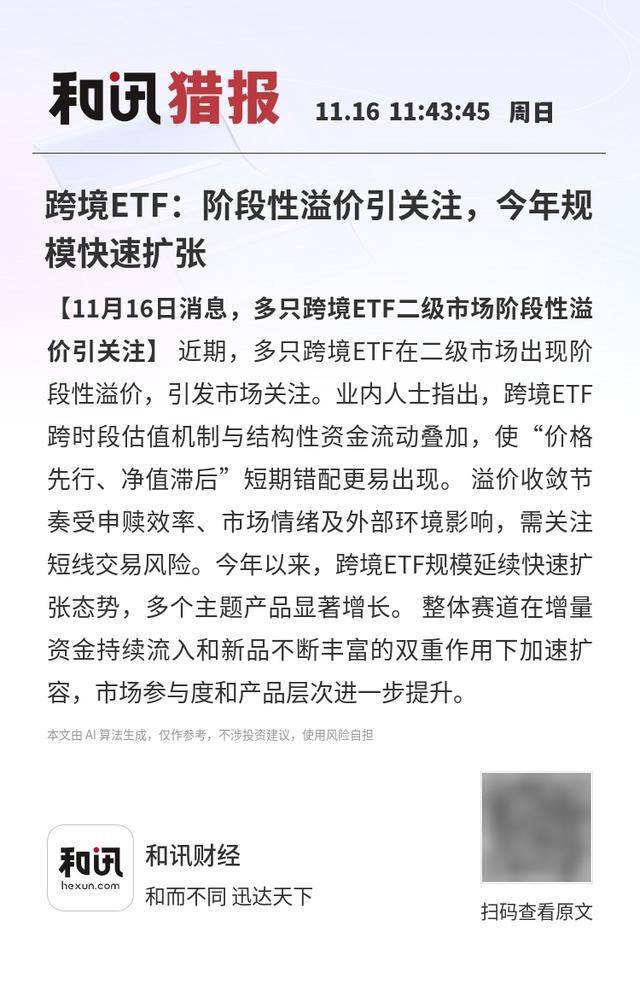
Core Viewpoint - Recent observations indicate that multiple cross-border ETFs have experienced temporary premiums in the secondary market, attracting market attention [1] Group 1: Market Dynamics - The cross-border ETF valuation mechanism, combined with structural capital flows, leads to a situation where "prices lead and net values lag," making short-term mismatches more likely [1] - The pace of premium convergence is influenced by redemption efficiency, market sentiment, and external conditions, highlighting the need for caution regarding short-term trading risks [1] Group 2: Growth Trends - The scale of cross-border ETFs has continued to expand rapidly this year, with several thematic products showing significant growth [1] - The overall sector is accelerating its expansion due to a combination of sustained inflows of incremental capital and the continuous introduction of new products, resulting in increased market participation and product diversity [1]
【钛晨报】增强消费品供需适配性,国常会重磅部署;苹果CEO库克被曝或于明年卸任;宇树科技IPO辅导完成
Tai Mei Ti A P P· 2025-11-16 23:38
Group 1 - The State Council meeting emphasized enhancing the adaptability of supply and demand as a key measure to unleash consumption potential and facilitate economic circulation [3][4] - The shift in policy focus is moving from merely stimulating consumption or expanding production to achieving a higher level of dynamic balance and positive interaction between supply and demand [3][4] - The meeting outlined new measures to lead industrial upgrades through consumption upgrades, accelerate innovation in new technologies and models, and support enterprises in expanding high-quality consumer goods supply [4][16] Group 2 - The meeting highlighted the importance of precise matching of consumer demand with supply capabilities to reduce resource waste and improve market efficiency [3][4] - It was noted that enhancing supply-demand adaptability plays a bridging role in connecting production and consumption, promoting industrial and consumption upgrades [3][4] - The focus will be on developing flexible manufacturing facilities to efficiently respond to personalized consumer needs and creating new consumption scenarios and business formats [4] Group 3 - The financial sector is expected to play a crucial role in guiding capital to areas that create long-term value, requiring inclusivity and efficient resource allocation [5] - The potential of generative AI to reshape the financial industry is highlighted due to its data-intensive nature and the significant proportion of language-related tasks [5] - The investment plans of major companies like Hyundai and Samsung indicate a strong commitment to expanding their operations in electric vehicles and semiconductors, respectively, with significant financial commitments [13][14]

跨境ETF密集发布溢价提示 需求升温刺激规模翻倍扩张
Zheng Quan Shi Bao· 2025-11-16 22:36
Core Insights - Recent surge in cross-border ETFs has led to noticeable premiums in the secondary market, driven by increased demand from domestic investors for overseas assets [2][3] - The cross-border ETF market has experienced rapid expansion this year, with significant growth in various thematic products, indicating a robust inflow of incremental capital and diversification of investment strategies [4][5] Group 1: Premiums in Cross-Border ETFs - Multiple cross-border ETFs have shown varying degrees of premiums in the secondary market, with some products experiencing significant intraday premium rates [2] - For instance, the E Fund MSCI US 50 ETF had a premium deviation of 6.66% from its reference net value as of November 14, while the E Fund Nikkei 225 ETF had a premium of 6.01% [2] Group 2: Short-Term Mismatches - The cross-border ETFs exhibit a characteristic of time-lagged valuation, leading to short-term mismatches where prices may lead while net values lag [3] - External factors such as market volatility, exchange rate fluctuations, and liquidity of underlying stocks can influence the pace of premium convergence [3] Group 3: Growth of Cross-Border ETF Scale - The scale of cross-border ETFs has doubled this year, reaching 923.78 billion yuan, up from 424.02 billion yuan at the beginning of the year, marking it as one of the fastest-growing segments in public funds [4] - Key products like the FTSE China Hong Kong Internet ETF and others have surpassed 40 billion yuan in scale, contributing to the overall growth and liquidity of the cross-border ETF market [4] Group 4: Notable Trends in Hong Kong Stock ETFs - Hong Kong stock ETFs have shown particularly strong growth, with several products increasing by over 20 billion yuan this year, indicating a trend of accelerated expansion [5] - Newly established cross-border ETFs are continuously accumulating assets, enhancing the product diversity and depth within the market [5]
跨境ETF规模较年初增长超117%
Zheng Quan Ri Bao· 2025-11-16 17:18
Core Insights - The recent surge in cross-border ETF trading activity has led to significant growth in the market, with total assets reaching 923.78 billion yuan as of November 16, marking an increase of over 117% since the beginning of the year [1][4]. Group 1: Market Dynamics - The growth of cross-border ETFs is driven by investors' ongoing demand for global asset allocation and the improvement of product attributes, which has expanded the investment landscape [1]. - The performance of Hong Kong stock ETFs has been particularly notable, leading in both investment returns and asset growth, thus becoming a key growth engine in the cross-border ETF sector [1][4]. Group 2: Premium Situation - Several cross-border ETFs, including the Southern S&P 500 ETF (QDII) and Huaxia Nasdaq 100 ETF (QDII), have recently issued warnings about significant premium risks in secondary market trading, with the Southern S&P 500 ETF (QDII) showing a premium of over 5% as of November 14 [2][3]. - The premium situation is attributed to three main factors: heightened demand for cross-border assets, the asynchronous nature of net value updates compared to foreign market trading, and external market volatility affecting redemption efficiency [2]. Group 3: Performance of Hong Kong Stock ETFs - Hong Kong stock ETFs have shown remarkable performance, with several achieving net value growth rates exceeding 50% this year, and five ETFs surpassing 90% growth [5]. - The investment focus on innovative pharmaceuticals and technology sectors has been a significant driver of the high net value growth rates for Hong Kong stock ETFs [5]. - Market sentiment for Hong Kong stocks is expected to improve, with potential for a technical rebound, as core assets in the Hong Kong market exhibit substantial upward elasticity [5].
跨境ETF:阶段性溢价引关注,今年规模快速扩张
Sou Hu Cai Jing· 2025-11-16 04:43
Core Insights - Recent attention has been drawn to the phase premium of multiple cross-border ETFs in the secondary market [1][2] - Industry experts indicate that the valuation mechanism across time periods and structural capital flows contribute to a short-term mismatch where "prices lead and net values lag" [1][2] - The pace of premium convergence is influenced by redemption efficiency, market sentiment, and external conditions, highlighting the need to be cautious of short-term trading risks [1][2] - The scale of cross-border ETFs has continued to expand rapidly this year, with significant growth in various thematic products [1][2] - The overall sector is accelerating its expansion due to a dual effect of continuous inflow of incremental capital and the ongoing introduction of new products, enhancing market participation and product diversity [1][2]