Manus

Search documents
A股公司,密集披露;“两船”合并,获批;宇树科技开启上市辅导……周末,大消息!
证券时报· 2025-07-20 10:27
Group 1: Foreign Investment - In the first half of 2025, China attracted foreign investment amounting to 423.23 billion RMB, a year-on-year decrease of 15.2% [1] - A total of 30,014 new foreign-invested enterprises were established, representing a year-on-year increase of 11.7% [1] - The manufacturing sector attracted 109.06 billion RMB, while the service sector attracted 305.87 billion RMB [1] - High-tech industries received 127.87 billion RMB in foreign investment, with significant growth in e-commerce services (127.1%), chemical pharmaceuticals (53%), aerospace equipment (36.2%), and medical instruments (17.7%) [1] Group 2: Regulatory Developments - The People's Bank of China released a draft regulation to standardize interbank market brokerage activities, prohibiting brokerage institutions from participating in primary bond issuance and over-the-counter bond business [3] - The Shenzhen Stock Exchange announced a pilot program for the continuation of corporate bond issuance and the expansion of asset-backed securities, aimed at meeting reasonable financing needs and enhancing market liquidity [4] Group 3: Corporate Performance - Over 1,500 listed companies in A-shares have disclosed their half-year performance forecasts, with 676 companies expecting positive results, accounting for approximately 43% [5] - 26 companies anticipate a net profit increase exceeding 1,000% [5] - 193 companies are expected to turn losses into profits, with positive forecasts concentrated in hardware, chemicals, and machinery sectors [5] Group 4: Industry Meetings and Actions - A meeting was held by the Ministry of Industry and Information Technology, the National Development and Reform Commission, and the State Administration for Market Regulation to discuss the regulation of the electric vehicle industry, with 17 major automotive companies in attendance [8] - The Ministry of Commerce organized a meeting to combat the smuggling of strategic minerals, emphasizing a "zero tolerance" policy and increased law enforcement efforts [2] Group 5: Mergers and Acquisitions - The China Securities Regulatory Commission approved the merger of China Shipbuilding Industry Corporation and China Shipbuilding Heavy Industry Corporation, allowing for the issuance of 3.053 billion new shares [10] Group 6: New Listings and IPOs - Hangzhou Yushu Technology Co., Ltd. has completed its listing counseling filing with the Zhejiang Securities Regulatory Bureau [11] - Bullish Company, involved in cryptocurrency trading and media, has submitted registration documents for an IPO on the New York Stock Exchange [12]



OpenAI会杀死Manus们吗?
虎嗅APP· 2025-07-20 03:02
Core Viewpoint - OpenAI's release of ChatGPT Agent marks a significant advancement in AI capabilities, allowing for complex task execution and planning, which poses challenges for existing AI startups in the agent space [3][7][39]. Group 1: OpenAI's ChatGPT Agent - ChatGPT Agent can autonomously plan and execute tasks, utilizing various tools for functions such as data retrieval and travel planning [3][8]. - OpenAI describes ChatGPT Agent as the strongest AI agent model to date, emphasizing its ability to integrate task planning and execution within a single system [7][8]. - The model is part of the o3 series but has not been individually named yet [8]. Group 2: Competitive Landscape - Startups like Manus and Genspark are responding aggressively to OpenAI's release, claiming superior performance in various tasks compared to ChatGPT Agent [10][19]. - Manus has released multiple comparison tests showcasing faster response times and higher task completion quality than OpenAI's offering [10][18]. - Genspark's founder claims their AI agent outperforms ChatGPT Agent in speed, cost, and output quality [19]. Group 3: Market Implications - The AI agent market is projected to grow from $5.1 billion in 2024 to $47.1 billion by 2030, with a CAGR of 44.8% [38]. - Major companies like Microsoft and Amazon are already experiencing workforce reductions due to AI integration, indicating a shift in job dynamics [38]. - OpenAI's ChatGPT Agent is expected to significantly impact various industries by automating complex tasks, which could lead to further job displacement [39]. Group 4: Technical Aspects - ChatGPT Agent has achieved high performance in academic tests, outperforming previous models like GPT-4o in specific tasks [25][26]. - The model's capabilities are likened to those of a junior investment banking analyst, showcasing its advanced analytical skills [26]. - Startups are focusing on application innovation, while OpenAI emphasizes foundational model capabilities, leading to differing strategies in the AI agent space [24][36].

浙江5部门通告追溯娃哈哈20年资金流向?官方辟谣;农夫山泉、祖名股份:与余杭异味自来水无关联;演唱会出轨门CEO宣布辞职丨邦早报
创业邦· 2025-07-20 01:15
Group 1 - Zhejiang authorities denied rumors about tracing Wahaha's 20-year fund flow, labeling it as false news [2] - Farmer Spring and Zunming Co. clarified their non-involvement in the recent water contamination incident in Liangzhu, stating they do not have production bases in the affected area [4][5] - The founder of West B, Jia Guolong, criticized the irrational pricing strategies of food delivery platforms, urging for a return of pricing power to merchants [8] Group 2 - Moutai's e-commerce channel saw a significant change with 24 online stores being removed, indicating a tightening of channel control by major liquor companies [10] - Gree responded to complaints about a ranking platform, asserting that the platform lacks credibility and has a history of legal issues [10] - NIO announced that it has surpassed 80 million battery swaps and has established 3,405 battery swap stations [10] Group 3 - BMW announced the establishment of a new IT research center in Nanjing, which will be one of its six global centers [17] - Lixun Robotics has commenced construction on a headquarters project with a total investment of 5 billion yuan, expected to generate an annual output value of 10 billion yuan upon completion [17] - Corning's commitments to the EU were accepted, avoiding potential antitrust fines related to exclusive supply agreements [19] Group 4 - The Chinese unicorn companies' total valuation exceeded 1.2 trillion USD, with the integrated circuit sector leading in the number of companies and valuation [33] - The global PC shipment volume increased by 8.4% year-on-year in Q2 2025, with Lenovo maintaining the leading position [31]

OpenAI将启动5000万美元基金,支持非营利组织和社区组织;Kimi K2登顶全球开源模型冠军丨AIGC日报
创业邦· 2025-07-20 01:15
Group 1 - Manus co-founder Ji Yichao published a lengthy technical analysis reflecting on the company's journey from early success to recent challenges, including layoffs and account closures on domestic platforms [1] - Chinese models dominate the global open-source model rankings, with Kimi K2, DeepSeek R1, and Qwen3 taking the top three spots, outperforming Google's Gemma3 and Meta's Llama4, indicating a significant advancement in China's AI capabilities [1] - OpenAI announced a $50 million initial fund to support non-profit and community organizations, aiming to leverage AI for transformative impacts in education, economic opportunities, community organization, and healthcare [1] - Perplexity, an AI startup backed by Nvidia, is negotiating with mobile device manufacturers to pre-install its Comet AI mobile browser, challenging Google's dominance in the mobile market [2]

Manus回应撤离中国市场原因
第一财经· 2025-07-19 07:34
Core Viewpoint - Manus has withdrawn from the Chinese market to focus on international expansion, citing operational efficiency adjustments and a shift in strategy towards context engineering for product iteration [1]. Summary by Sections Technical Insights - Manus will emphasize context engineering, leveraging memory and processes for rapid product iteration, focusing on improving training efficiency rather than training new models [1][3]. - The importance of long context (Lossless Long Context) in AI-native products is highlighted, as it enhances personalized interactions and utilizes user interaction history effectively [2]. Lessons Learned - The founder reflects on past experiences with Peak Labs, where the decision to develop a proprietary model became irrelevant after the emergence of advanced models like OpenAI's GPT-3, underscoring the significance of context learning [3]. - Manus has opted to utilize open-source foundational models for training end-to-end agents, avoiding the pitfalls of developing a base model from scratch [3]. Market Challenges - Despite the strategic shift, Manus faces limitations compared to OpenAI's ChatGPT Agent, which benefits from proprietary model advantages and end-to-end training for complex tasks [4]. - The competitive landscape is challenging, with the agent market experiencing significant homogenization and unclear business models, necessitating continuous optimization and exploration of differentiated strategies for Manus [4].

Manus“删博、裁员、跑路新加坡”后,创始人首次复盘经验教训
Hu Xiu· 2025-07-19 06:44
Group 1 - Manus experienced rapid growth and controversy within four months, transitioning from a successful startup to facing significant public scrutiny [1][4][6] - The company raised $75 million in Series B funding led by Benchmark, achieving a valuation of $500 million, which generated high expectations from the market [5] - Controversies arose in late June, including unannounced layoffs, mass deletion of posts by the founding team, and the company's relocation to Singapore, leading to public outcry [6][7] Group 2 - Co-founder Ji Yichao addressed the controversies through a lengthy blog post, focusing on the product and technology rather than the company's issues [3][8] - Manus chose to focus on context engineering instead of developing an end-to-end model, learning from past experiences with large models like GPT-3 [8][12] - Key insights from the blog include the importance of KV cache hit rate, managing tool availability without dynamic changes, and treating the file system as an external memory [8][9][10][34] Group 3 - The company emphasizes the need to retain error information in the context to help the model learn from mistakes, which is crucial for improving agent behavior [11][50] - Manus aims to avoid being limited by few examples by introducing structured variations in actions and observations, which helps break patterns and adjust model attention [52][54] - The conclusion highlights that context engineering is vital for agent systems, influencing their speed, recovery ability, and scalability [56]
回应撤离中国市场原因,Manus首度披露技术侧经验教训
Di Yi Cai Jing· 2025-07-19 06:17
Core Insights - Manus has withdrawn from the Chinese market and is focusing on international expansion, citing operational efficiency adjustments and internationalization strategies as the main reasons for this shift [2] - The co-founder of Manus, Ji Yichao, emphasized the importance of context engineering in their technology strategy, aiming to enhance product iteration speed by leveraging memory and process construction [2][4] - The company has learned from past experiences, particularly from their previous venture, Peak Labs, and has decided to avoid investing in foundational model development, instead opting to utilize open-source models for training [5] Context Engineering - Context in large models refers to the information set that models reference when processing tasks or generating outputs, which enhances understanding and performance [3] - The concept of Lossless Long Context is crucial for AI-native products, as it allows for personalized interactions by effectively utilizing user interaction history [3] - The Key-Value Cache (KV-Cache) hit rate is vital for improving inference efficiency and optimizing resource utilization, thereby reducing computational costs [3] Lessons Learned - Ji Yichao reflected on the lessons learned from Peak Labs, where the decision to develop a model from scratch became irrelevant after the emergence of advanced models like OpenAI's GPT-3 [4] - The Manus team has undergone multiple adjustments to their Agent framework to achieve a locally optimal solution, recognizing the challenges of relying on external models for task execution [5] - Despite the focus on efficiency, Manus faces limitations compared to competitors like OpenAI, which utilize proprietary models for better handling of complex tasks [5] Market Challenges - As Manus shifts to the international market, it faces competition from larger platforms that attract developers and users, posing a threat to market share for startups [5] - The current landscape for Agent products is characterized by significant homogenization, unclear business models, and high costs, making it challenging for startups to differentiate themselves [5] - Continuous optimization of technical strategies and exploration of differentiated development paths are essential for Manus to navigate these market challenges [5]
Manus季逸超:构建Manus的经验教训 | Jinqiu Select
锦秋集· 2025-07-19 05:00
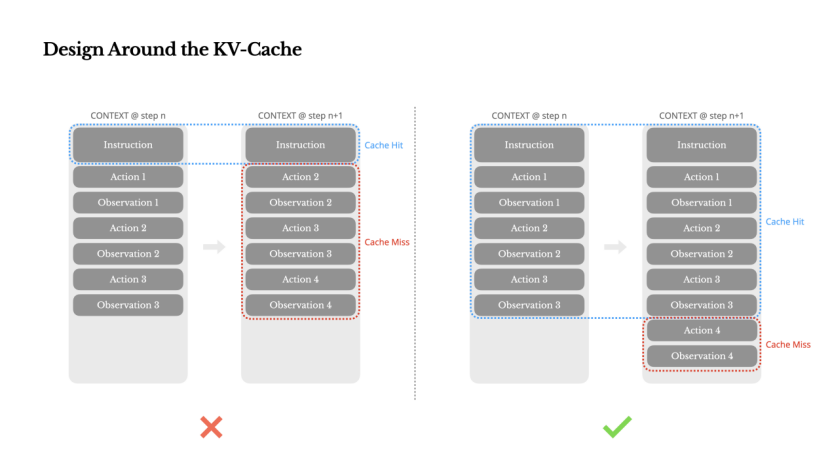
Core Viewpoint - The article discusses the choice between end-to-end training and context engineering in developing general AI agents, highlighting the latter as a more adaptable approach in a rapidly evolving landscape of large models [1][3]. Group 1: Context Engineering Insights - Manus AI's decision to adopt context engineering was influenced by past experiences where self-trained models quickly became obsolete after the release of GPT-3, emphasizing the need for flexibility in model development [4][5]. - The article outlines six core practices derived from Manus's experience, which significantly reduced product iteration cycles from weeks to hours, showcasing an effective technical path for startups [2][3]. Group 2: Key Practices for KV-Cache Optimization - The KV-cache hit rate is identified as the most critical metric for AI agents in production, directly affecting latency and cost, with a notable example showing a 10x cost difference between cached and uncached tokens [7][8]. - Strategies to enhance KV-cache hit rates include maintaining stable prompt prefixes, using only appended context, and employing file systems as external memory to overcome context limitations [8][19]. Group 3: Managing Tool Complexity - The article advises against dynamically adding or removing tools in the agent's action space, suggesting instead to manage tool availability through context-aware masking of token logits to maintain stability [12][13]. - This approach helps prevent confusion in the model when previous actions reference tools that are no longer defined, thereby reducing the risk of erroneous actions [12][17]. Group 4: Utilizing External Memory - Manus employs a file system as an externalized memory solution to address the limitations of context windows, allowing for persistent and unlimited storage that can be directly manipulated by the agent [18][22]. - This method mitigates the risks associated with irreversible context compression, ensuring that critical information is not lost [22]. Group 5: Attention Manipulation Techniques - The use of a todo.md file to continuously update task goals serves as a mechanism to keep the model focused on its objectives, preventing it from losing track during complex tasks [23][26]. - This technique helps maintain the model's attention on the task at hand, especially in lengthy interactions requiring multiple tool calls [26]. Group 6: Learning from Errors - Retaining failed attempts in the context is emphasized as a crucial learning mechanism, allowing the model to adapt and reduce the likelihood of repeating mistakes [30][31]. - The article argues that error recovery is a significant indicator of an agent's performance, yet it is often underrepresented in academic benchmarks [30]. Group 7: Avoiding Few-Shot Traps - The article warns against the pitfalls of few-shot learning in agent systems, where repetitive patterns in context can lead to suboptimal decision-making [32][34]. - Introducing structured variability in actions and observations can help break these patterns and enhance the model's adaptability [34]. Conclusion - Context engineering is presented as an essential and emerging science for agent systems, with the design of context playing a pivotal role in defining agent behavior, speed, recovery, and scalability [35].

ChatGPT Agent遭暴击,国产AI轮番“公开处刑”
Hu Xiu· 2025-07-19 04:00
Core Insights - The excitement surrounding the release of OpenAI's ChatGPT agent is primarily felt by competing companies rather than end users, indicating a competitive landscape in the agent market [5][6]. - Companies like Manus and Genspark are actively comparing their products with ChatGPT, suggesting a fierce competition and positioning themselves as superior alternatives [1][4][50]. Product Comparisons - Manus has released multiple tweets highlighting its agent's capabilities compared to OpenAI's, claiming to be faster and more efficient [1]. - Genspark showcased a demo that emphasizes its agent's ability to complete tasks more smoothly than ChatGPT, indicating a focus on user experience [4]. - The ChatGPT agent has been rolled out to Pro users, with demand exceeding expectations, leading to a phased rollout for Plus and Team users [6]. User Experience and Performance - A user tested the ChatGPT agent by generating a comprehensive retirement plan presentation, which took about 20 minutes to complete, but the final product was deemed simplistic [12][14]. - The agent's process involved automatic information gathering without user intervention, showcasing its efficiency [13]. - Comparisons with Manus and Genspark revealed that while ChatGPT can generate presentations, the quality and aesthetics of the outputs from competitors were often superior [50][105]. Market Dynamics - The launch of the ChatGPT agent is perceived as a significant event in the agent market, akin to a "competitive bomb" being dropped, which has prompted other companies to enhance their offerings [5]. - The competitive landscape is characterized by rapid responses from companies like Manus and Genspark, who are eager to demonstrate their products' advantages over ChatGPT [1][4][50]. Financial Independence and Retirement Planning - The article discusses a financial independence model (FIRE) for a high-income individual aiming to retire at 30 with $5 million, highlighting the challenges of achieving such goals in a high-cost city like Vancouver [156][160]. - The analysis indicates that even with high savings rates (80-90%), the target of $5 million may not be feasible without extraordinary investment returns or additional income sources [157][159].

Manus「删博跑路」后,创始人首次深度复盘:公开产品细节,总结教训
3 6 Ke· 2025-07-19 01:15
Core Insights - Manus AI has abruptly withdrawn from the Chinese market, clearing all social media content and seemingly pausing the development of its Chinese version, following the relocation of its global headquarters to Singapore [1] - The co-founder of Manus AI, Ji Yichao, published a technical blog to refocus attention on the product's technology amidst the controversy, sharing valuable lessons learned during the development of Manus [3][9] Group 1: Company Developments - Manus AI has moved its global headquarters to Singapore and has offices in Tokyo and California, indicating a strategic shift in its operational focus [1] - The company has faced scrutiny and speculation regarding potential layoffs and whether it is abandoning the Chinese market [1] Group 2: Technical Insights from the Blog - The blog emphasizes the importance of context engineering over traditional model training, allowing for quicker product updates [6][10] - Key practices for improving KV-cache hit rates are outlined, including maintaining stable prompts, appending context only, and marking cache breakpoints [12][16][17] - The use of a file system for persistent context is recommended to manage the limitations of context windows in modern AI models [25][30] - The blog discusses the significance of maintaining attention through continuous updates to a todo list, which helps keep the model focused on its goals [31][34] - It highlights the importance of retaining error logs to improve model behavior and reduce the likelihood of repeating mistakes [35][38] - The introduction of structured variations in actions and observations is suggested to prevent the model from falling into repetitive patterns [39][41] Group 3: Future Implications - The article concludes that context engineering is essential for the future of agent systems, as it defines the behavior, speed, recovery, and scalability of AI agents [42]