华安证券

Search documents
募集规模创近三年新高,FOF市场加速回暖;个人养老金产品扩容
Zhong Guo Ji Jin Bao· 2025-11-29 07:53
Group 1: Personal Pension and Financial Institutions - The Ministry of Finance and the People's Bank of China have included savings treasury bonds in personal pension products to support the development of a multi-tiered pension insurance system, which is expected to enhance investor enthusiasm and improve the quality of the personal pension system [2] - On November 27, Wang Ying officially took over as the new chairman of China Merchants Fund, with a focus on maintaining strategic stability and enhancing execution capabilities for the next three years [5][6] Group 2: Public Funds and Market Trends - Several fund companies, including Jiahe Fund and China Merchants Fund, announced the termination of sales agreements with specific sales companies, indicating a shift in sales strategies [3] - The public fund market has seen a significant increase in new fund issuance, with over 1 trillion units issued this year, and equity funds reaching 527.285 billion units, a year-on-year increase of 93.8% [8] - The FOF (Fund of Funds) market has rebounded, with 69 new FOFs established this year, raising a total of 69.236 billion yuan, marking a three-year high [10][11] Group 3: REITs and ETF Developments - The public REITs market is expanding, with the first tunnel public REIT submitted for approval, indicating growth in this investment vehicle [12] - On November 25, the stock ETF market experienced a net outflow of over 17.5 billion yuan, despite a general market increase, reflecting a trend of selling during market rises [13] - A new ETF linked to the ChiNext 50 index was launched in Thailand, marking the first time a Chinese ETF has been listed in Southeast Asia, providing new investment opportunities for Thai investors [15] Group 4: Banking and Wealth Management - Banks are preparing for the 2026 "opening red" campaign, with a focus on stable products like "fixed income+" and dividends, while also increasing allocations to equity funds due to market recovery [18]

又见券商资管 批量变更管理人!
Zhong Guo Ji Jin Bao· 2025-11-28 09:40
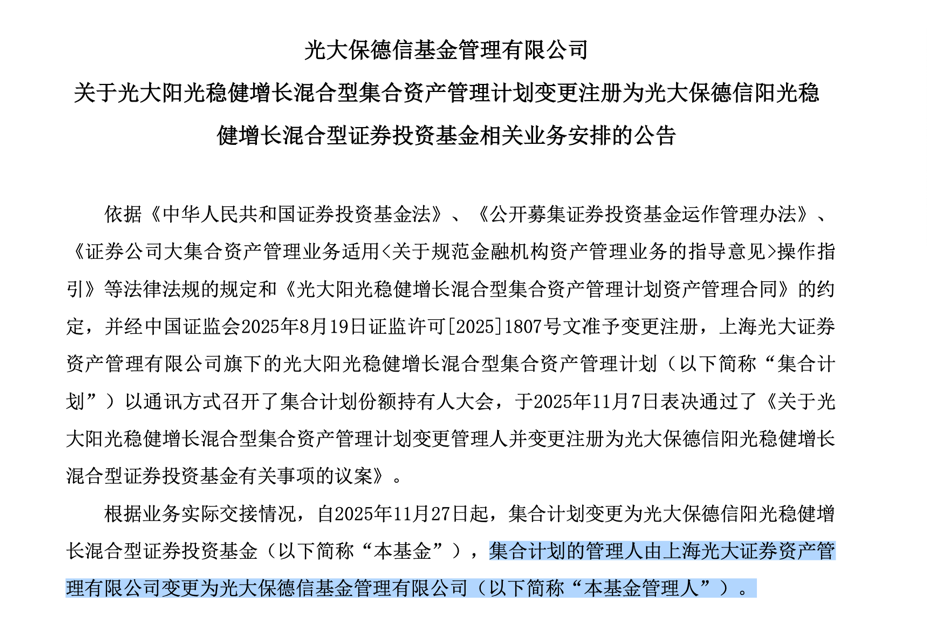
Core Viewpoint - The article discusses the recent changes in management for several large collective investment products under Guangzheng Asset Management, indicating a trend of transitioning these products to public fund management companies as the deadline for compliance with new regulations approaches [5][6]. Group 1: Management Changes - On November 27, Guangzheng Asset Management transferred eight large collective investment products to Everbright Pramerica Fund Management, which is 55% owned by Everbright Securities [5]. - This transfer is part of a broader trend where many securities firms are moving their collective investment products to affiliated public fund companies due to the expiration of the transitional period for compliance with new asset management regulations [5][6]. Group 2: Industry Trends - The transition to public fund management is becoming the mainstream approach for securities firms that do not hold public fund licenses, as they face three options: liquidation, extension, or changing the management [5][6]. - The pace of management changes has accelerated, with multiple firms, including GF Asset Management and Huafu Fund, also announcing similar transitions in November [6][7]. - As of now, only Guojin Asset Management remains in the queue for public fund license applications, while several firms, including Guangzheng Asset Management, have withdrawn their applications [8][9]. Group 3: Market Competition - The asset management industry is experiencing intense competition, particularly in fixed income and cash management products, from public funds and bank wealth management subsidiaries [9]. - Analysts suggest that the public fund path is more suitable for leading institutions with comprehensive financial ecosystems and retail channels, while specialized securities firms may find private fund paths more advantageous [9].
券商频频“输血”海外子公司,释放什么信号?
证券时报· 2025-11-28 09:31
Core Viewpoint - Chinese securities firms are significantly increasing capital support for their overseas subsidiaries, driven by the demand for cross-border investment banking and wealth management expansion, particularly in high-margin OTC derivatives business [1][5][7]. Group 1: Capital Support Mechanisms - Huatai Securities announced the issuance of four medium-term notes totaling $230 million, backed by its wholly-owned subsidiary [1]. - Common methods for capital supplementation by Chinese securities firms include direct shareholder capital increases, issuance of perpetual bonds/subordinated debt, and capital loans with shareholder support [3][5]. - Notable firms such as Dongxing Securities, Shanxi Securities, and Bank of China Securities have announced capital increases for their Hong Kong subsidiaries, with amounts reaching up to 2.137 billion HKD [4]. Group 2: Business Expansion Drivers - The demand for capital supplementation is primarily driven by the expansion of cross-border business and the growth of high capital-consuming operations, particularly in OTC derivatives [7][8]. - The surge in cross-border client demand and the need for risk management and asset allocation services are pushing Chinese securities firms to enhance their capital base [7][8]. - The Hong Kong market is becoming a hub for cross-border wealth management, benefiting Chinese securities firms due to their inherent advantages [8]. Group 3: Challenges in Capital Supplementation - Despite the push for capital increases, challenges remain, including restrictions on cross-border capital injection, difficulties in overseas financing, and liquidity risks [11][12]. - Current foreign exchange management policies limit the ability of Chinese securities firms to conduct cross-border transactions effectively, creating obstacles in capital flow and business development [11][12]. - The need for regulatory policy optimization, group-level coordination, and transformation of subsidiaries into lighter capital businesses is emphasized to overcome these challenges [12].

又见券商资管,批量变更管理人!
中国基金报· 2025-11-28 09:22
Core Viewpoint - The article discusses the recent management changes of large collective investment products under Guangzheng Asset Management, indicating a trend of transitioning these products to public fund management companies as the deadline for regulatory compliance approaches [2][5]. Group 1: Management Changes - On November 27, Guangzheng Asset Management transferred 8 large collective products to Everbright Pramerica Fund Management, which is 55% owned by Everbright Securities [5]. - This transfer is part of a broader trend where many securities firms are moving their collective investment products to affiliated public fund companies to comply with new regulations [5][7]. Group 2: Industry Trends - The transition period for securities firms' collective investment products is nearing its end, with many firms opting to change management to avoid issues related to liquidation or investor concerns [5][7]. - In 2024, Guangzheng Asset Management reported revenues of 675 million yuan and a net profit of 219 million yuan, with assets under management reaching 3,114 billion yuan, reflecting a growth of 3.71% from the beginning of the year [5]. Group 3: Regulatory Compliance - According to the 2018 asset management regulations, securities firms must complete the public offering transformation of their collective products by the end of the transition period, with options including liquidation, extension, or management change [5][8]. - The article notes that many firms have chosen to change management to public fund companies, which has become a mainstream approach in the industry [5][8]. Group 4: Competitive Landscape - The article highlights that securities firms face intense competition from public funds and bank wealth management subsidiaries, particularly in fixed income and cash management products [8]. - Analysts suggest that the public fund path is more suitable for leading institutions with comprehensive financial ecosystems, while specialized securities firms may find private paths more advantageous [8].

券商频频“输血”海外子公司,释放什么信号?
券商中国· 2025-11-28 04:00
Core Viewpoint - Chinese securities firms are significantly increasing capital support for their overseas subsidiaries, driven by the demand for cross-border investment banking and wealth management expansion [2][6]. Group 1: Capital Support Initiatives - Huatai Securities announced the issuance of four medium-term notes totaling $230 million, guaranteed by its wholly-owned subsidiary [1]. - This year, several Chinese securities firms, including Dongxing Securities and Huatai Securities, have provided capital support to their Hong Kong subsidiaries, with the highest capital increase reaching HKD 21.37 billion [3][4]. - The common methods for capital supplementation include direct shareholder capital increases, issuance of perpetual bonds, and capital loans [3]. Group 2: Business Expansion Drivers - The demand for capital supplementation is primarily driven by the expansion of cross-border businesses and high capital-consuming operations, particularly in the OTC derivatives sector [6][7]. - The growth in cross-border client demand and the need for risk management and asset allocation services are pushing Chinese securities firms to enhance their capital strength [6][7]. Group 3: Challenges in Capital Supplementation - Despite the increasing capital support, challenges remain, including restrictions on cross-border capital flows and difficulties in overseas financing [8][9]. - The current foreign exchange management system poses obstacles for Chinese securities firms in conducting cross-border transactions, leading to liquidity risks [9]. - Recommendations for overcoming these challenges include optimizing regulatory policies, enhancing group coordination, and transforming subsidiaries towards lighter capital business models [10].

港股IPO规模登顶全球!上市券商投行业务前三季度净收入252亿元,2026年行业又将押注哪些热点赛道?
Mei Ri Jing Ji Xin Wen· 2025-11-28 00:38
Core Insights - The investment banking business of securities firms is experiencing a recovery, with net income reaching 252 billion yuan in the first three quarters of 2025, a year-on-year increase of 24% [1][2] - The IPO market is rebounding, with A-share and H-share IPOs growing by 61% and 237% respectively, while Hong Kong's IPO scale ranks first globally [1][2] - The industry is characterized by a "stable top tier and emerging mid-tier" dynamic, with the market share of the top five firms (CR5) increasing to 52% [2][3] Industry Performance - In the first three quarters of 2025, listed securities firms achieved a total investment banking net income of 251.5 billion yuan, a 23.5% increase year-on-year [2] - Major firms like CITIC Securities and CICC reported significant growth in net income, with increases ranging from 23.4% to 46.2% [2] - The concentration of investment banking business is rising, benefiting top firms more than smaller ones, with the CR5 market share up by 8 percentage points compared to 2024 [2] Future Outlook - The investment banking sector is expected to focus on hard technology, mergers and acquisitions, and green finance as key areas of growth in 2026 [1][3][4] - The A-share market is anticipated to maintain a steady expansion, particularly in the hard technology sector, due to ongoing reforms and increased IPO opportunities [3][4] - The Hong Kong market is expected to see continued high demand for listings from Chinese companies, supported by the A+H listing model [5][6] Strategic Initiatives - Firms are enhancing their organizational structures to improve collaboration and efficiency, focusing on sectors like hard technology and renewable energy [6][7] - Investment banks are actively expanding their presence in the Hong Kong IPO market, with firms like Huatai and Guolian Minsheng aiming to strengthen their competitive advantages through talent development and cross-border integration [7][8][9] - The implementation of supportive policies such as the "Six Merger Rules" and "Eight Science and Technology Innovation Board Rules" is driving market vitality and creating opportunities for investment banks [5][6]



从信息推送到决策赋能,AI时代券商投顾价值重估
Mei Ri Jing Ji Xin Wen· 2025-11-27 13:29
Core Insights - The brokerage industry is undergoing profound changes driven by two main factors: the upgrading of investor demands for personalized and real-time decision-making support, and the rapid development of artificial intelligence technology reshaping business models and service ecosystems [1][2] Investor Demand and Advisory Upgrade - Since 2025, investors have demanded a comprehensive upgrade in brokerage advisory services, focusing on product selection, service content, and overall service experience [2] - There is a significant increase in diversified and global asset allocation needs, with clients shifting attention to commodities, alternative assets, and overseas markets due to low interest rates [2] - Investors now seek full-process investment support, requiring not just products but also professional advice and continuous service, especially during market volatility [2] AI Application in Brokerage - The application of AI in the brokerage industry has transitioned from tool assistance to business restructuring [3] - By 2025, AI competition in wealth management will focus on three core areas: building an "intelligent agent" driven service matrix, providing deep personalized decision-making based on user data, and creating an integrated service loop that combines AI understanding, human-machine collaboration, and intelligent execution [3][6] - For instance, Guotai Junan Securities launched a new AI-driven app that redefines customer service models and enhances the investment journey through innovative features [3] Differentiation in AI Advisory - Despite double-digit growth in AI tool users among brokerages, the industry faces challenges of homogenization in AI advisory services [5] - The core issue lies in the lack of significant differentiation in underlying technology, data sources, investment strategies, and final output portfolios [5] - True differentiation is not just about the presence of features but also about ease of use, interaction experience, and precision of data services [5] Talent and Workflow Transformation - The core of brokerage business transformation is talent, necessitating skill upgrades and redefinition of traditional advisory roles [6] - Brokerages are focusing on enhancing the rigor and accuracy of AI advisory tools through extensive training and integration with financial investment models [6] - The advisory team is evolving into three roles: AI strategy trainers, human-machine collaboration designers, and complex client relationship managers, balancing technical and humanistic solutions [7]




上市券商投行业务前三季度净收入251.5亿元 2026年又将押注哪些热点赛道?
Mei Ri Jing Ji Xin Wen· 2025-11-27 13:29
Core Insights - The investment banking sector is experiencing a recovery with significant growth in net income and IPO activities, particularly in A-shares and H-shares [1][2][3] Group 1: Market Performance - In the first three quarters of 2025, listed brokers achieved a net investment banking income of 251.5 billion yuan, a year-on-year increase of 24% [1][2] - A-shares and H-shares IPO scales grew by 61% and 237% respectively, with Hong Kong IPOs ranking first globally [1][2] - The top five companies in the investment banking sector accounted for 52% of the market share, with several mid-sized brokers experiencing growth rates exceeding 50% [1][3] Group 2: Future Outlook - The investment banking industry anticipates that hard technology, mergers and acquisitions, and green finance will be core hotspots in 2026 [1][4] - The deepening of the registration system and the demand for cross-border financing are expected to drive market expansion [1][3] Group 3: Strategic Initiatives - Companies are enhancing their organizational mechanisms and focusing on industry-specific strategies to improve service efficiency and client support [5][6] - Investment banks are actively responding to policy changes, such as the "Eight Articles of the Sci-Tech Innovation Board" and "Six Articles of Mergers and Acquisitions," to capitalize on market opportunities [5][6] - Firms are building comprehensive platforms for merger opportunities and establishing dedicated departments to streamline merger and acquisition processes [6][8] Group 4: Cross-Border Expansion - Major investment banks are strengthening their presence in the Hong Kong market, leveraging cross-border integration advantages to enhance service capabilities [7][8] - Companies like Huatai have completed numerous Hong Kong IPO projects, positioning themselves among the top in the market [7]


券商资管转型生变:“参公”产品变更管理人 公募牌照申请退潮
2 1 Shi Ji Jing Ji Bao Dao· 2025-11-27 13:01
Core Viewpoint - The transition period for the transformation of "publicly offered collective products" is nearing its end, prompting several brokerage firms to change the management of their collective products to avoid liquidation and successfully convert them into public fund products [1][4]. Group 1: Changes in Management of Collective Products - As of November, at least 25 publicly offered collective products have officially changed their management to public fund companies, with notable changes including products from Guangfa Fund, Huafu Fund, and others [1][3]. - The process for changing management involves obtaining approval from the China Securities Regulatory Commission (CSRC) and holding a meeting for product holders to vote on the change [3][4]. - The changes not only involve the management but may also affect product names, investment strategies, and fee structures [3][4]. Group 2: Shift in Focus for Brokerage Asset Management - Brokerage asset management firms are increasingly abandoning the pursuit of public fund licenses, with several firms like Guangfa Asset Management and Guotou Securities Asset Management withdrawing their applications [6][7]. - The reasons for this shift include the lengthy wait for license approval, high initial investment costs for establishing independent operations, and the competitive landscape of the public fund industry [7][9]. - Firms are now focusing on differentiated strategies in private asset management and wealth management, which are seen as more advantageous compared to the public fund sector [2][8]. Group 3: Strategic Implications of the Transition - The transition to changing management for collective products is viewed as a necessary response to regulatory compliance requirements, allowing firms to retain clients and avoid fund liquidation [4][5]. - The current trend indicates a move away from "license worship" towards a more rational understanding of the profitability challenges associated with public fund operations [7][9]. - Brokerage firms are now concentrating on creating value-driven products that cater to specific client needs, emphasizing absolute returns and tailored investment strategies [10].


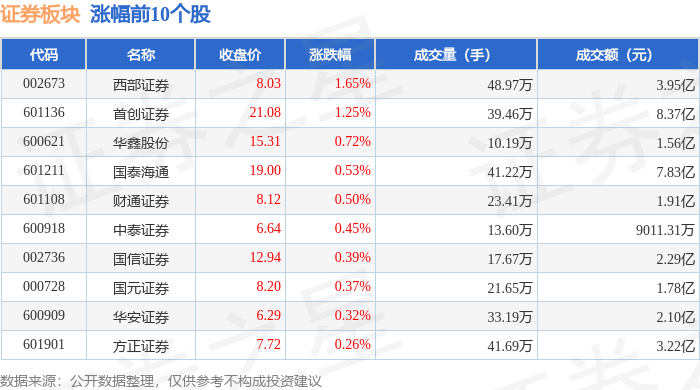
证券板块11月27日涨0%,西部证券领涨,主力资金净流出3.58亿元
Zheng Xing Xing Ye Ri Bao· 2025-11-27 09:07
Market Overview - On November 27, the securities sector experienced a slight increase of 0.0%, with Western Securities leading the gains. The Shanghai Composite Index closed at 3875.26, up by 0.29%, while the Shenzhen Component Index closed at 12875.19, down by 0.25% [1]. Individual Stock Performance - Western Securities (002673) closed at 8.03, with a rise of 1.65% and a trading volume of 489,700 shares [1]. - First Capital Securities (601136) closed at 21.08, up by 1.25% with a trading volume of 394,600 shares [1]. - Huaxin Co. (600621) closed at 15.31, increasing by 0.72% with a trading volume of 101,900 shares [1]. - Other notable performers include: - Dream Travel (601211) at 19.00, up 0.53% [1] - Caitong Securities (601108) at 8.12, up 0.50% [1] - Zhongtai Securities (600918) at 6.64, up 0.45% [1]. Fund Flow Analysis - The securities sector saw a net outflow of 358 million yuan from institutional investors, while retail investors contributed a net inflow of 527 million yuan [2]. - Notable net inflows from retail investors were observed in: - CITIC Securities (600030) with a net inflow of 29.61 million yuan [3] - Western Securities (002673) with a net inflow of 17.21 million yuan [3]. - Conversely, significant net outflows were recorded for: - CITIC Securities (600030) with a net outflow of 60.64 million yuan from institutional investors [3] - Huaxin Co. (600909) with a net outflow of 6.32 million yuan from retail investors [3].