
三博脑科

Search documents
ETF盘中资讯|刚刚,全市场规模最大医疗ETF(512170)再失半年线,场内频现溢价,“抄底”资金单周爆买逾8亿元
Sou Hu Cai Jing· 2026-01-26 03:53
Group 1 - The A-share medical sector weakened on January 26, with AI medical and brain-computer interface concepts leading the decline, as Meien Health dropped by 6% and Weining Health and Sanbo Brain Science fell over 5% [1] - The largest medical ETF in the market (512170) declined by more than 1.6%, losing its half-year line, with real-time transactions exceeding 600 million yuan [1] - Despite the overall decline, the medical ETF (512170) showed high-frequency premiums in the market, indicating active buying interest, with a weekly increase in positions exceeding 813 million yuan [1] Group 2 - CITIC Securities recently published a weekly review of the pharmaceutical industry, indicating that policy impacts will eventually clear, and companies will gradually recover after strategic adjustments, with the medical device sector undergoing dual recovery in valuation and performance [3] - The report suggests increasing allocation to the medical device sector by 2026, with major investment opportunities arising from performance recovery, overseas expansion, brain-computer interfaces, and AI medical technologies, potentially leading to multi-bagger stocks in a tech bull market [3] - The CXO sector is experiencing rapid growth due to advancements in ADC and peptide drugs, with increasing demand for related CXO services, and segments like small nucleic acids and CGT are expected to develop quickly [3] Group 3 - The largest medical ETF (512170) has a fund size of 26.8 billion yuan, making it the largest in the market among medical ETFs [3] - The medical ETF and its linked fund (012323) cover 12 AI medical and brain-computer interface concept stocks, with over 50% weight in medical devices and nearly 25% in CXO [3] - For those interested in Hong Kong stock medical opportunities, the Hong Kong Stock Connect Medical ETF (159137) focuses on medical innovation, gathering core leaders in various pharmaceutical fields, including medical devices, AI medical, CXO, and innovative drugs [3]

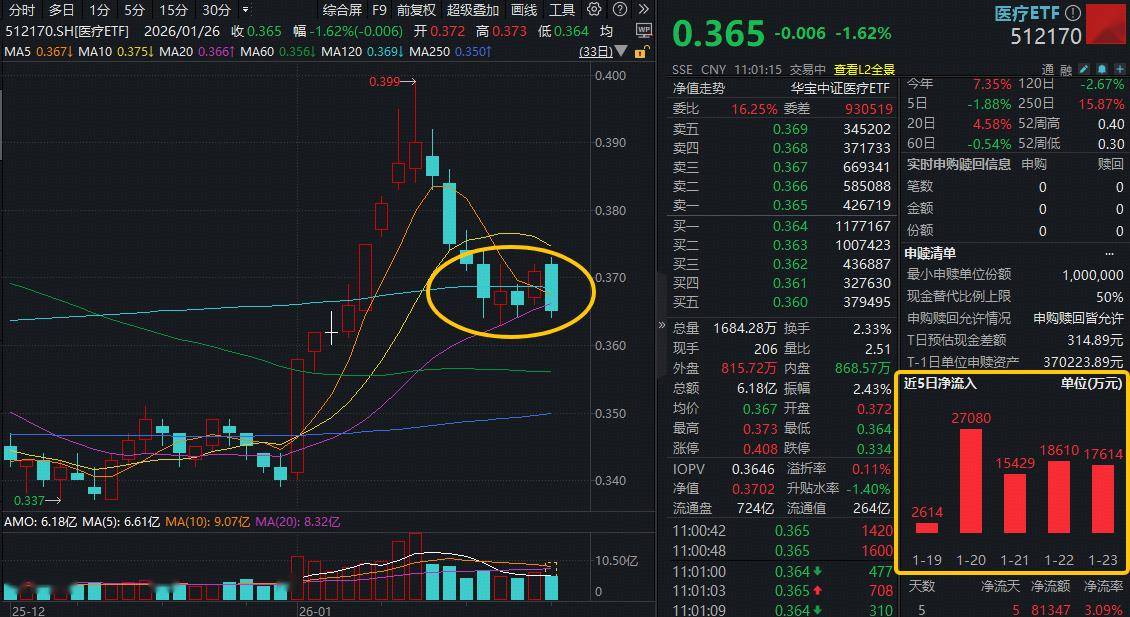
刚刚,全市场规模最大医疗ETF(512170)再失半年线,场内频现溢价,“抄底”资金单周爆买逾8亿元
Xin Lang Cai Jing· 2026-01-26 03:25
Group 1 - The A-share medical sector weakened on January 26, with AI medical and brain-computer interface concepts leading the decline, as Meien Health dropped by 6% and Weining Health and Sanbo Brain Science fell over 5% [1][6] - The largest medical ETF in the market (512170) fell by more than 1.6%, losing its half-year line, with real-time transactions exceeding 600 million yuan [1][6] - Notably, the medical ETF (512170) showed high-frequency premiums in the market, indicating active low-buying funds, with a weekly increase of over 813 million yuan [1][6] Group 2 - CITIC Securities recently published a weekly review of the pharmaceutical industry, indicating that policy impacts will eventually clear, and corporate strategic adjustments will lead to gradual recovery, particularly in the medical device sector, which is undergoing dual recovery in valuation and performance [3][8] - The report suggests increasing allocation to the medical device sector by 2026, with main investment opportunities arising from performance recovery, overseas expansion, brain-computer interfaces, and AI medical technologies, potentially leading to multi-fold stock growth in a tech bull market [3][8] - The CXO sector is experiencing rapid growth due to advancements in ADC and peptide drugs, with increasing demand in related fields such as small nucleic acids and CGT, indicating long-term growth potential [3][8] Group 3 - The medical ETF (512170) has a fund size of 26.8 billion yuan, making it the largest among medical ETFs in the market [3][8] - The ETF covers over 50% weight in medical devices and nearly 25% in CXO, including 12 AI medical and brain-computer interface concept stocks [3][8] - For those interested in Hong Kong stock medical opportunities, the Hong Kong Stock Connect Medical ETF (159137) is highlighted as a high-elasticity T+0 tool, focusing on medical innovation and gathering core leaders in various medical fields [3][8]
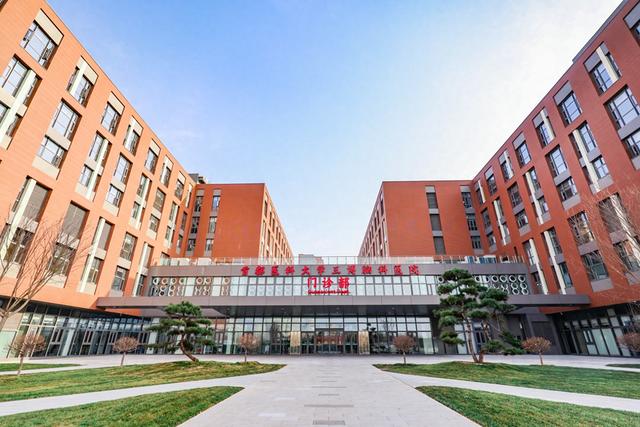
三博脑科东坝新院区周一运营开诊,东五环外医疗服务再升级
Bei Jing Ri Bao Ke Hu Duan· 2026-01-25 09:53
Core Viewpoint - The new East Ba District branch of Capital Medical University Sanbo Brain Hospital is set to officially open on January 26, enhancing regional medical resources and services [1][8]. Group 1: Hospital Overview - The new hospital is located at No. 36 East Ba Middle Road, Chaoyang District, with a total construction area of 63,000 square meters, featuring 480 beds and 13 operating rooms, including advanced surgical facilities [5][12]. - The hospital aims to serve over 100,000 outpatient visits annually, utilizing smart technology to improve patient experience, such as a robotic pharmacy that can sort and deliver medications in approximately 15 seconds [12][14]. Group 2: Services and Specializations - The hospital is designed as a "large specialty, small comprehensive" facility, focusing on neurology while also developing emergency, pediatric neurology, critical care, pain management, rehabilitation, and traditional Chinese medicine departments [16][19]. - The hospital will establish five centers: International Neurological Consultation Center, Brain Health Management Center, Difficult Critical Illness Diagnosis Center, High-end Talent Training Center, and Medical Achievement Transformation Center [19]. Group 3: Community Impact - The East Ba District has a dense population, and the new hospital is expected to meet the local demand for accessible healthcare services, with residents expressing anticipation for its opening [16][19]. - The hospital's strategic location and expanded services aim to address the diverse medical needs of the surrounding community [16][19].

机械设备行业:超声波“重启”阿尔茨海默大脑 临床试验点亮治疗新希望
Xin Lang Cai Jing· 2026-01-25 06:33
Core Insights - A breakthrough in Alzheimer's treatment was observed when a focused ultrasound surgery unexpectedly improved the cognitive function of a patient suffering from both Alzheimer's and muscle tension disorder, challenging the traditional belief that Alzheimer's is irreversible [1] - The global prevalence of Alzheimer's is high, with nearly 17 million patients in China alone, leading to significant caregiving pressures on families [1] Group 1: Innovative Approaches - The research team led by Professor Sun Bomin is exploring a new pathway for Alzheimer's treatment by using high-energy ultrasound to directly stimulate brain neural circuits, moving away from conventional low-energy ultrasound-assisted drug therapies [2] - After a year of preparation, clinical trials were initiated, showing an average cognitive improvement rate of approximately 50% among the first seven moderate to severe patients treated, with some patients regaining household skills and emotional connections [2] Group 2: Market Potential - The global brain-computer interface (BCI) market is projected to grow from approximately $2.62 billion in 2024 to $2.94 billion in 2025, and is expected to reach $12.4 billion by 2034, with a compound annual growth rate of 17.35% over the next decade [2] - In China, the BCI market is anticipated to grow from 3.2 billion yuan in 2024 to 6.14 billion yuan by 2028, supported by national strategies aimed at fostering high-tech industries [2] Group 3: Companies to Watch - Companies such as Rock Mountain Technology, Hanwei Technology, Sanbo Brain Science, Innovation Medical, Dongfang Zhongke, Xiangyu Medical, Entropy Technology, Chengyitong, Weisi Medical, Microland, Aipeng Medical, and Beiyikang are suggested for attention in this emerging field [3]

超声波重启阿尔茨海默大脑,临床试验点亮治疗新希望:机械设备
Huafu Securities· 2026-01-25 05:28
Investment Rating - The industry rating is "Outperform the Market," indicating that the overall return of the industry is expected to exceed the market benchmark index by more than 5% over the next 6 months [14]. Core Insights - A breakthrough in Alzheimer's treatment was observed when a focused ultrasound surgery unexpectedly improved the cognitive function of a patient, challenging the traditional belief that Alzheimer's is irreversible. This condition affects nearly 17 million patients in China, leading to significant caregiving burdens [4][5]. - The research team led by Professor Sun Bomin is exploring a new approach using high-energy ultrasound to directly stimulate brain neural circuits, with initial clinical trials showing an average improvement rate of about 50% among seven moderate to severe patients [5]. - The global brain-computer interface (BCI) market is projected to grow rapidly, with an estimated size of approximately $2.62 billion in 2024, reaching $2.94 billion in 2025, and potentially growing to $12.4 billion by 2034, reflecting a compound annual growth rate of 17.35% over the next decade [6]. Summary by Sections Industry Overview - The report highlights the significant unmet medical need in Alzheimer's treatment and the potential for innovative therapies to emerge from recent clinical findings [4][5]. Market Potential - The brain-computer interface market is expected to see substantial growth, with specific projections for both global and Chinese markets, indicating a strategic focus on high-tech industries as outlined in national economic plans [6]. Investment Recommendations - The report suggests monitoring companies such as Yanshan Technology, Hanwei Technology, Sanbo Brain Science, and others, which are positioned to benefit from advancements in the BCI and related technologies [6].



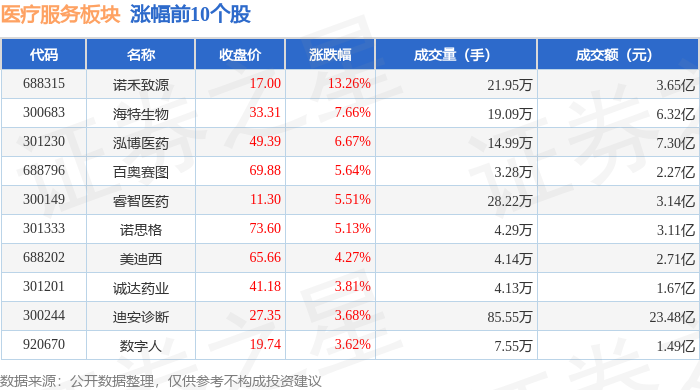
医疗服务板块1月23日涨1.19%,诺禾致源领涨,主力资金净流入9.91亿元
Zheng Xing Xing Ye Ri Bao· 2026-01-23 09:04
Core Viewpoint - The medical services sector experienced a rise of 1.19% on January 23, with notable gains from companies like Nuohua Zhiyuan, which led the sector's performance [1]. Group 1: Market Performance - The Shanghai Composite Index closed at 4136.16, up 0.33%, while the Shenzhen Component Index closed at 14439.66, up 0.79% [1]. - The medical services sector saw significant individual stock movements, with Nuohua Zhiyuan (688315) closing at 17.00, up 13.26%, and Hai Te Biological (300683) closing at 33.31, up 7.66% [1]. Group 2: Trading Volume and Value - Nuohua Zhiyuan had a trading volume of 219,500 shares and a transaction value of 365 million yuan [1]. - Hai Te Biological recorded a trading volume of 190,900 shares with a transaction value of 632 million yuan [1]. Group 3: Capital Flow - The medical services sector saw a net inflow of 999.1 million yuan from institutional investors, while retail investors experienced a net outflow of 1.069 billion yuan [2]. - The capital flow data indicates that major stocks like Diyan Diagnosis (300244) had a net inflow of 288 million yuan from institutional investors [3].




医药生物行业1月22日资金流向日报
Zheng Quan Shi Bao Wang· 2026-01-22 09:24
Market Overview - The Shanghai Composite Index rose by 0.14% on January 22, with 22 out of the 28 sectors in the Shenwan classification experiencing gains, led by the construction materials and defense industries, which increased by 4.09% and 3.23% respectively [1] - The beauty and banking sectors saw the largest declines, with decreases of 0.76% and 0.43% respectively [1] Capital Flow Analysis - The main capital outflow from the two markets totaled 21.612 billion yuan, with 12 sectors experiencing net inflows [1] - The telecommunications sector had the highest net inflow, amounting to 8.019 billion yuan, and it rose by 2.83% [1] - The defense industry also saw significant inflow, with a net inflow of 5.713 billion yuan and a daily increase of 3.23% [1] - The electronics sector faced the largest net outflow, totaling 13.206 billion yuan, followed by the power equipment sector with an outflow of 7.206 billion yuan [1] Pharmaceutical and Biological Industry Performance - The pharmaceutical and biological sector declined by 0.42%, with a net capital outflow of 3.027 billion yuan [2] - Out of 478 stocks in this sector, 253 rose while 204 fell, with 2 stocks hitting the daily limit up [2] - The top three stocks with the highest net inflow were Sanbo Brain Science (1.42 billion yuan), Yunnan Baiyao (667.561 million yuan), and Innovation Medical (637.008 million yuan) [2] - The sector's outflow was led by Hengrui Medicine, which saw a net outflow of 372.7538 million yuan, followed by Xingqi Eye Medicine and Aidi Pharmaceutical with outflows of 208.3529 million yuan and 121.6946 million yuan respectively [3]


医疗服务板块1月21日涨0.18%,南模生物领涨,主力资金净流入5050.97万元
Zheng Xing Xing Ye Ri Bao· 2026-01-21 08:53
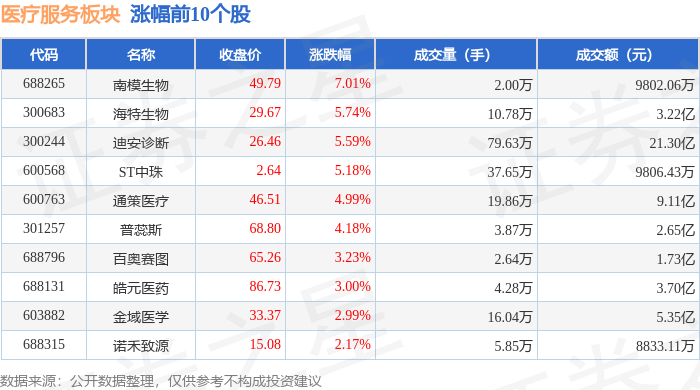
Market Overview - The medical services sector increased by 0.18% on January 21, with Nanmo Biology leading the gains [1] - The Shanghai Composite Index closed at 4116.94, up 0.08%, while the Shenzhen Component Index closed at 14255.12, up 0.7% [1] Top Gainers in Medical Services - Nanmo Biology (688265) closed at 49.79, up 7.01% with a trading volume of 20,000 shares and a transaction value of 98.02 million [1] - Hite Biology (300683) closed at 29.67, up 5.74% with a trading volume of 107,800 shares and a transaction value of 32.2 million [1] - Dean Diagnostics (300244) closed at 26.46, up 5.59% with a trading volume of 796,300 shares and a transaction value of 2.13 billion [1] - ST Zhongzhu (600568) closed at 2.64, up 5.18% with a trading volume of 376,500 shares and a transaction value of 9.81 million [1] - Tongce Medical (600763) closed at 46.51, up 4.99% with a trading volume of 198,600 shares and a transaction value of 911 million [1] Top Losers in Medical Services - Digital Human (920670) closed at 18.72, down 4.44% with a trading volume of 74,500 shares and a transaction value of 143 million [2] - Hongbo Pharmaceutical (301230) closed at 46.36, down 1.88% with a trading volume of 131,200 shares and a transaction value of 614 million [2] - Chengda Pharmaceutical (301201) closed at 41.39, down 1.76% with a trading volume of 36,600 shares and a transaction value of 153 million [2] Capital Flow in Medical Services - The medical services sector saw a net inflow of 50.51 million from institutional investors, while retail investors experienced a net outflow of 375 million [2] - The sector's overall capital flow indicates a strong interest from institutional and speculative investors, with retail investors pulling back [2][3] Notable Capital Inflows - Sanbo Brain Science (301293) had a net inflow of 91.48 million, representing 9.03% of its total capital [3] - Tongce Medical (600763) saw a net inflow of 83.46 million, accounting for 9.16% of its total capital [3] - BGI Genomics (300676) recorded a net inflow of 51.81 million, which is 8.37% of its total capital [3]



再迎支持政策,手术机器人价格立项落地!医疗设备ETF大成(516610)早盘涨近2%,助力把握“人工智能+”医疗向上行情
Xin Lang Cai Jing· 2026-01-21 04:52
Core Viewpoint - The recent release of the "Guidelines for the Pricing of Surgical and Treatment Auxiliary Medical Services" by the National Healthcare Security Administration is expected to drive the clinical adoption of surgical robots and other innovative technologies, enhancing the demand for terminal equipment and surgical assistance [1][2]. Group 1: Market Performance - The medical device ETF, Dachen (516610), saw a nearly 2% increase, with a trading volume expanding significantly, tracking the CSI All-Share Healthcare Equipment and Services Index (H30178), which rose by 1.11% [1]. - Key component stocks such as Tianzhihang, Dian Diagnostics, and Shuoshi Bio experienced substantial gains, with increases of 11.76%, 9.54%, and 8.64% respectively [1]. Group 2: Policy Impact - The new guidelines categorize surgical robot assistance into three levels: navigation, participation, and precise execution, and introduce a separate fee for "remote surgical assistance," aimed at enhancing the distribution of quality clinical resources to grassroots levels [1]. - The implementation of these guidelines is expected to standardize the establishment and pricing of surgical robots across provinces, promoting the clinical popularization of innovative technologies [2]. Group 3: Industry Trends - The "AI+" initiative is driving revolutionary developments in the medical industry, with applications in brain-computer interfaces and surgical robots gaining traction [1][2]. - The collaboration between NVIDIA and Eli Lilly to invest up to $1 billion in an AI joint innovation lab signifies a shift towards data and algorithm-driven drug development, enhancing efficiency and reducing risks in the pharmaceutical industry [2]. Group 4: ETF Composition - The Dachen medical device ETF focuses on leading companies in the medical device sector, with approximately 82% weight in medical devices and nearly 40% in "AI+" medical applications [3]. - The ETF has a significant allocation to brain-computer interface (BMI) stocks, covering a complete industry chain from neural regulation to surgical instruments and genetic testing, positioning it favorably in the market [3].

慢牛下的AI算力与应用
2026-01-21 02:57
Summary of Key Points from Conference Call Records Industry Overview - The AI computing sector is currently experiencing a bottoming phase, with expectations of gradual recovery starting in February and reaching a peak in March and April, with an overall increase potentially exceeding 50% [1][2][6] - AI applications are expected to see short-term adjustments but maintain a positive long-term outlook, with a new wave of growth anticipated during the March earnings release period [1][2][6] Core Insights and Arguments - The decline in annual report forecasts should not be overly concerning, as it reflects strong industry demand rather than a lack of it. For instance, Shenghong Technology's lower forecast was attributed to raw material shortages and capacity constraints [1][4][7] - Current valuations are estimated at 15-20 times for 2026 and 7-10 times for 2027, suggesting that market dips present good buying opportunities [4][15][17] - The domestic computing industry is supported by strong supply and demand dynamics, with significant growth expected this year, particularly in cabinet-level and superpoint solutions [1][5][9] Investment Opportunities - Investors should focus on sectors where AI applications are gaining traction, such as customer service, video, and finance, which have begun to scale up [1][10][19] - Companies with technological barriers and core competitiveness, such as Alibaba and Tencent, are highlighted as potential investment targets due to their strong growth prospects [11][19] - The optical cable industry is experiencing increased demand, with China Telecom planning to procure over 78 million kilometers of new optical cables, indicating a tightening supply-demand relationship [3][22][23] Additional Important Insights - The AI computing sector is expected to see significant growth opportunities in the coming months, particularly in March, with core companies potentially doubling in value [14][18] - The light-asset model of companies like Xuchuang and Xinyi Sheng is expected to outperform heavier asset models due to their ability to increase shipment volumes even during large-scale expansions [16][17] - The optical cable market is projected to continue its upward trend in pricing due to increased demand from AI data center construction, with companies like Hengtong, Zhongtian, and Changfei being well-positioned [3][22][23] Conclusion - The overall sentiment towards the AI computing and application sectors remains optimistic, with significant growth expected in the near future. Investors are encouraged to strategically position themselves in these sectors to capitalize on upcoming opportunities.