成都银行

Search documents
金融活水浇灌巴蜀文旅之花 四川以金融创新赋能文旅产业高质量发展纪实
Jin Rong Shi Bao· 2026-01-29 05:15
当金融的理性严谨邂逅文旅的诗意浪漫,会碰撞出怎样的火花? 四川,这片拥有48.6万平方公里壮美山河的土地,正以其生动实践回答着这一命题:从海拔7556米的蜀 山之王贡嘎雪山到历史厚重的三星堆文明,从"一夫当关,万夫莫开"的剑门雄关到"天府之国"成都平原 的烟火人间,金融服务正以前所未有的深度和广度,融入巴蜀文旅血脉,激荡出高质量发展的澎湃动 能。 2025年,四川文旅产业增加值占GDP比重继续增长,成为服务业增长的核心动力,全年接待游客总量超 12亿人次,旅游总收入超1.8万亿元。这份亮眼成绩单的背后,是一套独具特色的"四川模式"——以金 融创新破解文旅产业发展瓶颈,以制度保障护航产业行稳致远,以普惠理念润泽产业链条末梢。 战略擘画:夯实文旅金融的政策和智力基础 广元剑门关的实践提供了一套解决方案。中国人民银行广元市分行精准施策,指导农业银行广元分行组 建专项金融服务团队,开辟绿色审批通道,创新"县属国企保证担保+景区门票收费权质押"复合担保模 式,将景区未来预期收益转化为可质押资产,探索破解景区项目业主"轻资产、重资源"的融资瓶颈。 事实上早在2016年9月,广元市首笔"景区门票收费权质押+保证"模式贷款就 ...
银行板块持续走高 青岛银行涨停
Xin Lang Cai Jing· 2026-01-29 03:01
1月29日金融一线消息,银行板块盘中持续走高,青岛银行封涨停,齐鲁银行、渝农商行、苏州银行、 成都银行跟涨。其中,青岛银行日前发布2025年度业绩快报,实现归母净利润51.88亿元,同比增长 21.66%。 责任编辑:曹睿潼 1月29日金融一线消息,银行板块盘中持续走高,青岛银行封涨停,齐鲁银行、渝农商行、苏州银行、 成都银行跟涨。其中,青岛银行日前发布2025年度业绩快报,实现归母净利润51.88亿元,同比增长 21.66%。 责任编辑:曹睿潼 ...
城商行板块1月28日跌0.35%,宁波银行领跌,主力资金净流入7.24亿元
Zheng Xing Xing Ye Ri Bao· 2026-01-28 09:04
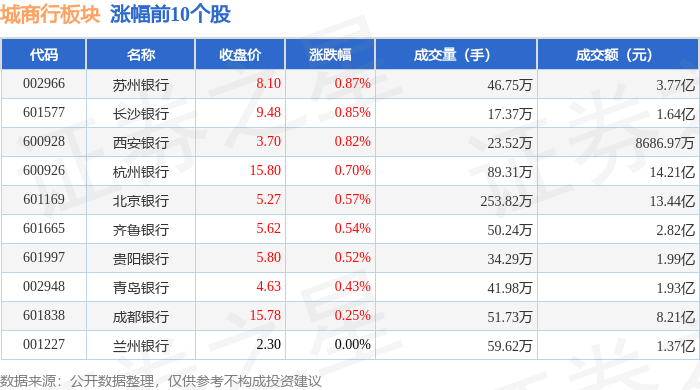
从资金流向上来看,当日城商行板块主力资金净流入7.24亿元,游资资金净流入8565.32万元,散户资金 净流出8.1亿元。城商行板块个股资金流向见下表: | 代码 | 名称 | 主力净流入(元) | 主力净占比 游资净流入 (元) | | 游资净占比 散户净流入(元) | | 散户净占比 | | --- | --- | --- | --- | --- | --- | --- | --- | | 600919 江苏银行 | | 2.49 Z | 13.77% | -2499.87万 | -1.38% | -2.24 Z | -12.39% | | eoilea | 北京银行 | 2.15 Z | 16.03% | -3997.26万 | -2.97% | -1.75 Z | -13.06% | | 601229 上海银行 | | 1.08亿 | 13.65% | 4314.61万 | 5.44% | -1.51 Z | -19.09% | | 6000009 | 南京银行 | 8171.13万 | 11.53% | 3568.90万 | 5.04% | -1.17 Z | -16.56% | | 601838 ...







一文纵览全国分省份财政社融特征
GF SECURITIES· 2026-01-28 07:49
Investment Rating - The industry investment rating is "Buy" [2] Core Insights - The average narrow deficit ratio for all provinces in 2024 is 16.4%, and the average broad deficit ratio is 20.0%, both at relatively low levels since 2010. The average debt ratio stands at 357.0%, which has been on the rise since 2016 [5] Summary by Sections Regional Finance - The average tax revenue ratio across provinces is 67.2% in 2024, showing a year-on-year decline of 2.7%. The overall trend indicates a decrease in tax revenue reliance [20][26] - The average fiscal self-sufficiency rate for all provinces is 43.9% in 2024, reflecting a continuous decline since 2013 [17][19] - The government fund budget, which accounts for 20% of fiscal revenue, has seen a revenue decline of 14.2% year-on-year in 2024, primarily due to the downturn in the real estate market [27][28] Regional Social Financing - The new social financing has shown significant differentiation, with a notable concentration in economically developed eastern regions. Approximately 60% of the new social financing increment from 2020 to 2024 has been directed towards eastern regions, although this percentage has been gradually declining [5] - In 2024, the marginal contribution of government financing has increased, while corporate financing has decreased. The contribution of government departments to new loans is 69.1%, while corporate and household contributions are 34.7% and 24.8%, respectively [5][19]



民企科创债发行家数和规模均居全国第3,四川“交卷”2025科技金融大文章
Sou Hu Cai Jing· 2026-01-28 06:42
Core Viewpoint - The People's Bank of China Sichuan Branch is prioritizing technology finance as a key task, implementing the "Star Plan" to enhance financial support for technological development in the province [1] Group 1: Policy Framework and Ecosystem - The Sichuan Branch has led the development of a comprehensive policy framework to support technology finance, including measures like the "Five Major Articles of Finance" and the "Star Plan" for 2025 [2] - A tiered financial interaction policy has been established, rewarding banks that provide loans to technology SMEs and issue innovation bonds, with over 45 million yuan distributed to 62 banks by 2025 [2] - The branch is promoting a coordinated approach to technology finance, focusing on eight national high-tech zones and two regions with strong technology finance foundations [2] Group 2: Support for Technological Innovation - The Sichuan Branch has set up re-loans for technological innovation and equipment upgrades, with extensive policy promotion and collaboration with local departments [3] - A monthly monitoring and quarterly reporting system has been established to evaluate the implementation of policies, with underperforming banks subject to discussions and on-site supervision [3] - By the end of 2025, banks in the province had granted 106.3 billion yuan in credit to technology enterprises and projects, a 2.6-fold increase from the end of 2024 [3] Group 3: Financial Product Innovation - Financial institutions are innovating products and services to better support technological innovation, with major banks establishing independent management mechanisms for technology finance [4] - New financial products such as innovation credit loans and intellectual property loans have been launched, with collaborative models between banks and other financial institutions [4] - By the end of November 2025, the balance of technology loans in the province reached 1.35 trillion yuan, a year-on-year increase of 13.5%, surpassing the national average by 2 percentage points [5] Group 4: Diversified Financing Channels - The Sichuan Branch is leveraging the bond market to support technological innovation, facilitating the issuance of 23.1 billion yuan in technology innovation bonds [6] - A pilot program for cross-border financing has been initiated, allowing 44 companies to sign foreign debt agreements totaling 6.59 million USD under a new policy framework [6]
银行股配置重构系列九:从主动基金 Q4 持仓看配置思路
Changjiang Securities· 2026-01-27 15:25
Investment Rating - The investment rating for the banking sector is "Positive" and is maintained [12] Core Insights - In Q4 2025, active funds did not significantly reduce their holdings in bank stocks, with a stable allocation ratio of 1.86% compared to the previous quarter. This reflects a general decline in market risk appetite. However, it is anticipated that the allocation ratio may decrease further in Q1 2026 due to a significant rebound in risk appetite and the relative underperformance of bank stocks at the beginning of the year [2][6] - The selection of individual stocks has shifted towards a focus on fundamental trends, with Ningbo Bank seeing the most significant increase in allocation due to improved asset quality and performance expectations. The bank has established a turning point in retail asset quality and is expected to lead the sector in performance [7][8] - The report suggests that the core investment strategy for 2026 should prioritize high-performing regional banks, particularly city commercial banks, as they are expected to maintain superior growth rates amid a stable credit structure [9] Summary by Sections Active Fund Holdings - As of Q4 2025, the allocation ratio of active public funds to bank stocks remained stable at 1.86%, indicating a recovery in market risk appetite. The allocation ratio is expected to hit a new low in Q1 2026 due to a resurgence in risk appetite and the underperformance of bank stocks [6][8] - City commercial banks experienced a reduction of approximately 1.7 billion in total holdings, but Ningbo Bank was notably increased by 860 million, reflecting a shift towards stocks with improving fundamentals [7][8] Stock Selection Trends - The focus on stock selection has shifted from high dividend yields to fundamental trends, with Ningbo Bank being the most significantly increased stock in Q4 2025. The bank's asset quality indicators have shown continuous improvement, and it is expected to see a growth in performance in 2026 [7][8] - Conversely, stocks like Chengdu Bank have been reduced significantly, reflecting concerns over performance volatility and ongoing adjustments in business structure [7] Market Dynamics - The banking sector has faced downward pressure due to capital outflows from active funds and index funds, leading to undervaluation in bank stocks. The report recommends seizing opportunities in quality city commercial banks at lower price levels [9][33] - The report highlights that the allocation strategy for 2026 should focus on high-quality city commercial banks, as they are expected to outperform in terms of earnings growth amid a stable credit environment [9]



城商行板块1月27日涨0.13%,青岛银行领涨,主力资金净流入4.04亿元
Zheng Xing Xing Ye Ri Bao· 2026-01-27 09:06
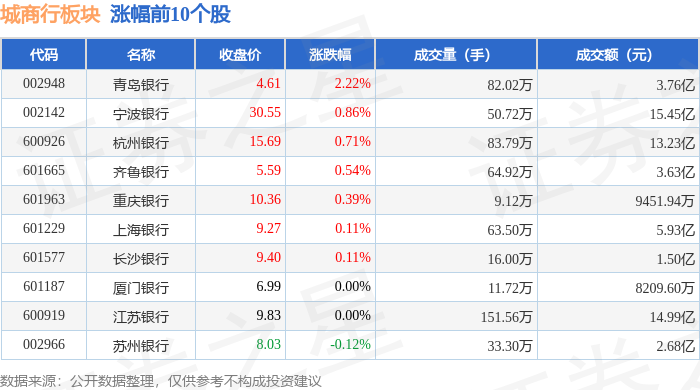
Market Performance - The city commercial bank sector increased by 0.13% compared to the previous trading day, with Qingdao Bank leading the gains [1] - The Shanghai Composite Index closed at 4139.9, up 0.18%, while the Shenzhen Component Index closed at 14329.91, up 0.09% [1] Individual Stock Performance - Qingdao Bank (002948) closed at 4.61, up 2.22% with a trading volume of 820,200 shares and a transaction value of 376 million [1] - Ningbo Bank (002142) closed at 30.55, up 0.86% with a trading volume of 507,200 shares and a transaction value of 1545 million [1] - Hangzhou Bank (600926) closed at 15.69, up 0.71% with a trading volume of 837,900 shares and a transaction value of 1323 million [1] - Qilu Bank (601665) closed at 5.59, up 0.54% with a trading volume of 649,200 shares and a transaction value of 363 million [1] - Chongqing Bank (601963) closed at 10.36, up 0.39% with a trading volume of 91,200 shares and a transaction value of 94.52 million [1] - Shanghai Bank (601229) closed at 9.27, up 0.11% with a trading volume of 635,000 shares and a transaction value of 593 million [1] - Other banks such as Changsha Bank, Xiamen Bank, and Suzhou Bank showed minimal changes in their stock prices [1] Capital Flow - The city commercial bank sector saw a net inflow of 404 million from main funds, while retail investors experienced a net outflow of 4.15 billion [2] - The main funds' net inflow and outflow for individual banks varied, with Ningbo Bank and Jiangsu Bank showing significant inflows [3] - Retail investors showed notable outflows in several banks, indicating a shift in investment sentiment [3]
成都银行股份有限公司首次公开发行限售股上市流通公告
Shang Hai Zheng Quan Bao· 2026-01-26 20:42
登录新浪财经APP 搜索【信披】查看更多考评等级 证券代码:601838 证券简称:成都银行 公告编号:2026-002 成都银行股份有限公司 首次公开发行限售股上市流通公告 本公司董事会及全体董事保证本公告内容不存在任何虚假记载、误导性陈述或者重大遗漏,并对其内容 的真实性、准确性和完整性依法承担法律责任。 重要内容提示: ● 本次股票上市类型为首发股份;股票认购方式为网下,上市股数为7,377,158股。 三、本次限售股上市流通的有关承诺 本次股票上市流通总数为7,377,158股。 ● 本次股票上市流通日期为2026年2月2日(因2026年1月31日为非交易日,故顺延至2026年2月2日)。 一、本次限售股上市类型 经中国证券监督管理委员会(以下简称"中国证监会")《关于核准成都银行股份有限公司首次公开发行 股票的批复》(证监许可〔2017〕2339号)核准,成都银行股份有限公司(以下简称"本公司"、"成都 银行")向社会首次公开发行人民币普通股(A股)股票361,225,134股,并于2018年1月31日在上海证券 交易所挂牌上市。首次公开发行后,本公司总股本为3,612,251,334股,其中有限售 ...
8亿投资海光信息,豪赚1200亿,成都国资跻身“最强捕手”
Zheng Quan Shi Bao Wang· 2026-01-26 12:23
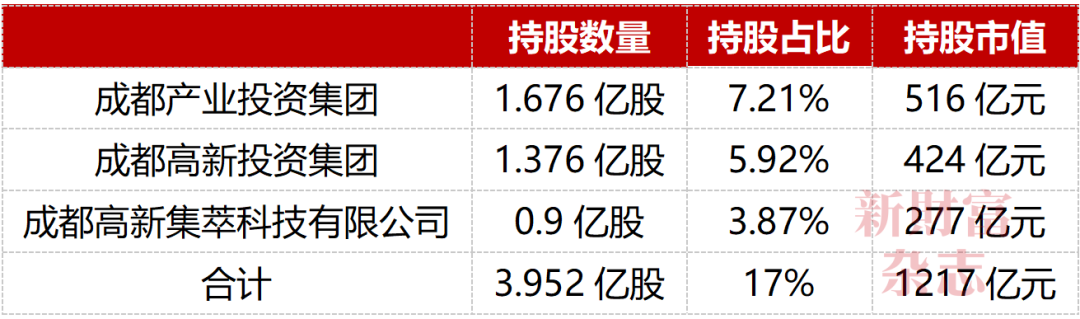
Core Insights - Chengdu's government venture capital investment in Haiguang Information has yielded over 120 billion yuan in returns, establishing a new benchmark for local state-owned investment [1][2][3] - The investment has transformed Haiguang Information into a 700 billion yuan domestic CPU giant, showcasing the potential of government-backed investments in strategic emerging industries [1][2][3] Investment Performance - Chengdu's state-owned enterprises invested 8.125 billion yuan in Haiguang Information, which has now a market value exceeding 121.7 billion yuan, representing a return of over 150 times [2][3][4] - The investment has generated significant financial returns, with Chengdu's state-owned enterprises having already recouped their initial investment through previous share sales [2][3][4] Strategic Implications - The success of Haiguang Information illustrates the effectiveness of government venture capital in driving local economic growth, job creation, and tax revenue [1][2][3] - Chengdu's model of "investment—appreciation—financing—investment" may serve as a reference for other local governments seeking to enhance their industrial landscape [1][2][3] Company Development - Haiguang Information, originally established in Tianjin, relocated to Chengdu after receiving investment from Chengdu's government, which facilitated its growth and development in the CPU sector [10][11][12] - The company has become the only domestic enterprise with x86 processor technology authorization, further solidifying its position in the semiconductor industry [12][13] Financial Restructuring - Chengdu's investment has positively impacted the financial statements of its state-owned enterprises, allowing them to maintain profitability despite challenges in other sectors [18][21] - The increase in the market value of Haiguang Information has enabled Chengdu's state-owned enterprises to issue bonds and secure financing for further investments [21][23] Industry Impact - Chengdu has emerged as a significant hub for semiconductor companies, with over 400 integrated circuit enterprises established, contributing to a growing industry scale [24] - The success of Haiguang Information has positioned Chengdu as a key player in the national semiconductor landscape, influencing local and regional economic strategies [24]