罗氏

Search documents
Merck Indicates Better Growth Visibility in Post-Keytruda LOE Period
ZACKS· 2026-02-16 17:45
Core Insights - Merck (MRK) reported better-than-expected fourth-quarter 2025 results, surpassing estimates for both earnings and sales, which has boosted investor optimism regarding the company's long-term growth outlook [1] Group 1: Financial Performance - In 2025, Merck's new products, including Capvaxive and Winrevair, generated sales of $759 million and $1.4 billion, respectively, indicating strong market performance [4] - Another product, Welireg, achieved sales of $716 million in 2025, contributing to the overall positive financial results [5] - Merck's shares have increased by 44.1% over the past six months, outperforming the industry average rise of 28.4% [12] Group 2: Pipeline and Growth Opportunities - Merck is facing a significant patent cliff with its PD-1 therapy Keytruda losing exclusivity in 2028, but the company anticipates over $70 billion in potential non-risk-adjusted commercial opportunities from its pipeline by the mid-2030s [2][10] - The company's phase III pipeline has nearly tripled since 2021, bolstered by mergers and acquisitions, which supports long-term growth [6][10] - Merck's recent acquisition of Cidara Therapeutics added a promising antiviral candidate, MK-1406, to its pipeline, which is currently in late-stage studies [7] Group 3: Competitive Landscape - Keytruda faces competition from other PD-L1 inhibitors such as Bristol Myers' Opdivo, Roche's Tecentriq, and AstraZeneca's Imfinzi, with Opdivo generating $10.05 billion in sales in 2025 [9][11] Group 4: Valuation and Estimates - Merck's shares are currently trading at a price/earnings ratio of 18.77, which is lower than the industry average of 18.83 but higher than its 5-year mean of 12.51 [14] - The Zacks Consensus Estimate for 2026 earnings per share has decreased from $8.11 to $5.96, while the estimate for 2027 has slightly declined from $10.02 to $9.98 [15]



Prothena Stock Tumbles 36.8% Year Over Year: What Lies Ahead?
ZACKS· 2026-02-16 15:56
Core Viewpoint - Prothena Corporation (PRTA) has experienced a significant decline in share price, dropping 36.8% over the past year, primarily due to setbacks in its pipeline, particularly the failure of its candidate birtamimab in a late-stage study [1][6]. Financial Performance - The company has reported inconsistent earnings over the last four quarters, with losses widening due to increased research and development expenses and the impact of pipeline setbacks, including the discontinuation of birtamimab [2]. - Prothena's earnings have missed estimates in each of the last four quarters, with an average negative surprise of 26.72% [2]. Pipeline Setbacks - In May 2025, Prothena announced the discontinuation of birtamimab after the AFFIRM-AL study failed to meet its primary endpoint, removing a near-term value driver [3]. - The termination of birtamimab has significantly reduced near-term catalysts for the stock and shifted the company's strategic focus toward earlier-stage assets like PRX012, which are several years away from potential commercialization [4]. Workforce and Cost Management - In June, Prothena announced a 63% workforce reduction to streamline operating costs while ensuring continued support for its wholly owned programs and partnered program obligations [7]. Partnered Programs Progress - Prothena's pipeline progress is largely driven by partnered assets rather than wholly owned programs [8]. - Partner Novo Nordisk is evaluating coramitug in the phase III CLEOPATTRA program for ATTR cardiomyopathy, which could earn Prothena up to $1.23 billion in development and sales milestones [9]. - Roche has initiated the phase III PARAISO study on prasinezumab for early-stage Parkinson's disease, indicating ongoing commitment to this collaboration [10]. Collaboration Agreements - Prothena has a worldwide collaboration agreement with Roche, having received $135 million to date, with potential for up to $620 million in additional milestone payments and royalties on future sales [11]. - Bristol Myers Squibb is conducting a phase II study for its anti-tau antibody BMS-986446 in Alzheimer's disease, with primary completion expected in 2027 [12]. Ongoing Development - Prothena has initiated an early-stage first-in-human study on PRX019, with completion expected in 2026 [14].


Buy 2 Vanguard Index Funds to Beat the S&P 500 in the Next Decade, According to Wall Street Analysts
The Motley Fool· 2026-02-16 09:12
Core Viewpoint - Goldman Sachs anticipates that European and emerging-market equities will outperform the U.S. stock market over the next decade, with the S&P 500 projected to return 6.5% annually compared to 7.5% for European stocks and 12.8% for emerging-market stocks [1][2]. European Equities - European stocks are expected to achieve a 7.5% annual return, driven by strong earnings growth, a high dividend yield of approximately 3%, and stock buybacks [2]. - The Vanguard FTSE Europe ETF tracks around 1,200 companies in Europe, with significant weight in financials (24%), industrials (19%), and healthcare (13%) [5]. - Over the past decade, the S&P 500 outperformed the Vanguard FTSE Europe ETF, returning 335% (15.8% annually) compared to 174% (10.5% annually) for the European ETF [5][6]. - Analysts believe that European stocks, trading at cheaper valuations, could outperform U.S. stocks due to the historical expense of U.S. equities and a projected decline in the U.S. dollar relative to the euro [6]. Emerging-Market Equities - Emerging-market stocks are projected to return 12.8% annually, bolstered by strong earnings growth in China and India [2]. - The Vanguard FTSE Emerging Markets ETF measures the performance of about 6,200 companies, with a focus on technology (29%), financials (21%), and consumer discretionary (12%) [9]. - The Vanguard FTSE Emerging Markets ETF returned 162% (10.1% annually) over the last decade, significantly lagging behind the S&P 500, which returned 335% [9][10]. - Analysts expect emerging-market stocks to outperform due to stronger earnings growth, higher dividend yields, and a weakening U.S. dollar against emerging-market currencies [10]. Investment Options - The Vanguard FTSE Europe ETF has a low expense ratio of 0.06%, making it a cost-effective option for investors seeking exposure to European equities [8]. - Similarly, the Vanguard FTSE Emerging Markets ETF also features a low expense ratio of 0.06%, which is significantly lower than the average expense ratio of 1.13% for similar funds [11].

速递|默沙东杀入口服GLP-1:1.12亿美元买来MK-4082,120人一期开跑
GLP1减重宝典· 2026-02-15 04:08
Core Viewpoint - Merck's initiation of global Phase I clinical trials for the small molecule oral GLP-1 candidate MK-4082 represents a strategic move to regain market share in metabolic diseases post-DPP-4 era, focusing on broader health issues beyond glucose control [4][7]. Group 1: Merck's Strategy and Market Position - The collaboration between Merck and domestic company Haosen Pharmaceutical involves a clear financial structure, with Haosen receiving an upfront payment of $112 million and potential milestone payments up to $1.9 billion, along with revenue-sharing arrangements [6]. - Merck's choice to pursue small molecules instead of injectable large molecules is driven by the competitive landscape, where established players have set high clinical data standards and built extensive supply chains [7]. - The oral GLP-1 approach is seen as more scalable and suitable for large-scale commercialization, aligning with Merck's capabilities in managing broad indications [7]. Group 2: Industry Trends and Competitor Strategies - Major competitors like Novo Nordisk and Eli Lilly are fully engaged in the market with a comprehensive approach, including injectables and oral formulations, while focusing on supply capabilities and pricing strategies [8]. - Other companies, such as Roche and AstraZeneca, are diversifying their strategies, with Roche acquiring assets to enhance its portfolio and AstraZeneca pursuing both small molecule oral GLP-1 and multi-target approaches [9][10]. - Pfizer's strategy involves acquiring new generation long-acting assets and small molecule projects to mitigate risks associated with single project failures [9]. Group 3: Implications for Chinese Pharmaceutical Companies - The significance of MK-4082 extends to Chinese innovative drug companies, as the focus shifts from single-target me-too drugs to those with platform value, emphasizing small molecules, dual or multi-targets, and ultra-long-acting formulations [11]. - The market will closely monitor MK-4082's Phase I results for pharmacokinetics and tolerability, as well as Merck's potential to expand its asset portfolio with complementary mechanisms [11].

Better International ETF: iShares' IEFA vs. Schwab's SCHE
The Motley Fool· 2026-02-14 23:49
Core Insights - The Schwab Emerging Markets Equity ETF (SCHE) and iShares Core MSCI EAFE ETF (IEFA) provide low-cost international diversification but differ significantly in regional focus, sector weights, and recent performance [1][2] Cost & Size - Both SCHE and IEFA have an expense ratio of 0.07% - As of February 4, 2026, SCHE has a one-year return of 26.1% while IEFA has a return of 29.0% - SCHE offers a dividend yield of 2.8%, whereas IEFA provides a higher yield of 3.4% - SCHE has a beta of 0.87, indicating lower volatility compared to the S&P 500, while IEFA has a beta of 1.01 - Assets under management (AUM) for SCHE stand at $12.2 billion, significantly lower than IEFA's $173.4 billion [3][4] Performance & Risk Comparison - Over the past five years, SCHE experienced a maximum drawdown of -35.70%, compared to IEFA's -30.41% - An investment of $1,000 in SCHE would have grown to $1,027 over five years, while the same investment in IEFA would have grown to $1,338 [5] Portfolio Composition - IEFA includes over 2,500 developed-market stocks, with significant sector allocations in financial services (22%), industrials (20%), and healthcare (11%) - Major holdings in IEFA include ASML Holding, Roche Holding, and HSBC Holdings - SCHE focuses on emerging markets, with a notable emphasis on technology (23%) and financial services (23%), featuring top positions in Taiwan Semiconductor Manufacturing, Tencent Holdings Ltd., and Alibaba Group [6][7] Investor Implications - IEFA is suitable for investors seeking lower risk and volatility, given its focus on developed markets and larger number of holdings, which contributes to its lower five-year drawdown and higher dividend yield - SCHE appeals to aggressive investors looking for growth, particularly in technology stocks, but comes with higher volatility and political risks associated with emerging markets [9][10]
硕迪生物股价连续下跌,GLP-1赛道竞争加剧引关注
Xin Lang Cai Jing· 2026-02-14 20:15
以上内容基于公开资料整理,不构成投资建议。 来源:经济观察网 机构观点 经济观察网 硕迪生物(GPCR.OQ)近7天(2026年2月9日至13日)股价呈现连续下跌趋势。根据内部 数据库,截至2月13日收盘,股价报70.07美元,单日下跌2.73%;近5日累计跌幅达6.47%,区间振幅为 14.95%,最低触及69.95美元。成交活跃度分化,2月12日成交额放大至6405万美元(换手率1.24%),2 月13日回落至8924万美元(换手率1.77%)。同期生物技术板块上涨1.32%,但个股表现弱于大盘(纳 斯达克指数跌0.22%)。 多家券商指出,长期看好硕迪生物基于专利合作带来的现金流潜力及口服GLP-1管线的稀缺性。但短期 股价受制于市场情绪波动、板块获利了结压力以及低流动性环境放大波动,资金分歧显著。 近期事件 2025年12月30日,硕迪生物与罗氏及基因泰克达成非独家专利许可协议,获得1亿美元预付款,并有权 收取口服GLP-1药物CT-996未来销售额的低个位数百分比特许权使用费。该合作虽提供非稀释性资金支 持,但近期股价与这一利好形成反差,主要受医药板块轮动、技术面回调及市场对GLP-1赛道竞争加剧 ...
VXUS Offers Broader Global Exposure Than IEFA
Yahoo Finance· 2026-02-14 15:13
Core Insights - The Vanguard Total International Stock ETF (VXUS) includes emerging markets, while the iShares Core MSCI EAFE ETF (IEFA) focuses solely on developed markets outside the U.S. and Canada [1][2] Cost & Size Comparison - VXUS has an expense ratio of 0.05% and assets under management (AUM) of $606 billion, while IEFA has a slightly higher expense ratio of 0.07% and AUM of $178 billion [3][4] - The 1-year return for VXUS is 35.7%, compared to IEFA's 32.9%, and the dividend yield for VXUS is 2.91%, while IEFA offers a higher yield of 3.27% [3][4] Performance & Risk Analysis - Over the past five years, VXUS experienced a maximum drawdown of 29.44%, while IEFA had a slightly higher drawdown of 30.37% [5] - An investment of $1,000 would have grown to $1,504 in VXUS and $1,580 in IEFA over the same period [5] Portfolio Composition - VXUS holds 8,691 stocks, with significant positions in Taiwan Semiconductor Manufacturing Co Ltd, Tencent Holdings Ltd, and ASML Holding NV, providing geographic diversification with 38% in Europe, 27% in emerging markets, 25% in the Pacific, and 8% in North America [6] - IEFA contains 2,589 developed-market stocks, with major holdings in ASML Holding NV, Roche Holding AG, and AstraZeneca Plc, offering a stable composition for investors avoiding emerging-market risks [7] Investment Implications - Both ETFs are low-cost options for gaining international stock exposure, with improving global economic conditions and a weaker dollar potentially driving growth in international stocks in 2026 [8] - IEFA may be more suitable for the current bull market due to its recent outperformance and higher dividend yield, along with its focus on economically stable developed markets [8][9]
罗氏诊断试剂在华获批,股价稳健上涨
Jing Ji Guan Cha Wang· 2026-02-13 19:36
Core Viewpoint - Roche's stock price remains stable, closing at $58.80 on February 13, 2026, with a 0.32% increase from the previous day, driven by recent developments in diagnostics and research, as well as strong financial performance [1][2]. Recent Events - Roche Diagnostics received approval from the National Medical Products Administration of China for the VENTANA CLDN18 companion diagnostic, marking it as the first tool for targeted therapy with trastuzumab for gastric cancer, potentially enhancing Roche's position in precision medicine [1]. - Roche announced that its investigational BTK inhibitor Fenebrutinib met its primary endpoint in a Phase 3 study for primary progressive multiple sclerosis, showing a 12% reduction in the risk of disability progression, reinforcing its pipeline potential in neuroscience [1]. Financial Performance - In 2025, Roche's global sales reached 61.5 billion Swiss francs (approximately $74.1 billion), reflecting a 7% year-over-year growth, with core operating profit increasing by 13%. The approval of four new products or indications in China and the inclusion of ten innovative drugs in the medical insurance system further solidified its position as the second-largest market globally [1]. Stock Performance - As of February 13, Roche's stock has increased by 2.45% over the past seven days and has risen 14.02% year-to-date, although it has not surpassed its historical high [2]. - The pharmaceutical sector in the U.S. rose by 1.83% during the same period, while the Nasdaq index fell by 2.02%. Roche's stock resilience is partly attributed to capital inflows into the sector and a low turnover rate, with an average turnover rate of approximately 0.05% over the past seven days [2]. - TD Cowen maintained a "Hold" rating on Roche as of February 11, with a target price of $67, citing progress in its oncology and neuroscience pipelines as supporting long-term value, while also noting challenges related to patent expirations [2].

阿斯利康,豪赌中国
Ge Long Hui· 2026-02-13 17:24
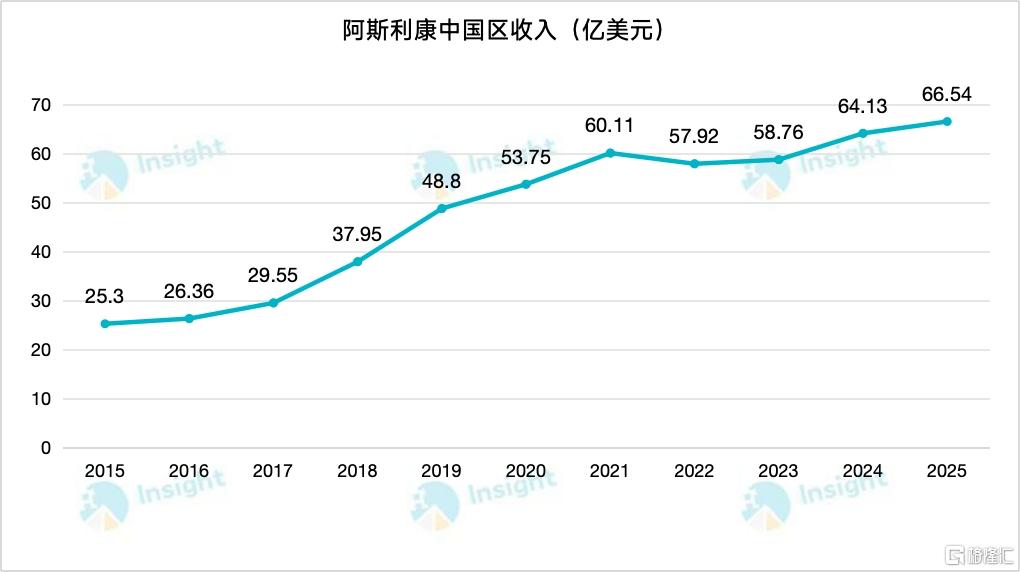
Core Insights - AstraZeneca achieved a record revenue of $6.664 billion in China for 2025, marking a significant milestone in its 30-year history in the market [1] - The company plans to invest $15 billion in China by 2030 and has established a $18.5 billion collaboration with CSPC Pharmaceutical Group [1] Revenue Performance - AstraZeneca is the second-largest market for the company, with 2024 revenues reaching $54.073 billion, and China contributing $6.413 billion, a year-on-year increase of 11% [1] - In 2025, total revenue reached $58.739 billion, with China contributing $6.654 billion, accounting for 11% of total revenue, maintaining the top position among multinational pharmaceutical companies in China [1][3] Product Portfolio - Since entering the Chinese market in 1993, AstraZeneca has introduced over 40 innovative drugs, including key products in oncology and chronic disease management [3] - The inhaled budesonide suspension is the highest-selling drug in China, although its sales have declined due to policy price adjustments [3] - Osimertinib is expected to become a new flagship product in China, potentially replacing budesonide due to the large market for non-small cell lung cancer patients [3][4] Strategic Focus - AstraZeneca is focusing on a comprehensive "innovation offensive" in China, particularly in oncology, cardiovascular, renal, and metabolic disease areas [6] - The company has a robust pipeline in oncology, with several promising drugs set to launch in China, including novel AKT inhibitors and TROP2 ADCs for breast cancer treatment [6] - The pipeline also includes treatments for chronic diseases and rare diseases, addressing the diverse needs of the Chinese market [7][8] Investment Plans - AstraZeneca's $15 billion investment will focus on expanding drug manufacturing and R&D capabilities, particularly in cell therapy and radiolabeled drug conjugates [12][13] - The company has made 23 collaborations in China since 2021, totaling over $40 billion, with a significant focus on oncology and chronic disease treatments [9][12] Market Positioning - AstraZeneca aims to leverage China's scientific and manufacturing strengths to provide cutting-edge treatment solutions, positioning itself as a leader in cell therapy capabilities [13] - The company has established global strategic R&D centers in Beijing and Shanghai and operates multiple production bases across China [13][14] Conclusion - AstraZeneca's deep integration into the Chinese market signifies a shift from merely selling products to becoming a core participant in China's healthcare ecosystem, evolving into a global innovation center rooted in China [15]

ALNY Q4 Earnings Beat, Sales Miss Despite Y/Y Growth, Stock Down
ZACKS· 2026-02-13 16:20
Core Insights - Alnylam Pharmaceuticals reported fourth-quarter 2025 adjusted earnings of $1.25 per share, exceeding the Zacks Consensus Estimate of $1.16, compared to adjusted earnings of 6 cents in the same quarter last year [1] - Total revenues for the quarter were $1.10 billion, falling short of the Zacks Consensus Estimate of $1.14 billion, but representing an 85% year-over-year increase from $593.2 million [2] Financial Performance - Net product revenues reached $994.7 million, marking a 121% increase year over year, driven by strong demand for Amvuttra and other marketed drugs [3] - Net revenues from collaborators were $40.9 million, a 62% decrease from the previous year, primarily due to the absence of revenues from Novartis in the reported quarter [4] - Royalty revenues increased by 73% year over year to $61.4 million [5] Product Performance - Amvuttra generated sales of $826.6 million, up 189% year over year, although it missed the Zacks Consensus Estimate of $837.2 million [8] - Givlaari sales were $86.8 million, reflecting a 34% year-over-year increase and exceeding the Zacks Consensus Estimate of $79.7 million [9] - Oxlumo recorded sales of $49.6 million, a 14% increase year over year, but fell short of the Zacks Consensus Estimate of $55.2 million [9] Guidance and Future Outlook - For 2026, Alnylam expects net product revenues between $4.9 billion and $5.3 billion, indicating a year-over-year growth of 64-77% at constant exchange rates [17] - The company anticipates net revenues from collaborations and royalties to be in the range of $400 million to $500 million, with adjusted R&D and SG&A expenses projected between $2.7 billion and $2.8 billion [17] Overall Assessment - Alnylam's fourth-quarter results were mixed, with earnings surpassing estimates but revenues missing expectations, likely due to high market expectations rather than a decline in demand [18] - The significant year-over-year revenue growth was primarily driven by strong sales of Amvuttra, supported by recent label expansions [19]