Fenebrutinib

Search documents
医药行业深度报告:多发性硬化症全球累及患者群体庞大,BTK抑制剂有望成为新型治疗方案
Ping An Securities· 2026-03-23 05:51
Investment Rating - The industry investment rating is "Outperform the Market," indicating an expected performance exceeding the market by more than 5% within the next six months [54]. Core Insights - The global population affected by multiple sclerosis (MS) is substantial, with over 2 million patients worldwide, particularly prevalent in Europe and the United States. The disease primarily affects individuals aged 20-40, with a significant economic burden, as the costs in the U.S. alone exceed $24 billion [3][6]. - Current therapies for MS include CD20 monoclonal antibodies, which dominate the market. Notably, Roche's Ocrelizumab is projected to generate approximately $9 billion in sales by 2025, while Novartis's Ofatumumab is expected to reach $4.426 billion [3][17]. - BTK inhibitors are emerging as a promising new treatment option for MS, targeting both adaptive and innate immune mechanisms. Several companies, including Sanofi, Roche, and Novartis, are advancing their BTK inhibitors through clinical trials, with significant results expected in the near future [3][24][30][34]. Summary by Sections 1. Global Patient Population of Multiple Sclerosis - MS is characterized by inflammatory demyelination in the central nervous system, with symptoms including vision loss and motor impairment. The disease typically begins between the ages of 20 and 40, with a global prevalence of approximately 2.99 million patients as of 2022 [6][10]. 2. BTK Inhibitors as a New Treatment Option - BTK inhibitors are significant due to their ability to modulate B cell and myeloid cell activity, making them potential treatments for MS. Several BTK inhibitors are in clinical development, with promising results from trials conducted by companies like Sanofi and Roche [24][30][34]. 3. Investment Recommendations - The report recommends focusing on companies with advanced pipelines in the MS treatment space, particularly those with BTK inhibitors in late-stage clinical trials, such as Novartis's Remibrutinib and Innovent Biologics's Orelabrutinib [50].


药渡每周渡选-20260313
药渡数据· 2026-03-13 02:57
Investment Rating - The report does not explicitly state an investment rating for the industry Core Insights - The global biopharmaceutical industry is experiencing a surge in capital market activities, with significant collaborations and financing deals, including a $1.18 billion global rights authorization for a dual antibody by Deqi Pharmaceuticals and a $1.53 billion exclusive license agreement between China National Pharmaceutical Group and Sanofi [4][10] - Clinical advancements are notable in metabolic, oncology, and immunology fields, with Roche's Fenebrutinib showing a 51% reduction in annual relapse rate for multiple sclerosis and promising results from various drugs targeting obesity and cancer [5][8] - The industry is witnessing a strategic shift towards accelerated capitalization and upgraded R&D models, with companies focusing on core technology platform development and AI-driven drug discovery becoming a trend [5][10] Summary by Sections Global Biopharmaceutical Industry Dynamics - The capital market is seeing dense collaboration and financing activities, with multiple companies securing significant funding and partnerships [4] - Notable financing events include Candid's $505 million merger for NASDAQ listing and various companies completing rounds of financing exceeding hundreds of millions [10][11] Major Events in the Global Biopharmaceutical Industry - Deqi Pharmaceuticals authorized global rights for its CD3/CD19 dual antibody, potentially earning up to $1.18 billion [6] - Clinical data from Hansoh Pharmaceutical's obesity treatment showed a 19.3% average weight reduction in a Phase III trial, indicating strong efficacy [6][8] - China National Pharmaceutical Group's exclusive licensing deal with Sanofi for a JAK/ROCK inhibitor could yield up to $1.53 billion [6] Important Clinical Developments/Results - Roche's Fenebrutinib demonstrated a 51% reduction in annual relapse rate for multiple sclerosis in Phase III trials [8] - Kanfang Biologics' Cardonili achieved a 100% overall survival rate at 24 months in cervical cancer patients during Phase II trials [8] - Petrelintide, also from Roche, showed a 10.7% average weight loss in obese patients over 42 weeks in Phase II trials [8] Important Financing and Transaction Events - The report highlights multiple significant financing and strategic collaboration events, including a $400 million strategic financing for Teva Pharmaceuticals and various companies completing substantial funding rounds [10][11] - Five and Boao's IPO application in Hong Kong and other companies securing large investments indicate a trend towards increased capital influx in the biopharmaceutical sector [11][12]




Roche (OTCPK:RHHB.F) Update / briefing Transcript
2026-03-09 17:02
Summary of Conference Call on Roche's Gazyva and Immunology Pipeline Company and Industry Overview - The conference call focused on Roche's Gazyva and its development in immune-mediated kidney and rheumatological diseases, particularly systemic lupus erythematosus (SLE) [2][3] - The call included discussions on the phase III ALLEGORY study results for Gazyva in SLE, presented at EULAR [2] Core Points and Arguments Gazyva's Market Potential - Roche estimates the peak sales opportunity for Gazyva in immune-mediated diseases to be around $2 billion, covering SLE, lupus nephritis, membranous nephropathy, and IgA nephropathy (IgAN) [3][4] - The U.S., EU5, and Japanese market for SLE and related conditions is projected to grow from $5 billion in 2025 to approximately $11.4 billion by 2030, driven by new innovative medicines [3] Sales Forecasts - Gazyva sales for 2030 are forecasted to reach $1.7 billion, an increase of $0.7 billion from 2025 [4] - Sales expectations for giredestrant have risen from CHF 0.9 billion in 2029 to CHF 3.2 billion in 2030, indicating strong market confidence [5] Clinical Development and Pipeline - Gazyva has shown significant efficacy in treating lupus nephritis, with a 56% reduction in the risk of lupus nephritis flare [18] - The ALLEGORY study enrolled 303 patients, achieving a primary endpoint of SRI-4 with 76.7% of patients on Gazyva meeting this endpoint compared to 53% on placebo, a treatment difference of 23 percentage points [36] - Secondary endpoints also showed significant improvements, including a 42% risk reduction in flare rates [40] Unmet Needs in Lupus Treatment - The current treatment landscape for lupus nephritis emphasizes the need for long-term efficacy and steroid-sparing options, with patient surveys indicating fatigue management as a significant unmet need [15][16] - The guidelines now recommend starting treatment with triple therapy, including steroids, mycophenolate mofetil, and a biologic therapy [16] Safety and Efficacy - Gazyva's glycoengineered anti-CD20 mechanism leads to deeper B-cell depletion compared to traditional therapies, which is crucial for its efficacy in autoimmune diseases [16][30] - The safety profile showed manageable infections and infusion-related reactions, with a slightly higher incidence of neutropenia in the Gazyva group [44] Additional Important Insights - The call highlighted the importance of patient adherence to treatment regimens, with Gazyva's infusion schedule designed to enhance compliance [52] - Discussions on the potential for allogeneic CAR-T therapies in autoimmune diseases were noted, emphasizing scalability and accessibility [54] - The need for further data on subgroup analyses, particularly among different ethnicities, was acknowledged as an area for future exploration [49][53] Conclusion - Roche's Gazyva is positioned as a leading treatment option in the growing market for immune-mediated diseases, with promising clinical data supporting its efficacy and safety profile. The company is focused on addressing unmet patient needs and enhancing treatment adherence through innovative therapeutic approaches.
Roche (OTCPK:RHHB.F) Update / briefing Transcript
2026-03-09 17:02
Summary of Roche Virtual Immunology SLEuro Investor Event Company and Industry Overview - **Company**: Roche - **Industry**: Immunology, specifically focusing on immune-mediated kidney and rheumatological diseases, including systemic lupus erythematosus (SLE) and lupus nephritis [3][10] Core Points and Arguments Gazyva Development and Market Potential - Gazyva is projected to have a peak sales opportunity of around **$2 billion** in immune-mediated diseases, including SLE, membranous nephropathy, and IgA nephropathy (IgAN) [4][5] - The market for SLE, lupus nephritis, membranous nephropathy, and IgAN is expected to grow from **$5 billion** in 2025 to approximately **$11.4 billion** by 2030, driven by new innovative medicines [4][5] - Gazyva sales are forecasted to reach **CHF 1.7 billion** by 2030, which is an increase of **CHF 0.7 billion** from previous estimates [5] Clinical Trial Results - The Phase III ALLEGORY study for Gazyva in SLE showed a **23.1%** improvement in the primary endpoint (SRI-4) compared to placebo, with **76.7%** of patients on Gazyva achieving this endpoint [21][38] - Secondary endpoints also showed significant improvements, including a **42%** reduction in the risk of lupus nephritis flare [41] - Gazyva demonstrated a **35%** remission rate (DARS remission) compared to **14%** for placebo, marking it as one of the highest rates seen in global pivotal trials [42] Treatment Landscape and Unmet Needs - Lupus affects approximately **3.4 million** people worldwide, with **50%** experiencing renal involvement [14] - The current treatment landscape emphasizes the need for long-term efficacy and safety, as well as steroid-sparing options [15][16] - Biologics are expected to rise in use, driven by a treat-to-target approach in guidelines [16] Pipeline and Future Developments - Roche is pursuing various B-cell depleting strategies, including bispecifics and CAR-T therapies, to address chronic autoimmune diseases [8][25] - The company has initiated a Phase 3 trial for sefaxersen, an antisense oligonucleotide targeting complement factor B in IgAN, with a focus on reducing proteinuria [27][28] Additional Important Insights - The ALLEGORY study enrolled patients with high disease activity, requiring a SLEDAI score of **8 or greater**, which is higher than most other studies [35] - The study's design included a requirement for low complement levels, indicating a more active patient population [36] - Safety data indicated that infections were more common in the Gazyva group, but they were manageable [45] Conclusion - Roche's Gazyva shows promising results in treating SLE and lupus nephritis, with significant market potential and a strong pipeline of therapies aimed at addressing unmet needs in immune-mediated diseases [3][4][5][21][27]
罗氏2025年销售额615.16亿瑞士法郎,2026年将公布5款新药III期数据
Xin Lang Cai Jing· 2026-03-07 21:00
Product Development Progress - Roche announced a significant breakthrough in the autoimmune field with its BTK inhibitor Fenebrutinib for treating relapsing multiple sclerosis (RMS), achieving a 51% reduction in annual relapse rate in the Phase III study (FENhance 1) [1] - The company plans to submit a marketing application to global regulatory authorities, potentially making it the first oral medication to cover both RMS and primary progressive multiple sclerosis (PPMS) [1] - In the weight loss sector, Roche aims to be among the top three globally, with its candidate drug CT-388 showing a 22.5% weight reduction over 48 weeks in Phase II clinical trials [1] - Roche will present Phase III supporting data for five new molecular entities (NMEs) in 2026, focusing on unmet needs such as poor responders and muscle loss [1] - The company plans to submit three NMEs for approval in 2026, including giredestrant and vamikibart, and will expand two key indications, concentrating on oncology, neurology, and immunology [1] Financial Performance - Roche's next financial report is expected to be released on July 28, 2026, with the 2025 report showing sales of CHF 61.516 billion, reflecting a 7% growth at constant exchange rates [2] - Core operating profit increased by 13% in 2025 [2] - The company anticipates a high single-digit growth in adjusted earnings per share for 2026, with profit growth expected to outpace sales revenue growth [2]
刚刚!罗氏新药III期成功,但8例死亡病例引发关注
Xin Lang Cai Jing· 2026-03-02 11:50
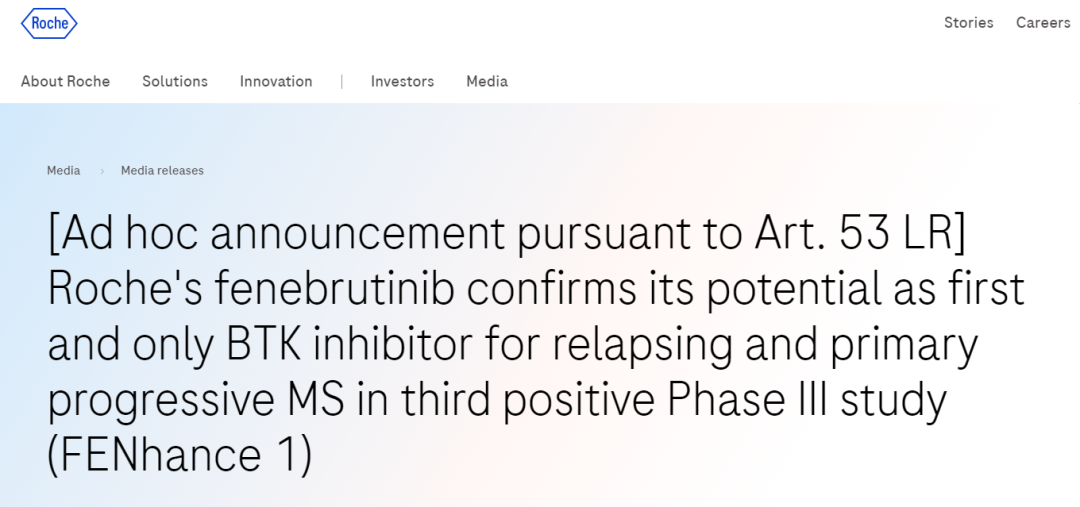
Core Insights - Roche announced that its oral BTK inhibitor Fenebrutinib achieved the primary endpoint in the pivotal Phase III study (FENhance 1) for relapsing multiple sclerosis (RMS) [1][6] - This marks the completion of all three pivotal Phase III studies for Fenebrutinib in the multiple sclerosis (MS) field [2][8] Efficacy Results - The FENhance 1 study demonstrated a significant reduction in annualized relapse rate (ARR) by 51% compared to the active control drug teriflunomide over a treatment period of at least 96 weeks, consistent with the results from the previously published FENhance 2 study, which showed a 59% reduction in ARR [3][9] - Combined data from both studies indicate that patients treated with Fenebrutinib experience a relapse on average every 17 years, showcasing strong disease control capabilities [4][10] Secondary Endpoints and Safety - Both RMS studies showed statistically significant and clinically meaningful effects of Fenebrutinib in reducing brain lesions (MRI lesions) [4][10] - All disease progression-related endpoints, including the composite confirmed disability progression at 12 and 24 weeks (cCDP), indicated favorable trends for Fenebrutinib [4][10] - The overall tolerability of Fenebrutinib was good, with liver enzyme elevations comparable to the control drug teriflunomide, and only one case of asymptomatic and reversible Hy's Law observed in each treatment group [4][10] - Notably, there were 8 deaths of various causes reported in the Fenebrutinib group across the two RMS studies, compared to 1 in the control group, prompting further investigation by Roche to clarify the reasons [4][10] Drug Profile and Future Plans - Fenebrutinib is a non-covalent, reversible, and highly selective BTK inhibitor designed to target both the peripheral and central nervous systems, addressing both acute inflammation and chronic damage driving long-term disability progression [5][11] - Roche's Chief Medical Officer, Dr. Levi Garraway, stated that the key study results, combined with early data, provide strong evidence that Fenebrutinib could become the first high-efficacy oral therapy for both relapsing (RMS) and primary progressive multiple sclerosis (PPMS) [5][11] - Roche plans to present the complete data from the FENhance 1, FENhance 2, and FENtrepid studies at the 2026 American Academy of Neurology (AAN) annual meeting and submit it to regulatory authorities [5][11]

与高盛同行-搭乘-魔法巴士-探访大型制药企业
Goldman Sachs· 2026-03-01 17:22
Investment Rating - The report does not explicitly provide an investment rating for the industry or specific companies Core Insights - The GLP-1 and obesity market is projected to reach a significant size by 2030, with Eli Lilly and Novo Nordisk both forecasting a market space of $105 billion, and oral medications expected to activate new consumer groups [1][4] - Recent price adjustments to $675 are seen as a government-driven initiative to optimize supply chains and reduce patient out-of-pocket costs rather than a systemic change in net pricing [5] - PBM reforms are a central topic among companies, potentially breaking rebate barriers and benefiting differentiated drug access, with implications for research and development strategies [5][6] Summary by Sections GLP-1 and Obesity Market - Eli Lilly and Novo Nordisk predict a market size of $105 billion by 2030, with both companies expecting Medicare Part D sales to gradually increase, particularly strong growth anticipated in 2027 [1][4] - Both companies agree that oral formulations will activate new consumer groups without significantly impacting existing injection sales [4] - There is a divergence in views on the key drivers for oral weight loss drug revenues, with Novo Nordisk emphasizing weight loss effectiveness while Eli Lilly argues that top-tier weight loss may not be the primary driver due to diverse consumer needs [4] Pricing Strategies - The recent price reduction to $675 is interpreted as a strategic move to align with government considerations, aiming to optimize supply chains and reduce patient costs rather than indicating a price war [5] - The adjustment is seen as a baseline change rather than a systemic alteration in net pricing [5] PBM Reform - PBM reform is highlighted as a critical issue, with potential to disrupt existing rebate structures and improve access for differentiated drugs [5][6] - Companies like Novartis and Pfizer are adjusting their R&D strategies in response to these reforms, particularly in immunology [5] M&A Activity - The report anticipates a very active M&A market in 2026, with large pharmaceutical companies having sufficient balance sheet capacity for significant transactions [3][10] - Eli Lilly is expected to pursue opportunities beyond typical transactions, while Merck's target transaction size is around $10 billion [3][10] Company-Specific Catalysts - Merck is expected to have multiple important data readouts in 2026 across various therapeutic areas, with management aiming to reduce risk by approximately $35 billion by the end of 2026 [7][8] - Novartis is focusing on the impact of Roche's Fenebrutinib data on its Remibrutinib in multiple sclerosis, expressing confidence in its monthly monitoring approach [8][11] Long-term Growth and Challenges - Novartis faces long-term growth pressures, particularly regarding the potential impact of generics on Kisangali, which is expected to peak in sales by 2028 [11][12] - The report discusses the potential for significant sales gaps due to patent expirations, emphasizing the need for new product lines to achieve double-digit growth in the 2030s [11][14]


罗氏诊断试剂在华获批,股价稳健上涨
Jing Ji Guan Cha Wang· 2026-02-13 19:36
Core Viewpoint - Roche's stock price remains stable, closing at $58.80 on February 13, 2026, with a 0.32% increase from the previous day, driven by recent developments in diagnostics and research, as well as strong financial performance [1][2]. Recent Events - Roche Diagnostics received approval from the National Medical Products Administration of China for the VENTANA CLDN18 companion diagnostic, marking it as the first tool for targeted therapy with trastuzumab for gastric cancer, potentially enhancing Roche's position in precision medicine [1]. - Roche announced that its investigational BTK inhibitor Fenebrutinib met its primary endpoint in a Phase 3 study for primary progressive multiple sclerosis, showing a 12% reduction in the risk of disability progression, reinforcing its pipeline potential in neuroscience [1]. Financial Performance - In 2025, Roche's global sales reached 61.5 billion Swiss francs (approximately $74.1 billion), reflecting a 7% year-over-year growth, with core operating profit increasing by 13%. The approval of four new products or indications in China and the inclusion of ten innovative drugs in the medical insurance system further solidified its position as the second-largest market globally [1]. Stock Performance - As of February 13, Roche's stock has increased by 2.45% over the past seven days and has risen 14.02% year-to-date, although it has not surpassed its historical high [2]. - The pharmaceutical sector in the U.S. rose by 1.83% during the same period, while the Nasdaq index fell by 2.02%. Roche's stock resilience is partly attributed to capital inflows into the sector and a low turnover rate, with an average turnover rate of approximately 0.05% over the past seven days [2]. - TD Cowen maintained a "Hold" rating on Roche as of February 11, with a target price of $67, citing progress in its oncology and neuroscience pipelines as supporting long-term value, while also noting challenges related to patent expirations [2].
罗氏股价近期稳健上涨,研发与财务表现受关注
Jing Ji Guan Cha Wang· 2026-02-13 15:31
Core Viewpoint - Roche's stock price has shown resilience despite not reaching historical highs, driven by product development progress and a solid performance in 2025 [1][2]. Product Development Progress - Roche's investigational drug Fenebrutinib achieved its primary endpoint in a Phase III study for primary progressive multiple sclerosis (PPMS), reducing the risk of disability progression by 12% [1]. - The approval of the VENTANA CLDN18 companion diagnostic by the Chinese regulatory authority enhances Roche's position in precision medicine, particularly for targeted therapy in gastric cancer [1]. Financial Performance - Roche reported a global sales figure of 61.5 billion Swiss francs (approximately 74.1 billion USD) for 2025, reflecting a 7% year-over-year growth, with core operating profit increasing by 13% [2]. - The pharmaceutical segment grew by 9%, while the diagnostics segment saw a 2% increase, driven by innovative drugs such as Ocrevus and Hemlibra [2]. - In China, Roche expanded its portfolio with four new product approvals and ten innovative drugs included in the medical insurance system, alongside an investment of over 2 billion yuan in a biopharmaceutical production base in Shanghai [2]. Institutional Perspective - TD Cowen maintained a "Hold" rating on Roche with a target price of 67 USD, citing progress in oncology and neuroscience pipelines as supporting long-term value, while also noting challenges related to patent expirations [3]. Market Environment - The pharmaceutical sector in the U.S. saw an overall increase of 1.83%, while the Nasdaq index declined by 2.02% over the past five days. Roche's stock resilience is partly attributed to capital inflows into the sector and a low turnover rate, with an average daily turnover rate of approximately 0.05% over the past week [4].
医药生物周报(26年第5周):Roche口服BTK抑制剂PPMS三期临床数据公布
Guoxin Securities· 2026-02-13 00:45
Investment Rating - The report maintains an "Outperform" rating for the pharmaceutical and biotechnology sector [5][39]. Core Insights - The pharmaceutical sector has shown resilience, outperforming the overall market, with traditional Chinese medicine leading the gains [1][28]. - Roche's oral BTK inhibitor Fenebrutinib has demonstrated non-inferiority to Ocrelizumab in treating primary progressive multiple sclerosis (PPMS), marking a significant advancement in the treatment landscape [2][11]. - The global market for multiple sclerosis (MS) treatment exceeds $20 billion, with unmet needs in PPMS due to limited treatment options [3][25]. Summary by Sections Market Performance - The overall A-share market declined by 1.3%, while the biopharmaceutical sector increased by 0.1%, indicating a stronger performance relative to the market [1][28]. - Specific segments within the biopharmaceutical sector showed varied performance, with traditional Chinese medicine rising by 2.6% [1][28]. Clinical Data and Drug Development - Roche's Fenebrutinib trial for PPMS included 985 patients and achieved its primary endpoint, showing a 12% reduction in disease progression risk compared to Ocrelizumab [2][11][24]. - The safety profile of Fenebrutinib was comparable to Ocrelizumab, with a similar incidence of adverse events [22][24]. Company Earnings Forecast and Investment Recommendations - Key companies in the sector, such as Mindray Medical, WuXi AppTec, and Aier Eye Hospital, are rated as "Outperform" with projected earnings growth [4][39]. - Mindray Medical is highlighted for its strong R&D and international expansion, while WuXi AppTec is recognized for its comprehensive drug development services [39]. Valuation Metrics - The TTM price-to-earnings ratio for the pharmaceutical and biotechnology sector stands at 37.31x, compared to the overall A-share market at 21.98x [35][36]. - Specific segments like chemical pharmaceuticals and biological products have higher valuations, indicating investor confidence in these areas [35][36].