Synchrony Financial

Search documents
特朗普利率突袭冲击金融股,华尔街高管财报季遭质询
智通财经网· 2026-01-16 12:48
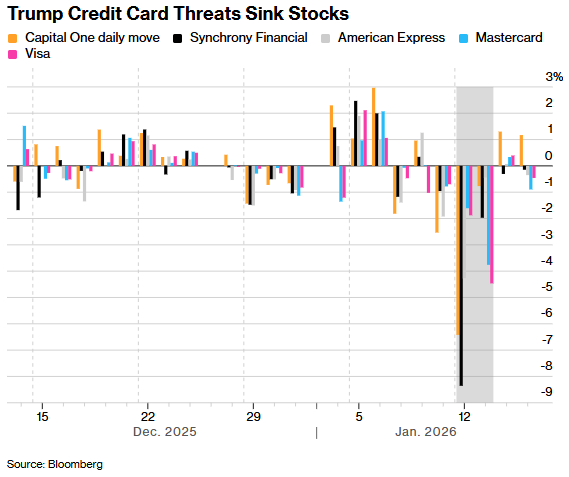
Core Viewpoint - President Trump's unexpected request for credit card companies to set a cap on interest rates at 10% could significantly impact the profitability of the financial sector, leading to a decline in financial stocks and raising concerns among bank executives during earnings calls [1][4]. Financial Sector Impact - The proposed interest rate cap is half of the current average rate on outstanding balances, potentially erasing billions in profits for credit card issuers [1]. - Major banks such as Capital One (COF.US), JPMorgan Chase (JPM.US), and American Express (AXP.US) experienced significant stock declines following the announcement [1]. - Analysts from KBW indicated that if the policy is implemented, it would severely weaken the profitability of credit card issuers and could trigger economic repercussions [4]. Legislative Developments - Trump has called for Congressional support for the Credit Card Competition Act, which targets the nearly $200 billion in swipe fees charged by banks and payment companies, negatively affecting stocks of Visa (V.US) and Mastercard (MA.US) [4]. - Some analysts doubt the feasibility of the interest rate cap, suggesting that the probability of it being enacted is less than 20% due to the lack of legislative support [4]. Broader Economic Effects - Bank executives have warned that the interest rate cap could lead to a significant economic slowdown and push consumers towards unregulated lending sources [5]. - The proposed changes are expected to have ripple effects beyond the financial sector, impacting industries such as airlines and retail, which rely on partnerships with credit card companies for substantial revenue [7]. - Airlines like Delta (DAL.US) and United Airlines (UAL.US) saw stock declines, as did retailers like Macy's (M.US) and Kohl's (KSS.US), due to concerns over the potential impact of the proposed legislation [7].







Trump’s Market Mayhem: A Daily Dose of Volatility, Served Fresh
Stock Market News· 2026-01-16 06:00
Financial Sector - The financial sector experienced a significant downturn following President Trump's announcement of a one-year cap of 10% on credit card interest rates, effective January 20, 2026, aimed at protecting consumers from high rates averaging around 20% [2][3] - Major financial institutions like JPMorgan Chase, Bank of America, Citigroup, and Wells Fargo saw their stock prices drop significantly, with JPMorgan's shares falling 4.2% to $310.90 despite better-than-expected earnings [3][4] - Consumer finance firms specializing in credit cards faced even steeper declines, with drops between 8% and 11% for companies like Synchrony Financial and Capital One, while Visa and Mastercard also saw declines of over 2% [4] Semiconductor Industry - A trade deal between the U.S. and Taiwan resulted in a reduction of tariffs on Taiwanese goods from 20% to 15%, in exchange for Taiwan's commitment to invest $250 billion in U.S. semiconductor and AI sectors [6][7] - Taiwan Semiconductor Manufacturing Co. reported a 35% year-over-year increase in fourth-quarter profit, leading to a 4.5% surge in its U.S.-listed shares, with trading volume increasing by 159% [7] - Despite a new 25% tariff on specific high-end AI chips, Nvidia's stock rebounded by around 3% due to positive earnings from TSMC and exemptions for companies investing in America [8][9] Healthcare Sector - President Trump introduced "The Great Healthcare Plan" aimed at lowering prescription drug prices and insurance premiums, but the lack of details and the need for Congressional approval left the market skeptical [10] - Some healthcare stocks like UnitedHealth Group and Cigna saw modest gains, but the overall market impact was minimal due to concerns over rising premium costs for millions of Americans [10] Geopolitical Developments - President Trump's announcement of a "Board of Peace" in Gaza and withdrawal from 66 global organizations had little immediate market impact, overshadowed by economic news [11] - Oil prices dropped approximately 5% following Trump's de-escalation of military threats against Iran, indicating a positive market reaction to reduced geopolitical tensions [11] Market Volatility - The week illustrated the unpredictable nature of the market under Trump's administration, characterized by sudden policy announcements and immediate market reactions, creating a challenging environment for investors [12]



Analyst says 'buy the dip' in top bank stock after credit card cap drop
Yahoo Finance· 2026-01-15 23:59
Core Viewpoint - President Trump's proposal to cap credit card interest rates at 10% has led to a significant sell-off in credit card stocks, particularly affecting American Express [1][4]. Group 1: Impact of Interest Rate Cap - A 10% cap on credit card interest would represent a major shift, as the average rate is currently 19.6% [2]. - This cap poses a substantial risk to credit card issuers that depend on interest for revenue and profits [2]. - Despite the sell-off, some analysts believe that American Express is less vulnerable due to its reliance on fees rather than interest income [2][4]. Group 2: American Express's Business Model - American Express focuses on higher-income households willing to pay annual fees for premium card perks, differentiating it from competitors like Synchrony Financial, which relies on no-fee, high-interest cards [5][9]. - The company generates significant revenue from merchant swipe fees, which, combined with card fees, accounted for 65% of its total revenue in the last quarter [10][11]. - American Express's write-offs are lower than those of competitors, indicating a more stable customer base [11]. Group 3: Market Reaction and Analyst Insights - Following the announcement of the interest rate cap, American Express shares fell by 7.3%, including a 4.3% drop on January 12 [3]. - Analysts suggest that the recent decline presents a buying opportunity, as the stock is expected to rebound [3][12]. - The stock price chart indicates a pullback to reliable support levels, with expectations of recovery as earnings are reported on January 30 [7].
This Bull Run Looks Tired: If SPY Breaks Below $685, A Big Correction May Be Next
Seeking Alpha· 2026-01-15 21:12
Core Insights - The market narrative is rapidly changing, with investors initially focusing on the $602 billion capital expenditure planned by five hyperscalers, including Oracle, for the year [1] Group 1: Investment Strategy - The investment style described is contrarian and highly risky, often involving illiquid options [1] - The portfolio allocation is approximately 50% in shares and 50% in call options, reflecting a balance between risk and traditional equity investment [1] - The investment timeframe typically ranges from 3 to 24 months, targeting stocks that have recently experienced sell-offs due to non-recurrent events [1] Group 2: Stock Screening Process - The screening process involves fundamental analysis to assess company health, leverage, and financial ratios compared to sector and industry averages [1] - Insider buying at lower prices post-sell-off is a key indicator for potential investment opportunities [1] - Technical analysis is utilized to determine optimal entry and exit points, employing multicolor lines for support and resistance levels on weekly charts [1]

Wall Street Breakfast Podcast: TSMC, Lam Research Spark Early Market Rally
Seeking Alpha· 2026-01-15 12:00
Company Performance - Taiwan Semiconductor (TSM) reported a net profit of NT$506 billion (US$16 billion) for the October-December quarter, marking a 35% increase year-over-year, surpassing analysts' expectations. The company plans to increase its capital expenditure budget to US$52 billion to US$56 billion for 2026, up from approximately US$40 billion last year [4] - Lam Research (LRCX) saw a 6% increase in stock price, with Stifel forecasting a 10% to 15% increase in wafer fabrication equipment spending for calendar year 2026, translating to a year-over-year increase of US$10 billion to US$15 billion, primarily driven by advanced foundry/logic and DRAM [5] Service Disruptions - Verizon (VZ) restored its network services after a nationwide outage that affected over 171,000 customers, primarily due to loss of mobile signal. The company plans to issue account credits to impacted customers [6][7] New Financial Products - Bilt introduced three new credit cards under the Bilt Card 2.0 name, offering a 10% introductory APR for 12 months. The cards are designed to provide rewards on rent and mortgage payments [8][9] - The Bilt Palladium Card has an annual fee of US$495, offering 2x points on everyday spending and a 50,000 sign-up bonus. The Bilt Obsidian Card, with a US$95 annual fee, offers 3x points on dining and groceries, while the Bilt Blue Card has no annual fee and offers 1x points on everyday spending [10][11]



Bank CEOs warn rate cap would have 'unintended consequences'
American Banker· 2026-01-14 21:38
Core Viewpoint - Bank CEOs are expressing significant concern regarding President Trump's proposal for a 10% cap on credit-card interest rates, highlighting potential negative impacts on credit access and consumer spending [9]. Industry Reactions - Brian Moynihan, CEO of Bank of America, stated that implementing a cap would constrict credit and lead to unintended consequences, emphasizing the importance of affordability [2][3]. - Citi's CEO Jane Fraser opposed the cap, warning that it would severely impact access to credit for consumers and businesses, potentially forcing them to seek predatory alternatives [3]. - Wells Fargo's CEO Charlie Scharf acknowledged the importance of affordability but suggested that the response to the issue should be carefully considered [4]. Financial Implications - Analysts predict that a cap on credit-card interest rates could significantly reduce earnings for banks with large card portfolios, with estimates suggesting it could wipe out card earnings for a year [7][10]. - The average credit-card interest rate was reported at 21.39% in Q3 2025, indicating that a 10% cap would drastically alter the current economic landscape for credit cards [6][11]. - JPMorganChase's CFO Jeremy Barnum noted that the cap would negatively affect both consumers and the broader economy, leading to a loss of credit access for those who need it most [15][16]. Market Reactions - Shares of Synchrony Financial and Bread Financial Holdings, which are heavily reliant on interest income, have seen declines of approximately 11% and 14% respectively since the proposal [12]. - Larger banks with diversified business models may experience smaller impacts, but they still face challenges due to the proposed one-year time limit on the cap [12][13]. Legislative Outlook - Analysts believe there is a "very low chance" that the 10% cap will pass Congress, as it could undermine the Treasury's goal of encouraging banks to lend more [8][14]. - The legal feasibility of implementing and enforcing such a cap is also questioned, with some analysts suggesting it may be difficult to achieve [14].


JPMorgan and Citi Aren’t Feeling the Affordability Crisis
MINT· 2026-01-14 18:53
Core Viewpoint - Despite an affordability crisis affecting many Americans, major banks are reporting strong consumer spending and a positive economic outlook for 2026 [1][2]. Group 1: Bank Performance and Consumer Behavior - Fourth-quarter earnings from major banks like Bank of America, Citigroup, JPMorgan Chase, and Wells Fargo indicate that households and small businesses are resilient, with no signs of deterioration in their financial health [2]. - JPMorgan's CEO Jamie Dimon noted that consumers have money and job availability remains, contributing to a positive outlook for the next 6 to 12 months [3]. - Bank of America's CFO Alastair Borthwick reported a 16% increase in invested assets held by retail clients, reaching approximately $600 billion, with $19 billion in inflows over the year [3]. Group 2: Economic Indicators and Consumer Spending - Retail sales data for November showed the strongest growth since July, driven by increased car buying and holiday shopping, supporting the view of a growing economy [4]. - Wells Fargo's CEO Charlie Scharf mentioned that early indicators, such as checking accounts and direct deposit amounts, have not shown significant negative trends [5]. Group 3: Affordability Issues and Credit Trends - While affordability issues exist in sectors like housing and healthcare, the overall sentiment is mixed, with lingering effects of past inflation impacting consumer perceptions [6]. - The Federal Reserve Bank of New York reported that the share of borrowers more than 90 days late on credit card debt rose to over 12% late last year, up from less than 8% at the end of 2022 [7]. - Despite rising delinquencies among lower-income borrowers, major banks are not experiencing increased late payment rates on credit cards, and actual losses on bad debts have decreased as a proportion of total balances [8]. Group 4: Regulatory Concerns and Industry Response - President Trump's focus on high credit card interest rates and corporate ownership of rental homes has prompted pushback from major banks, which argue that such measures could harm profits and restrict credit access [9][10]. - Citigroup's CFO Mark Mason warned that proposed policies could negatively impact credit availability for those who need it most, potentially harming the economy [10]. Group 5: Future Outlook - Smaller U.S. banks reporting later may reveal more consumer strain, but with unemployment contained, significant issues are not anticipated [11]. - Overall, American consumer spending is expected to continue driving economic growth and bank profits [11].

Don’t fight the White House as it picks stock winners and losers, says Fundstrat’s Tom Lee
Yahoo Finance· 2026-01-14 14:50
Group 1 - Major indexes have experienced a decline, breaking a three-session winning streak due to geopolitical concerns and worries over Federal Reserve independence [1][3] - Fundstrat's Tom Lee advises investors to monitor signals from Washington to identify outperforming stocks early in the year [2][3] - Lee identifies credit-card companies, the Federal Reserve, and institutional buyers of mortgages as the three "losers" in the current market environment [4][6] Group 2 - Credit-card companies such as Capital One, Synchrony Financial, Citigroup, JPMorgan Chase, and Bank of America faced declines after President Trump proposed a 10% cap on interest rates for credit-card balances [4][5] - The inquiry into Fed Chairman Jerome Powell by the Department of Justice has raised concerns about the independence of the Federal Reserve, which Lee emphasizes is crucial for investors [6] - A potential "winner" identified by Lee is the mortgage sector, as Trump aims to enhance affordability for Americans, leading to increased investments in builder stocks and home-goods retailers like Wayfair, which has risen 18% in 2026 [8]
异动盘点0114 | 餐饮股涨幅居前,阿里健康再涨超14%;比特币概念股走高,支付概念板块延续昨日跌势
贝塔投资智库· 2026-01-14 04:01
Group 1 - The stock of Tongdao Liepin (06100) rose by 10.17%, reflecting market recognition of its "AI recruitment strategy" and "financial stability" [1] - The restaurant sector saw significant gains, with Haidilao (06862) up 7.7%, Jiumaojiu (09922) up 5.38%, and Helens (09869) up 6.67%, driven by demand recovery since early 2023 [1] - Voice Technology (02495) surged over 10% after announcing a share issuance of 6.73 million shares at HKD 46.3 each, with approximately 50% of the proceeds allocated for R&D [1] Group 2 - Alibaba-W (09988) increased by nearly 5%, following announcements at the 2025 Cloud Summit regarding changes to hardware infrastructure in response to new market demands [1] - Hua Hong Semiconductor (01347) rose over 5.3% after announcing a plan to acquire approximately 97.5% of Huali Micro for CNY 8.268 billion [2] - Jiufang Zhitu Holdings (09636) saw an increase of nearly 8%, attributed to active market trading with a daily turnover reaching CNY 3.6 trillion [2] Group 3 - Jingtai Holdings (02228) rose over 5.5%, with a month-to-date increase of nearly 50%, following the successful dual approval of its incubated company ReviR's innovative drug RTX-117 [2] - Xun Ce (03317) briefly rose over 6%, reaching a new high of HKD 68, due to a strategic cooperation framework agreement with Jinyong Investment [2] - Alibaba Health (00241) surged over 14.2%, with a month-to-date increase exceeding 30%, following the announcement of a milestone solution in the infant vascular tumor treatment field [3] Group 4 - Bitcoin rose over 2.5%, reaching USD 93,500, with Bitcoin-related stocks also increasing, including MSTR up 6.63% and COIN up 4% [4] - GCDT, a green decarbonization technology company, saw its stock price surge 25% after its IPO, which aims to raise approximately USD 10 million for factory construction and debt repayment [4] - Lithium giant Albemarle (ALB.US) rose 4.46%, with analysts noting a reduction in concerns over its balance sheet as it achieves leverage optimization [4] Group 5 - Gold concept stocks showed mixed performance, with AngloGold Ashanti (AU.US) up 1.11% and Barrick Mining (B.US) up 1.39%, while some others declined [5] - Google (GOOGL.US) increased by 1.24% following a significant partnership with Apple to advance AI technology, with Google's Gemini model becoming a core support for future Apple devices [5] - Payment concept stocks continued to decline, with major banks also falling, amid concerns over potential impacts from proposed credit card interest rate caps [6] Group 6 - Intel (INTC.US) and AMD (AMD.US) saw initial gains of 7.33% and 6.39%, respectively, after KeyBanc Capital Markets upgraded their ratings to "overweight" [6] - Rezolve AI (RZLV.US) fell 9.23% despite raising its long-term revenue forecast, indicating significant commercialization progress [7] - Satellogic (SATL.US) declined 1.11% after a previous surge, following the announcement of a contract for two high-resolution satellites [7]


特朗普利率上限设想,正成为700亿美元信用卡债市“达摩克利斯之剑”
智通财经网· 2026-01-14 01:21
Group 1 - Proposed credit card interest rate cap policy could severely impact the $70 billion credit card debt securitization market, but investors believe the likelihood of implementation is low, resulting in a muted market reaction [1] - Analysts from JPMorgan indicated that a 10% interest rate cap would significantly reduce the excess spread, a key profitability metric, to levels comparable to those during the 2008 financial crisis [1] - The credit card asset-backed securities market is highly sensitive to the interest rate cap policy, which could block high-interest borrowers from accessing credit cards, leading to a significant contraction in the market [2][3] Group 2 - If the interest rate cap is enforced, banks are expected to tighten credit issuance, leading to a decline in overall loan volumes and a reduction in the issuance of credit card asset-backed securities [3] - Current data shows that credit card ABS has dropped from a peak of 36% of total ABS issuance in 2009 to just 9% [2] - The stock market reacted negatively, with significant declines in shares of banks and credit card issuers, particularly those with a higher proportion of low-quality borrowers [4] Group 3 - Analysts predict that if the interest rate cap is made permanent, it could lead to systemic adjustments in credit card companies' strategies, including reduced credit issuance to non-prime consumers and increased fees [4][5] - Major banks like Citigroup, JPMorgan, and Bank of America could see a decline in earnings per share ranging from 1% to 10% due to the proposed policy [5] - The potential impact on credit card companies' book values could be severe, with estimates suggesting declines of 20% to 40% for certain firms under the temporary cap [5][6]