苏州银行

Search documents
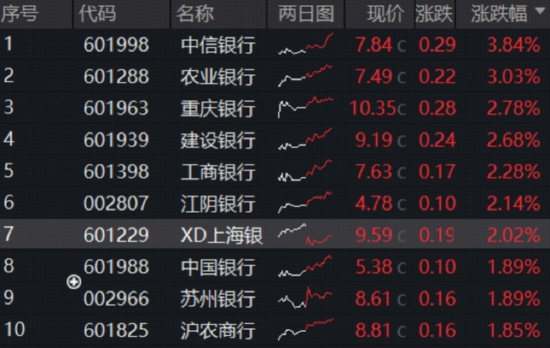
小红日报|标普红利ETF(562060)标的指数微跌0.12%,银行股集体走强
Xin Lang Ji Jin· 2025-10-17 01:27
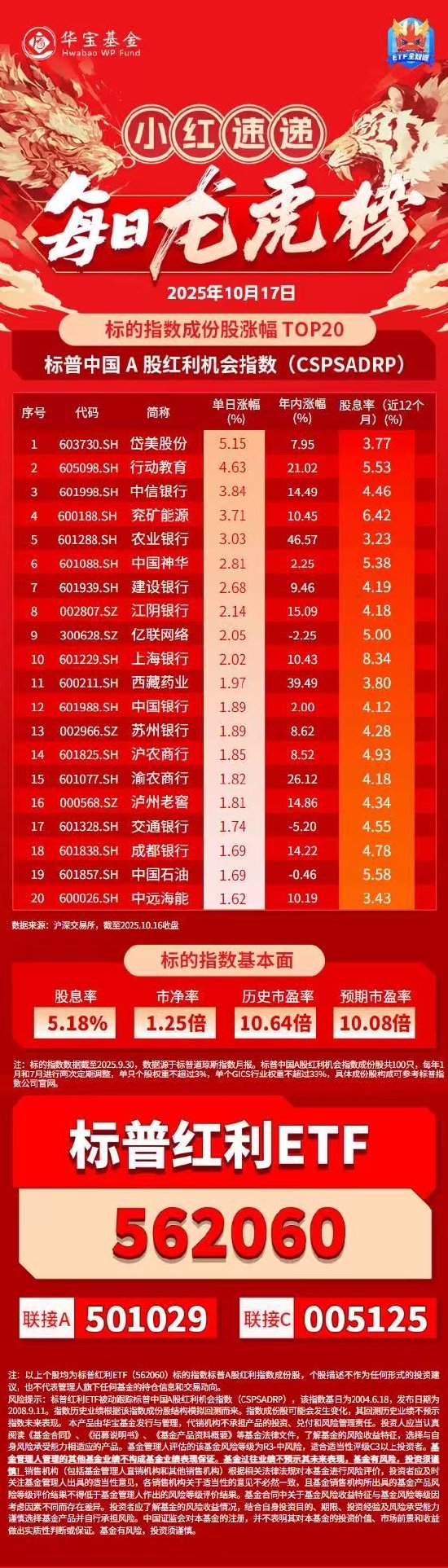
Core Insights - The article highlights the top-performing stocks in the S&P China A-Share Dividend Opportunity Index, showcasing significant price increases and dividend yields for various companies [1]. Group 1: Stock Performance - The top stock, Dai Mei Co., Ltd. (603730.SH), experienced a daily increase of 5.15% and a year-to-date increase of 7.95%, with a dividend yield of 3.77% [1]. - Action Education (605098.SH) saw a daily rise of 4.63% and a remarkable year-to-date increase of 21.02%, with a dividend yield of 5.53% [1]. - CITIC Bank (H5'866T09) reported a daily increase of 3.84% and a year-to-date increase of 14.49%, with a dividend yield of 4.46% [1]. Group 2: Dividend Yields - Yanzhou Coal Mining Company (600188.SH) had a daily increase of 3.71% and a year-to-date increase of 10.45%, with a dividend yield of 6.42% [1]. - Agricultural Bank of China (601288.SH) showed a daily increase of 3.03% and an impressive year-to-date increase of 46.57%, with a dividend yield of 3.23% [1]. - China Shenhua Energy (601088.SH) recorded a daily increase of 2.81% and a year-to-date increase of 2.25%, with a dividend yield of 5.38% [1].





“白衣骑士”频登场、多数仍陷转股难 银行可转债背后“冰火两重天”
Bei Jing Shang Bao· 2025-10-16 14:47
Core Viewpoint - The convertible bond market for banks in October is experiencing a significant divergence, with some banks like Shanghai Pudong Development Bank achieving a high conversion rate due to support from institutional investors, while many others are struggling with near-zero conversion rates [1][2][4] Group 1: Performance of Convertible Bonds - Shanghai Pudong Development Bank has achieved a conversion rate of 76.50%, with a total conversion amount of 38.25 billion yuan, alleviating repayment pressure ahead of its 50 billion yuan convertible bond maturity [2][4] - The market shows a stark contrast, with over half of the existing bank convertible bonds having conversion rates close to zero, indicating a significant disparity in performance [1][4] - Five banks have successfully exited the market through forced redemption, with a total issuance amount of 56 billion yuan involved [4][5] Group 2: Role of Institutional Investors - Institutional investors, referred to as "white knights," have played a crucial role in supporting the conversion of bonds into stocks, enhancing market confidence and improving the financing environment for banks [2][3] - Notable investors include China Mobile and Dongfang Asset, which have increased their holdings in Shanghai Pudong Development Bank through bond conversions [2][3] Group 3: Challenges for Smaller Banks - Smaller banks are facing challenges due to their stock prices being below the conversion price, leading to a lack of motivation for investors to convert bonds [6][7] - The low conversion rates directly limit banks' ability to supplement their core tier one capital, which is essential for risk management [6][7] Group 4: Future Outlook and Strategies - Analysts predict that the divergence in conversion rates will continue, with larger banks likely to achieve higher rates through stock price recovery or strategic investor involvement, while smaller banks may struggle [8][9] - Banks are encouraged to explore diversified capital-raising strategies beyond relying solely on convertible bonds to address core tier one capital pressures [8][9]

“白衣骑士”频登场、多数仍陷转股难,银行可转债背后“冰火两重天”
Bei Jing Shang Bao· 2025-10-16 14:33
Core Viewpoint - The convertible bond market for banks in October is experiencing a significant divergence, with some banks like Shanghai Pudong Development Bank (SPDB) achieving high conversion rates due to support from institutional investors, while many others are struggling with near-zero conversion rates, highlighting a clear divide between strong and weak banks [1][6]. Group 1: SPDB's Convertible Bond Performance - SPDB has achieved a conversion rate of over 76.5% for its 50 billion yuan convertible bonds, alleviating repayment pressure ahead of maturity [3][5]. - Key institutional investors, referred to as "white knights," such as China Mobile and Dongfang Asset, have significantly increased their holdings through conversion, enhancing SPDB's capital structure [3][4]. - The involvement of strategic investors is expected to boost market confidence and improve the financing environment for SPDB, mitigating liquidity risks associated with bond maturity [5][11]. Group 2: Market Divergence - The overall bank convertible bond market has shown a stark contrast, with some banks successfully triggering redemption clauses and completing conversions, while others have conversion rates close to zero [6][8]. - Five banks have exited the market through forced redemption this year, indicating a trend of successful conversions among stronger banks [6][7]. - In contrast, several banks, including Shanghai Bank, have seen minimal conversion activity, with some bonds having conversion rates as low as 0.11% [7][8]. Group 3: Factors Affecting Conversion Rates - The low conversion rates are primarily attributed to the performance of underlying stocks, investor sentiment, and the banks' operational conditions [8][9]. - When stock prices remain below conversion prices, investors are discouraged from converting due to potential immediate losses, particularly in banks with high conversion premiums [8][9]. - Regulatory policies also restrict conversion prices from falling below net asset values, which has diminished the attractiveness of conversions for many banks [8][9]. Group 4: Future Capital Supplementation Strategies - The increasing market divergence necessitates banks to explore diversified capital supplementation methods, especially for those with low conversion rates [10][12]. - Larger state-owned banks and quality joint-stock banks may achieve higher conversion rates through stock price recovery or strategic investor involvement, while smaller banks face ongoing challenges [10][12]. - Banks are encouraged to enhance their operational fundamentals, optimize regional strategies, and communicate effectively with investors to improve market perceptions and conversion rates [9][10].

机构:四季度银行深蹲起跳!各路资金掉头加码,百亿银行ETF(512800)放量6连阳,农业银行涨超3%
Xin Lang Ji Jin· 2025-10-16 11:56
Group 1 - The banking sector in A-shares has shown strong performance, particularly as it rose against the market trend, indicating its defensive nature [1] - As of the market close, 39 out of 42 banking stocks increased, with notable gains from CITIC Bank and Agricultural Bank exceeding 3% [1][2] - The banking ETF (512800) saw a price increase of 1.48%, marking a six-day consecutive rise, with a trading volume of 2.419 billion yuan [2] Group 2 - Recent data indicates that insurance capital has been actively purchasing bank stocks, with Ping An Life increasing its holdings in China Merchants Bank and Postal Savings Bank [4] - There have been significant share buybacks from bank shareholders and executives, with Suzhou Bank reporting a total of 36.22 million shares bought back, amounting to approximately 298 million yuan [4] - The overall outlook for the banking sector remains positive, with expectations of revenue and profit growth in the third quarter, driven by narrowing declines in net interest income and increasing fee income [4] Group 3 - Market conditions, including geopolitical tensions, are expected to lead to a shift in investor preference towards defensive assets, benefiting the banking sector [6] - The banking ETF has experienced substantial inflows, totaling 3.893 billion yuan over the past five days, reaching a record high in size at 18.496 billion yuan [6][8] - The banking sector is anticipated to outperform the market in the fourth quarter, as investors seek safer investment options amid rising geopolitical risks [6]

票据冲量诉求减弱,M1与M2剪刀差稳步收窄:——2025年9月金融数据点评
Shenwan Hongyuan Securities· 2025-10-16 09:31
Investment Rating - The industry investment rating is "Overweight" indicating a positive outlook compared to the overall market performance [3][27]. Core Insights - The report highlights a decrease in new social financing (社融) in Q3 2025, with a total of 7.23 trillion yuan, a year-on-year decrease of 335.2 billion yuan. The M1 growth rate reached 7.2%, the highest since March 2021, indicating improved business activity [3][4][7]. - The report notes a shift from "scale priority" to "efficiency-oriented" lending, with banks focusing on quality over quantity in credit issuance. This trend is expected to create a divergence in performance among banks, particularly benefiting those in economically developed regions or those with strong local government financing needs [3][4]. - The report emphasizes the need to monitor the sustainability of M1 growth and the impact of retail deposit trends on overall liquidity [3][4]. Summary by Sections Social Financing and Credit Growth - In September, new social financing amounted to 3.53 trillion yuan, a year-on-year decrease of 229.7 billion yuan, with total social financing growing at 8.7% year-on-year [3][4][6]. - New loans in September were 1.83 trillion yuan, down 920 billion yuan year-on-year, with corporate loans showing a mixed performance [3][4][14]. Monetary Indicators - M1 growth increased by 1.2 percentage points to 7.2%, while M2 growth decreased by 0.4 percentage points to 8.4% [7][12]. - The M1-M2 spread narrowed to -1.2 percentage points, the lowest since 2021, indicating a shift towards more liquid deposits [3][4]. Bank Performance and Valuation - The report includes a comparative analysis of listed banks, highlighting their market capitalization, P/E ratios, and ROE metrics, indicating varying levels of performance and valuation across the sector [19]. - Banks with strong fundamentals and favorable policy environments, such as Chongqing Bank and Suzhou Bank, are expected to outperform [3][4].


银行业数据点评:信贷增量弱、结构改善
Xiangcai Securities· 2025-10-16 08:49
Investment Rating - The industry investment rating is maintained at "Overweight" [3][10]. Core Insights - The growth rate of social financing has slowed down, with a weak credit increment but an improvement in structure. In September, the social financing growth rate decreased by 0.1 percentage points to 8.7%, continuing its gradual decline. The growth rates of financial institution loans and medium to long-term loans also fell to 6.6% and 6.3%, respectively, primarily due to a significant reduction in bill financing and a continuous improvement in corporate loan structure [6][12]. - In September, the new social financing amounted to 3.53 trillion yuan, a year-on-year decrease of 229.7 billion yuan, mainly due to a substantial decline in government bond financing and bill financing, with government bond financing down by 347.1 billion yuan year-on-year [6][12]. - The new RMB loans in September were 1.6 trillion yuan, a year-on-year decrease of 366.2 billion yuan, with a reduction in bill discounting weakening credit growth. However, the amount of undiscounted bills increased by 192.3 billion yuan year-on-year [6][12]. - The growth of residents' medium to long-term loans has been supported by policy measures, with a year-on-year increase of 20 billion yuan in September, while short-term loans decreased by 127.9 billion yuan [6][15]. - The corporate loan structure has improved significantly, with new corporate loans amounting to 1.22 trillion yuan, a year-on-year decrease of 270 billion yuan, primarily due to a notable reduction in bill financing [7][15]. Summary by Sections Credit Data Analysis - The credit data for September shows a trend of structural improvement, with the expectation that subsequent policy financial tools will support medium to long-term credit stability. The cost of deposits continues to decline, and the interest margin is expected to stabilize, leading to relatively stable banking performance [9][32]. - The M1 and M2 growth rates indicate a narrowing gap, with M1 growing by 7.2% and M2 by 8.4% in September. The increase in M1 is likely related to accelerated fiscal spending [8][24]. Investment Recommendations - The report suggests focusing on state-owned banks for their stable high dividend configuration value, as well as opportunities for valuation recovery in joint-stock banks and regional banks under improved economic expectations. Recommended banks include CITIC Bank, Jiangsu Bank, Chengdu Bank, Shanghai Rural Commercial Bank, Chongqing Rural Commercial Bank, Changshu Bank, and Suzhou Bank [10][32].
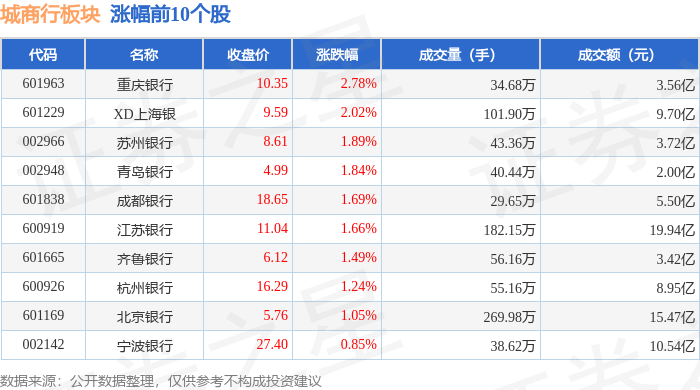
城商行板块10月16日涨0.81%,重庆银行领涨,主力资金净流出4059.77万元
Zheng Xing Xing Ye Ri Bao· 2025-10-16 08:27
Market Performance - The city commercial bank sector increased by 0.81% on October 16, with Chongqing Bank leading the gains [1] - The Shanghai Composite Index closed at 3916.23, up 0.1%, while the Shenzhen Component Index closed at 13086.41, down 0.25% [1] Individual Stock Performance - Chongqing Bank (601963) closed at 10.35, up 2.78% with a trading volume of 346,800 shares [1] - XD Shanghai Bank (601229) closed at 9.59, up 2.02% with a trading volume of 1,019,000 shares [1] - Suzhou Bank (002966) closed at 8.61, up 1.89% with a trading volume of 433,600 shares [1] - Other notable performances include Qingdao Bank (002948) up 1.84% and Chengdu Bank (601838) up 1.69% [1] Capital Flow Analysis - The city commercial bank sector experienced a net outflow of 40.6 million yuan from institutional investors and a net outflow of 188 million yuan from speculative funds, while retail investors saw a net inflow of 228 million yuan [1] - Jiangsu Bank (600919) had a significant net inflow of 1.4 billion yuan from institutional investors, despite a net outflow of 114 million yuan from speculative funds [2] - Ningbo Bank (002142) reported a net inflow of 58.6 million yuan from institutional investors, while experiencing a net outflow from both speculative and retail investors [2]


2025年9月金融数据点评:票据冲量诉求减弱,M1与M2剪刀差稳步收窄
Shenwan Hongyuan Securities· 2025-10-16 07:50
Investment Rating - The report maintains an "Overweight" rating for the banking sector, indicating a positive outlook for the industry compared to the overall market performance [3][25]. Core Insights - The financial data for September 2025 shows a decrease in new social financing (社融) by 335.2 billion year-on-year, with a total of 7.23 trillion added in the third quarter, reflecting a slowdown in credit demand [3][5]. - M1 growth reached 7.2% year-on-year, the highest since March 2021, suggesting increased business activity, while M2 growth was 8.4%, indicating a slight decline [4][8]. - The shift from "scale priority" to "efficiency-oriented" lending is a clear trend in the industry, with banks focusing on quality over quantity in their loan portfolios [4][3]. Summary by Sections Financial Data Overview - In September 2025, new loans totaled 1.29 trillion, a decrease of 300 billion year-on-year, with the total for the first nine months at 14.75 trillion, down 1.27 trillion from the previous year [4][3]. - The M1-M2 spread narrowed to -1.2 percentage points, the lowest since 2021, driven by increased liquidity in both corporate and personal deposits [4][8]. Loan Dynamics - Corporate loans saw an increase of 1.62 trillion in September, with short-term loans contributing significantly to this growth [4][3]. - Residential loans remained stable, but short-term loans showed a notable decrease, indicating weak demand for leverage among consumers [4][18]. Social Financing and Government Bonds - The contribution of government bonds to social financing turned negative, with a significant drop in new government bonds issued in September, totaling approximately 1.2 trillion, down 347.1 billion year-on-year [4][3]. - The overall social financing growth rate was 8.7% year-on-year, but this reflects a slowdown compared to previous periods [5][7]. Investment Recommendations - The report suggests a focus on leading banks and quality regional commercial banks, highlighting the potential for value recovery in the banking sector [4][20]. - The current dividend yield for the banking sector has returned to an attractive range, supporting the outlook for stable earnings growth [4][20].


A股银行股涨幅扩大,农业银行涨超2%
Ge Long Hui A P P· 2025-10-16 05:53
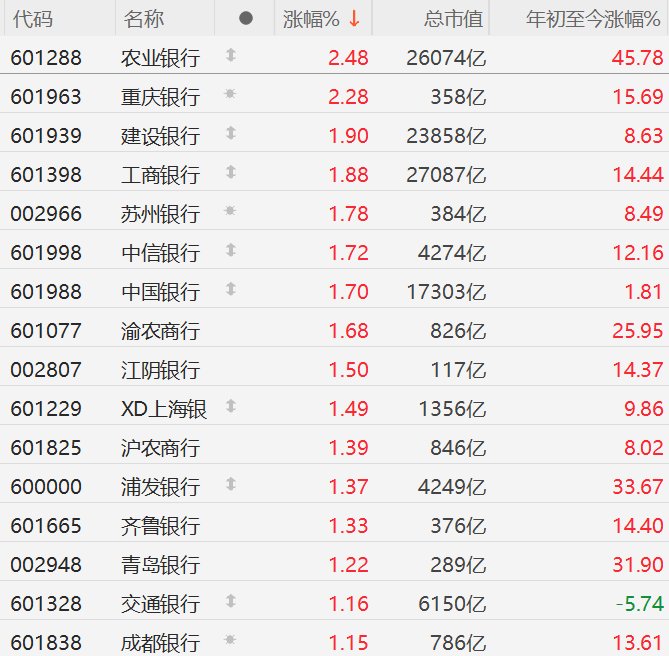
Core Insights - A-shares of bank stocks have seen significant gains, with Agricultural Bank and Chongqing Bank rising over 2% [1] Group 1: Stock Performance - Agricultural Bank (601288) increased by 2.48%, with a total market capitalization of 26,074 billion and a year-to-date increase of 45.78% [2] - Chongqing Bank (601963) rose by 2.28%, with a market cap of 358 billion and a year-to-date increase of 15.69% [2] - Construction Bank (601939) saw a rise of 1.90%, with a market cap of 23,858 billion and a year-to-date increase of 8.63% [2] - Industrial and Commercial Bank (601398) increased by 1.88%, with a market cap of 27,087 billion and a year-to-date increase of 14.44% [2] - Other banks such as Suzhou Bank (1.78%), Citic Bank (1.72%), and China Bank (1.70%) also experienced gains [2] Group 2: Market Trends - The MACD golden cross signal has formed, indicating a positive trend for these bank stocks [1]
中国平安增持招行、邮储,年内耗资千亿港元加仓银行H股!银行AH优选ETF(517900)盘中涨近1%
2 1 Shi Ji Jing Ji Bao Dao· 2025-10-16 03:00
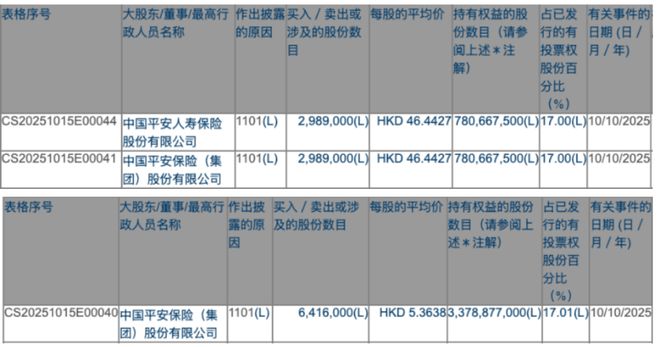
Core Viewpoint - The banking sector is experiencing a rally, with significant increases in stock prices for various banks, driven by insurance capital increasing their holdings in Hong Kong bank stocks, particularly by China Ping An [1][2]. Group 1: Investment Activities - China Ping An's subsidiary, Ping An Life, increased its holdings in China Merchants Bank (CMB) by 2.989 million H-shares, raising its total to 781 million shares, which represents 17% of CMB's H-shares [2]. - On the same day, China Ping An purchased 641,600 H-shares of Postal Savings Bank, increasing its stake to 17.01% [2]. - Since the beginning of the year, China Ping An has significantly increased its investments in H-shares of banks, including Agricultural Bank and Industrial and Commercial Bank, with total expenditures exceeding 100 billion Hong Kong dollars [4]. Group 2: Market Trends - The banking sector has seen a net inflow of nearly 100 million yuan into the Bank AH Preferred ETF (517900) over four consecutive days, indicating strong investor interest [7]. - The insurance sector's stock holdings have increased by 26.69% since the beginning of the year, with banks consistently representing the highest proportion of these holdings, reaching 47.2% by mid-2025 [4][6]. Group 3: Performance Metrics - The China Banking Index has experienced a cumulative decline of 15.21% from July 11 to October 9, while the CSI 300 Index rose by 17.44% during the same period [9]. - Since the launch of the Bank AH Total Return Index on December 6, 2017, it has achieved a cumulative return of 82.26%, outperforming the China Banking Total Return Index by 21.49% [9][11].