Snowflake Inc.

Search documents
Software Giant Up 64% This Year Nears Buy Point Amid Nvidia Partnership; Earnings Ahead
Investors· 2025-11-18 17:44
Group 1 - Snowflake (SNOW) is experiencing a strong performance, gaining 64% year to date, and is finding support at a key level near a buy point [1] - The stock is highlighted as a selection for IBD 50 Growth Stocks To Watch, indicating its potential for further profit [1] - Other companies like Alphabet and Nvidia also saw significant stock price increases, suggesting a positive trend in the tech sector [4] Group 2 - The article mentions that several stocks, including those in the AI sector, are nearing buy points, reflecting investor interest in growth opportunities [4] - There is a focus on the aerospace sector alongside Snowflake, indicating a diverse range of industries performing well [4] - The market is currently influenced by trade talks and CPI data, which could impact stock performance [4]

Snowflake CEO 复盘:为什么 LLM 时代企业需要一个 AI Data Cloud?
海外独角兽· 2025-11-18 12:17
Core Insights - Snowflake has transformed from a data infrastructure-focused company to an AI-driven AI Data Cloud, significantly enhancing its value proposition in the enterprise data platform space [2][3][9] - AI has contributed to 50% of Snowflake's new customers and accounted for 25% of all use cases, driving a 32% year-over-year increase in product revenue [2][3] Transformation and Strategy - The transition to AI is seen as a critical step in Snowflake's strategic evolution, with a focus on amplifying the value of existing data [3][4] - The new CEO, Sridhar Ramaswamy, has implemented tactical adjustments to improve accountability and streamline operations, emphasizing faster iteration and customer feedback [9][10] - Snowflake Intelligence, set to launch in November 2024, aims to provide natural language querying and semantic search capabilities, enhancing user interaction with data [10][13] Product Development and AI Integration - Snowflake's AI strategy focuses on leveraging existing data rather than competing directly with major AI model developers like OpenAI [13][14] - The company has integrated a unified sales data platform called Raven, which consolidates various sales dashboards into a single interface for better data exploration [14][15] - Snowflake Intelligence is designed to be user-friendly, allowing employees at all technical levels to access and utilize data without needing SQL skills [15][16] Competitive Landscape and Market Position - Snowflake positions itself as a data platform innovator, differentiating from traditional cloud service providers by emphasizing data-first solutions [26][30] - The company recognizes the importance of partnerships with major software vendors like SAP to enhance its market reach and collaborative value creation [31][33] - Continuous innovation is deemed essential for maintaining competitiveness against larger cloud service providers, which possess vast resources [28][29] AI ROI and Business Impact - Coding agents are identified as a high ROI area, enabling faster project execution and lowering technical barriers for businesses [36][37] - The company advocates for a gradual approach to AI investment, encouraging clients to start with small-scale projects to demonstrate value before scaling up [37][38] - Snowflake's role in the data ecosystem is crucial for shortening the time from investment to value realization, especially compared to developing in-house AI solutions [38][39]


机器人的 GPT 时刻比我们以为的更近|AGIX PM Notes
海外独角兽· 2025-11-17 12:05
Group 1 - The AGIX index aims to capture the beta and alphas of the AGI era, which is expected to be a significant technological paradigm shift over the next 20 years, similar to the impact of the internet [2] - The article emphasizes the importance of learning from legendary investors like Warren Buffett, Ray Dalio, and Howard Marks to navigate the AGI revolution [2] Group 2 - AGIX has shown a year-to-date return of 26.72% and a return of 74.54% since 2024, outperforming major indices like QQQ and S&P 500 [5] - The performance of AGIX portfolios indicates a slight decline in sectors such as semi & hardware, infrastructure, and application [6] Group 3 - The article discusses the potential of robots reaching a critical point of general intelligence with around 7 billion parameters, similar to the breakthrough seen with GPT-3 [10] - It highlights the advancements in hardware and engineering that are necessary for robots to operate effectively in real-world environments [11] Group 4 - The article outlines the challenges in data collection for robotics, emphasizing the need for diverse and extensive datasets to achieve generality in various tasks [12][13] - It discusses different approaches to data collection, including world models and real-world interactions, to enhance robotic capabilities [17] Group 5 - The article notes that the AI verticals have faced significant sell-offs by hedge funds, particularly in AI technology stocks, leading to a notable market rotation [18] - It highlights the financial relationship between OpenAI and Microsoft, revealing that OpenAI's revenue is significantly impacted by its operational costs [20][21] Group 6 - The article mentions significant investments in AI infrastructure, such as Alphabet's $40 billion investment in Texas data centers and Nvidia's collaboration with Cisco to enhance AI deployment [22][23] - It also covers various acquisitions in the AI space, including Salesforce's acquisition of Doti for $100 million and Snowflake's acquisition of Datometry to improve database migration capabilities [24][25]





哪些AI应用值得中期投资
GOLDEN SUN SECURITIES· 2025-11-16 06:42
Investment Rating - The report maintains an "Accumulate" rating for the computer industry [4] Core Insights - The report identifies three categories of AI applications worth mid-term investment: Custom Agent Platforms, High Barrier Vertical Applications, and AI Infrastructure [10][12][26] - OpenAI's recent developments, including the Apps SDK and AgentKit, signify a shift towards creating an AI application ecosystem, allowing developers to build interactive applications within ChatGPT [12][13] - Major companies like Tencent and Alibaba are also developing their own AI ecosystems, with Tencent planning to integrate AI capabilities into WeChat and Alibaba revamping its mobile AI application to compete with ChatGPT [14][17] Summary by Categories Custom Agent Platforms - OpenAI's Apps SDK enables developers to create interactive applications within ChatGPT, enhancing user experience and functionality [12][13] - The introduction of AgentKit allows for easy development of AI agents without extensive coding knowledge, showcasing its efficiency through a live demonstration [13] - Partnerships with various sectors, including education and real estate, highlight the broad applicability of these AI applications [12][14] High Barrier Vertical Applications - The report emphasizes that strong industry know-how, proprietary data, complex workflows, and regulatory compliance create significant barriers to entry for competitors [18][19][20][22] - Companies with deep industry expertise and unique data sources are positioned to leverage large models as tools to enhance their existing advantages rather than being threatened by them [18][19] - Examples include Palantir, which has established a strong foothold in the defense sector through its AI platform [22][23] AI Infrastructure - Infrastructure providers are positioned to gain stable returns by serving all companies involved in the AI arms race, with Snowflake and CrowdStrike highlighted as key players [26][29] - Snowflake's cloud data platform supports scalable AI deployments, while its Cortex suite allows users to run advanced AI models without data migration [28] - CrowdStrike's Falcon platform aims to secure AI operations by protecting against various cyber threats, collaborating with major tech companies to enhance AI security [29][30] Investment Recommendations - The report suggests focusing on companies in the computing sector, particularly those involved in AI infrastructure and agent development, including notable firms like Cambricon, Alibaba, Tencent, and Salesforce [7][34]


索罗斯Q3持仓:亚马逊(AMZN.US)晋升第一重仓股 清仓存储芯片股闪迪(SNDK.US)、西部数据(WDC.US)及特斯拉(TSLA.US)
智通财经网· 2025-11-15 00:54
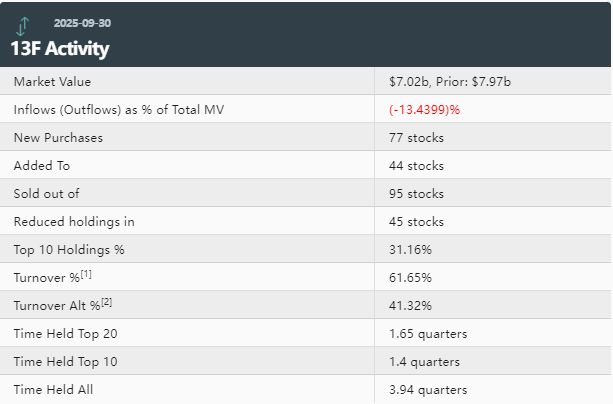
Core Insights - Soros Fund Management reported a total market value of $7.02 billion for Q3 2025, down 13% from $7.97 billion in the previous quarter [1][2] - The fund added 77 new stocks and increased holdings in 44 stocks, while reducing positions in 45 stocks and completely selling out of 95 stocks [1][2] - The top ten holdings accounted for 31.16% of the total market value [1][2] Holdings Overview - The largest holding is Amazon (AMZN.US) with approximately 2.23 million shares valued at about $488.8 million, representing 6.96% of the portfolio, with a significant increase of 481.47% in shares held [3][4] - Smurfit WestRock (SW.US) is the second largest holding with around 7.75 million shares valued at approximately $329.8 million, making up 4.70% of the portfolio, with a 3.56% increase in shares [3][4] - Spotify (SPOT.US) ranks third with about 185 million shares valued at approximately $253.1 million, accounting for 3.61% of the portfolio, with a 29.68% increase in shares [3][4] - Other notable holdings include Globant (GLOB.US) and Google (GOOGL.US), with significant increases in shares of 17.08% and 2341.11% respectively [3][4] Trading Activity - The top five purchases by percentage change in portfolio were Amazon, Invesco S&P 500 Equal Weight ETF (RSP.US), Google, Ford Motor Company (FORD.US), and VanEck Semiconductor ETF (SMH.US, PUT) [5][6] - The top five sales included First Solar (FSLR.US, CALL), iShares Russell 2000 ETF (IWM.US, PUT), Invesco QQQ Trust (QQQ.US, CALL), SPDR S&P 500 ETF (SPY.US, PUT), and Liberty Broadband (LBRDK.US) [5][6]

2 Future AI IPOs I Couldn't Be More Excited About
247Wallst· 2025-11-14 14:53
Core Insights - The article discusses the anticipation surrounding upcoming IPOs of major AI companies, particularly OpenAI and Anthropic, which have not yet entered public markets [2][3][4] - There is a belief that once these companies go public, they could experience significant initial demand, potentially leading to one of the most oversubscribed IPOs in history [3][4][8] - The current market environment is characterized by caution, with concerns about AI spending and interest rate changes potentially impacting the success of these IPOs [6][8] Company Insights - OpenAI and Anthropic are highlighted as leading AI firms that retail investors are eager to invest in, with Anthropic projected to reach profitability sooner than OpenAI despite having lower brand recognition [4][10] - Databricks is also mentioned as a promising AI company that could debut with a valuation exceeding $100 billion due to its rapid growth and partnership with OpenAI [11][12] - CoreWeave, which has already gone public, faced initial market challenges but later saw significant gains, indicating the volatility and potential for recovery in the AI sector [7][8] Market Environment - The article emphasizes the uncertainty in the market, particularly regarding how major AI IPOs will perform amid investor caution and potential interest rate hikes by the Federal Reserve [6][8] - Despite the cautious sentiment, there is a strong belief that the demand for shares in OpenAI and Anthropic will lead to successful IPO launches, driven by a large base of retail investors waiting for these opportunities [8][9]

Palantir's Commercial Surge Becomes the Defining Catalyst
ZACKS· 2025-11-14 13:12
Core Insights - Palantir's explosive commercial momentum is a key factor driving its growth outlook [1] - The upward revision of U.S. commercial revenue guidance indicates a structural shift in demand [2] Revenue Guidance - Palantir raised its U.S. commercial revenue guidance to exceed $1.433 billion from over $1.302 billion, reflecting at least 104% year-over-year growth [2] - For Q4, the company expects revenue of $1.329 billion, indicating 13% sequential and 61% year-over-year growth [3] - Full-year 2025 revenue guidance is raised to a midpoint of $4.398 billion, a 53% increase from 2024 [3] Financial Performance - Adjusted operating income expectations were raised to a range of $2.151-$2.155 billion from $1.912-$1.920 billion [4] - Projected adjusted free cash flow is between $1.9 billion and $2.1 billion, up from the previous guidance of $1.8 billion to $2.0 billion [4] - Palantir anticipates GAAP operating income and net income in every quarter of 2025, enhancing investor confidence [5] Revenue Diversification - Palantir is diversifying its revenue mix while maintaining stability from government clients, positioning itself as a dependable player in enterprise AI [6] Peer Comparison - Snowflake is a relevant competitor, integrating AI into its cloud data platform and overlapping with Palantir's commercial targets [7] - Datadog specializes in observability and cloud intelligence, competing indirectly with Palantir as enterprises modernize infrastructure [8] Stock Performance - Palantir's stock has surged 127% year-to-date, significantly outperforming the industry's 7% rally [9] Valuation - PLTR trades at a forward price-to-sales ratio of 73X, well above the industry's 4.9X [11]


RBC Capital上调Snowflake目标价至300美元
Ge Long Hui· 2025-11-13 09:48
Core Viewpoint - RBC Capital raised the target price for Snowflake from $275 to $300 while maintaining an "Outperform" rating [1] Group 1 - The adjustment in target price reflects a positive outlook on Snowflake's performance in the market [1]
红杉合伙人重磅发声:我们正身处AI泡沫,80%的钱投错了地方,毛利率会是AI应用穿越周期的生死线
Xi Niu Cai Jing· 2025-11-13 07:38
Core Insights - David Cahn, a partner at Sequoia Capital, acknowledges the existence of an AI bubble while emphasizing the importance of distinguishing between compute producers and consumers in the industry [1][2][3] - Cahn argues that the real winners in the AI space will be those who utilize compute effectively, rather than those who produce it, as the latter are likened to high-leverage commodity businesses [1][3] - He expresses concern over the current capital flow, stating that over 80% of funding is still directed towards compute producers, which he believes is a misallocation of resources [1][24] Group 1 - Cahn highlights the critical distinction between compute producers and consumers, suggesting that the latter will thrive in the long run [1][3] - He critiques the prevailing narrative of "King making" in venture capital, asserting that success is determined by the quality of the founding team and product-market fit rather than merely by capital investment [2][34] - Cahn warns against the misconception that companies can only succeed in an environment of unlimited financing, emphasizing the need for sustainable business models [2][3] Group 2 - Cahn predicts that AI could reshape 5% or more of global GDP, but warns that most excess profits will be diluted by competition and labor costs, rather than accruing to a few monopolistic giants [3][30] - He identifies defense as the next significant battleground for AI, predicting increased global conflicts as AI becomes more integrated into defense technologies [3][30] - Cahn believes that the current AI investment landscape is characterized by a "bubble" mentality, where capital is concentrated in a few major players, leading to potential systemic risks [25][30] Group 3 - Cahn discusses the physicality of AI infrastructure, noting that the construction of data centers and the acquisition of power resources are critical to the industry's future [6][7] - He emphasizes the importance of understanding the supply chain dynamics in AI, suggesting that the ability to build data centers will become a competitive advantage [9][10] - Cahn points out that the current focus on AI's physical requirements is essential for translating AI advancements into GDP growth [7][8] Group 4 - Cahn expresses skepticism about the sustainability of high salaries for AI talent, attributing it to an "ecosystem anxiety" where companies feel pressured to demonstrate progress [10][12] - He reflects on the unpredictability of AI advancements, suggesting that the timeline for achieving significant breakthroughs may be longer than currently anticipated [32][33] - Cahn warns that the current concentration of investment in a few tech giants could lead to significant market volatility if the AI narrative shifts [30][29]
从 Snowflake 到 Sierra,每家企业软件公司都在销售同样的 AI 代理
Hua Er Jie Jian Wen· 2025-11-13 00:44
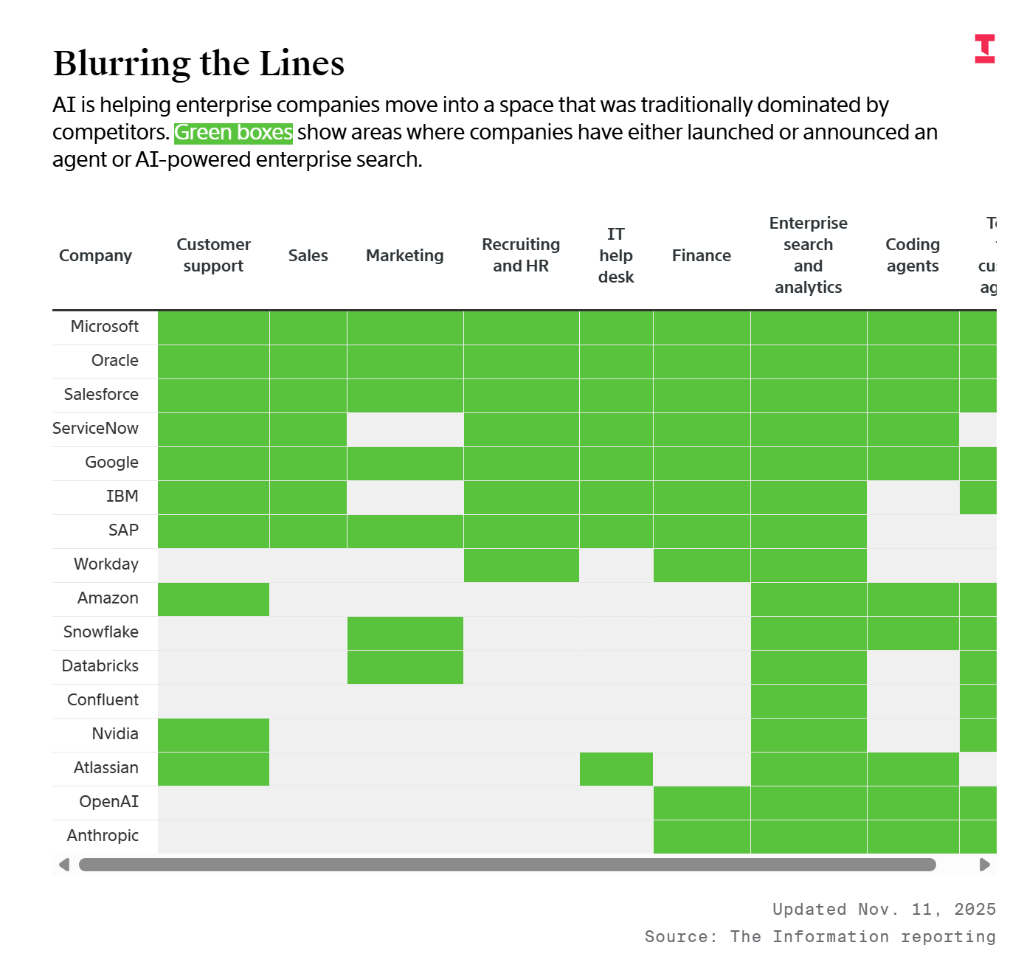
Core Insights - The enterprise software industry is experiencing unprecedented competition as traditional market boundaries are disrupted by artificial intelligence (AI) [1] - Major tech companies are launching similar AI agents, leading to confusion among enterprise buyers and delaying purchasing decisions [1][2] - The rise of AI agents is blurring the lines between different software markets, with at least seven major tech companies competing in eight functional areas [3] Market Dynamics - The competition is characterized by a high degree of product overlap, as many companies rely on foundational AI models from firms like OpenAI and Anthropic [6] - Established database and data streaming companies are now competing with emerging AI application startups in areas like sales and customer support [7] - Existing software giants leverage their vast customer bases and data to create a competitive advantage, making it easier for clients to use AI agents that integrate with their core software [8] Buyer Behavior - Enterprise buyers are facing challenges in selecting AI products due to significant feature overlap, leading to a complicated decision-making process [8][9] - Convenience is a key factor in decision-making, with companies preferring AI solutions that integrate seamlessly with their existing data systems [9] Strategic Approaches - Software giants are adopting a hybrid AI model strategy, combining proprietary data-driven models with external advanced language models to create a robust ecosystem [12] - The critical nature of enterprise software creates natural barriers to entry, as companies are cautious about migrating core business processes to new AI solutions [12] Adoption Challenges - Despite the potential of AI agents, their commercialization has not significantly boosted revenue for major companies like Salesforce and ServiceNow [13] - Slow adoption is attributed to the need for extensive manual support during configuration and concerns over the maturity of vendor-provided AI solutions [14] - As the number of AI agents within enterprises increases, the focus may shift to managing and coordinating these agents across different software platforms [14]