
电投能源

Search documents
起飞!寒潮消息引爆,冰雪旅游又火了!
Mei Ri Shang Bao· 2025-11-13 10:26
Coal Industry - The price of thermal coal has risen significantly, surpassing 800 yuan per ton, marking a new high for the year as of November 13 [1][3] - The coal sector has shown strong performance, with key listed coal companies reporting a more than 20% increase in profits in Q3 compared to the previous quarter [3][4] - Factors contributing to the rise in coal prices include extreme weather conditions, with northern regions experiencing significant temperature drops, while southern regions faced higher than average temperatures [3][4] - The coal industry is expected to benefit from a dual attribute of dividends and cyclical characteristics, making it a favored asset for market funds [3] Ice and Snow Tourism Industry - The ice and snow tourism sector has seen a surge, with multiple stocks hitting the daily limit up, driven by events such as the "Qixing Mountain·Camel Cup" wilderness survival challenge [5][6] - The ice and snow industry in China is projected to exceed 1 trillion yuan by 2025, with continuous growth expected due to upcoming major winter sports events [7] - The tourism industry is currently benefiting from a combination of policy incentives and demand release, with recommendations to focus on leading companies in online travel agencies (OTA), comprehensive cultural tourism service providers, and ice and snow tourism leaders [7]


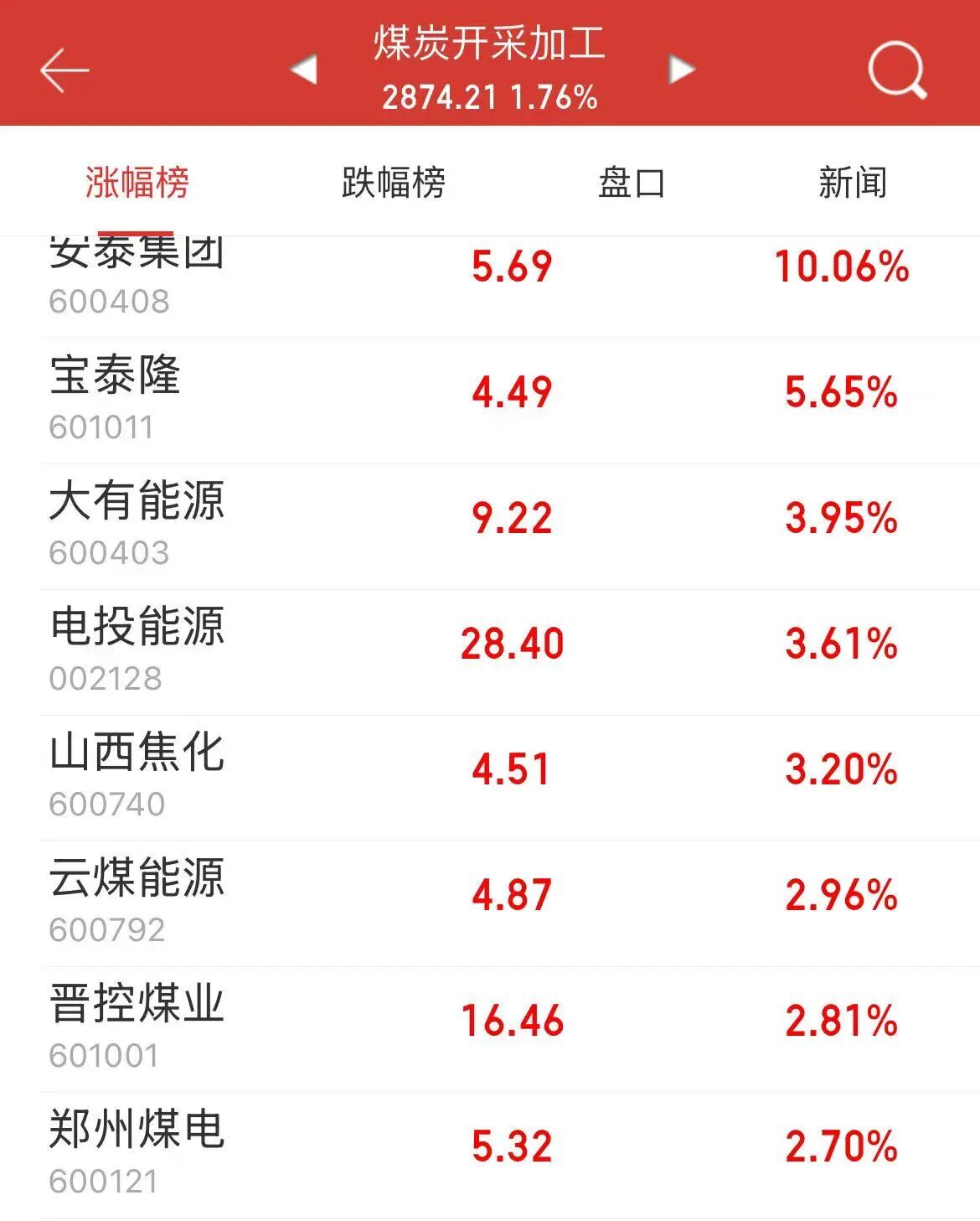
电投能源涨2.01%,成交额1.88亿元,主力资金净流入1146.13万元
Xin Lang Zheng Quan· 2025-11-13 02:54
Core Viewpoint - Electric Power Investment Energy Co., Ltd. has shown a significant increase in stock price and trading activity, indicating positive market sentiment and potential growth opportunities in the coal and aluminum sectors [1][2]. Company Performance - As of September 30, Electric Power Investment Energy reported a revenue of 22.403 billion yuan, representing a year-on-year growth of 2.72%. However, the net profit attributable to shareholders decreased by 6.40% to 4.118 billion yuan [2]. - The company has distributed a total of 11.815 billion yuan in dividends since its A-share listing, with 4.550 billion yuan distributed over the past three years [3]. Stock Market Activity - On November 13, the stock price increased by 2.01% to 27.96 yuan per share, with a trading volume of 188 million yuan and a turnover rate of 0.31%. The total market capitalization reached 62.674 billion yuan [1]. - Year-to-date, the stock price has risen by 48.88%, with a 3.98% increase over the last five trading days, 16.31% over the last 20 days, and 35.40% over the last 60 days [1]. Shareholder Information - The number of shareholders decreased by 11.29% to 27,100 as of September 30, while the average number of circulating shares per person increased by 12.72% to 82,831 shares [2]. - Among the top ten circulating shareholders, Hong Kong Central Clearing Limited is the fifth largest, holding 47.2447 million shares, an increase of 18.5055 million shares from the previous period [3]. Business Segments - The company's main business segments include aluminum products (55.11% of revenue), coal products (30.29%), and electricity products (13.02%), with other revenues accounting for 1.59% [1].

——A股央企ESG评价体系白皮书系列报告之十二:煤炭央企ESG评价结果分析:治理深化与赋能可持续性
Shenwan Hongyuan Securities· 2025-11-12 11:10
Investment Rating - The report indicates that the overall ESG performance of the selected coal enterprises is good, with most companies scoring above 70, and one company exceeding 90 [3][8]. Core Insights - The ESG performance management of the coal industry central enterprises shows a solid foundation, with a majority achieving high scores in ESG evaluations, reflecting a steady improvement in the industry's overall ESG development level [3][8]. - Environmental management is becoming more mature, with comprehensive pollution prevention and emission reduction measures in place, although transparency regarding energy consumption and carbon emissions data needs improvement [3][15]. - The social dimension highlights the active fulfillment of social responsibilities by coal central enterprises, particularly in rural revitalization and social welfare initiatives [3][38]. - The governance structure is robust, with complete establishment of party building and professional committees, but the linkage of ESG performance to assessment mechanisms remains insufficient [3][55]. Summary by Sections Overall Performance - Most coal central enterprises have good overall ESG scores, with the majority scoring above 70, indicating a solid foundation in ESG management [3][8]. - Only two companies have their ESG reports verified by third-party institutions, suggesting a need for improvement in third-party verification processes [3][8]. Environmental Management - Four companies scored over 20 points in environmental indicators, showing a strong emphasis on environmental protection management [3][15]. - All companies disclosed pollution prevention and emergency management measures, achieving a 100% disclosure rate for these indicators [3][15]. - However, only 40% of companies fully disclosed greenhouse gas emissions and pollutant information, which affects accurate carbon performance assessment [3][22]. Social Responsibility - All five enterprises disclosed specific projects and expenditures related to rural revitalization, demonstrating active engagement in social responsibility [3][39]. - Three companies provided details on their social welfare donations, indicating a commitment to community support [3][42]. - The newly added "energy supply guarantee" indicator reflects the industry's unique characteristics, with all companies mentioning their efforts in this area [3][52]. Governance Structure - The governance framework is solid, with 100% disclosure of party building activities and the establishment of ESG leadership bodies in most companies [3][55]. - However, only one company has effectively linked ESG performance to its assessment mechanisms, indicating room for improvement in this area [3][60]. - All companies have established compliance management systems, but none have set up a compliance committee [3][70].




A股央企ESG评价体系白皮书系列报告之十二:煤炭央企ESG评价结果分析:治理深化与赋能可持续性
Shenwan Hongyuan Securities· 2025-11-12 09:41
Investment Rating - The report maintains a positive outlook on the coal industry, specifically for central enterprises, with an investment rating of "Overweight" [4]. Core Insights - The report evaluates five central enterprises in the coal industry, highlighting their ESG performance management. Most companies scored above 70, indicating a solid level of ESG management within the industry [4][10]. - The environmental dimension shows maturity, with comprehensive pollution prevention and emission reduction measures, although transparency in energy consumption and carbon emissions data needs improvement [4][19]. - The social dimension emphasizes the active fulfillment of social responsibilities, particularly in rural revitalization and public welfare initiatives [4][41]. - The governance structure is robust, with complete establishment of party-building and professional committees, but the linkage of ESG performance to assessment mechanisms remains weak [4][57]. Summary by Sections Overall Performance - Most coal central enterprises exhibit strong overall performance in ESG assessments, with a majority scoring above 70, and some achieving scores between 80-89 and above 90 [4][10]. Environmental Management - Four enterprises scored over 20 in environmental indicators, reflecting a strong emphasis on environmental protection. However, there are gaps in the disclosure of energy consumption and greenhouse gas emissions data [4][19][25]. Social Responsibility - All five enterprises disclosed specific projects and expenditures related to rural revitalization. They also reported on social welfare actions, with three companies providing details on donation amounts [4][41][46]. Governance Structure - The governance framework is well-established, with all companies disclosing their party-building activities. However, only one company effectively links ESG performance to management assessments [4][57][62].
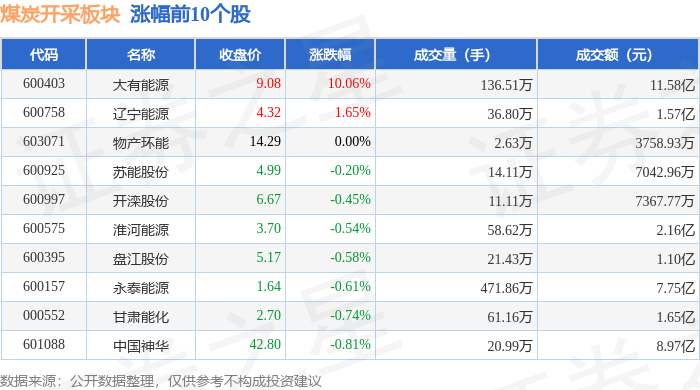
煤炭开采板块11月11日跌1.38%,电投能源领跌,主力资金净流出4.1亿元
Zheng Xing Xing Ye Ri Bao· 2025-11-11 08:46
Core Viewpoint - The coal mining sector experienced a decline of 1.38% on November 11, with Electric Power Investment Energy leading the losses. The Shanghai Composite Index closed at 4002.76, down 0.39%, while the Shenzhen Component Index closed at 13289.0, down 1.03% [1]. Group 1: Market Performance - The coal mining sector's stocks showed mixed performance, with Daya Energy rising by 10.06% to close at 9.08, while Electric Power Investment Energy fell by 3.66% to 26.88 [1][2]. - The trading volume for Daya Energy was 1.3651 million shares, with a transaction value of 1.158 billion yuan, indicating strong investor interest [1]. - The overall net outflow of main funds in the coal mining sector was 410 million yuan, while retail investors saw a net inflow of 264 million yuan [2]. Group 2: Individual Stock Analysis - Daya Energy had a significant net inflow of 203 million yuan from main funds, while Electric Power Investment Energy experienced a net outflow of 249,100 yuan [3]. - Huabei Mining saw a net inflow of 33.46 million yuan from main funds, indicating a positive sentiment towards the stock despite the overall sector decline [3]. - The stock performance of Electric Power Investment Energy and Shanxi Coking Coal showed notable declines of 3.66% and 2.79%, respectively, reflecting broader market challenges [2].


电投能源跌2.01%,成交额1.00亿元,主力资金净流入280.49万元
Xin Lang Cai Jing· 2025-11-11 02:04
Core Viewpoint - The stock of Electric Power Investment Energy has experienced fluctuations, with a current price of 27.34 CNY per share, reflecting a year-to-date increase of 45.58% and a recent upward trend over various trading periods [1][2]. Financial Performance - For the period from January to September 2025, Electric Power Investment Energy reported a revenue of 22.403 billion CNY, representing a year-on-year growth of 2.72%. However, the net profit attributable to shareholders decreased by 6.40% to 4.118 billion CNY [2]. - Cumulative cash dividends since the company's A-share listing amount to 11.815 billion CNY, with 4.550 billion CNY distributed over the past three years [3]. Shareholder Information - As of September 30, 2025, the number of shareholders for Electric Power Investment Energy is 27,100, showing a decrease of 11.29% from the previous period. The average number of circulating shares per shareholder increased by 12.72% to 82,831 shares [2]. - Among the top ten circulating shareholders, Hong Kong Central Clearing Limited holds 47.2447 million shares, an increase of 18.5055 million shares compared to the previous period [3]. Market Activity - The stock experienced a decline of 2.01% during intraday trading, with a trading volume of 100 million CNY and a turnover rate of 0.16%. The total market capitalization stands at 61.285 billion CNY [1]. - In terms of capital flow, there was a net inflow of 2.8049 million CNY from major funds, with significant buying and selling activities recorded [1]. Business Overview - Electric Power Investment Energy, established on December 18, 2001, and listed on April 18, 2007, is primarily engaged in the production, processing, and sales of coal products, thermal power, and electrolytic aluminum. The revenue composition includes aluminum products (55.11%), coal products (30.29%), power products (13.02%), and others (1.59%) [1]. - The company operates within the coal mining sector, specifically focusing on thermal coal, and is associated with various concepts such as thermal coal, non-ferrous aluminum, low price-to-earnings ratio, and state-owned enterprise reform [1].
煤炭专题:布局PPI转正关键时点
Xinda Securities· 2025-11-10 07:45
Investment Rating - The coal industry is rated as "Positive" [2] Core Viewpoints - The coal industry is currently in a new round of prosperity cycle that started in 2021, with price fluctuations gradually returning to a reasonable range [3][11] - The impact of coal prices on the Producer Price Index (PPI) is significant, with expectations that coal PPI will turn positive by the second quarter of 2026 [3][41] - The supply-demand situation in the coal market is expected to remain balanced, with regional disparities, driven by policies that restrict supply and increasing mining costs [3][12] Summary by Sections 1. Coal Supply and Demand Review and Outlook - The coal market has experienced a significant price increase since 2021 due to global economic recovery and structural mismatches in supply and demand [11] - From 2023 to June 2025, coal prices have declined to recent lows due to a phase of supply-demand loosening, but have stabilized since July 2025 due to policy constraints [3][11] - The demand for coal is expected to remain stable, supported by electricity generation and industrial needs, despite a peak in overall coal demand [16][19] 2. Correlation Analysis between Coal and PPI - The coal mining sector has a weight of approximately 2.3% in the PPI index, and coal price fluctuations have a strong transmission effect on PPI [38][39] - The coal industry has been a significant contributor to PPI changes, especially during periods of PPI recovery [41][44] 3. Historical Opportunities in Coal Sector during PPI Recovery - Historical data shows that the coal sector has experienced significant price increases during previous PPI recovery phases, particularly in 2016 and 2021 [3][4] - The coal sector's performance is often led by small to mid-cap companies with high growth potential during the early stages of PPI recovery [4] 4. Investment Recommendations - The report suggests focusing on companies that benefit from rising coal prices, such as Shanxi Coking Coal, Lu'an Environmental Energy, and Shenhua Shares [4] - Companies with stable performance and dividend attributes, such as Shaanxi Coal and China Coal Energy, are also recommended for investment [4]
动力煤价上破800元,炼焦煤联动走强 | 投研报告
Zhong Guo Neng Yuan Wang· 2025-11-10 03:08
Core Viewpoint - The coal industry is experiencing a significant price increase, particularly in thermal coal, with prices surpassing key thresholds and indicating a potential upward trend in the market [1][2][3]. Group 1: Thermal Coal Price Dynamics - As of November 7, the Qinhuangdao Q5500 thermal coal price reached 817 RMB/ton, marking a substantial increase, with other ports reporting prices as high as 778 RMB/ton [1][2]. - The price surge is attributed to a combination of supply constraints due to strict production checks post-National Day and increased demand driven by colder weather in northern regions [2][3]. - The current price has surpassed the previously indicated target of 750 RMB/ton for coal-electricity profit sharing and is now within the anticipated price range of 800-860 RMB/ton [1][2][3]. Group 2: Coking Coal Market Trends - As of November 7, the price of coking coal at the Jingtang Port was reported at 1860 RMB/ton, rebounding from a low of 1230 RMB/ton in July [2]. - Coking coal futures have shown a significant rebound, increasing from 719 RMB in June to 1270 RMB, representing a cumulative increase of 76.6% [2]. - The price of coking coal is closely linked to thermal coal prices, with a notable price ratio of 2.4 times, suggesting that coking coal prices will follow the upward trend of thermal coal [2][3]. Group 3: Investment Logic - The upward movement in thermal coal prices is expected to follow a four-step process, including the restoration of long-term contracts and reaching a profit-sharing equilibrium for coal and power companies [3]. - The ideal target price for coal is projected to be around 750 RMB by 2025, with the potential for further increases driven by market dynamics [3]. - Coking coal prices are influenced more by market supply and demand, with target prices derived from the ratio to thermal coal prices, indicating potential future price levels [3]. Group 4: Investment Recommendations - The coal sector presents dual investment logic: cyclical elasticity and stable dividends, with both thermal and coking coal prices positioned for upward movement due to improving supply-demand fundamentals [4][5]. - Key stocks to consider include those benefiting from cyclical logic such as Jinko Coal and Yanzhou Coal, and those with strong dividend potential like China Shenhua and Shaanxi Coal [5].
旺季需求临近,煤价涨势未休 | 投研报告
Zhong Guo Neng Yuan Wang· 2025-11-10 02:15
Core Insights - The report indicates a significant increase in coal prices, with Qinhuangdao port's thermal coal price rising to 808 RMB/ton, a weekly increase of 40 RMB/ton [1][2] - The report highlights a mixed trend in coal consumption, with coastal provinces experiencing an increase while inland provinces saw a decrease [4] - The overall sentiment in the coal industry remains optimistic, with expectations of continued price increases due to supply constraints and seasonal demand [5][6] Thermal Coal Prices - As of November 8, the market price for Qinhuangdao port thermal coal (Q5500) is 808 RMB/ton, up 40 RMB/ton week-on-week [1][2] - Prices for thermal coal from various production areas have also increased, with Shaanxi Yulin's thermal block coal (Q6000) at 760 RMB/ton (+50 RMB/ton) and Inner Mongolia Dongsheng's large block premium coal (Q5500) at 634 RMB/ton (+42.8 RMB/ton) [2] Coking Coal Prices - Coking coal prices have also risen, with the price for main coking coal at Jing Tang port reaching 1800 RMB/ton, an increase of 60 RMB/ton [3] - The price for premium coking coal from Linfen is now 1670 RMB/ton, up 60 RMB/ton week-on-week [3] Consumption Trends - Coastal provinces have seen a weekly increase in coal consumption by 7,000 tons/day (+3.88%), while inland provinces experienced a decrease of 9,400 tons/day (-2.82%) [4] - The overall coal inventory in coastal provinces decreased by 104.20 million tons (-3.09%), indicating tighter supply conditions [4] Industry Outlook - The coal industry is entering a new upward cycle, supported by fundamental and policy factors, with a recommendation for low-cost coal sector investments [5] - The report emphasizes the importance of high-quality coal companies with strong cash flow and dividend yields, suggesting that the coal sector remains undervalued [5][6] - The anticipated seasonal demand increase and low inventory levels at ports and power plants are expected to drive further price increases in the coming months [5]
铝逻辑有望逐步兑现,铝价迎来上行周期 | 投研报告
Zhong Guo Neng Yuan Wang· 2025-11-10 01:43
Group 1: Aluminum Industry - Aluminum prices are expected to enter an upward cycle as the logic of aluminum shortage gradually materializes, with electrolytic aluminum profits continuing to expand [3] - Shanghai aluminum rose by 1.74% to 21,700 yuan/ton, with electrolytic aluminum gross profit at 5,741 yuan/ton, a 3.66% increase month-on-month [3] - Domestic electrolytic aluminum operating capacity is nearing its ceiling, while overseas projects are progressing slowly, leading to a potential shortage in electrolytic aluminum next year [3] Group 2: Copper Industry - Copper prices are experiencing fluctuations due to accumulated domestic inventory, with London copper, Shanghai copper, and US copper showing respective changes of -1.57%, -1.23%, and -3.05% [2] - Domestic electrolytic copper social inventory increased by 11.34% to 203,000 tons, while the operating rate of electrolytic copper rods rose by 1.54 percentage points to 61.97% [2] - The copper supply-demand balance may shift from tight equilibrium to shortage due to insufficient capital expenditure in copper mines and frequent supply disruptions [2] Group 3: Lithium Industry - Lithium demand is exceeding expectations, leading to a destocking cycle for lithium salts, with lithium prices showing signs of recovery from the bottom [4] - Carbonate lithium price decreased by 0.19% to 80,400 yuan/ton, while spodumene concentrate fell by 1.80% to $927/ton [4] - The lithium battery demand is expected to remain strong, potentially leading to a profit turning point for companies in the lithium sector [4] Group 4: Cobalt Industry - The tight supply of cobalt raw materials remains unchanged, with cobalt prices expected to continue rising [5] - The price of MB cobalt increased by 0.43% to $23.53 per pound, while domestic electric cobalt prices fell by 1.54% to 384,000 yuan/ton [5] - The Democratic Republic of Congo has lifted its cobalt export ban but implemented a quota system, which may delay the arrival of cobalt raw materials [5]