
中国人民银行

Search documents
央行:建立在特定情景下向非银机构提供流动性的机制性安排
Feng Huang Wang· 2026-01-06 10:04
Core Viewpoint - The People's Bank of China emphasizes the need to address financial risks in key sectors and enhance financial stability through various measures in 2026 [1] Group 1: Financial Risk Management - The focus for 2026 includes the prudent resolution of financial risks in key areas [1] - Continued efforts will be made to manage the debt risks of financing platforms and to orderly advance the exit of these platforms [1] - Risk disposal will be promoted in key regions and institutions, with an emphasis on identifying and correcting risks in small and medium-sized financial institutions [1] Group 2: Macro-Prudential Management - The central bank will enhance its macro-prudential management and financial stability functions [1] - There will be improvements to the macro-prudential and financial stability management toolbox [1] - A financial market monitoring indicator system will be developed, and exploration of macro-prudential management in financial markets will be initiated [1] Group 3: Liquidity Support and Regulation - Mechanisms will be established to provide liquidity to non-bank institutions under specific scenarios [1] - The effectiveness of two monetary policy tools supporting the capital market will be emphasized [1] - Financial market regulatory enforcement will be strengthened, with ongoing efforts to combat illegal activities in the financial market [1]
央行:加强对银行间债券市场、货币市场、外汇市场、票据市场、黄金市场及有关衍生品的监督管理
Xin Lang Cai Jing· 2026-01-06 10:00
Core Viewpoint - The People's Bank of China (PBOC) is committed to implementing a series of monetary policy measures to support stable economic growth and financial market stability while advancing financial reforms and enhancing international cooperation [2][6][10]. Group 1: Monetary Policy Measures - The PBOC has introduced a new package of monetary policy measures since 2025, including lowering the reserve requirement ratio and interest rates to maintain liquidity and reduce financing costs [3][14]. - The central bank aims to keep social financing conditions relatively loose and ensure that the growth of social financing and money supply aligns with economic growth and price level expectations [18]. Group 2: Financial Risk Management - Financial risks in key areas are being effectively mitigated, with the PBOC enhancing monitoring and regulatory measures in the bond market and supporting the resolution of debt risks associated with financing platforms [4][19]. - The establishment of the PBOC's Macro-Prudential and Financial Stability Committee aims to strengthen the financial stability framework [15]. Group 3: International Financial Cooperation - The PBOC is actively engaging in international financial cooperation, participating in global governance initiatives, and enhancing macroeconomic policy coordination through platforms like the G20 [3][20]. - Support for the establishment of the International Monetary Fund's Shanghai Center reflects the PBOC's commitment to global financial governance reform [9][20]. Group 4: Financial Services and Development - The PBOC is focused on improving financial services for high-quality development, including increasing loan quotas for technology innovation and small enterprises, and enhancing the quality of financial support in various sectors [4][16]. - Over 700 entities have issued technology innovation bonds totaling more than 1.5 trillion yuan, indicating a strong push towards supporting technological advancements [14]. Group 5: Legislative and Regulatory Enhancements - The PBOC is advancing important legislative reforms, including the Financial Stability Law and the Commercial Banking Law, to strengthen the regulatory framework [5][16]. - Efforts to enhance the management of digital currency and improve anti-money laundering regulations are also underway [5][20].

持续完善中央银行制度 支撑金融强国建设
Jing Ji Ri Bao· 2026-01-06 03:41
Core Viewpoint - A strong central bank is essential for building a financial powerhouse, as highlighted in the recommendations from the 20th Central Committee of the Communist Party of China, which emphasizes the need for a scientific and robust monetary policy system and comprehensive macro-prudential management system to support high-quality financial development during the 14th Five-Year Plan period [1][2]. Group 1: Central Bank's Role and System - The central bank serves as the core of the financial system, evolving with economic changes and establishing widely accepted goals and functions. The People's Bank of China (PBOC) was established in 1948, marking the beginning of the exploration of the central banking system in China [2]. - The PBOC aims to maintain currency stability and financial stability as dual objectives, with the monetary policy system and macro-prudential management system serving as foundational tools for macro management [2][3]. - The PBOC's focus during the 14th Five-Year Plan includes enhancing the monetary policy framework, improving the macro-prudential management system, and ensuring effective policy transmission mechanisms [3][4]. Group 2: Monetary Policy Framework - A scientific and robust monetary policy system is crucial for sustainable economic growth, requiring a balance between price-based and quantity-based tools while addressing external shocks [4][5]. - The PBOC emphasizes the importance of maintaining a steady monetary policy, dynamically achieving a balance among currency stability, economic growth, full employment, and international balance of payments [5][6]. - The relationship between short-term and long-term goals, growth and risk prevention, and internal and external factors must be carefully managed to enhance financial stability and support economic transformation [6][7]. Group 3: Macro-Prudential Management - The macro-prudential management system is essential for preventing systemic financial risks, requiring improvements in cross-departmental and cross-market regulatory frameworks [8][9]. - The PBOC has initiated the construction of a macro-prudential policy framework since the 2008 financial crisis, establishing a system that reflects China's unique characteristics [8][10]. - The PBOC plans to enhance the monitoring and assessment of systemic financial risks, improve risk prevention measures for key institutions, and continuously enrich the macro-prudential management toolbox [10][11].
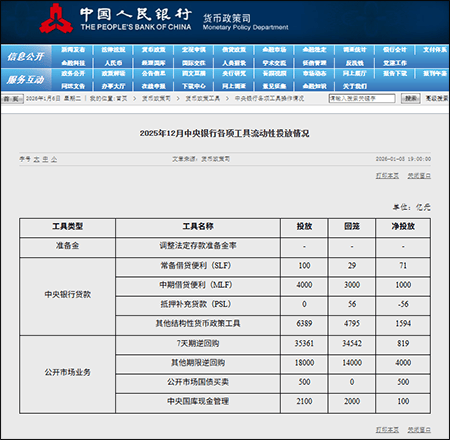
8028亿!央行公布去年12月净投放
Sou Hu Cai Jing· 2026-01-06 02:20
Core Insights - The People's Bank of China reported a net liquidity injection of 802.8 billion yuan for December 2025, indicating a proactive monetary policy stance to support the economy [1] Group 1: Liquidity Injection Details - Medium-term lending facility (MLF) provided a liquidity injection of 400 billion yuan, with a net injection of 100 billion yuan after 300 billion yuan was withdrawn [1] - Standing lending facility (SLF) contributed a net injection of 71 billion yuan, with 100 billion yuan injected and 29 billion yuan withdrawn [1] - There was no injection from the pledged supplementary lending (PSL), resulting in a net withdrawal of 56 billion yuan [1] - Other structural monetary policy tools saw a net injection of 159.4 billion yuan, with 638.9 billion yuan injected and 479.5 billion yuan withdrawn [1] Group 2: Open Market Operations - In the open market operations, the 7-day reverse repos resulted in a net injection of 81.9 billion yuan, with 35,361 billion yuan injected and 34,542 billion yuan withdrawn [1] - Other term reverse repos achieved a net injection of 400 billion yuan, with 18,000 billion yuan injected and 14,000 billion yuan withdrawn [1] - The net injection from government bond transactions in the open market was 50 billion yuan, while central treasury cash management contributed a net injection of 10 billion yuan [1] - The required reserve ratio remained unchanged during the month [1]
持续完善中央银行制度
Jing Ji Ri Bao· 2026-01-05 22:05
强大的中央银行是建设金融强国必须具备的关键核心金融要素之一。党的二十届四中全会通过的《中共 中央关于制定国民经济和社会发展第十五个五年规划的建议》提出,构建科学稳健的货币政策体系和覆 盖全面的宏观审慎管理体系。这是"十五五"时期推动金融高质量发展、加快建设金融强国的战略举措, 为完善中央银行制度指明了方向。 支撑金融强国建设 中央银行是金融体系的中枢,随着经济变迁而演进发展,形成了一系列被广泛接受的基本目标和职能定 位。中央银行制度是一国最重要的货币金融管理制度。我国于1948年成立了中国人民银行,开启了中央 银行制度的探索之路,经过改革开放以来特别是党的十八大以来的不断实践,构建了一系列既符合经济 金融普遍规律,又具有鲜明中国特色的中央银行制度。 《中共中央关于制定国民经济和社会发展第十五个五年规划的建议》提出,完善中央银行制度,构建科 学稳健的货币政策体系和覆盖全面的宏观审慎管理体系,畅通货币政策传导机制。 中央银行以维护币值稳定和金融稳定为双目标,货币政策体系和宏观审慎管理体系是中央银行实施宏观 管理的两项基础性工具,是实现双目标的双支柱。构建科学稳健的货币政策体系和覆盖全面的宏观审慎 管理体系,有利于 ...
【金融观察】数字人民币计息改革意义深远
Zheng Quan Shi Bao· 2026-01-05 18:49
在数字人民币计息改革的同时,数字人民币的性质也随之发生了变化,具体表现为数字人民币从"数字 现金时代"迈入"数字存款货币时代",从中国人民银行的负债转变为商业银行的负债,从不计息、不能 派生货币的模式演变为计息、能派生货币的模式。数字人民币在具备价值尺度功能的基础上,新增了价 值储藏功能等。同时,因为实名数字人民币钱包内的余额视为存款,其需要按照存款准备金要求交纳存 款准备金,不仅意味着数字人民币纳入货币政策调控框架,商业银行也可以利用货币派生机制通过发放 贷款创造存款来实现货币创造。 从中国人民银行看,数字人民币从央行负债转变为商业银行负债后,改变了商业银行原本只为数字人民 币提供服务和承担责任的局面,有助于进一步调动商业银行的积极性,探索更多的场景使用数字人民 币。同时,这一改变有助于提高广大居民使用数字人民币的积极性,让数字人民币发挥更大的作用。在 宏观调控上,可以通过引导数字人民币存款利率变化,或者利用数字人民币提升结构性货币政策工具的 精准度,以更好开展调控。再者,在风险管理上,可以依托银行账户管理优势更好开展反洗钱等。 从商业银行看,改革后其继续享用中国人民银行提供的技术支持保障,承担合规和反洗钱 ...

中国人民银行公布2025年12月各项工具流动性投放情况
Xin Hua Wang· 2026-01-05 13:50
Core Viewpoint - The People's Bank of China reported liquidity injection through various tools for December 2025, indicating a net liquidity injection in the financial system [1] Group 1: Liquidity Injection Details - In December 2025, the Medium-term Lending Facility (MLF) injected 400 billion yuan, with 300 billion yuan being withdrawn, resulting in a net injection of 100 billion yuan [1] - The net injection from open market transactions of government bonds amounted to 50 billion yuan [1] - Central treasury cash management saw a net injection of 10 billion yuan [1] Group 2: Reverse Repo Operations - The 7-day reverse repurchase agreements (reverse repos) had an injection of 35,361 billion yuan, with 34,542 billion yuan being withdrawn, leading to a net injection of 819 billion yuan [1]
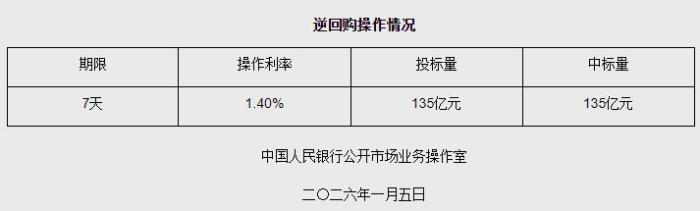
1月5日央行开展135亿元7天期逆回购操作
Zhong Guo Xin Wen Wang· 2026-01-05 01:55
| | 逆回购操作情况 | | | | --- | --- | --- | --- | | 期限 | 操作利率 | 投标量 | 中标量 | | 7 - | 1.40% | 135亿元 | 135亿元 | | | 中国人民银行公开市场业务操作室 | | | 截图来自央行网站。 1月5日央行开展135亿元7天期逆回购操作 中新网1月5日电 据央行网站消息,2026年1月5日中国人民银行以固定利率、数量招标方式开展了135亿 元7天期逆回购操作。具体情况如下: 广告等商务合作,请点击这里 本文为转载内容,授权事宜请联系原著作权人 中新经纬版权所有,未经书面授权,任何单位及个人不得转载、摘编或以其它方式使用。 关注中新经纬微信公众号(微信搜索"中新经纬"或"jwview"),看更多精彩财经资讯。 来源:中国新闻网 编辑:付健青 ...
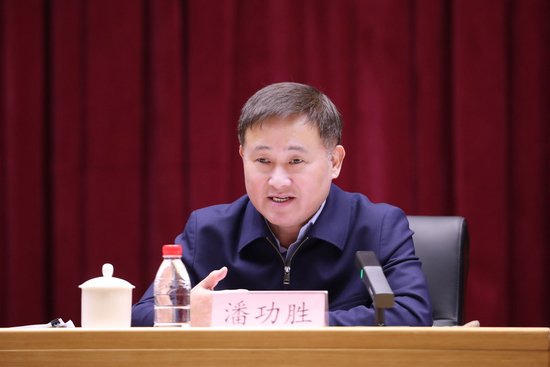
潘功胜看望慰问外汇储备经营管理人员
Jin Rong Shi Bao· 2026-01-05 01:07
Core Viewpoint - The People's Bank of China emphasizes the importance of foreign exchange reserve management in maintaining economic and financial stability amid global market fluctuations [1] Group 1: Leadership and Acknowledgment - Pan Gongsheng, the Governor of the People's Bank of China, visited the Central Foreign Exchange Business Center to express appreciation for the management personnel [1] - The management team is recognized for effectively safeguarding the safety, liquidity, and value preservation of foreign exchange reserve assets [1] Group 2: Strategic Focus for 2026 - The Central Foreign Exchange Business Center is urged to align with the guiding principles of Xi Jinping's thought and implement the decisions from the 20th National Congress and subsequent plenary sessions [1] - The center is tasked with enhancing the quality of foreign exchange reserve management and responding to global economic and financial challenges [1] - There is a call for better coordination between development and security while tracking global economic trends closely [1]
潘功胜看望慰问年终决算干部职工
Jin Rong Shi Bao· 2026-01-05 01:07
本报讯 记者马玲报道 2025年12月30日,中国人民银行党委书记、行长潘功胜到清算总中心看望慰 问年终决算干部职工,向大家致以节日问候和新年祝福。中国人民银行党委委员、副行长陆磊陪同慰 问。 潘功胜听取了清算总中心及部分分行关于2025年度年终决算准备工作汇报,现场察看各支付清算系 统运行情况。潘功胜指出,支付清算系统是我国重要的金融基础设施,是我国金融市场运行、金融机构 运营的"血液"。支付清算系统的安全稳定运行对年终决算至关重要。 潘功胜强调,年终决算是一项系统工程,需要各单位、各部门密切配合,周密组织,严格落实各项 制度要求,做好技术和应急保障,以饱满的精神状态和扎实的工作作风,全力以赴完成好年终决算各项 任务。 中国人民银行有关司局主要负责同志参加慰问。 责任编辑:袁浩 ...