中国太平

Search documents
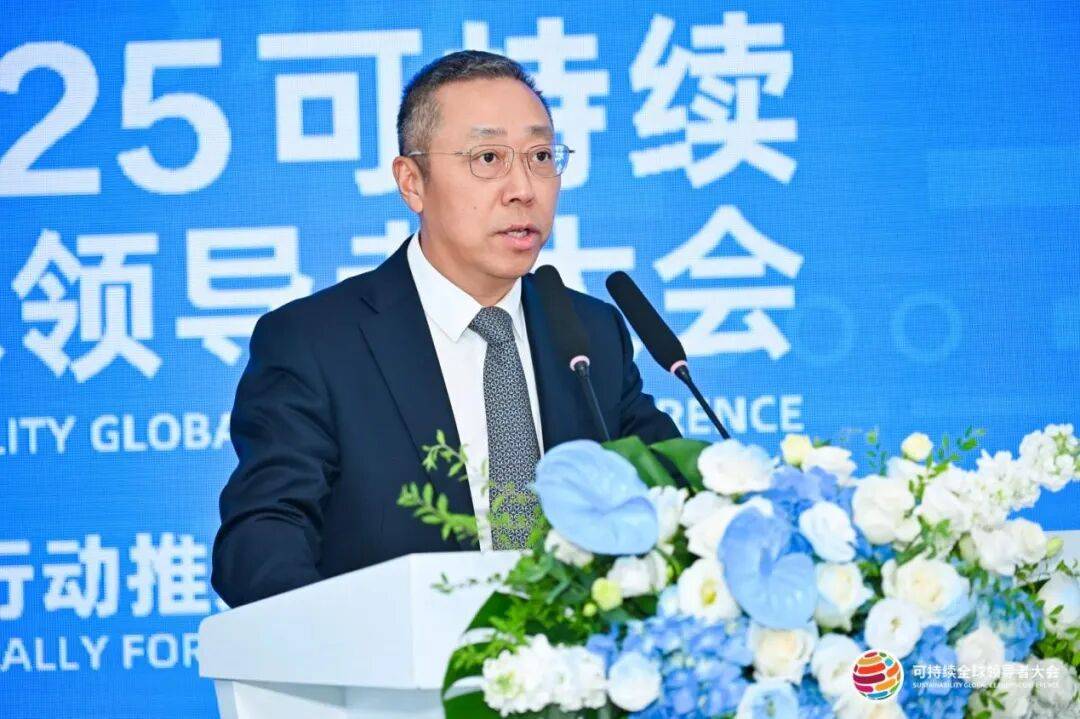
人保资产黄明:低利率周期与科技革命下,资产配置从传统大类向多元化、精细化转型
Sou Hu Cai Jing· 2025-10-24 16:08
Core Insights - The low interest rate environment is a fundamental challenge for the Chinese insurance industry, necessitating a strategic transformation in asset allocation to address pressures from interest margin losses, solvency, and liquidity [1][2][3] Group 1: Macro and Industry Changes - The global economic landscape is shifting, with the share of the US and European economies in global GDP decreasing from 62% in 2001 to 50% in 2023, while Asia's share increased from 27% to 36% [6] - The trend of de-globalization is accelerating, particularly with the US leading efforts to decouple from China, which has created significant market volatility and challenges for the industry [6] - Sustainable development has become a global consensus, with China excelling in ESG (Environmental, Social, and Governance) initiatives, leading to a positive correlation between high ESG ratings and market pricing [7] Group 2: Domestic Economic Transition - China's economic growth engine is transitioning from investment-driven to sectors like renewable energy, electric vehicles, and high-tech manufacturing, which are rapidly developing [8] - R&D expenditure in China has increased from 1 trillion yuan in 2012 to over 3.6 trillion yuan in 2024, positioning the country as a major competitor in technology [8] - The domestic low interest rate cycle is ongoing, with rates around 1.5%-1.6% nearing their lower bound, reflecting market pessimism about economic prospects [9] Group 3: Investment Opportunities in Technology - Technology sectors such as renewable energy, AI, and biotechnology are emerging as new economic growth drivers, with direct competition between China and the US [10] - The capital market in China is shifting towards a technology-driven model, with significant growth in the market capitalization of tech companies [10] Group 4: Challenges in Insurance Asset Management - The insurance industry faces significant challenges, including interest margin losses and asset-liability matching pressures, with investment yields declining by 30-50 basis points annually [11][12] - The implementation of new accounting standards has increased the volatility of investment returns, necessitating a focus on stable performance in asset allocation [12] Group 5: Strategic Transformation in Asset Allocation - The insurance asset allocation strategy is shifting from traditional categories to a more diversified and refined approach, emphasizing duration gap management and innovative non-standard assets [13][14] - To mitigate equity asset volatility, the industry is adopting a multi-faceted strategy that includes optimizing accounting matches and balancing investment styles [15] - There is a significant push towards long-term investments in high-quality technology companies, with an emphasis on enhancing research capabilities in the tech sector [16]

太平资产副总辞任沪农商行董事 或触发会计核算方式调整
2 1 Shi Ji Jing Ji Bao Dao· 2025-10-24 14:41
Core Viewpoint - The resignation of Li Guanying from the board of Shanghai Rural Commercial Bank is linked to the adjustment of accounting standards for insurance funds, which may impact the bank's financial reporting and investment classification by China Taiping Insurance Group [2][6][12] Group 1: Resignation Details - Li Guanying resigned from his position as a non-executive director on October 17, 2023, nearly one year before his term was set to end on October 10, 2026 [6] - His resignation will not affect the legal number of board members or the normal operation of the board [2][6] Group 2: Investment Implications - Taiping Asset Management stated that investing in Shanghai Rural Commercial Bank is part of a diversified investment strategy for insurance funds, and the resignation is due to accounting adjustments [6][12] - The resignation may lead to a change in how China Taiping accounts for its investment in Shanghai Rural Commercial Bank, potentially shifting from equity method accounting to fair value measurement [12] Group 3: Market Reactions and Speculations - There are speculations in the market that Taiping Asset may plan to reduce its stake in Shanghai Rural Commercial Bank or adjust its cooperation strategy following Li Guanying's resignation [8][10] - Experts suggest that the impact of the resignation is difficult to predict and may simply be a normal personnel change rather than a significant strategic shift [8][10]

增资获批,比利时富杰保险正式入股太平养老
Sou Hu Cai Jing· 2025-10-24 10:34
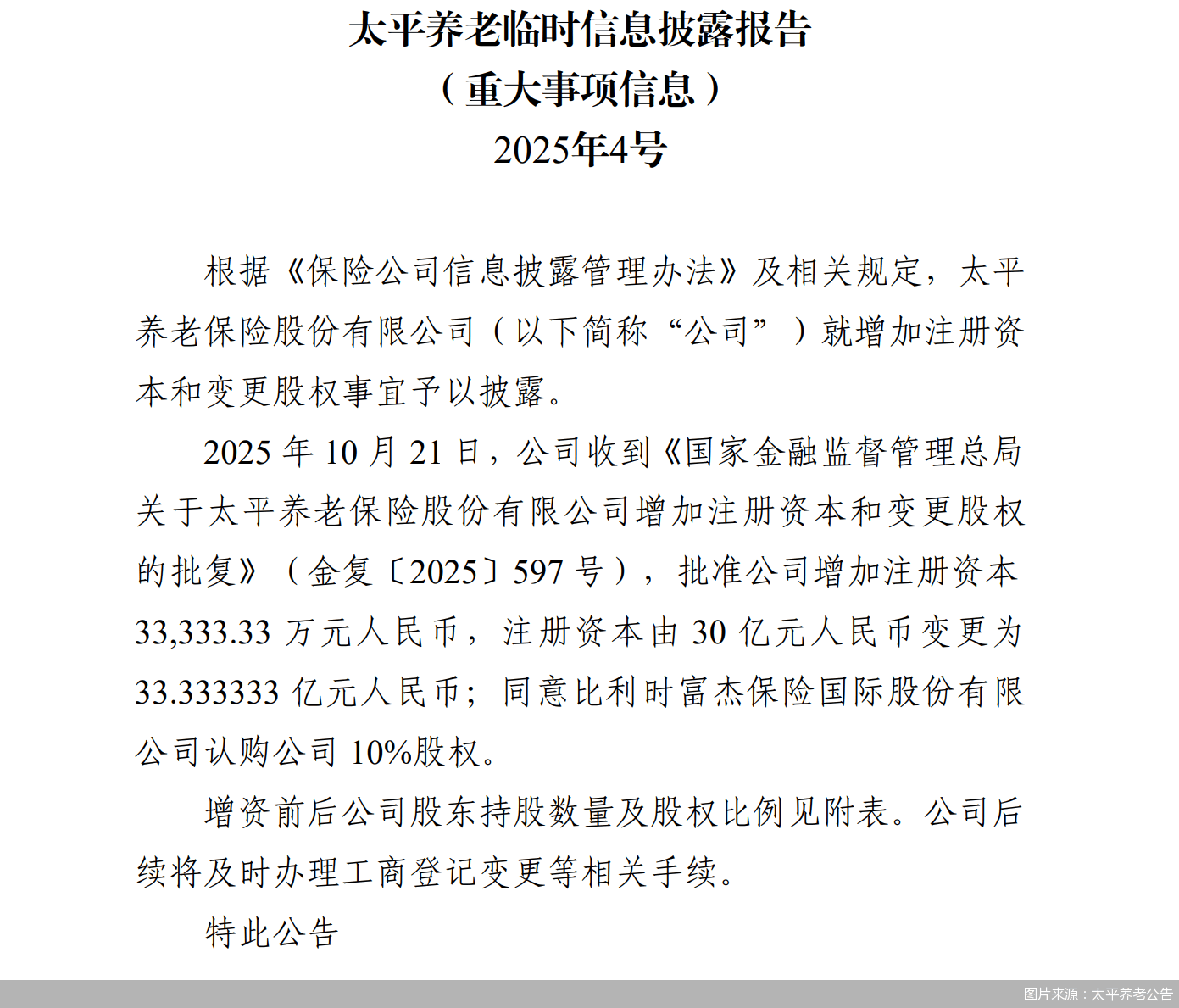
Group 1 - The core point of the article is that Taiping Pension Insurance Co., Ltd. has received approval from the National Financial Regulatory Administration to increase its registered capital by 333.333 million yuan, raising the total from 3 billion yuan to 3.333 billion yuan [1] - The capital increase will be fully subscribed by the new shareholder, Belgium Fortis Insurance International Co., Ltd., which will acquire a 10% stake in Taiping Pension, making it the second-largest shareholder [1] - Following the capital increase, the shareholding of the largest shareholder, China Taiping Insurance Holdings Company Limited, will be diluted from 99.99% to 89.99% [1]
沪农商行董事离任引发减持误读 太平资管称仅为会计准则调整
Jing Ji Guan Cha Wang· 2025-10-23 15:00
Core Viewpoint - The resignation of Li Guanying from the board of Shanghai Rural Commercial Bank has sparked speculation in the capital market regarding potential stock divestment by China Taiping Insurance, despite assurances that the resignation will not affect the bank's board operations [3][4][6]. Summary by Sections Announcement Details - On October 20, Shanghai Rural Commercial Bank announced the resignation of Li Guanying due to work reasons, confirming that this will not lower the board's membership below the legal requirement [3][4]. - Li Guanying is currently the Deputy General Manager and Financial Officer of Taiping Asset Management, which manages investments for China Taiping Insurance [4]. Market Speculation - The explanation regarding the "adjustment needs of insurance company accounting standards" has led to market speculation that this could indicate a reduction in China Taiping's stake in Shanghai Rural Commercial Bank [4][5]. - The new accounting standards, effective in early 2026, will require insurance companies to classify stocks they hold as FVOCI (Fair Value Through Other Comprehensive Income) if they meet certain criteria, including holding over 5% of shares or having board representation [4][5]. Accounting Implications - FVOCI assets allow for stock price fluctuations to be excluded from annual profit reports, enhancing profit stability for insurance companies. However, once classified as FVOCI, these stocks must be held long-term [5]. - With Li Guanying's departure, and given that China Taiping holds less than 5% of the bank's shares, there is speculation that the bank's stock may be reclassified to FVTPL (Fair Value Through Profit or Loss), allowing for easier divestment [5][6]. Future Actions and Dividends - Insiders suggest that the market may have misunderstood the implications of the accounting adjustments, indicating that China Taiping is unlikely to reduce its holdings in the near term [6]. - As a significant shareholder with a 4.3% stake, the future nomination of a new board member by China Taiping is of interest to the market [7]. - Shanghai Rural Commercial Bank has consistently provided substantial cash dividends, with a total of 41.66 billion yuan distributed in the 2024 fiscal year, representing 33.91% of its net profit, indicating a strong return on investment for shareholders [7].

全国规模最大AIC母基金落地福田
Sou Hu Cai Jing· 2025-10-22 23:25
Core Insights - The "1+4" white paper on wealth management in Shenzhen was released during the "2025 Xiangmi Lake Wealth Management Week," aiming to establish Shenzhen as an international wealth management center [2] Group 1: Wealth Management Development - The event attracted over 900 representatives from various financial institutions, including banks, insurance asset management, and venture capital [2] - The total entrusted asset management scale in China has exceeded 100 trillion yuan, with a year-to-date increase of nearly 6% and a year-on-year increase of over 15% [3] - The banking wealth management and insurance asset management sectors have seen steady growth, with bank wealth management reaching 30.67 trillion yuan and insurance funds at 36.23 trillion yuan by Q2 2025 [4] Group 2: Shenzhen's Financial Landscape - Shenzhen's asset management scale has surpassed 31 trillion yuan, accounting for about 20% of the national total, nearing the levels of Hong Kong and Singapore [5] - The Futian District, as Shenzhen's financial center, manages over 18 trillion yuan, representing approximately 60% of the city's total asset management [6] - The establishment of the first AIC (Asset Investment Company) mother fund in Shenzhen, with a scale of 70 billion yuan, marks a significant milestone in local industry investment [8] Group 3: Future Outlook - The wealth management industry in Shenzhen and the Greater Bay Area is expected to continue enhancing its role as a capital market hub, integrating technology, industry, and finance [7] - The newly established AIC mother fund aims to support strategic sectors such as artificial intelligence, semiconductors, and new energy, creating a multi-layered fund ecosystem [8][9] - The fund's establishment aligns with national policies to promote high-quality development in venture capital and entrepreneurship [9][10]

保险业筑牢健康保障网
Jing Ji Ri Bao· 2025-10-22 22:05
商业健康保险作为基本医保的重要补充,能够针对医疗费用、重大疾病、长期护理等风险提供保障,是 保险业发挥筑牢社会保障网功能的重要险种。 健康保险在持续快速发展的同时,产品形态单一、行业经营能力不足、基础薄弱、专业机构发展较慢、 与医疗医药协同不够等问题也逐步显现,制约了服务保障水平的提升。国家金融监督管理总局近期发布 《关于推动健康保险高质量发展的指导意见》(以下简称《意见》),针对性地优化现有政策,打通卡 点堵点,明确健康保险未来方向和发展重点,推动健康保险高质量发展。 产品供给更加丰富 近年来,商业健康保险产品供给增加,有力保障了人民健康。金融监管总局公布的信息显示,目前,保 险公司在售商业医疗保险产品超过1.1万个,既包含城市定制型商业医疗保险等,也包含公立医院国际 部、私立医院乃至境外医院的中高端医疗保险产品;既包含企事业团体医疗保险,也包含个人医疗保 险,较好地满足了人民群众多层次健康保障需求。部分保险公司针对慢性病人群,专门开发了相关医疗 保险产品,通过适当放宽投保条件,对有既往症和慢性病的老年人群给予合理保障,如平安e生保2023 (慢病版)医疗保险、太平超e保(慢病版)医疗保险、友邦智选康惠慢病 ...
第四届中国保险历史文化论坛举行
Jin Rong Shi Bao· 2025-10-22 06:19
Group 1 - The forum commemorates the 150th anniversary of the establishment of the national insurance industry and the 30th anniversary of the implementation of the Insurance Law, highlighting its historical significance [1][2] - The China Insurance Society emphasizes that the study of insurance history and culture is crucial for establishing cultural confidence and providing historical references for modern governance in the insurance sector [1] - The event featured over a hundred experts and scholars from the insurance industry, including notable figures such as former vice-chairmen of the China Insurance Regulatory Commission [2] Group 2 - New publications were launched during the forum, including "World Insurance History," "Insurance in Historical Context," and "Curatorial Notes on the Basic Exhibition of the China People's Insurance Museum" [2]
非银三季报密集发布,频频超预期!全市场唯一港股通非银ETF(513750)盘中涨超3%
Xin Lang Cai Jing· 2025-10-21 02:42
Group 1 - The non-bank financial sector has reported better-than-expected performance in Q3, with several companies announcing profit increases for the first three quarters of 2025 [1] - Xinhua Insurance expects a net profit attributable to shareholders of the parent company to be between 29.986 billion and 34.122 billion yuan, an increase of 9.306 billion to 13.442 billion yuan compared to the same period in 2024, representing a year-on-year growth of 45% to 65% [1] - China Life anticipates a net profit of approximately 156.785 billion to 177.689 billion yuan for the first three quarters of 2025, an increase of about 52.262 billion to 73.166 billion yuan compared to 2024, indicating a year-on-year growth of about 50% to 70% [1] Group 2 - As of the end of 2024, the balance of insurance fund utilization reached 33.26 trillion yuan, a year-on-year increase of 15.08%, outpacing the average growth rate of the asset management industry [2] - The asset allocation structure is increasingly favoring standard products, with bond allocation rising to 50.7% and stock allocation increasing to 8.3% [2] - Insurance companies are actively increasing their equity asset allocation in the context of a recovering capital market, with China Life's stock and fund allocation growing by approximately 36% compared to the same period last year [2] Group 3 - As of October 20, 2025, the latest scale of the Hong Kong Stock Connect Non-Bank Financial ETF reached 20.778 billion yuan, with net inflows of 9.62 billion yuan over the past five trading days [3] - The Hong Kong Stock Connect Non-Bank Financial ETF is the first and only ETF tracking the Hong Kong non-bank index, with over 60% of its allocation in insurance stocks [3] - The ETF selects up to 50 listed companies that meet the non-bank financial theme from the Hong Kong Stock Connect securities range to reflect the overall performance of these companies [3]

港股内险股集体拉升上涨,中国人寿涨超4%
Mei Ri Jing Ji Xin Wen· 2025-10-21 01:56
Core Viewpoint - The Hong Kong insurance stocks experienced a collective surge, with notable increases in share prices for major companies in the sector [1] Group 1: Stock Performance - China Life Insurance led the gains with an increase of over 4% [1] - China Pacific Insurance rose by 3.5% [1] - New China Life Insurance saw a rise of 2.6% [1] - Other companies such as New China Life, Ping An Insurance, China Pacific Insurance, and AIA Group all recorded increases of over 2% [1]



港股异动丨内险股集体上涨 中国人寿涨超4% 中国平安涨超2%
Ge Long Hui· 2025-10-21 01:52
Group 1 - The core viewpoint of the article highlights a collective rise in Hong Kong insurance stocks, with China Life leading the gains at over 4% [1] - Major insurance companies such as China Life, New China Life, and PICC have announced significant profit increases, with net profit growth exceeding 40% year-on-year, and China Life leading with a projected increase of 50% to 70% [1] - The strong performance in equity investments is identified as a key driver behind the net profit growth of these companies [1] Group 2 - Several brokerage firms maintain an optimistic outlook on the insurance sector, anticipating a "double hit" in valuation and performance due to "asset-liability resonance" [1] - Continuous policy support from multiple departments encourages insurance capital to enter the market as long-term funds, promoting the establishment of a long-term assessment mechanism [1]