
招商银行

Search documents
A股银行股集体上涨,渝农商行涨超2%
Ge Long Hui A P P· 2026-02-04 01:57
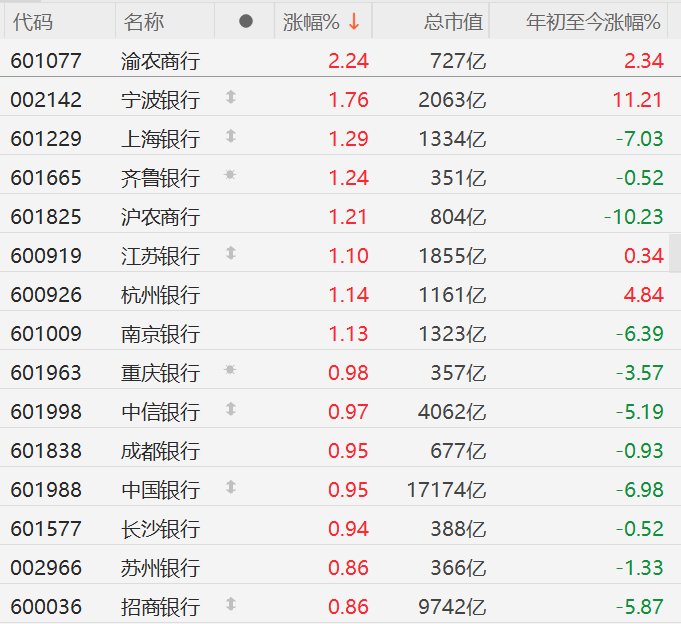
Group 1 - A-shares of bank stocks collectively rose, with notable increases in stocks such as Chongqing Rural Commercial Bank, which rose over 2%, and several others including Ningbo Bank, Shanghai Bank, and Qilu Bank, which rose over 1% [1] - Specific stock performance includes Chongqing Rural Commercial Bank increasing by 2.24% with a total market value of 72.7 billion, and Ningbo Bank rising by 1.76% with a market value of 206.3 billion [2] - The year-to-date performance shows significant variations, with Ningbo Bank up 11.21%, while Shanghai Bank down 7.03%, and Hu'nong Commercial Bank down 10.23% [2] Group 2 - The MACD golden cross signal has formed, indicating a positive trend for these bank stocks [2]





涨超1.8%,大湾区ETF(512970)成立以来超越基准年化收益达3.33%
Xin Lang Cai Jing· 2026-02-04 01:55
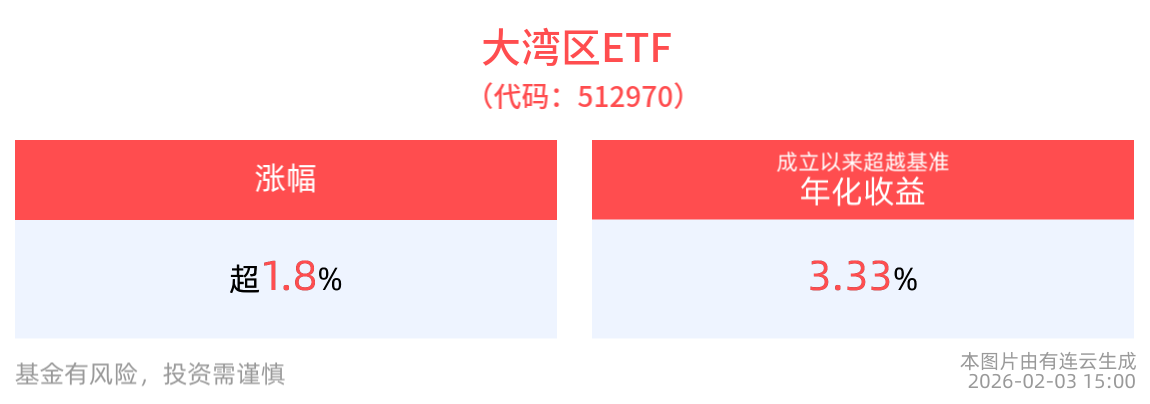
Core Viewpoint - The performance of the Zhuhai-Hong Kong-Macao Greater Bay Area Development Theme Index and its related ETF indicates a strong upward trend, reflecting positive market sentiment towards companies benefiting from the Greater Bay Area development [2][3]. Group 1: Index Performance - As of February 3, 2026, the Zhuhai-Hong Kong-Macao Greater Bay Area Development Theme Index (931000) increased by 1.50%, with notable gains from component stocks such as XW Communication (up 13.12%) and Mingyang Smart Energy (up 7.63%) [2]. - The Greater Bay Area ETF (512970) rose by 1.83%, with a latest price of 1.5 yuan, and has accumulated a 16.77% increase over the past six months [2]. - The ETF's trading volume showed a turnover rate of 1.59% with a transaction value of 1.3822 million yuan, and an average daily transaction of 1.0538 million yuan over the past week [2]. Group 2: Risk and Return Metrics - The Greater Bay Area ETF recorded a Sharpe ratio of 1.51 over the past year as of January 30, 2026, indicating a favorable risk-adjusted return [2]. - The maximum drawdown for the ETF this year was 5.52%, with a relative benchmark drawdown of 0.02% [2]. - The management fee for the ETF is set at 0.15%, while the custody fee is 0.05% [2]. Group 3: Index Composition - The index closely tracks companies that benefit from the Greater Bay Area development, including a selection of up to 50 Hong Kong market securities, 300 companies from the Shanghai-Hong Kong-Shenzhen markets, and 100 mainland market securities [3]. - As of January 30, 2026, the top ten weighted stocks in the index accounted for 44.55% of the total, with major companies including Ping An Insurance, Luxshare Precision, and BYD [3][4].
“业绩亮眼+部署升级” 银行业以高质量发展护航“十五五”开局
Jin Rong Shi Bao· 2026-02-04 01:47
Core Viewpoint - The banking industry is focusing on supporting the real economy through strategic transformation and risk management, with a clear emphasis on high-quality development and service to key sectors [1][3][8]. Group 1: Performance of Listed Banks - Several A-share listed banks, including China Merchants Bank, CITIC Bank, and Shanghai Pudong Development Bank, have reported significant growth in both operating income and net profit for 2025, indicating a recovery in profitability [2]. - CITIC Bank and Shanghai Pudong Development Bank have both entered the "10 trillion yuan club," with total assets of 10.13 trillion yuan and 10.08 trillion yuan respectively, marking growth rates of 6.28% and 6.55% year-on-year [2]. - The overall trend for joint-stock banks in 2025 is characterized by stable scale, optimized structure, risk control, and improved efficiency, showcasing strong resilience against economic cycles [2]. Group 2: Strategic Focus on Real Economy - The banking sector is shifting from "scale expansion" to "high-quality development," with a focus on precise strategies to support the real economy and address cyclical fluctuations [3][6]. - Major state-owned banks have emphasized the importance of serving the real economy in their 2026 operational plans, aligning their actions with national strategic directives [4]. - Agricultural Bank of China is prioritizing support for rural revitalization, while Bank of China aims to enhance its global capabilities and services [4]. Group 3: Digital Transformation and Innovation - Digital transformation is becoming a key support for banks to enhance their service efficiency to the real economy, with initiatives like "AI+" being implemented to innovate service models and improve decision-making [5]. - Postal Savings Bank is pursuing a comprehensive upgrade strategy focusing on digitalization and value-driven growth, aiming for high-quality development [5]. Group 4: Financial Resource Allocation - The banking industry is actively channeling more financial resources into key areas such as expanding domestic demand, technological innovation, and supporting small and micro enterprises [6][8]. - Banks are adjusting their strategic layouts to focus on the "five major financial articles," enhancing the precision and effectiveness of their services to the real economy [6]. - Notable growth in technology finance loans has been reported, with Hangzhou Bank and Nanjing Bank showing increases of 23.44% and 19.49% respectively [6][7]. Group 5: Regional and Sectoral Support - Banks are increasingly focusing on regional development and industrial upgrades, with initiatives to strengthen local financial services and support manufacturing sector transformations [7]. - The emphasis on supporting small and micro enterprises has led to significant growth in inclusive finance loans, with Hangzhou Bank and Nanjing Bank reporting increases of 17.06% and 17.46% respectively [7]. - The banking sector is aligning its services with national strategies in areas such as technological innovation, green development, and rural revitalization [8].
泰山榜|山东银行版图透视:法人机构219家,一二级分行总数达420家
Xin Lang Cai Jing· 2026-02-03 23:55
Core Viewpoint - Shandong Province aims to reform and restructure rural commercial banks and village banks while deepening internal control and risk management actions in urban commercial banks, highlighting the importance of a well-distributed financial service network for regional economic vitality and development potential [2]. Financial Institutions Overview - As of now, Shandong Province has a total of 219 banking legal entities, including 170 first-level branches and 250 second-level branches, with a total of 639 headquarters and branches, supported by 14,700 other outlets [2]. - The core components of Shandong's banking industry include joint-stock banks, urban commercial banks, and rural commercial banks, which work collaboratively to outline a clear regional banking landscape [2]. Joint-Stock Banks - Joint-stock banks play a pivotal role in Shandong's banking sector, characterized by a "leading head, focused core, and precise efforts" strategy, connecting national financial markets with local economies [3][4]. - As of September 2025, Hengfeng Bank, the only national joint-stock commercial bank with independent legal status in Shandong, has total assets of 1.568726 trillion yuan, nearing the 1.6 trillion yuan mark [4]. - National joint-stock banks have established 25 first-level branches and 119 second-level branches in Shandong, with a notable presence in Jinan, Qingdao, and Yantai [4]. Urban Commercial Banks - Urban commercial banks are essential local financial institutions in Shandong, leveraging geographical and service advantages to empower local economies and improve livelihoods [5][6]. - Shandong has 14 local urban commercial banks, including Qilu Bank and Qingdao Bank, along with branches from three non-local urban commercial banks, forming a comprehensive service matrix across the province [5]. Rural Commercial Banks - Rural commercial banks are the most numerous banking entities in Shandong, with 110 institutions focused on serving rural areas and supporting agricultural development [7][8]. - These banks provide a full range of financial services, effectively addressing issues of financing difficulties in rural regions [7]. - Additionally, 91 village banks complement rural commercial banks by extending financial services to remote areas, creating a multi-layered and comprehensive rural financial service system [8]. Future Outlook - Despite facing challenges such as smaller scales and weaker risk resistance, rural commercial banks in Shandong are deepening reforms and enhancing service capabilities, with asset quality steadily improving [8]. - Experts suggest that the three banking groups—joint-stock banks, urban commercial banks, and rural commercial banks—should continue to leverage their strengths and address development challenges to support high-quality economic growth and rural revitalization in Shandong [8].




金价震荡 多银行积存金投资门槛再上调
Sou Hu Cai Jing· 2026-02-03 23:11
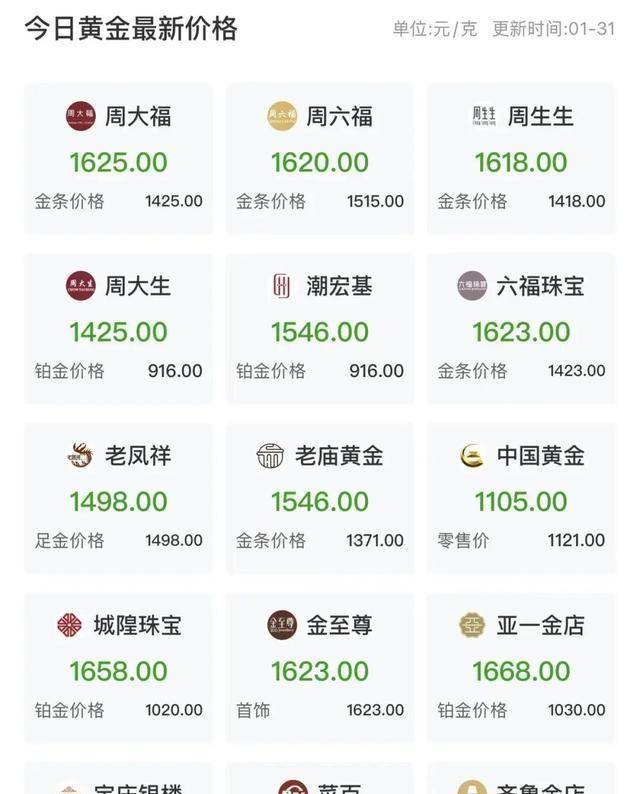
最近一周,国际国内金价出现大幅震荡,工行、农行、中行、建行、交行等多家国有大行以及部分股份 制银行,陆续调整积存金等贵金属相关业务规则,并同步发布市场风险提示,强化投资者风险管控要 求。此次各银行对于积存金业务的密集调整,距上一次调整仅过去两个月时间。随着投资门槛的不断上 调,积存金业务已不再是此前投资者眼中的"低门槛"业务。 金价坐上"过山车" 上周起,在开年以来被市场热捧的黄金,突然开启了令投资者心惊胆战的史诗级巨震,其价格形成明显 的"过山车"走势。1月30日,国际现货黄金在创下历史新高后突遭大跌,后迅速反弹,第二日金价再度 遭遇暴跌,并创下40年来的最大单日跌幅。虽然本周以来,金价有所反弹,但距离此前高点尚有较大缺 口。 1月26日,伦敦黄金现货价格首次突破每盎司5000美元,创历史新高。随后继续上涨,1月28日,伦敦黄 金现货价格突破每盎司5200美元。1月29日早盘冲破每盎司5500美元,并一度创下历史新高,虽然随后 金价略有回落,但已站稳5500美元/盎司。当日,国际金价的飙升迅速传导至国内市场,国内部分主流 金饰品牌报价刷新1700元/克,创下历史新高,单日价格上涨近百元。 1月30日,伦敦黄 ...





黄金进入“未知领域”投资者心态极限拉扯
Zhong Guo Zheng Quan Bao· 2026-02-03 20:27
● 本报记者 郝健 近期黄金价格上演过山车式行情。实物黄金交易中,回购柜台前投资者因价格波动或获利了结或陷入浮 亏纠结,而销售区却因投资需求与刚需消费持续火爆;金融市场上,黄金主题类ETF上演"跌停后反 弹",资金在恐慌与淡定之间反复切换。机构表示,黄金价格短期波动加剧,长期牛市逻辑虽未改变, 但需警惕市场动荡风险。 卖金各有考量 虽已是中午十二点半,北京某商场办理黄金回购业务的柜台前依然排着长队。 "周日人多,队伍绕着圈排,根本看不到头,等三个小时是常事。"一位住在附近的大爷告诉中国证券报 记者,他今天已是第二次过来,"儿子结婚急用钱,看着金价从高点下来了,怕再跌,赶紧来卖掉一部 分,落袋为安。" 这种"怕再跌"的心理,在投资者中颇具代表性。投资者魏女士从去年底开始分批购入投资金条,面对当 前的高位震荡,她选择先卖出一部分锁定利润。"涨的时候总觉得还能涨,跌的时候又怕一直跌。人性 就是这样。反正现在卖也是赚的。" 次日,剧情再次反转。2月3日,这20只ETF收盘全部上涨。黄金股票型ETF中,国泰中证沪深港黄金产 业股票ETF领涨,当日涨幅4.24%;商品型黄金ETF中,华安易富黄金ETF上涨5.19%,表现 ...
黄金进入“未知领域” 投资者心态极限拉扯
Zhong Guo Zheng Quan Bao· 2026-02-03 20:23
Core Viewpoint - Recent fluctuations in gold prices have led to a mixed sentiment among investors, with some opting to sell for profit while others remain hopeful for future gains. Despite short-term volatility, the long-term bullish outlook on gold remains intact, though market risks should be monitored [1][7]. Group 1: Investor Behavior - Many investors are selling gold due to fears of further price declines, with some choosing to lock in profits after recent purchases [2][3]. - A segment of investors, however, remains optimistic about gold's long-term value, viewing current price dips as buying opportunities [4][6]. - Emotional factors and social media influence are driving some new investors to make impulsive purchases, despite the risks associated with price volatility [4][5]. Group 2: Market Dynamics - The physical gold market is experiencing a stark contrast between high demand for purchases and anxiety over price fluctuations among sellers [2][4]. - Gold-themed ETFs have shown significant trading activity, with notable inflows even during price declines, indicating a complex investor sentiment towards these financial instruments [6][7]. - Institutions are observing a shift in the narrative surrounding gold trading, focusing more on the restructuring of global financial dynamics rather than just liquidity changes [7].
贵州钢绳股份有限公司关于开立募集资金临时补充流动资金专项账户并签订募集资金临时补充流动资金专项账户监管协议的公告
Shang Hai Zheng Quan Bao· 2026-02-03 19:12
Core Viewpoint - Guizhou Steel Rope Co., Ltd. has announced the establishment of a temporary special account for the supplementary use of idle raised funds, with a maximum limit of RMB 200 million for a period not exceeding 12 months [1][3]. Fundraising Basic Situation - The company raised a total of RMB 460,104,000 by issuing 80,720,000 shares at a price of RMB 5.70 per share, with a net amount of RMB 445,580,160 after deducting issuance costs of RMB 14,523,840 [1]. Fundraising Supervision Agreement - The company has signed a tripartite supervision agreement with its sponsor, Haitong Securities Co., Ltd., and five banks to regulate the management of the raised funds and protect investors' rights [2][4]. - The special account for raised funds has been opened at the Industrial and Commercial Bank of China, with an account balance of RMB 0.00 as of January 30, 2026 [4]. Main Content of the Agreement - The special account is exclusively for the temporary supplementary use of raised funds and cannot be used for other purposes [4]. - The sponsor is responsible for supervising the use of the raised funds and must conduct at least one on-site investigation every six months [5][6]. - The agreement stipulates that if the amount withdrawn from the account exceeds RMB 50 million or 20% of the net amount of raised funds, the company must notify the sponsor [6]. Agreement Validity and Termination - The agreement will be effective upon signing and will remain in effect until all funds are fully utilized and the account is legally closed [6][7]. - If the agreement is terminated early, the company must sign a new agreement within two weeks and announce it promptly [7].

金价暴跌,男子花20万买200克,银行纷纷发布公告
Sou Hu Cai Jing· 2026-02-03 17:50
Core Viewpoint - The recent sharp decline in gold prices has led to a mixed market reaction, with some investors looking to buy the dip while others are counting their losses [1][3][4] Market Reaction - On January 30, gold futures on the New York Commodity Exchange fell below $4,800 per ounce, with a daily drop exceeding 10%, while spot gold hit a low of $4,682 before closing at $4,880.03, marking a maximum daily decline of over 12% [1] - Domestic gold jewelry prices also adjusted downward, with most products dropping approximately 80 yuan per gram, reflecting a significant market correction [1][4] Investor Behavior - In Beijing, some individuals exchanged old jewelry for cash, while others took the opportunity to invest in gold bars, indicating a mix of fear and greed in the market [3] - A customer at a gold store in Nanchang expressed a desire to invest in gold, stating that it serves both as an adornment and an investment, highlighting the dual nature of gold as a commodity [4] Price Dynamics - Major gold retailers like Chow Tai Fook and Chow Sang Sang reported price drops of 60 to 90 yuan per gram within just one to two days, illustrating the rapid market adjustment [4] - The recent price drop is noted as the largest single-day decline in 40 years, with silver prices also experiencing a significant drop of over 35% [4] Market Conditions - The decline in gold prices is attributed to a combination of overheated market conditions and external triggers, such as a downturn in U.S. stock markets and disappointing earnings reports from major companies like Microsoft [6][7] - The volatility in the market is further exacerbated by speculation and the behavior of institutional investors, leading to a chain reaction of sell-offs [7][9] Regulatory Response - Major banks in China have implemented measures to assess the risk tolerance of individual investors participating in gold accumulation transactions, indicating a proactive approach to managing systemic risk [9] - These measures aim to protect investors from high volatility and ensure that they are informed and capable of handling potential losses [9] Long-term Outlook - Despite short-term volatility, the long-term outlook for gold remains optimistic due to persistent factors such as inflation expectations, geopolitical uncertainties, and diverging monetary policies [12] - The current price fluctuations are viewed as a market correction rather than a fundamental shift in gold's value proposition [12] Conclusion - The market is experiencing a misalignment between expectations and reality, driven by liquidity and valuation asymmetries, necessitating a balanced approach between investor protection and market liquidity [14] - Investors are encouraged to maintain a long-term perspective, manage their positions carefully, and prioritize risk control in the face of market volatility [14]
丈量地方性银行(2):浙江163家区域性银行全梳理-20260203
GF SECURITIES· 2026-02-03 13:31
Investment Rating - The industry investment rating is "Buy" [2] Core Insights - The report provides a comprehensive analysis of 163 regional banks in Zhejiang Province, highlighting their asset and liability structures, profitability, and asset quality [6][20] - The asset growth rate for major city commercial banks in Zhejiang is 9.4%, which is lower than the 14.2% growth rate of listed city commercial banks, while major rural commercial banks show an asset growth rate of 8.0%, exceeding the 6.7% growth rate of listed rural commercial banks [6][25] - The report indicates that the loan-to-asset ratio for city commercial banks is projected to reach 55.5% in 2024, an increase of 95 basis points year-on-year, while rural commercial banks will see a decrease to 59.3%, down 19 basis points [31] - Profitability metrics show that the average Return on Assets (ROA) for city commercial banks in Zhejiang is 0.78%, slightly above the average of listed city commercial banks, while rural commercial banks have an average ROA of 0.82%, which is below the average of listed rural commercial banks [6][31] - The asset quality of regional banks in Zhejiang is reported to be better than that of listed banks, with non-performing loan ratios lower by 16 basis points for city commercial banks and 9 basis points for rural commercial banks compared to their listed counterparts [6][31] Summary by Sections Section 1: Economic Structure of Zhejiang Province - Zhejiang Province is focused on high-quality development and aims to become a model for common prosperity [13] - The province's GDP is heavily concentrated in cities like Hangzhou, Ningbo, and Wenzhou, with Hangzhou accounting for 24.3% of the total GDP in 2025 [15] Section 2: Overview of 163 Regional Banks - The report categorizes the banks into city commercial banks, rural banks, and others, with a total of 163 banks in the region [20] - The distribution of registered capital among these banks is relatively balanced, with 63 banks having over 500 million yuan in registered capital [22] Section 3: Asset and Liability Structure - The asset growth of major city and rural commercial banks has been declining since 2019, with city banks showing a growth rate of 9.4% in the first half of 2025 [25] - The liability structure indicates that customer deposits account for 77.5% of liabilities for city commercial banks, which is higher than the 66.2% for listed city banks [44] Section 4: Profitability and Asset Quality - The average ROE for city commercial banks in Zhejiang is 11.98%, slightly lower than the average of listed city banks [6][31] - The report highlights that the non-performing loan ratio for city commercial banks is lower than that of listed banks, indicating better asset quality [6][31]
