
美元信用重塑

Search documents
黄金白银,突然大反转!
Sou Hu Cai Jing· 2026-02-04 08:51
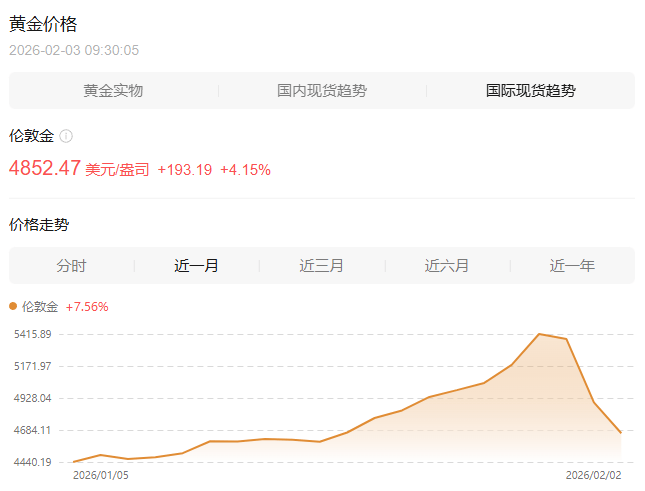
Group 1 - The core viewpoint of the articles highlights the significant volatility in gold and silver prices, with gold experiencing a sharp rise followed by a historic drop, and silver also showing substantial fluctuations [3][4][9]. - As of February 3, spot gold reached $4852.47 per ounce, marking a daily increase of 4.15%, while spot silver surged by 8% to $85.5 per ounce [1]. - The volatility of gold has reached over 44%, the highest since the 2008 financial crisis, indicating extreme market conditions [3]. Group 2 - The National Investment Silver LOF experienced a record drop of 31.5% on February 2, attributed to significant fluctuations in international silver prices [4]. - The adjustment in valuation methods for the National Investment Silver LOF led to a premium rate of 109.92% in the secondary market, raising concerns among investors [4][8]. - Analysts suggest that the current market dynamics for gold are driven more by financial attributes and speculative factors rather than fundamental changes, complicating predictions for future price movements [10]. Group 3 - Multiple institutions forecast that while short-term trading risks are present, the long-term outlook for gold remains positive, with expectations of a return to upward trends [9]. - The current gold bull market is characterized by a shift in narrative compared to previous cycles, focusing on the reconstruction of dollar credit and global order rather than liquidity changes [9]. - Analysts believe that the financial attributes of gold prices are now the primary drivers, making it challenging to predict market tops due to the lack of historical reference points [10].

黄金进入“未知领域”投资者心态极限拉扯
Zhong Guo Zheng Quan Bao· 2026-02-03 20:27
Core Viewpoint - Recent fluctuations in gold prices have led to a mixed sentiment among investors, with some opting to sell for profit while others remain hopeful for future gains. Despite short-term volatility, the long-term bullish outlook on gold remains intact, although market risks should be monitored [1][6]. Group 1: Selling Gold Considerations - Many investors are selling gold due to fears of further price declines, with some choosing to lock in profits after recent price drops [1]. - A significant number of sellers express a sense of urgency, driven by personal financial needs, such as funding a wedding [1]. - Others, however, maintain a long-term perspective, believing that gold will appreciate over time, thus feeling less pressure from short-term price movements [2]. Group 2: Buying Gold Enthusiasm - The demand for gold investment remains strong, with crowded sales areas indicating robust consumer interest despite price volatility [2][3]. - Some buyers view current price dips as opportunities to "buy the dip," reflecting a mindset that sees potential for future gains [3]. - Social media influences and group dynamics also play a role in driving new investors to purchase gold, even if they are not fully informed about market conditions [3]. Group 3: ETF Market Dynamics - Gold-themed ETFs have experienced significant trading activity, with notable inflows even during price declines, indicating investor interest in capitalizing on market fluctuations [4][5]. - On February 2, all gold ETFs hit their daily limit down, but the following day saw a complete rebound, showcasing the volatile nature of investor sentiment [4][6]. - Analysts suggest that the current gold market is characterized by unprecedented volatility, with a shift in trading logic focusing more on the restructuring of global financial systems rather than just liquidity changes [6].
独家洞察 | 黄金急跌:是趋势终结,还是过热之后的必要冷却?
慧甚FactSet· 2026-02-03 08:50
Core Viewpoint - The recent sharp decline in gold prices, despite a generally optimistic long-term outlook, has sparked discussions about whether the gold bull market has ended. This decline is attributed to macroeconomic factors and market dynamics rather than a fundamental shift in gold's value proposition [3][5]. Group 1: Market Dynamics - Gold prices experienced a significant drop, with COMEX gold futures falling 8.88% on January 30 and 0.90% on February 2, bringing the price to $4702.60 per ounce. The spot gold price also saw a decline of 9.25%, marking the largest single-day drop since April 1, 1980 [1][3]. - The market's reaction is largely influenced by the nomination of Kevin Warsh as the next Federal Reserve Chair, who is perceived as hawkish, raising concerns about potential tightening of monetary policy and its impact on gold and other non-yielding assets [3][4]. - Increased margin requirements for gold and silver futures by the Chicago Mercantile Exchange (CME) have raised trading costs, prompting some investors to exit the market. The accumulation of profit-taking pressure from previous price increases has also contributed to the volatility [3][4]. Group 2: Long-term Outlook - Despite the short-term volatility, major institutions maintain a positive long-term outlook for gold. Deutsche Bank predicts that gold prices could rise to $6000 per ounce, while the China branch of the World Gold Council suggests that gold may challenge $6500 per ounce in the coming year [4][5]. - Goldman Sachs has raised its 2026 gold price target to $5400 per ounce, citing ongoing central bank purchases, potential interest rate cuts, and rising macroeconomic uncertainties as key factors supporting gold prices [4][5]. - The core narrative supporting gold remains intact, driven by the restructuring of dollar credit, global order changes, and persistent macroeconomic uncertainties. The current price adjustment is viewed as a necessary cooling period rather than a negation of the long-term bullish trend [5].
突然反转!黄金、白银直线拉升!此前白银基金紧急公告,有人称“两天亏掉一个月利润”
Sou Hu Cai Jing· 2026-02-03 03:46
Group 1 - The core viewpoint of the articles highlights the significant volatility in gold and silver prices, with gold experiencing a sharp rise followed by a historic drop, and silver also showing substantial fluctuations [3][4][5] - As of February 3, spot gold reached $4852.47 per ounce, marking a daily increase of 4.15%, while spot silver surged by 8% to $85.5 per ounce [1] - The volatility of gold has reached over 44%, the highest since the 2008 financial crisis, indicating extreme market conditions [3] Group 2 - The National Investment Silver LOF experienced a record single-day decline of 31.5% on February 2, attributed to significant fluctuations in international silver prices [5] - The adjustment in valuation methods for the National Investment Silver LOF led to a premium rate of 109.92% in the secondary market, raising concerns among investors [5][9] - Analysts suggest that the current gold bull market is fundamentally different from previous cycles, focusing more on the restructuring of dollar credit and global order rather than liquidity changes [12] Group 3 - Multiple institutions predict that while short-term trading risks are present, the long-term outlook for gold remains positive, with expectations of a return to upward trends [11] - The current market dynamics indicate that speculative and emotional factors are driving gold price movements, complicating predictions for market peaks [12]
部分银行实物金条库存松动,投资情绪降温
Di Yi Cai Jing Zi Xun· 2026-02-02 11:53
Core Viewpoint - The recent significant fluctuations in gold and silver prices have led to a cooling of investor enthusiasm for physical gold, with some investors opting to wait and observe the market [2][3]. Group 1: Price Movements - As of February 2, spot gold has dropped by 6.80% to $4,562 per ounce, while spot silver has decreased by 11.46% to $75.49 per ounce [2]. - In January, gold prices surged, with COMEX gold futures reaching over $5,600 per ounce, marking a monthly increase of over 29%, while COMEX silver futures peaked at $120 per ounce, with a monthly rise of 72% [3]. - On January 30, both gold and silver prices experienced a sharp decline, with COMEX gold futures falling by 8.35% to $4,907.50 per ounce and COMEX silver futures dropping by 25.50% to $85.25 per ounce [3]. Group 2: Investor Behavior - Following the price drop, some investors have chosen to wait rather than invest in physical gold, as evidenced by the availability of gold bars in banks that were previously sold out [2][3]. - Various banks have reported a shift in inventory status, with some gold products now showing sufficient stock, contrasting with the previous high demand [5][6]. Group 3: Market Sentiment - Investor sentiment has become polarized, with some believing that gold prices will continue to decline, while others are taking the opportunity to buy at lower prices [7]. - The World Gold Council reported that global gold demand is expected to exceed 5,000 tons by 2025, driven primarily by strong physical gold investment demand [7]. Group 4: Institutional Insights - Analysts suggest that the recent volatility in gold prices is influenced by market sentiment and speculative factors, making it difficult to predict price movements accurately [9]. - Despite short-term risks, many institutions maintain a positive long-term outlook for gold, with expectations of a return to upward trends later in the year [8].
部分银行实物金条库存松动,投资情绪降温
第一财经· 2026-02-02 11:12
Core Viewpoint - The article discusses the recent volatility in gold and silver prices, highlighting a significant drop in investor enthusiasm for physical gold as prices decline sharply after a historic rise in January [3][4][5]. Price Fluctuations - As of February 2, 2026, spot gold fell by 6.80% to $4,562 per ounce, while spot silver dropped by 11.46% to $75.49 per ounce [3]. - In January, gold prices surged, with COMEX gold futures reaching over $5,600 per ounce, marking a monthly increase of over 29%, while COMEX silver futures peaked at $120 per ounce, with a maximum monthly increase of 72% [4]. Investor Sentiment - Following the price drop, investor sentiment shifted, with some choosing to wait and observe rather than invest in physical gold, leading to increased inventory levels at banks [3][5][6]. - Reports indicate that previously sold-out gold bars are now available for purchase at several banks, indicating a cooling in demand [6][8]. Market Dynamics - The recent price fluctuations are attributed to concerns over the independence of the Federal Reserve following President Trump's nomination of Kevin Walsh as the new chairman, which alleviated fears and led to a rebound in the dollar [5]. - Banks have issued warnings about the risks associated with gold trading, advising clients to assess their risk tolerance and avoid impulsive trading decisions [9]. Long-term Outlook - Despite short-term volatility, analysts remain optimistic about the long-term prospects for gold, with expectations of a return to upward trends later in the year [11][12]. - The World Gold Council reported that global gold demand reached a record high of 5,002 tons in 2025, driven primarily by strong physical gold investment demand [10].
金价蹦极,行情结束还是“倒车接人”?机构紧急研判!
Di Yi Cai Jing· 2026-02-01 08:57
Core Viewpoint - The recent sharp decline in gold and silver prices has raised questions about whether this represents a buying opportunity or signals the end of the current upward trend in gold prices [1][2]. Group 1: Market Reaction - On January 30, gold prices experienced their largest single-day drop since February 1980, with London gold falling from nearly $5,600 to a low of $4,700, marking a maximum decline of 16% [2]. - Silver prices also saw a significant drop, falling from around $121 to approximately $78, with a maximum decline exceeding 35% [2]. - The immediate trigger for this decline was the nomination of Kevin Walsh as the new Federal Reserve Chairman, which alleviated concerns about the independence of the Fed and led to a rebound in the US dollar [1][2]. Group 2: Historical Context - The current situation has sparked discussions about the "golden decade curse," as historical patterns show that gold bull markets typically last around 10 years [3]. - The first bull market spanned from 1970 to 1980, with a cumulative increase of 1,610%, while the second lasted from 2000 to 2011, with a 498% increase [3]. - The ongoing bull market, which began around 2016, is now approaching the 10-year mark, raising concerns about its sustainability [3]. Group 3: Short-term and Long-term Outlook - Analysts suggest that the market is currently undergoing a significant adjustment, with a consensus leaning towards a "short-term severe adjustment, but long-term bull market remains intact" [4]. - The market is expected to digest the implications of Walsh's Fed era, which may lead to a higher interest rate environment, exerting systemic pressure on dollar-denominated commodities [5]. - Despite the short-term volatility, the fundamental logic supporting gold's long-term price increase remains solid, with expectations that gold could challenge $6,500 per ounce within the year [5][6].
周周芝道 - “疯狂”黄金背后的宏观逻辑
2025-10-13 14:56
Summary of Key Points from Conference Call Industry Overview - The discussion primarily revolves around the **gold market** and its macroeconomic influences, particularly in the context of the **US-China trade conflict**, **monetary policies in Japan and Europe**, and **US government shutdowns**. Core Insights and Arguments 1. **Gold Price Surge**: Since 2025, gold prices have benefited from multiple factors, including the escalation of the US-China trade conflict, potential monetary easing in Japan, political instability in Europe, and the US government shutdown, leading to an investment return of approximately **50%** [1][4][5]. 2. **Global Fiscal Policies**: The global fiscal policy environment is characterized by a tendency towards easing rather than tightening, with post-pandemic fiscal expansion leading to increased inflationary pressures, thereby supporting commodity prices, including gold [1][6]. 3. **Supply Chain Restructuring**: The restructuring of global supply chains, triggered by the trade war, has resulted in significant changes in the financial system, causing the dollar index to weaken and gold to gain a premium as a safe-haven asset [1][9]. 4. **US Economic Demand Decline**: The US is experiencing a decline in economic demand, which is contributing to expectations of looser monetary policy and further driving up gold prices [1][10]. 5. **ETF Inflows and Private Purchases**: Increased inflows into ETFs and a rise in private sector purchases of gold bars have been significant drivers of gold price increases, reflecting market concerns over US monetary liquidity and trade uncertainties [2][12]. Additional Important Insights 1. **Market Divergence**: Recent market performance has shown a clear divergence, with gold prices rising sharply while risk assets like US stocks, Hong Kong stocks, and A-shares have declined [3]. 2. **Political Instability in Europe**: Political instability in France and the potential for renewed monetary easing in Japan have heightened market risk aversion, further supporting gold prices [1][7]. 3. **US Government Shutdown Impact**: The US government shutdown highlights the fiscal disagreements between political parties, increasing market uncertainty and bolstering safe-haven assets like gold [1][8]. 4. **Long-term Risks**: While short-term factors such as trade conflicts and fiscal easing support gold prices, there are potential risks in 2026 if US demand stabilizes, which could negatively impact gold [1][11]. 5. **Technological Development**: The future trajectory of the US economy, particularly in terms of technological advancements, will be a key determinant of economic cycles and, consequently, gold prices [1][11]. This summary encapsulates the critical points discussed in the conference call, focusing on the dynamics affecting the gold market and the broader economic implications.