
春秋航空

Search documents
又有外航,“下架”中国航线
3 6 Ke· 2025-11-20 09:28
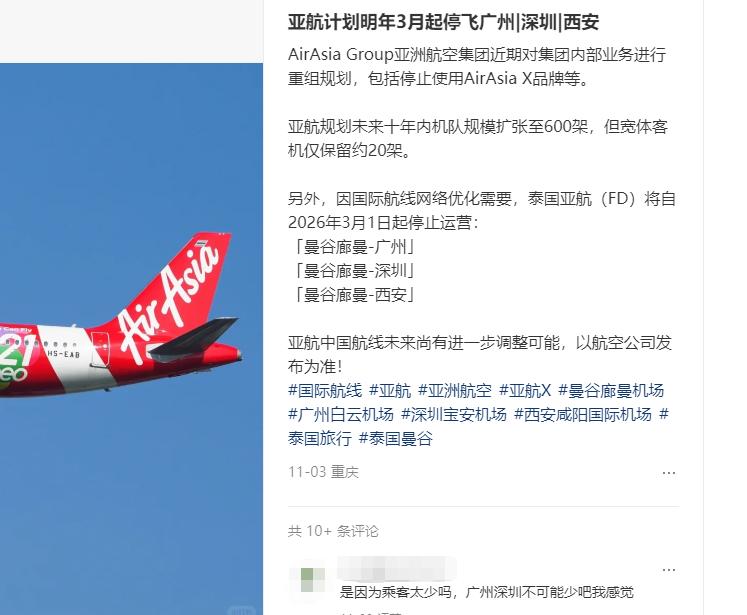
Core Viewpoint - AirAsia's decision to suspend three routes between China and Thailand is a strategic response to market demand changes, competitive pressures, and a broader restructuring of the company [1][5]. Group 1: Strategic Restructuring - AirAsia's route adjustments are part of a larger restructuring effort, which includes the integration of subsidiaries under the AirAsia Group and the retirement of long-haul brand AirAsia X [6]. - The company is shifting its fleet strategy by retiring A330 wide-body aircraft and focusing solely on the Airbus A320 series, particularly the A321XLR, to enhance its low-cost carrier model [9]. - The previous "super app" strategy has been shelved, with a clear focus on core aviation operations [9]. Group 2: Market Demand and Financial Performance - The demand for flights on the China-Thailand routes has declined significantly, with a recovery rate of only 53.8% for flights from China to Thailand during the summer travel season [12]. - Data from OAG indicates that the number of seats available on routes from mainland China to Thailand has dropped from 7.4 million in summer 2019 to 4.1 million in summer 2025, a 44% decrease [13]. - AirAsia's Q2 financial report shows a 9% year-on-year decline in sales and service revenue, totaling 23.045 billion Thai Baht, with an average load factor of 84% [16]. Group 3: Competitive Landscape - The low-cost airline market in Southeast Asia is experiencing intense competition, with two-thirds of international flights operated by low-cost carriers, compared to one-third globally [17]. - Competitors like Thai Airways and Spring Airlines are expanding their services to capture market share, further squeezing AirAsia's operational space [18]. - The airline industry is facing a paradox of increasing passenger volumes but declining profitability, prompting AirAsia to optimize its route network as a strategic response to competitive pressures [19].

春秋航空:首次回购约3.58万股
Mei Ri Jing Ji Xin Wen· 2025-11-20 09:20
Group 1 - Spring Airlines announced a share buyback of approximately 35,800 shares, representing 0.0037% of the total share capital, with a total expenditure of around 2 million RMB [1] - The buyback occurred at a maximum price of 55.99 RMB per share and a minimum price of 55.42 RMB per share [1] - As of the report, Spring Airlines has a market capitalization of 54.7 billion RMB [1] Group 2 - For the year 2024, Spring Airlines' revenue composition is 97.67% from air transportation and 2.33% from other businesses [1]

航空机场板块11月20日跌0.8%,吉祥航空领跌,主力资金净流出1.23亿元
Zheng Xing Xing Ye Ri Bao· 2025-11-20 09:04
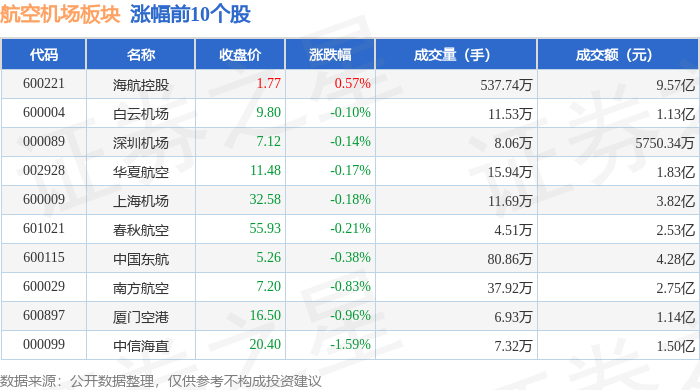
Core Viewpoint - The aviation and airport sector experienced a decline of 0.8% on November 20, with China Southern Airlines leading the losses. The Shanghai Composite Index closed at 3931.05, down 0.4%, while the Shenzhen Component Index closed at 12980.82, down 0.76% [1]. Summary by Category Stock Performance - The following stocks in the aviation and airport sector showed notable performance: - Hainan Airlines (600221) closed at 1.77, up 0.57% with a trading volume of 5.3774 million shares and a transaction value of 9.57 billion yuan [1]. - China Eastern Airlines (600115) closed at 5.26, down 0.38% with a trading volume of 808.6 thousand shares and a transaction value of 4.28 billion yuan [2]. - Xiamen Airport (600897) closed at 16.50, down 0.96% with a trading volume of 69.3 thousand shares and a transaction value of 1.14 billion yuan [2]. Capital Flow - The aviation and airport sector saw a net outflow of 123 million yuan from institutional investors, while retail investors contributed a net inflow of 162 million yuan [2]. - The capital flow for specific stocks included: - Shanghai Airport (600009) had a net inflow of 45.5255 million yuan from institutional investors, but a net outflow of 47.5760 million yuan from retail investors [3]. - Hainan Airlines (600221) experienced a net outflow of 5.8716 million yuan from institutional investors, while retail investors had a net inflow of 22.9749 million yuan [3].






春秋航空(601021) - 春秋航空关于以集中竞价交易方式首次回购公司股份的公告
2025-11-20 09:02
证券代码:601021 证券简称:春秋航空 公告编号:2025-065 春秋航空股份有限公司 关于以集中竞价交易方式首次回购公司股份的公告 本公司董事会及全体董事保证本公告内容不存在任何虚假记载、误导性陈述 或者重大遗漏,并对其内容的真实性、准确性和完整性承担法律责任。 重要内容提示: | 回购方案首次披露日 | 2025/8/29 | | | | | | --- | --- | --- | --- | --- | --- | | 回购方案实施期限 | 2025 年 8 月 8 月 | 27 | 日~2026 | 年 | 26 日 | | 预计回购金额 | 30,000万元~50,000万元 | | | | | | 回购用途 | □减少注册资本 √用于员工持股计划或股权激励 | | | | | | | □用于转换公司可转债 □为维护公司价值及股东权益 | | | | | | 累计已回购股数 | 35,800股 | | | | | | 累计已回购股数占总股本比例 | 0.0037% | | | | | | 累计已回购金额 | 1,999,650.00元 | | | | | | 实际回购价格区间 | 55.42元 ...
春秋航空:首次回购0.0037%公司股份,已回购金额199.97万元
Xin Lang Cai Jing· 2025-11-20 08:47
春秋航空公告,2025年11月20日,公司通过上海证券交易所交易系统以集中竞价交易方式首次回购公司 股份35800股,占公司目前总股本的0.0037%,回购最高价格为人民币55.99元/股,回购最低价格为人民 币55.42元/股,使用资金总额为人民币199.97万元(不含交易佣金、过户费等交易费用)。 ...
A股第八家!萧山本土公司成立15年,要上市了!
Sou Hu Cai Jing· 2025-11-20 08:24
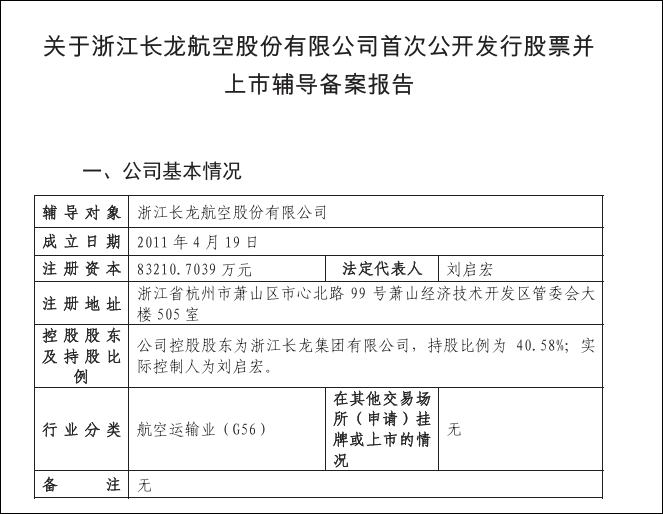
Group 1 - Zhejiang Changlong Airlines Co., Ltd. has made progress in its IPO journey after being included in the "Key Proposed Listed Companies List of Hangzhou City" (July 2025 edition) [1] - The company has completed the counseling filing registration for its initial public offering and plans to list its shares [1] - Established on April 19, 2011, Changlong Airlines is the only local passenger and cargo airline in Zhejiang Province, classified as a medium to large airline [2] Group 2 - The controlling shareholder of Changlong Airlines is Zhejiang Changlong Group Co., Ltd., holding a 40.58% stake, with Liu Qihong as the actual controller [2] - If the IPO is successful, it will mark the eighth airline company listed on the A-share market, which currently has seven listed airlines [3] - The three major state-owned airlines continued to incur losses in the first half of the year, while the four private airlines achieved profitability, with Spring Airlines reporting a net profit of 1.169 billion yuan [3]
甘肃民航启动“干支通、全网联”试点 以规划质量为核激活西北航空枢纽新动能
Zhong Guo Min Hang Wang· 2025-11-20 06:17
Core Viewpoint - The launch of the "trunk and branch connectivity, full network integration" pilot project in Gansu Province represents a strategic initiative to enhance the quality of civil aviation planning and optimize the aviation network layout, aiming to provide replicable experiences for high-quality development of civil aviation networks in Northwest China and nationwide [1][4]. Group 1: Pilot Project Overview - The pilot project was officially approved by the Civil Aviation Administration and marks a breakthrough in cross-airline and cross-industry transfer service models [1]. - The initiative is a key measure under Gansu's 14th Five-Year Plan for civil aviation, focusing on improving network accessibility, transfer convenience, and service quality [1][2]. Group 2: Future Development Directions - Gansu's civil aviation aims to establish a "hub + branch" network centered around Lanzhou Zhongchuan International Airport, extending trunk and branch transfer routes to cover the entire province and connect to the Northwest and nationwide [2]. - The provincial airport group will leverage resource integration advantages to solidify the route network foundation and develop transfer-friendly products to meet market demand [2]. Group 3: Implementation and Safety Measures - The Northwest Regional Administration of Civil Aviation has organized a meeting to refine the implementation path of the pilot project, emphasizing the need for planning to guide operational efficiency and safety [3]. - Key safety measures will be integrated into the entire planning process, focusing on critical nodes such as baggage sorting, transfer security checks, and flight coordination [3]. Group 4: Economic and Social Impact - The pilot project is expected to enhance the convenience and efficiency of travel for the public, while also contributing to Gansu's development as a new inland open highland, thereby boosting the economic and social development of the Northwest region [4].
四天超50万人取消赴日机票,多国争抢中国客源,韩国意外成黑马
21世纪经济报道· 2025-11-19 13:26
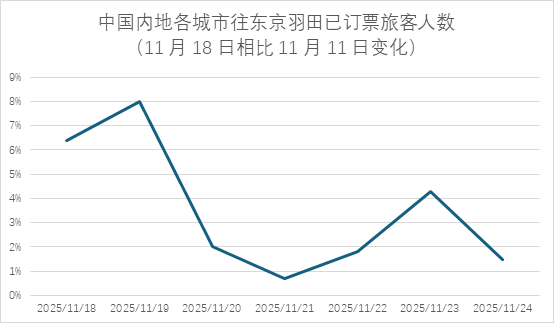
Core Viewpoint - The Japanese tourism market is experiencing a rapid decline due to travel warnings and the implementation of free ticket refund policies by airlines, leading to a significant number of cancellations by travelers [1][3][6]. Group 1: Ticket Cancellations and Market Impact - As of November 19, approximately 900,000 tickets for trips to Japan remain booked but unused, down from 1.55 million on November 15, indicating a reduction of 543,000 tickets in just four days [1][2]. - Major Chinese airlines, including Air China, China Eastern, and China Southern, have introduced free refund policies for flights to Japan, followed by other airlines, which has led to a sharp decline in passenger numbers [3][5]. - The number of travelers originally planned for Japan dropped from 1.55 million to 1.06 million, a decrease of 32%, with the cancellation rate on November 16 being 27 times the number of new bookings, highlighting safety concerns among travelers [6][8]. Group 2: Effects on Travel Agencies - Travel agencies have been forced to cancel all group tours to Japan for November and December, significantly impacting their business, especially in terms of fixed costs related to local services and accommodations [11][12]. - Despite the airlines' refund policies alleviating some financial pressure, travel agencies remain concerned about the potential impact on upcoming holiday travel during New Year and Spring Festival [11][12]. Group 3: Shifts in Tourist Preferences - With the decline in interest in Japan, other destinations such as Southeast Asia and Russia are actively competing for Chinese tourists, with a reported 20% increase in inquiries for Southeast Asian travel products [12][15]. - Following the announcement of a visa-free policy for Chinese tourists by Russia, there has been a significant surge in flight searches to Moscow, with some routes seeing increases of over 300% [14][15]. - Thailand has also launched the "Thailand Safe Travel" initiative to reassure Chinese tourists and is offering exclusive New Year promotions to attract visitors [15].

54.3万人取消赴日机票 俄罗斯泰国争抢中国客源
2 1 Shi Ji Jing Ji Bao Dao· 2025-11-19 12:52
Core Insights - The Japanese tourism market is experiencing a rapid decline due to travel warnings issued by Chinese authorities, leading to a significant number of cancellations and a shift in tourist preferences towards other destinations [1][2][4] Group 1: Ticket Cancellations and Market Impact - As of November 19, approximately 900,000 tickets for trips to Japan remain booked but unused, down from 1.55 million on November 15, indicating a cancellation of 543,000 tickets in just four days [1][2] - Major Chinese airlines, including Air China, China Eastern, and China Southern, have implemented free cancellation policies for flights to Japan, contributing to a 32% drop in planned travelers from 1.55 million to 1.06 million between November 15 and November 17 [2][4] - The cancellation rate reached 13.4% on November 18, the highest in five days, reflecting travelers' safety concerns dominating market trends [4] Group 2: Shift to Alternative Destinations - Other destinations are actively competing for the Chinese tourists who initially planned to visit Japan, with Southeast Asia seeing a 20% increase in inquiries for travel products [1][8] - Thailand has launched the "Thailand Safe Travel" initiative to alleviate safety concerns among Chinese tourists and is offering exclusive New Year discounts [8][11] - Russia is also attracting attention, with President Putin announcing a visa-free policy for Chinese tourists, leading to a surge in flight searches to Moscow [9][11] Group 3: Travel Agency Responses - Travel agencies have canceled all group tours to Japan for November and December, with 80% of travelers opting to cancel their trips following the travel warnings [7][8] - Despite the airlines' flexible cancellation policies, travel agencies face losses from non-recoverable costs related to ground services and hotel bookings [7][8] - Some agencies report that the impact is manageable due to the current off-peak travel season, but there are concerns about the potential effects on the upcoming New Year and Spring Festival travel [7][8]

春秋航空时隔九年发债 科创底色刷新行业民企最低利率
2 1 Shi Ji Jing Ji Bao Dao· 2025-11-19 10:16
Core Viewpoint - Spring Airlines has successfully issued bonds for the first time in nine years, reflecting market recognition and favorable conditions for private enterprises in the current bond market [1][2]. Group 1: Bond Issuance Details - The bond issuance, named "25春秋K1," raised 800 million yuan with a three-year term and received 3.03 times subscription, achieving a coupon rate of 1.98%, the lowest for similar bonds in the transportation sector [1][2]. - The Shanghai Stock Exchange has seen significant growth in the issuance of technology innovation bonds, with over 1 trillion yuan issued since the pilot program began, averaging a growth rate of approximately 75% from 2022 to 2024 [1]. Group 2: Company Performance and Financial Health - Spring Airlines is projected to achieve 20 billion yuan in revenue and 2.273 billion yuan in net profit for 2024, leading among major domestic airlines [2]. - The company has optimized its debt structure through a private placement in 2022, allowing for increased capital expenditure while maintaining a manageable debt level [2]. Group 3: Recognition and Future Plans - Spring Airlines received an AAA credit rating in December, becoming the fifth airline in China to achieve this status and the only private airline to do so [3]. - The total bond issuance approved by the CSRC is 2 billion yuan, with plans for future issuances as market conditions allow [3]. Group 4: Technological Innovation and Market Strategy - The bond issuance is linked to the company's commitment to technological innovation, including the deployment of AI for operational efficiency and carbon emission reduction [4]. - Spring Airlines is focusing on increasing capacity on high-density routes and nurturing low-density routes through market operations and subsidies, while also recovering international routes [6]. Group 5: Industry Outlook - The aviation industry is expected to recover as the macroeconomic environment improves, with airlines having prepared for this recovery by investing in assets during previous downturns [6]. - Spring Airlines has demonstrated resilience and is positioned to benefit from the overall recovery in the aviation sector, with signs of profit improvement emerging [6].