中国建筑

Search documents
房屋建设板块11月13日跌0.13%,重庆建工领跌,主力资金净流出1.13亿元
Zheng Xing Xing Ye Ri Bao· 2025-11-13 08:45
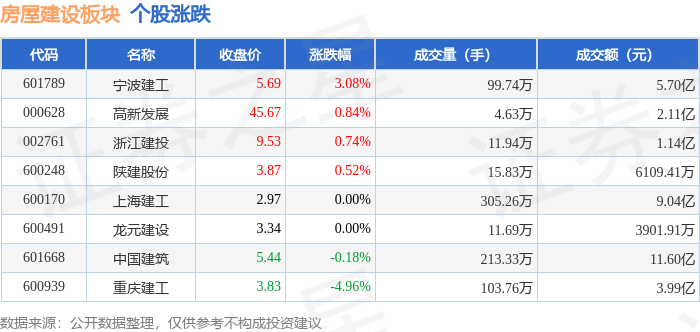
证券之星消息,11月13日房屋建设板块较上一交易日下跌0.13%,重庆建工领跌。当日上证指数报收于 4029.5,上涨0.73%。深证成指报收于13476.52,上涨1.78%。房屋建设板块个股涨跌见下表: 从资金流向上来看,当日房屋建设板块主力资金净流出1.13亿元,游资资金净流入7023.14万元,散户资 金净流入4274.04万元。房屋建设板块个股资金流向见下表: | 代码 | 名称 | 主力净流入 (元) | 主力净占比 游资净流入 (元) | | 游资净占比 散户净流入 (元) | | 散户净占比 | | --- | --- | --- | --- | --- | --- | --- | --- | | 600170 上海建工 | | 1166.89万 | 1.29% | -1530.68万 | -1.69% | 363.79万 | 0.40% | | 002761 浙江建投 | | 144.48万 | 1.27% | -479.63万 | -4.21% | 335.15万 | 2.94% | | 600248 陕建股份 | | -386.33万 | -6.32% | 300.34万 | 4.92% ...


建筑建材行业2026年度策略报告:行业底部区间,反内卷加速格局重塑-20251113
Western Securities· 2025-11-13 08:30
Core Conclusions - The construction sector has seen a cumulative increase of 10.83% from the beginning of 2025 to November 11, 2025, underperforming the broader market, while the building materials sector has increased by 22.32%, outperforming the market [7][18] - The overall construction market is experiencing a decline in scale, with significant business homogenization, necessitating a transformation within the industry, particularly among large state-owned construction enterprises [7][46] - The cement industry is under pressure, with a projected 6% decline in demand for the year, while supply-side policies aimed at capacity reduction and carbon emissions are expected to be key drivers for future adjustments [8][9] Industry Review - The construction and building materials sectors have shown varied performance, with the construction sector ranking 20th out of 30 industries in terms of cumulative growth, while the building materials sector ranks 10th [18][20] - The cement sector has faced declining sales volumes for most companies in 2025, with a significant increase in inventory levels due to poor peak staggering [8][9] - International engineering projects are seeing sustained growth, particularly in regions involved in the Belt and Road Initiative, with many state-owned construction companies reporting an increase in overseas orders [8][9] Investment Recommendations - The report suggests focusing on large construction blue-chip stocks such as China Railway and China Communications Construction, while also considering companies involved in international engineering and those with cyclical elasticity in domestic demand [9] - The report emphasizes the importance of high dividend yields from undervalued state-owned construction companies as a potential investment opportunity [8][9] Financial Performance Summary - The revenue decline in the construction sector has narrowed, while profit pressures continue, with significant improvements in cash flow noted [9][57] - For the cement industry, revenue declines have expanded, and profit growth has slowed, indicating ongoing challenges [9][57] - The eight major state-owned construction enterprises reported a total revenue of 4.81 trillion yuan for the first three quarters of 2025, reflecting a year-on-year decline of 3.99% [61]
每日报告精选-20251113
GUOTAI HAITONG SECURITIES· 2025-11-13 07:33
Group 1: Macro Insights - The monetary policy continues to emphasize "implementing a moderately loose monetary policy" and "maintaining reasonable growth in financial aggregates" [6] - The report highlights a shift towards combining "counter-cyclical and cross-cyclical adjustments" in monetary policy, indicating a more forward-looking approach [6][7] - There is a reduced urgency for short-term monetary easing, focusing instead on implementing previous policies and preparing for cross-cyclical adjustments [7] Group 2: Technology and Manufacturing - The technology manufacturing sector remains buoyant, driven by global AI infrastructure investments, leading to increased demand in the semiconductor and energy sectors [9][12] - The real estate sector is experiencing a downturn, with a significant drop in property sales, particularly in first, second, and third-tier cities [10] - The lithium battery industry is seeing a substantial increase in demand, with prices for lithium hexafluorophosphate rising significantly [12] Group 3: Energy Storage - The introduction of a capacity pricing mechanism is expected to enhance the economic viability of energy storage across more provinces, driving significant growth in the sector [15][16] - Inner Mongolia's compensation for energy storage discharge is set at 0.28 yuan/kWh for 2026, which is expected to stimulate demand [17] - The bidding volume for energy storage in October 2025 showed a year-on-year increase of 24% and 29% for new installations, indicating strong market demand [18] Group 4: Cement Industry - Zambia and Malawi are experiencing a significant cement supply gap, with Malawi's demand far exceeding its production capacity [26][27] - Huaxin Cement is the leading cement producer in Zambia, holding a substantial market share, and is expected to alleviate some supply shortages in Malawi [27] - Cement prices in Malawi are high, reaching $200 per ton, while Zambia's prices remain stable, contributing to strong profitability in the region [28] Group 5: Oil Industry - OPEC's decision to halt production increases is expected to support oil prices, with a projected increase in production of 137,000 barrels per day in December [31] - The oil market is anticipated to remain balanced in 2026, with demand growth primarily coming from OECD countries [32] - Investment recommendations include companies with strong cash flows and dividends, such as China National Offshore Oil Corporation and PetroChina [32] Group 6: Tourism Industry - The hotel industry is expected to benefit from a narrowing decline in operating data and positive changes in company structures, leading to improved valuations [34] - The RevPAR (Revenue per Available Room) for leading hotel groups has shown a significant recovery, indicating a positive trend in the hospitality sector [35] - The supply structure in the hotel industry is diversifying, with smaller properties growing faster than larger ones, reflecting a shift in market dynamics [35] Group 7: Food and Beverage - The recent CPI data indicates a warming market sentiment, with expectations for white liquor to benefit from a style switch as the year ends [37] - The white liquor industry is experiencing a downturn, with Q3 revenues down 18% year-on-year, but a recovery is anticipated in the coming quarters [39] - The valuation of white liquor stocks is currently low, with a high dividend yield, making them attractive for investors [39] Group 8: Medical Devices - The medical device sector is poised for recovery, driven by government policies promoting equipment updates, with significant growth in tendering for new devices [46][48] - Major medical device companies are expected to benefit from the increasing demand for imaging and innovative treatment equipment [48] - The domestic market for medical devices is showing signs of improvement, with a notable increase in revenue for leading companies [48]
这个一线城市放大招!明年起出让宅地全部实施装配式建筑
3 6 Ke· 2025-11-13 06:54
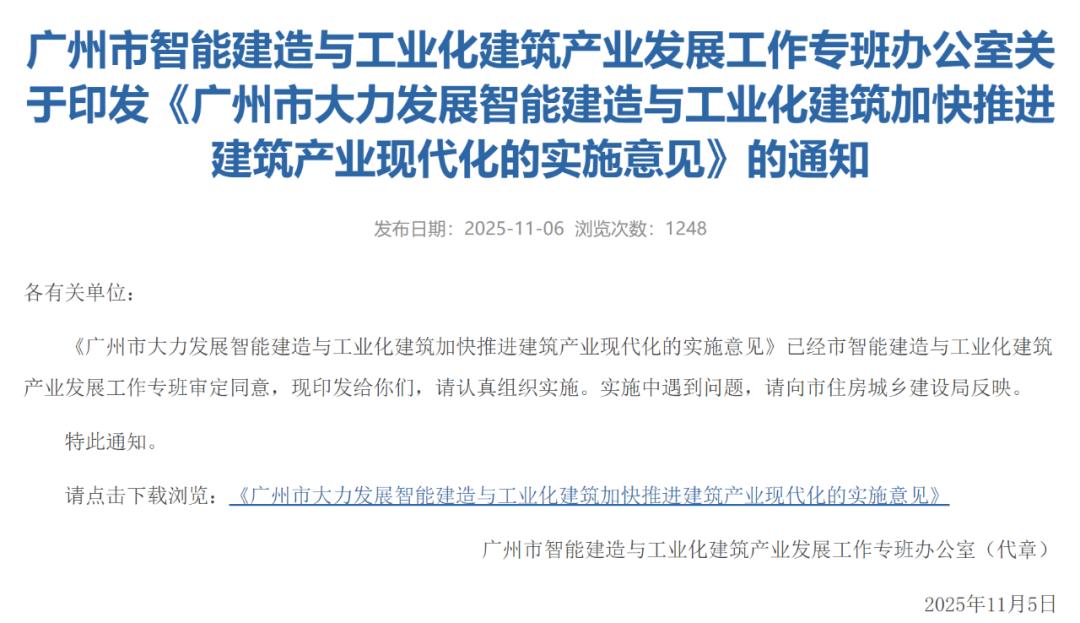
Core Viewpoint - Guangzhou will implement 100% prefabricated construction for residential land starting in 2026, aiming to modernize the construction industry and promote sustainable building practices [1][4][6]. Group 1: Implementation Details - The new policy mandates that all residential land sold in Guangzhou from 2026 will utilize prefabricated construction methods, with commercial and industrial land also encouraged to adopt these practices where feasible [6][7]. - The city aims to achieve a total output value of over 500 billion yuan in the smart construction and industrialized building sector by 2030 [4][6]. Group 2: Industry Trends and Benefits - Prefabricated construction is gaining traction in the real estate sector due to its efficiency and environmental benefits, with major developers like Vanke and Country Garden actively exploring this method [3][8]. - The approach aligns with consumer demand for high-quality housing that meets safety and sustainability standards, as highlighted by industry experts [3][9]. Group 3: Challenges and Recommendations - The prefabricated construction industry faces challenges such as high costs compared to traditional methods and a lack of skilled professionals with industrialized thinking [9]. - Experts suggest that unified national standards, increased policy support, and enhanced training for talent are necessary to improve the industry's profitability and efficiency [9].
国泰海通晨报-20251113
GUOTAI HAITONG SECURITIES· 2025-11-13 06:42
Macro Research - The monetary policy framework continues to emphasize "appropriate monetary policy" and "maintaining reasonable growth in financial aggregates," with a shift towards combining counter-cyclical and cross-cyclical adjustments, reflecting the requirements of the 14th Five-Year Plan [1][2][3] - The central bank's focus is transitioning from merely short-term counter-cyclical support to a more forward-looking layout that optimizes efficiency and structural adjustments to better serve long-term economic goals [3][4] Strategy Research - The technology manufacturing sector remains highly prosperous, with rising prices in memory chips and an improved outlook for the lithium battery supply chain due to tight supply and demand [4][5] - Real estate demand is weak, with a significant decline in passenger vehicle sales, while coal demand has improved, leading to a substantial price increase [4][5] Energy Equipment and New Energy Research - The future expansion of the capacity pricing mechanism for energy storage is expected to enhance the economic viability of storage solutions across more provinces, significantly boosting demand in 2026 [8][9] - The introduction of a compensation standard for energy storage in Inner Mongolia at 0.28 yuan/kWh is anticipated to stimulate storage demand [10][25] Agriculture Research - The pet consumption sector showed strong performance during the Double 11 shopping festival, with domestic brands rising in rankings and companies like Zhongchong Co. performing exceptionally well [11][12][14] - The pet industry is experiencing a shift towards higher quality and more emotional consumption behaviors, indicating a trend of pet products becoming more integrated into family life [14][12]





央企ETF(159959)开盘涨0.44%,重仓股澜起科技跌0.55%,中芯国际跌0.53%
Xin Lang Cai Jing· 2025-11-13 03:19
Core Viewpoint - The Central Enterprise ETF (159959) opened with a slight increase of 0.44%, priced at 1.602 yuan, reflecting the performance of its underlying assets and market conditions [1] Group 1: ETF Performance - The Central Enterprise ETF (159959) has a benchmark performance index of the CSI Central Enterprise Structural Adjustment Index [1] - Since its establishment on October 22, 2018, the fund has achieved a return of 59.39% [1] - The fund's return over the past month has been -0.19% [1] Group 2: Major Holdings - Key stocks in the ETF include: - 澜起科技 (Lianqi Technology) down 0.55% - 中芯国际 (SMIC) down 0.53% - 海康威视 (Hikvision) down 0.10% - 国电南瑞 (Guodian NARI) down 0.29% - 招商银行 (China Merchants Bank) up 0.09% - 宝钢股份 (Baosteel) up 0.26% - 中国神华 (China Shenhua) up 0.21% - 长安汽车 (Changan Automobile) up 0.16% - 中国电信 (China Telecom) unchanged - 中国建筑 (China State Construction) unchanged [1]





研判2025!中国抗震支架行业发展背景、产业链、市场规模、竞争格局和未来趋势分析:建筑安全需求拉动,抗震支架行业快速增长[图]
Chan Ye Xin Xi Wang· 2025-11-13 01:17
Core Insights - The seismic support bracket market in China is experiencing rapid growth due to increased national emphasis on building safety, with the market size projected to reach 8.942 billion yuan in 2024 [1][7]. Industry Overview - Seismic support brackets are components designed to enhance the seismic performance of buildings, primarily aimed at reducing damage from earthquakes [2]. - These brackets are part of building seismic facilities and consist of anchoring bodies, reinforcements, connectors, and supports, which work together to form a complete support system [2]. Industry Development Background - China is one of the countries most affected by seismic activity, accounting for 33% of global continental earthquakes, with over 95% of casualties resulting from building collapses during such events [4]. - The introduction of new seismic design standards post-2008 Wenchuan earthquake has led to a significant increase in the adoption of seismic support brackets in construction projects [6]. Industry Chain - The seismic support bracket industry consists of upstream raw materials (steel, aluminum, plastic, rubber), midstream manufacturing, and downstream applications across various building types [5]. - Steel is the primary material used due to its high strength and ability to absorb seismic energy, with China's steel production reaching 1.104 billion tons in the first nine months of 2025, a 5.4% increase year-on-year [5][6]. Current Industry Status - The seismic support bracket market has expanded from public buildings to commercial complexes, data centers, industrial plants, and residential buildings, particularly in new infrastructure projects like 5G base stations [1][7]. Competitive Landscape - The industry is structured into three tiers: international giants (e.g., Hilti, Fischer, Walraven) dominate the high-end market, domestic leaders (e.g., Jiupeng Hengye, Shengnian Technology) are the core driving force, and small enterprises compete primarily on price [7]. Key Companies - Jiupeng Hengye Group Co., Ltd. specializes in the research, production, and sales of seismic support brackets and has established a comprehensive operational model [8]. - Shengnian Technology Co., Ltd. focuses on earthquake protection technology and offers integrated solutions for various applications, including seismic support brackets [9]. Industry Development Trends - The seismic support bracket industry is expected to see technological innovations and upgrades, with new materials and smart technologies enhancing performance and reducing costs [11]. - The industry is also moving towards more environmentally friendly and sustainable practices, presenting new growth opportunities [11].

中国建筑国际(03311.HK):11月12日南向资金增持331.2万股
Sou Hu Cai Jing· 2025-11-12 19:36
Core Viewpoint - Southbound funds have significantly increased their holdings in China State Construction International (03311.HK), indicating growing investor confidence in the company [1] Group 1: Shareholding Changes - On November 12, 2025, southbound funds increased their holdings by 3.312 million shares, representing a 0.70% change [2] - Over the past five trading days, there have been five days of net increases, totaling 7.69 million shares [1] - In the last twenty trading days, there were 17 days of net increases, amounting to 16.706 million shares [1] Group 2: Current Holdings - As of now, southbound funds hold a total of 474 million shares of China State Construction International, which accounts for 8.97% of the company's total issued ordinary shares [1]


“搭积木”式盖楼再上热搜!广州放大招:2026年起出让宅地100%实施装配式建筑
Mei Ri Jing Ji Xin Wen· 2025-11-12 13:46
Core Viewpoint - Guangzhou's implementation of a policy mandating 100% prefabricated construction for residential land starting in 2026 signifies a major shift towards modernizing the construction industry, enhancing efficiency, and promoting sustainability [1][4][5]. Group 1: Policy Implementation - Starting in 2026, all residential land sold in Guangzhou will require the use of prefabricated construction methods [5][8]. - The policy also encourages the application of prefabricated construction in commercial and industrial land where technically feasible, with public areas in new commercial land to utilize prefabricated renovations [8]. - By 2030, the total output value of the smart construction and industrialized building industry in Guangzhou is expected to exceed 500 billion yuan [5]. Group 2: Industry Impact - The shift towards prefabricated construction aligns with the demand for high-quality housing that meets safety and environmental standards, as noted by industry experts [4][9]. - Major real estate companies such as Vanke, Country Garden, Greenland Group, and Poly Developments are already exploring and implementing prefabricated construction methods [4]. - The prefabricated construction sector is seen as a rapidly growing industry in China, with significant increases in production capacity and market interest [12]. Group 3: Challenges and Recommendations - Despite the advantages, the prefabricated construction industry faces challenges such as higher costs compared to traditional methods and a lack of skilled professionals with industrialized thinking [12]. - Industry experts recommend establishing unified national standards for prefabricated construction, increasing policy support, and enhancing talent training to improve the sector's profitability [12].
这个一线城市放大招!明年起,出让宅地全部实施装配式建筑
Mei Ri Jing Ji Xin Wen· 2025-11-12 13:38
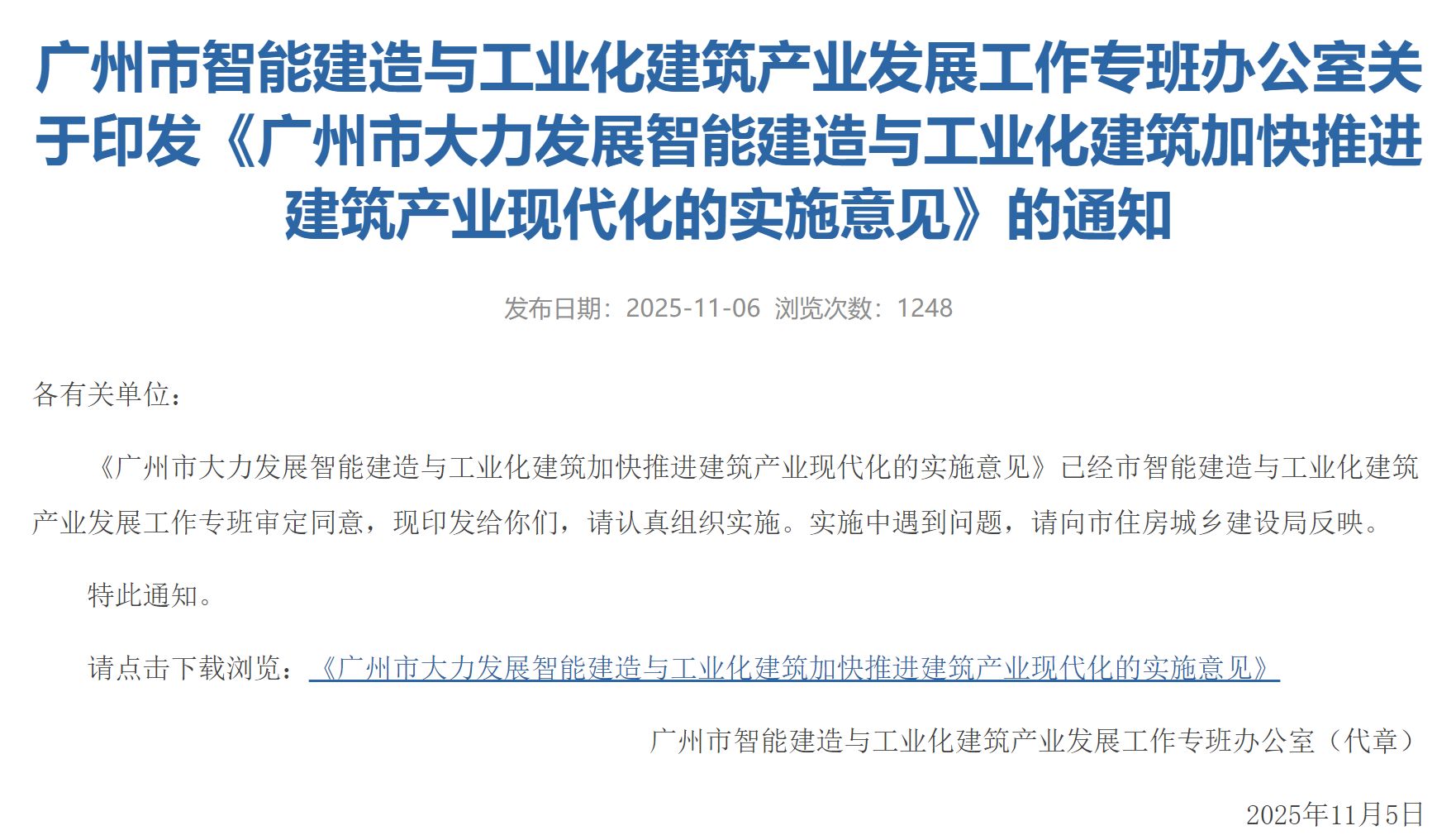
Core Viewpoint - Guangzhou is set to implement 100% prefabricated construction for residential land starting in 2026, aiming to modernize the construction industry and promote smart building practices [6][7]. Group 1: Policy Implementation - The implementation opinion from Guangzhou's construction bureau mandates that all residential land sold from 2026 must utilize prefabricated construction methods [7]. - Commercial and industrial land will also adopt prefabricated construction where technically feasible, with public areas in new commercial land required to use prefabricated decoration [7]. - By 2030, the total output value of the smart construction and industrialized building industry in Guangzhou is expected to exceed 500 billion yuan [6]. Group 2: Industry Trends - Prefabricated construction is gaining traction in the real estate sector due to its efficiency and environmental benefits, with major companies like Vanke, Country Garden, and Poly Developments exploring this method [4][8]. - The demand for high-quality housing aligns with the advantages of prefabricated buildings, which meet safety and environmental standards [4][10]. Group 3: Market Growth and Challenges - The prefabricated construction industry in China is rapidly growing, with significant increases in production capacity and market activity, as evidenced by a 82.1% year-on-year growth in Hunan province's prefabricated construction output [9]. - Despite the growth, the industry faces challenges such as high costs compared to traditional methods and a lack of skilled professionals, leading to overall low profitability [10].