逆周期与跨周期调节

Search documents
央行报告重申“适度宽松” 降准降息仍有空间
Xin Lang Cai Jing· 2026-02-10 21:07
Group 1 - The core viewpoint of the report emphasizes that the People's Bank of China (PBOC) will continue to implement a moderately accommodative monetary policy to support economic stability and growth amid complex internal and external environments [1][2] - The report indicates that by the end of 2025, the total social financing stock and the broad money supply (M2) grew by 8.3% and 8.5% year-on-year, respectively, which is consistently higher than the nominal economic growth rate, providing strong support for the real economy [1] - The report highlights that the interest rates for newly issued corporate loans and personal housing loans remained low at around 3.1%, contributing to a steady decline in overall financing costs [1] Group 2 - Credit resources are continuously directed towards key sectors, with loans for technology, green initiatives, inclusive finance, elderly care, and digital economy industries maintaining double-digit growth; notably, loans for the elderly care industry surged by 50.5% year-on-year [2] - The PBOC has enhanced its structural monetary policy tools, increasing various relending quotas and creating new tools such as relending for service consumption and elderly care, leading to a more comprehensive financial system [2] - The report reaffirms the commitment to a moderately accommodative monetary policy and emphasizes the need for flexible and efficient use of various policy tools, including reserve requirement ratio (RRR) cuts and interest rate reductions [2]
长城基金汪立:2026新开局,市场有望迈出关键一步
Xin Lang Cai Jing· 2026-01-06 08:47
Group 1: Market Overview - The A-share market exhibited a volatile adjustment pattern last week, with significant divergence among major indices and notable structural characteristics [1][7] - Technology applications showed strength, while the oil and petrochemical sectors experienced two consecutive weeks of gains; the military industry continued to gain traction, but the new energy sector saw a pullback [1][7] Group 2: Macro Analysis - The manufacturing PMI in December showed a seasonal rebound, reaching 50.1%, an increase of 0.9 percentage points from November, marking the first expansion since April [2][8] - Among 21 surveyed industries, 16 reported a PMI increase compared to November, driven by improved trade conditions, domestic policy adjustments, and energy supply stability [2][8] - The government has proactively issued new local government debt limits for 2026 and initiated significant investment plans totaling approximately 295 billion yuan to accelerate fund allocation [2][8] Group 3: Overseas Economic Data - Recent U.S. economic data exceeded expectations, with pending home sales in November rising by 3.3%, significantly above the anticipated 0.9% [3][9] - Initial jobless claims unexpectedly dropped to 199,000, lower than the forecast of 218,000, indicating a robust labor market [3][9] - The December FOMC meeting minutes indicated a hawkish stance, with most participants supporting potential rate cuts if inflation trends downward [3][9] Group 4: Investment Strategy - The Chinese stock market is expected to stabilize and surpass critical thresholds, supported by anticipated U.S. interest rate cuts and increased liquidity from new capital inflows [4][10] - The focus is on technology growth, non-bank financials, and cyclical assets, with a particular emphasis on AI and emerging market industrialization trends [4][10] - Investment opportunities include sectors such as internet, electronics, media, and manufacturing with global competitive advantages, as well as non-bank financials like insurance and brokerage firms [5][11]
国泰海通 · 晨报260105|元旦“微度假”热度高
国泰海通证券研究· 2026-01-04 13:14
Macro Insights - The New Year's holiday saw a significant increase in travel, with inter-regional mobility growing by 19.5% year-on-year, reaching a recent high. Short-distance "micro-vacations" have become mainstream, with strong performance in service consumption, particularly in entertainment. However, product consumption has declined due to the waning effects of year-end sales [4]. - Real estate sales are showing marginal declines, although the easing of purchase restrictions in first-tier cities has released some demand. Infrastructure and construction are still constrained by insufficient new projects [4]. - The port operations remain stable, but there is a divergence in domestic import freight rates and the Baltic Dry Index (BDI). Most industries are experiencing a decline in operating rates, with petrochemicals and automotive sectors showing weak performance due to rising costs and falling demand, while emerging sectors like lithium batteries and photovoltaics are performing well [4]. - The Producer Price Index (PPI) is generally rising, while the Consumer Price Index (CPI) shows mixed results. The RMB exchange rate has surpassed 7.0, with funding rates and government bond yields trending upward [4]. Strategy Insights - The A-share market is expected to see a "spring opening red" as it closed at 3968.84 points in 2025, marking an 18.41% annual increase. The market sentiment has shifted towards optimism, with expectations of a potential interest rate cut in the U.S. in 2026 [8]. - The influx of incremental capital, particularly through A500 ETF and insurance funds, is expected to solidify liquidity. The government has emphasized the need to stabilize and improve real estate market expectations, indicating a proactive approach to boosting growth [8][9]. - The central bank's fourth-quarter meeting highlighted the importance of price signals for promoting stable economic growth and reasonable price recovery, with a gradual emergence of price increases in certain sectors due to improved demand and supply constraints [10]. Industry Comparisons - The technology sector, particularly in AI and emerging industrialization trends, is expected to see strong growth. The domestic chip technology breakthroughs and storage price increases are anticipated to continue, with a focus on companies with global competitive advantages [11]. - Non-bank financial institutions are likely to benefit from increased demand for wealth management and the migration of household deposits, with recommendations for insurance and brokerage firms [11]. - The cyclical sectors are showing signs of improvement, with low valuations and positioning, benefiting from policies aimed at expanding domestic demand and stabilizing the real estate market. Recommendations include tourism services, hotels, and consumer goods [11]. - Specific themes to watch include AI applications, robotics, commercial aerospace, and domestic consumption, with a focus on new consumption patterns and service sectors [11].


兴业证券王涵 | 加大逆周期与跨周期调节力度,确保“十五五”良好开局——学习2025年中央经济工作会议精神的五点体会
王涵论宏观· 2025-12-12 06:33
Group 1 - The article emphasizes the positive trajectory of China's capital market and the increasing market sentiment, particularly in light of the Central Economic Work Conference held on December 10-11, which outlines the direction for China's macroeconomic development towards 2026 [1] - The conference highlighted the "Five Musts" for economic work, which include fully tapping economic potential, balancing policy support with reform innovation, ensuring effective regulation, combining investments in goods and people, and strengthening internal capabilities to face external challenges [1] - The meeting acknowledged the challenges faced by the economy but stressed the importance of confidence and leveraging advantages to maintain stable growth, indicating a readiness for economic work in 2026 [2] Group 2 - The conference established a general tone of "seeking progress while maintaining stability" with key policy goals focused on stabilizing employment, enterprises, markets, and expectations, reflecting a multidimensional and systematic approach to policy [3] - It emphasized the need to expand domestic demand and optimize supply to address the supply-demand imbalance, highlighting both demand-side management and supply-side reforms [3] - The monetary policy will focus on promoting stable economic growth while ensuring reasonable price recovery, indicating a supportive monetary environment for economic recovery [3] Group 3 - Eight key tasks for 2026 were outlined, emphasizing the integration of counter-cyclical and cross-cyclical policies across various dimensions such as domestic demand, innovation, reform, and social welfare [4] - Specific measures include implementing actions to boost consumption, increasing residents' income, and promoting a unified national market to enhance competition and support the private economy [4] - The policies aim to address short-term economic growth challenges while also opening up long-term growth potential [4] Group 4 - The conference's decisions are expected to enhance the stability and positive outlook of the capital market by reducing concerns over short-term economic growth through proactive macro policies [5] - The emphasis on cross-cyclical policies is seen as a way to create a favorable environment for long-term value investment in the capital market [5] - The focus on strengthening internal capabilities and better coordinating domestic economic work with international trade challenges is anticipated to bolster the economy's resilience against external shocks, providing a solid foundation for the capital market [5]

中央重磅会议!透露三大信号:2026年“房价拐点”来了
Sou Hu Cai Jing· 2025-12-10 13:16
Core Viewpoint - The central economic work conference outlines a policy blueprint for 2026, indicating that the real estate market is transitioning from a period of significant fluctuations to a more stable phase, with 2026 expected to be a critical turning point for housing prices in China [1] Group 1: Monetary and Fiscal Policy Support - The conference emphasizes the continuation of "more proactive fiscal policies and moderately loose monetary policies" in 2026, which will provide essential financial support for the real estate market [2] - Large-scale issuance of special bonds and government bonds will drive housing demand, particularly in urban renewal and village renovation projects [2] - Current first-home loan interest rates have reached a nearly 20-year low, easing the financial burden on homebuyers and creating a more favorable financing environment for real estate companies [2] Group 2: Policy Adjustment Strategies - The focus on "increasing counter-cyclical and cross-cyclical adjustment" indicates a shift in real estate regulation from short-term stimulus to a dual approach of stabilizing the market in the short term while promoting long-term transformation [4] - Local governments are gradually removing unreasonable restrictions in housing consumption, and cities like Guangzhou are initiating regular collection of commercial housing to improve supply-demand relationships [4] - The gradual policy adjustments aim to guide housing prices to stabilize and avoid significant market fluctuations, laying the groundwork for the upcoming turning point [4] Group 3: Domestic Demand and Urban Renewal - The conference prioritizes "building a strong domestic market and expanding consumption," linking the development of the real estate market closely with domestic demand strategies [6] - Urban renewal and village renovation are expected to release housing consumption potential, with 35% of buildings over 30 years old, representing a significant market opportunity [6] - The trend towards upgrading housing demand reflects a growing need for high-quality and functional housing, with targeted subsidies expected to further activate this potential [6] Group 4: Market Dynamics and Price Trends - The turning point in housing prices in 2026 is characterized as a transition from continuous decline to a "L-shaped bottoming and low-level consolidation," with regional differentiation becoming the norm [7] - Core areas in first-tier cities are projected to see moderate price increases of 2%-3%, while strong second-tier cities may experience structural recovery [7] - Third and fourth-tier cities are likely to maintain low-level fluctuations due to population outflows and high inventory levels, with some weaker cities continuing to face challenges [7]

21社论丨实施更加积极有为的宏观政策,着力扩大内需优化供给
21世纪经济报道· 2025-12-10 00:38
Group 1 - The core viewpoint emphasizes the need for a more proactive macroeconomic policy to enhance domestic demand and optimize supply, aiming for qualitative improvement and reasonable quantitative growth in the economy [1][5] - The strategy includes promoting consumption and investment as dual engines of domestic demand, fostering new consumption trends to drive technological innovation and industrial upgrades [1][2] - The meeting highlights the importance of expanding effective investment, particularly in infrastructure projects during the "14th Five-Year Plan" period, to support economic growth [2][3] Group 2 - The focus on innovation-driven growth aims to cultivate new momentum in strategic emerging industries such as new energy, aerospace, and quantum technology, which are expected to create large-scale markets [3][4] - The meeting calls for a combination of fiscal and monetary policies to support economic stability, with an emphasis on investing in both physical and human capital [4][5] - The proposed fiscal measures include issuing special government bonds and increasing public spending to support key sectors, while monetary policy aims to maintain liquidity and lower financing costs for businesses [5][6]

四大证券报精华摘要:12月9日
Xin Hua Cai Jing· 2025-12-09 02:36
Group 1 - China's proactive fiscal policy will continue to support consumption and improve public services, focusing on targeted measures to stimulate consumer spending [1] - The A-share market has shown signs of recovery with significant increases in major indices and a notable rise in trading volume, indicating a potential cross-year market rally [3] - The release of the new national medical insurance and commercial health insurance drug directories is expected to benefit several innovative pharmaceutical companies [4] Group 2 - China's import and export growth rate rebounded to 4.1% in November, marking ten consecutive months of year-on-year growth, demonstrating resilience in foreign trade [5] - The sodium-ion battery industry is gaining momentum as companies accelerate their development due to the rising cost of lithium carbonate, with a focus on cost-sensitive applications [7] - The wind power sector is shifting from large-scale turbine development to a "main unit + core components" model, emphasizing the need for technological integration and reliability [8] Group 3 - The implementation of consumer loan interest subsidies is expanding in regions like Sichuan, Guizhou, and Chongqing, with local banks joining the subsidy initiative [11] - The public fund issuance market remains active, with 38 new funds expected to launch in the upcoming week, reflecting sustained interest in investment products [12]
长城基金汪立:新兴科技有望重回主线,适度关注低估值消费与券商
Xin Lang Cai Jing· 2025-12-03 02:16
Core Viewpoint - The market is entering a phase of emotional recovery, with expectations for a rebound in financing buy-in amounts and transaction ratios as risk factors begin to stabilize [1][4]. Group 1: Market Trends - Since the market correction in October, both financing buy-in amounts and transaction ratios have significantly declined, but there has been a recent uptick in two-way financing activity as market risk appetite stabilizes [1][4]. - The overall market is expected to enter a phase of emotional recovery, with financing buy-in amounts and transaction ratios likely to gradually rebound [1][4]. Group 2: Investment Strategy - It is considered an appropriate time to position for the spring market, with emerging technology expected to regain prominence, alongside a focus on undervalued consumer stocks and brokerage firms [2][5]. - The technology growth sector is anticipated to benefit from improved global competitiveness, opening new growth opportunities for Chinese companies, particularly in sub-sectors like internet, semiconductors, media, power equipment, and innovative pharmaceuticals [2][5]. - The consumer sector is showing signs of bottoming out, with valuations and holdings at historical low levels, suggesting potential opportunities in consumer goods, hotels, airlines, and retail [2][5]. - The non-ferrous metals sector may see significant boosts from easing expectations, offering a favorable valuation compared to other popular sectors, thus presenting attractive investment opportunities [2][5].
长城基金汪立:前瞻布局春季行情
Xin Lang Cai Jing· 2025-12-02 06:09
Group 1: Market Overview - In November, the A-share market exhibited a volatile pattern, with the Shanghai Composite Index declining by 1.67%, while the ChiNext Index and the STAR Market Index fell by 4.23% and 6.24% respectively [1][7] - There was a significant shift in market structure as funds sought to rebalance their portfolios, with banking, petrochemical, textile, and light industry sectors showing the highest gains, while electronics, computers, and automotive sectors experienced notable pullbacks [1][7] Group 2: Macro Analysis - In October, the profits of industrial enterprises above designated size weakened, with a cumulative year-on-year growth rate of 1.9% from January to October, down from 2.4% in the previous period, and a significant drop to -5.5% in October compared to 21.6% in September [2][8] - The increase in raw material prices under the "anti-involution" policy, combined with weak demand, has narrowed corporate profit margins, although sectors like non-ferrous metals, electronic equipment, food, beverages, and automotive still maintained positive year-on-year growth [2][8] - The expectation of a Federal Reserve interest rate cut has risen, with indications from Fed officials suggesting a need for significant rate reductions to support economic growth, despite a recent increase in the unemployment rate to 4.4% [2][8] Group 3: Investment Strategy - Following the market correction since October, there has been a notable decline in margin trading activity, but recent stabilization in market risk appetite has led to a rebound in margin trading volumes [4][10] - The anticipated recovery in global liquidity due to the Fed's rate cut expectations, alongside the need for further policy measures to stimulate domestic growth, suggests a potential rebalancing of industry allocations [4][10] - Current market conditions may present an opportune moment to position for a spring rally, with a focus on emerging technologies, undervalued consumer stocks, and brokerage firms [5][11] - Specific sectors to watch include technology growth (internet, semiconductors, media, power equipment, innovative pharmaceuticals), consumer goods (mass products, hotels, airlines, retail), and non-ferrous metals, which are expected to benefit from easing monetary policies [5][11]
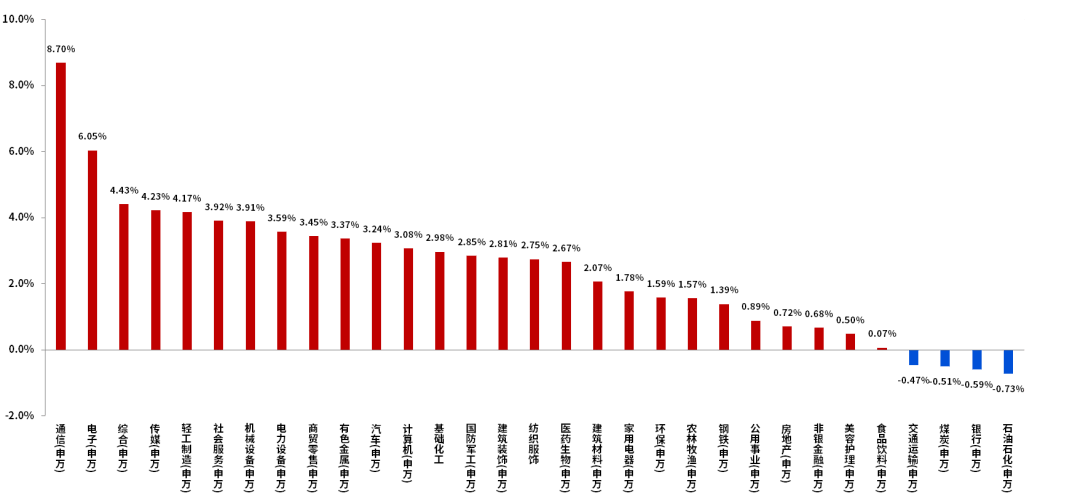
长城投研速递:新兴科技有望重回主线
Sou Hu Cai Jing· 2025-12-01 07:55
Domestic Macro - The cumulative year-on-year growth rate of profits for industrial enterprises above designated size from January to October is 1.9%, down 0.6 percentage points from 2.4% in January to September. In October, the year-on-year growth rate turned negative at -5.5%, compared to 21.6% in September. This decline is attributed to a high base from the previous year and rising raw material prices under the "anti-involution" trend, coupled with weak demand affecting profit margins [4][5][6] - Industries such as non-ferrous metals, electronic equipment, food, beverages, and automobiles still maintain positive year-on-year growth, while other sectors show negative profit growth. Profit recovery will depend on demand improvement and policy support [4][5] Foreign Macro - The expectation for a Federal Reserve interest rate cut in December has risen, with an 86.9% probability of a 25 basis point cut. Even if no cut occurs, its impact on the market is expected to be limited. The U.S. unemployment rate has increased to 4.4% despite a significant rise in non-farm employment in September [5][6] - Federal Reserve officials indicate that a substantial rate cut is necessary for economic development, suggesting a high likelihood of a rate cut in December [5] Bond Market - In the short term, the bond market is expected to maintain a range-bound oscillation due to reduced expectations for interest rate cuts this year. However, with the central bank restarting bond purchases, liquidity is likely to remain loose, leading to a market characterized by structural and speculative opportunities [6][13] - The central bank's net fund withdrawal last week was significant, with a total net withdrawal of 164.2 billion yuan through reverse repos. Despite this, the overall funding situation remains stable due to substantial mid-to-long-term fund injections [6][7] Equity Market - The market style has shifted back to technology growth, with significant gains in sectors such as telecommunications, electronics, and media, while industries like petrochemicals, banking, and coal have seen corrections. The overall market risk appetite has stabilized, leading to a rebound in margin trading activity [14][22] - The Shanghai Composite Index rose by 1.40%, the Shenzhen Component Index by 3.56%, and the ChiNext Index by 4.54% last week, indicating a strong performance in the equity market [14][15] Investment Strategy - Emerging technology is expected to remain a key investment theme, with a focus on undervalued consumer stocks and brokerage firms. The anticipated Federal Reserve rate cut and the need for policy support in response to weak economic data are driving this strategy [23] - The current market conditions may present an opportune moment to position for a spring rally, with potential in sectors such as technology, consumer goods, and non-ferrous metals [23]