
中国软件

Search documents
中国软件(600536)7月17日主力资金净流入1.59亿元
Sou Hu Cai Jing· 2025-07-17 07:15
Group 1 - The core viewpoint of the article highlights the recent performance and financial metrics of China Software (600536), indicating a stock price increase and significant net inflow of funds [1][3] - As of July 17, 2025, China Software's stock closed at 46.74 yuan, up 2.82%, with a trading volume of 323,700 hands and a transaction amount of 1.508 billion yuan [1] - The company reported total revenue of 640 million yuan for Q1 2025, a year-on-year decrease of 8.85%, while net profit attributable to shareholders was 80.625 million yuan, a year-on-year increase of 27.20% [1] Group 2 - The company has a current liquidity ratio of 1.144 and a quick ratio of 0.935, with a debt-to-asset ratio of 63.81% [1] - China Software has made investments in 42 companies and participated in 5,000 bidding projects, showcasing its active engagement in the market [2] - The company holds 75 trademark registrations and 123 patents, along with 19 administrative licenses, indicating a strong intellectual property portfolio [2]

金十图示:2025年07月17日(周四)中国科技互联网公司市值排名TOP 50一览


news flash· 2025-07-17 02:54
Group 1 - The article presents the market capitalization rankings of the top 50 Chinese technology and internet companies as of July 17, 2025 [1] - Alibaba leads the list with a market capitalization of $2760.32 billion, followed by Xiaomi Group at $1871.42 billion and Pinduoduo at $1492.47 billion [3][4] - Meituan ranks sixth with a market capitalization of $978.45 billion, indicating strong performance among major players in the sector [4] Group 2 - Other notable companies include Oriental Fortune at $515.59 billion, SMIC at $466.49 billion, and JD.com at $456.09 billion, showcasing a diverse range of businesses within the top rankings [4][5] - Kuaishou ranks 11th with a market capitalization of $376.96 billion, while Tencent Music and Li Auto follow closely with $332.09 billion and $314.71 billion respectively [4][5] - The list also features companies like Xpeng Motors at $170.92 billion and iFlytek at $151.19 billion, reflecting the growing influence of electric vehicles and AI technology in the market [4][5]


智能软件研发:算力与场景双驱动,智能软件研发进入“平台+服务”融合新阶段,头豹词条报告系列
Tou Bao Yan Jiu Yuan· 2025-07-16 12:00
Investment Rating - The report does not explicitly state an investment rating for the intelligent software development industry Core Insights - The intelligent software development industry focuses on developing and applying AI technologies to provide intelligent solutions that enhance business efficiency, optimize decision-making, and improve user experience. The industry is characterized by strong technological dependence, short product iteration cycles, and diverse cross-domain applications. China's robust capabilities in this field are driving continuous industry growth, with an expanding market size expected to continue [4][5][12] Industry Overview - The intelligent software development industry can be categorized into various application areas, including office software, embedded software, emerging technology software, information security software, and innovative software [5][10] - The market size of the intelligent software development industry is projected to grow from 1.4669 trillion RMB in 2019 to 2.8223 trillion RMB in 2024, with a compound annual growth rate (CAGR) of 13.98%. From 2025 to 2029, the market size is expected to increase from 3.1977 trillion RMB to 5.2693 trillion RMB, with a CAGR of 13.30% [31][32] Industry Characteristics - The industry exhibits strong technological dependence, with a reliance on diverse development tools and environments, including integrated development environments (IDEs), version control systems, and automated testing tools. As of April 2024, nearly 40 intelligent software development tools have been launched in China, showcasing the sector's technological vitality and innovation [13] - The product iteration cycle in the intelligent software development industry is short, allowing teams to quickly respond to market changes and user feedback, thereby enhancing user experience and satisfaction [14] - The industry demonstrates high diversity and cross-domain applications, with intelligent software being utilized in natural language processing, computer vision, voice recognition, autonomous driving, and financial analysis [15] Development Stages - The intelligent software development industry has evolved through four stages: 1. Emergence (1960-1969): Establishing the foundation for independent development and technological innovation 2. Initiation (1970-2000): The rise of independent database companies laid the groundwork for data processing and management 3. Rapid Growth (2001-2021): The industry began to focus on flexible, efficient, and responsive development methods 4. Maturity (2022-present): The industry has seen widespread penetration across various sectors, driving intelligent transformation and industrial upgrades [16][20] Industry Chain Analysis - The intelligent software development industry chain consists of three main segments: 1. Upstream: Hardware and basic software supply, including computer hardware, embedded chips, and operating systems 2. Midstream: Intelligent software development and research, covering demand research, design, coding, testing, and delivery 3. Downstream: Application and service sectors, including industry-specific software and intelligent solutions [21][22] Competitive Landscape - The market concentration in the intelligent software development industry is high, with leading companies such as iFLYTEK, Yonyou Network Technology, and Shanghai Baoxin Software in the first tier. The second tier includes China Software and Technology Service Corporation and Kingsoft Office Software, while the third tier consists of Beijing SuperMap Software and Inspur Software [38][39]


自主可控,坚定不移——计算机行业最新投资策略
2025-07-16 06:13
Summary of Conference Call Notes Industry Overview - The macroeconomic environment is influenced by multiple factors including national economic development, new productivity advancements, and national security concerns, with the ongoing US-China rivalry being a significant theme for the foreseeable future [1] - The focus on domestic autonomy and control is expected to create new opportunities in both software and hardware sectors, driven by national policies [1] Key Points on Software Sector - The software sector includes major areas such as large AI models, basic software (operating systems, databases), and industrial software (ERP, EDA, CAD) which have potential for domestic replacement [2][3] - Current domestic production of CPUs and GPUs is heavily reliant on foreign suppliers, with estimates indicating that 70-80% of server CPUs are sourced from Intel and AMD [2][3] - The domestic AI chip market is led by companies like Shenwei and Haiguang, with significant contributions from domestic models in the AI sector [3][4] Key Points on Hardware Sector - The hardware sector is primarily focused on core components like CPUs and GPUs, with a strong emphasis on domestic production capabilities [2][3] - The domestic CPU market is projected to have a substantial replacement space, with a market size exceeding 100 billion RMB [27] - The GPU market is also seeing potential for domestic alternatives, especially in light of US export controls affecting companies like NVIDIA and AMD [28][30] Policy and Market Dynamics - The US has intensified sanctions against China, particularly in advanced technology sectors, which has led to a tightening of export controls and tariffs [6][7][8] - The Chinese government is pushing for self-sufficiency in technology, with policies aimed at achieving autonomy in core technologies, including software and hardware [9][10] - The domestic market for AI servers is expected to grow significantly, with projections indicating that over 60% of AI server purchases will come from domestic sources by 2024 [10][11] Emerging Trends - The development of domestic operating systems, such as HarmonyOS, has gained traction, becoming the second-largest mobile OS in China, with a growing ecosystem of applications [12][18] - The shift towards distributed databases and cloud-based solutions is evident, with domestic companies like Alibaba and Tencent leading the market [21] - The industrial software sector is also evolving, with domestic firms capturing significant market shares in ERP and EDA solutions [23][24] Risks and Challenges - Potential risks include macroeconomic impacts on business demand, slower-than-expected development of large models and industries, and escalating US-China tensions [34] - The ongoing tariff and sanction environment poses uncertainties for the domestic technology sector, particularly in the CPU and GPU markets [15][16] Conclusion - The drive for self-sufficiency in technology is a critical aspect of the ongoing US-China rivalry, with significant implications for the software and hardware industries in China [33]



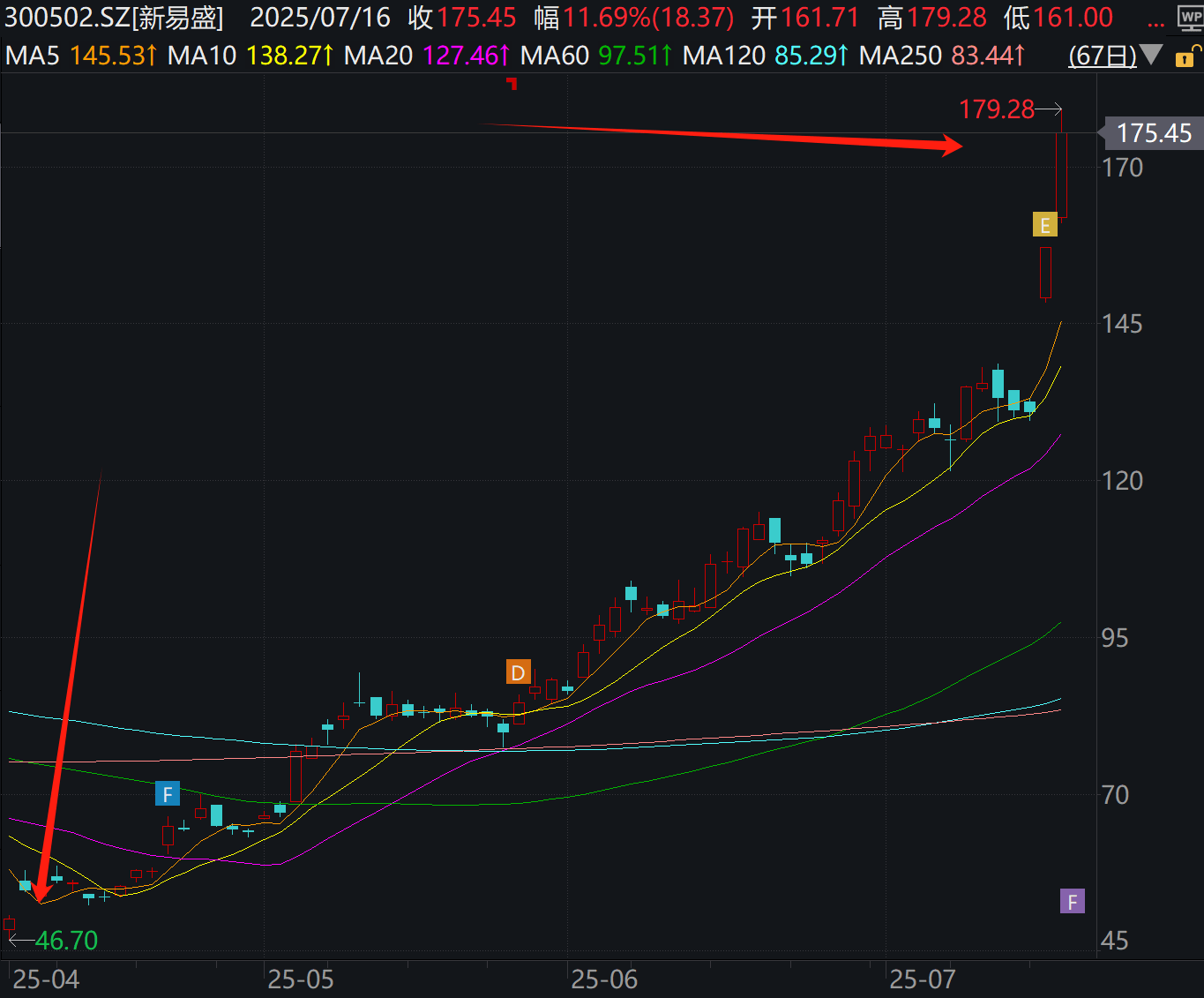
新易盛3个月翻三倍!算力股不仅要有概念,还要有业绩
Sou Hu Cai Jing· 2025-07-16 06:03
Core Viewpoint - The performance of companies in the AI and cloud computing sectors, particularly those linked to Nvidia's supply chain, is significantly influenced by their earnings reports, with New Yisheng and Zhongji Xuchuang showing strong profit growth, while Tianfu Communication lacks performance support and has seen a decline in stock price [3][7]. Group 1: Company Performance - New Yisheng's net profit for the first half of the year is expected to be between 3.7 billion to 4.2 billion yuan, representing a year-on-year increase of 327.68% to 385.47% [7][8]. - Zhongji Xuchuang's second-quarter net profit is projected to be between 2.017 billion to 2.817 billion yuan, with a year-on-year growth of 50% to 109% [7][8]. - The earnings reports of other companies within the cloud computing ETF also show significant increases, with Qianfang Technology and Hengsheng Electronics expecting net profit growth of 1534.65% and 740.95% respectively [7][8]. Group 2: Market Trends - The cloud computing ETF (159890) has seen a rise of 0.94% with a trading volume exceeding 40 million yuan, indicating strong market interest [5]. - The ETF's technical indicators show an upward trend across multiple moving averages, suggesting a potential for a significant rebound [5]. - The overall market sentiment is driven by the release of second-quarter earnings and Nvidia's AI chip supply, creating substantial investment opportunities [9].


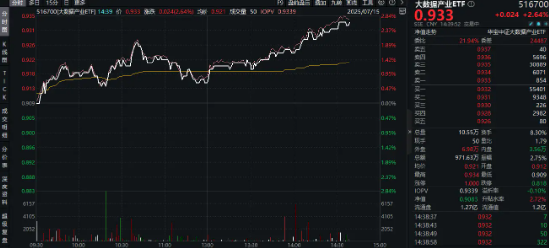
首个AI智能体安全测试标准来袭,蚂蚁、清华、电信牵头发布!大数据产业ETF(516700)盘中涨超2.6%
Xin Lang Ji Jin· 2025-07-15 06:49
Group 1 - The core viewpoint of the news is the release of the first AI agent safety testing standard, which has led to significant stock price increases for companies like Tax Friend Co., Yonyou Network, and others in the data technology sector [1][3] - The AI STR series standard was officially launched at the United Nations in Geneva, developed by Ant Group, Tsinghua University, and China Telecom, along with over twenty domestic and international institutions [3] - The standard addresses behavioral risks associated with AI agents crossing "language barriers" and establishes a comprehensive risk analysis framework [3] Group 2 - Nvidia's CEO announced two key developments: the approval of H20 chip sales to China and the upcoming launch of the RTXpro GPU, indicating strong market activity in the AI hardware sector [3] - The optical module leader, NewEase, forecasted a net profit increase of 328%-385% year-on-year for the first half of 2025, with Q2 net profit expected to grow by 35.22%-67.01% quarter-on-quarter, reflecting high industry vitality [3] - Analysts from Huaxi Securities noted rapid growth in overseas AI demand, particularly from new enterprises, which is driving high capital expenditures in AI [4] Group 3 - The AI computing center is highlighted as a crucial component of information infrastructure, providing essential support for the growing demand for AI computing power [4] - The investment opportunities in the AI industry chain are expected to accelerate due to the increasing richness of application scenarios driven by emerging technologies like AI and big data [4] - The data industry ETF (516700) focuses on sectors such as data centers and cloud computing, with significant holdings in leading companies, indicating a strong outlook for technology self-reliance [5] Group 4 - The investment logic for the AI industry includes geopolitical factors, macroeconomic conditions, technological advancements, and timing in procurement standards [6] - The urgency for self-reliance in the AI sector is emphasized due to geopolitical disturbances and the need for national security [6] - The domestic market for software and hardware is expected to grow as local manufacturers achieve technological breakthroughs [6]
中国软件(600536) - 2025 Q2 - 季度业绩预告
2025-07-14 08:05
[Performance Forecast Summary](index=1&type=section&id=I.%20Current%20Period%20Performance%20Forecast) The company anticipates a net loss for the first half of 2025, with net profit attributable to shareholders ranging from -87 million to -72.5 million RMB, and non-recurring adjusted net profit from -90 million to -75 million RMB 2025 Semi-Annual Performance Forecast | Metric | Estimated Amount (Million RMB) | | :--- | :--- | | Net Profit Attributable to Parent Company Shareholders | -87 to -72.5 | | Net Profit Attributable to Parent Company Shareholders (Excluding Non-Recurring Items) | -90 to -75 | [Comparison with Prior Period Performance](index=1&type=section&id=II.%20Prior%20Period%20Operating%20Performance%20and%20Financial%20Position) The company expects a significant reduction in net loss for the first half of 2025 compared to the prior year, with an anticipated decrease in loss of approximately 186 million to 200 million RMB from the previous year's 273 million RMB net loss 2025 Semi-Annual Performance vs. Prior Period (Unit: Million RMB) | Metric | 2025 Semi-Annual (Estimated) | 2024 Semi-Annual (Actual) | | :--- | :--- | :--- | | Net Profit Attributable to Parent Company Shareholders | -87 to -72.5 | -272.6472 | | Net Profit Attributable to Parent Company Shareholders (Excluding Non-Recurring Items) | -90 to -75 | -285.8222 | - Compared to the prior year, the net loss attributable to parent company shareholders is expected to decrease by **185.6472 million to 200.1472 million RMB**[6](index=6&type=chunk) [Analysis of Performance Change](index=1&type=section&id=III.%20Primary%20Reasons%20for%20Current%20Period%20Performance%20Change) The company's continued loss is primarily due to the seasonal concentration of project settlements in the second half, though the significant year-over-year reduction in loss is attributed to core business focus, improved contract quality, enhanced delivery efficiency, strengthened internal controls, and ongoing cost reduction initiatives - The primary reason for the current period's loss is the concentration of most project settlements and acceptances in the second half of the year[5](index=5&type=chunk) - The significant reduction in loss is primarily due to: - Focusing on core responsibilities and main business - Increasing market development efforts and improving the quality of new contracts - Intensifying project delivery efforts - Strengthening integrated business, financial, and human resource management to enhance digital control capabilities - Continuously promoting cost reduction and efficiency improvement[6](index=6&type=chunk) [Risk Warning and Other Matters](index=2&type=section&id=IV.%20Risk%20Warning) The company confirms no material uncertainties affecting the accuracy of this performance forecast, while reminding investors that the preliminary, unaudited data will be superseded by the final audited figures in the 2025 annual report - The company declares that there are no material uncertainties affecting the accuracy of this performance forecast[7](index=7&type=chunk) - Investors are advised that the forecast data provided is preliminary and unaudited, with final accurate figures subject to the company's officially disclosed audited 2025 annual report[8](index=8&type=chunk)
中国软件:预计2025年上半年净利润亏损8700万元-7250万元
news flash· 2025-07-14 07:49
Core Viewpoint - The company, China Software (600536), anticipates a net loss attributable to shareholders of the parent company ranging from -87 million to -72.5 million yuan for the first half of 2025, primarily due to project settlements concentrated in the second half of the year [1] Financial Performance - The expected net profit attributable to shareholders, excluding non-recurring gains and losses, is projected to be between -90 million and -75 million yuan for the first half of 2025 [1] - The company expects to reduce its net loss by 186 million to 200 million yuan compared to the same period last year [1] Strategic Initiatives - The reduction in loss is attributed to the company's focus on its core business, increased market development efforts, improved quality of new contracts, and enhanced project delivery [1] - The company is strengthening integrated management of finance and operations, improving digital management capabilities, and continuously promoting cost reduction and efficiency enhancement [1]
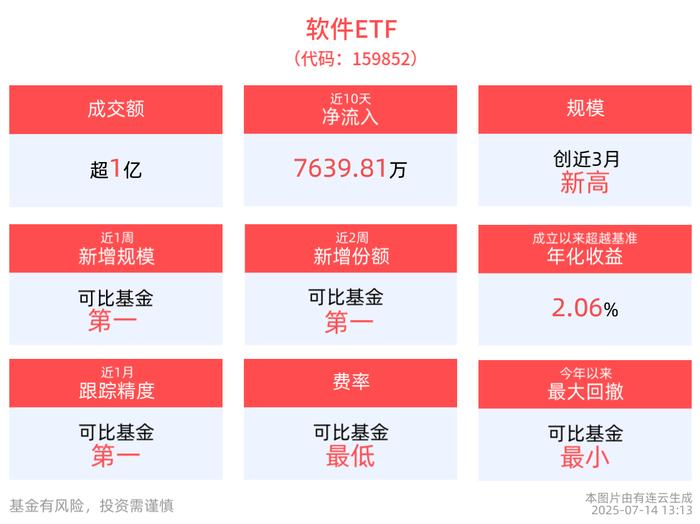
最新规模创近3月新高,软件ETF(159852)近10日“吸金”超7600万元
Xin Lang Cai Jing· 2025-07-14 05:43
Group 1 - The software service index of Zhongzheng has decreased by 1.69% as of July 14, 2025, with mixed performance among constituent stocks, led by Guanghuan Xinwang with a rise of 3.89% [1] - The software ETF (159852) has seen a turnover of 4.72% and a transaction volume of 156 million yuan, ranking first among comparable funds in terms of average daily transaction volume over the past year [3] - The latest scale of the software ETF has reached 3.256 billion yuan, marking a three-month high and also ranking first among comparable funds [3] Group 2 - The software ETF has experienced a significant increase in shares, with a growth of 73 million shares over the past two weeks, leading among comparable funds [3] - Recent net inflow of funds into the software ETF is 12.8944 million yuan, with six out of the last ten trading days showing net inflows totaling 76.3981 million yuan [3] - The software ETF has seen a net value increase of 4.16% over the past three years, with the highest single-month return since inception being 39.35% [3] Group 3 - The Ministry of Industry and Information Technology has released the "2025 Work Points for the Integration of Informatization and Industrialization," emphasizing support for high-quality development of basic and industrial software [3] - The computer industry is rapidly developing due to market expansion and policy catalysts, with domestic market share increasing year by year due to localization policies [5] - As of June 30, 2025, the top ten weighted stocks in the Zhongzheng software service index account for 60.56% of the index, with key players including Keda Xunfei and Kingsoft [5][7]
金十图示:2025年07月14日(周一)中国科技互联网公司市值排名TOP 50一览
news flash· 2025-07-14 02:52
Group 1 - The article presents the market capitalization rankings of the top 50 Chinese technology and internet companies as of July 14, 2025 [1] - The leading company by market capitalization is 台棋电 (Taiwan Semiconductor Manufacturing Company) with a valuation of 11,949.75 million [3] - Tencent Holdings ranks second with a market cap of 5,815.18 million, followed by Alibaba at 2,546.4 million [3][4] Group 2 - Xiaomi Group is ranked fourth with a market capitalization of 1,889.61 million, while Pinduoduo follows in fifth place with 1,489.35 million [3][4] - Meituan and NetEase are positioned sixth and seventh, with market caps of 929.41 million and 812.27 million respectively [3][4] - Other notable companies in the top 10 include 东方财富 (East Money) at 523.39 million and 中芯国际 (SMIC) at 476.15 million [4][5] Group 3 - The rankings continue with companies like 京东 (JD.com) at 448.31 million and 快手 (Kuaishou) at 356.11 million [4][5] - Baidu, 理想汽车 (Li Auto), and 贝壳 (Beike) are also included in the top 15, with market caps of 298.84 million, 296.08 million, and 221.89 million respectively [4][5] - The list concludes with 云费智联 (Yunfei Zhili) at 41.76 million, marking the 50th position [6]



