
苏州银行

Search documents
区域银行冲向科技金融
券商中国· 2025-10-09 11:16
Core Viewpoint - The article emphasizes the importance of fintech as a leading business segment for banks and financial institutions, highlighting the proactive approach of these entities in embracing technological advancements [1]. Group 1: Development of Fintech in Regional Banks - Many regional banks, particularly city and rural commercial banks, are following the lead of larger banks in developing fintech, although their progress may be limited by resources [2]. - Zhejiang Rural Commercial Bank has reported that since launching its fintech pilot in Jiaxing, the proportion of technology enterprise loans has exceeded 30% of corporate loans, covering 7,200 tech enterprises [2]. - Various county-level rural commercial banks in Jiaxing have begun to establish specialized mechanisms for fintech, such as dedicated departments and service models [3]. Group 2: Challenges and Strategies - The development of fintech is challenging for regional banks, which need to root their efforts in local economic structures and overcome internal limitations [5]. - A listed rural commercial bank indicated that it had been considering fintech since 2017, but only completed team formation in 2021, reflecting the long-term commitment required [4]. Group 3: Growth in Technology Loans - Despite smaller loan scales compared to larger banks, regional banks are accelerating their technology loan offerings, with significant growth rates reported [6]. - For instance, Jiangsu Bank's technology loan balance reached 2,740 billion yuan, growing by 17.80% year-on-year, while Hangzhou Bank's technology loans increased by 21.77% [7]. - Other regional banks, such as Qilu Bank and Qingdao Bank, also reported substantial growth in technology loans, with increases of 17.60% and 20.85% respectively [7]. Group 4: Organizational Structure and Specialization - Banks are adapting their organizational structures to support fintech, with many establishing dedicated departments and specialized branches [9]. - For example, Ningbo Bank has set up a technology finance department to provide comprehensive services to tech enterprises, while Qingdao Bank has developed a specialized mechanism for fintech [10]. - Hangzhou Bank has created a well-structured fintech system with multiple regional centers and specialized institutions [11].





苏州银行:大股东国发集团及其一致行动人累计增持3626万股,增持金额近2.98亿元
Cai Jing Wang· 2025-10-09 10:35
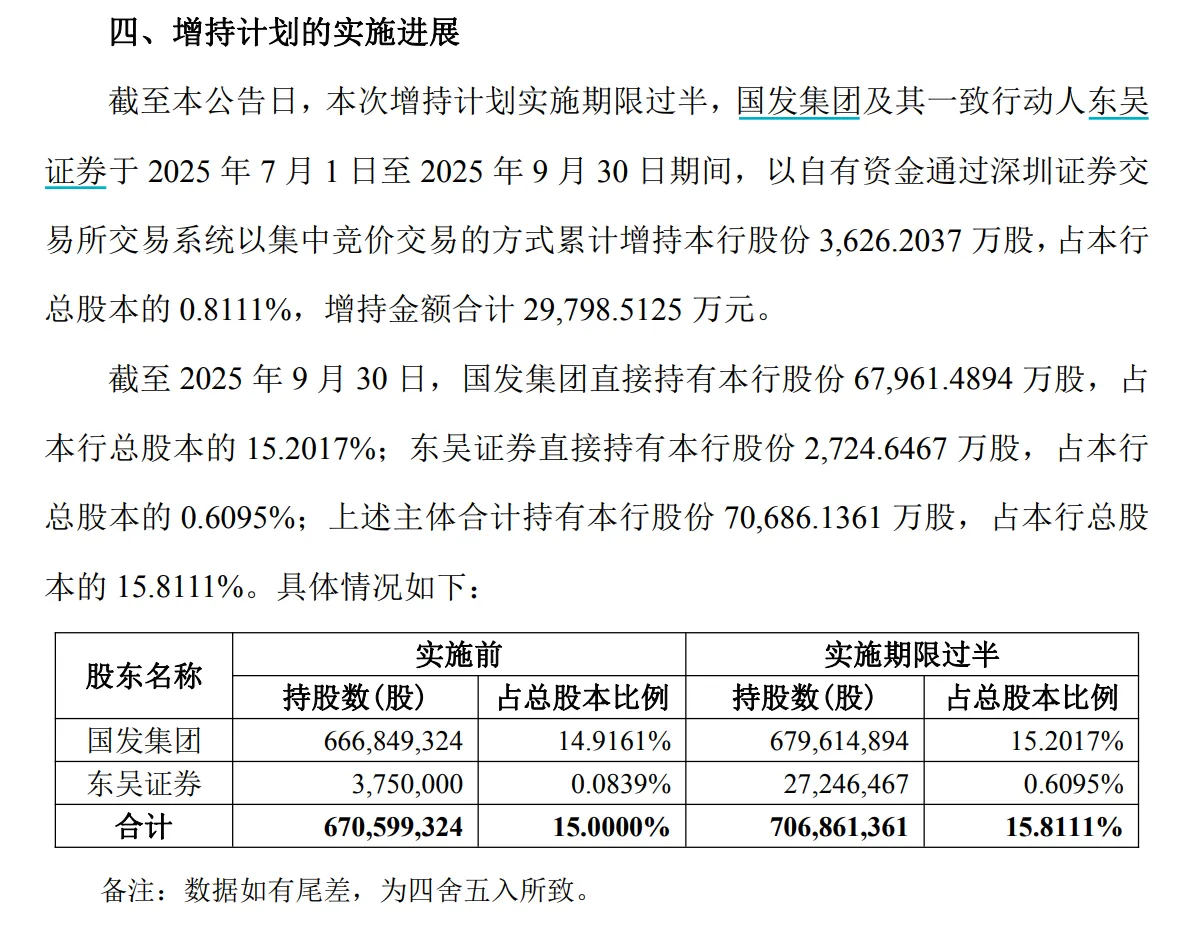
Core Viewpoint - Suzhou Bank's major shareholder, Suzhou International Development Group Co., Ltd., plans to increase its stake in the bank by at least 400 million RMB over a six-month period starting from July 1, 2025, reflecting confidence in the bank's future development and long-term investment value [1]. Group 1: Shareholding Details - As of the announcement, Suzhou International Development Group held 666,849,324 shares, representing 14.9161% of the total share capital of Suzhou Bank [3]. - By the midpoint of the implementation period, the shareholding of Suzhou International Development Group increased to 679,614,894 shares, which is 15.2017% of the total [3]. - The total shareholding of both Suzhou International Development Group and Dongwu Securities increased from 670,599,324 shares (15.0000%) to 706,861,361 shares (15.8111%) during the same period [3]. Group 2: Investment Plan - The investment plan includes a cumulative purchase of 36,262,037 shares by Suzhou International Development Group and Dongwu Securities, amounting to nearly 298 million RMB [1]. - The plan is set to continue as both entities express their intention to further increase their holdings in Suzhou Bank [1].
苏州银行(002966.SZ):国发集团及其一致行动人东吴证券累计增持0.8111%股份
Ge Long Hui A P P· 2025-10-09 09:22
Core Viewpoint - Suzhou Bank (002966.SZ) announced that Guofa Group and its concerted party, Dongwu Securities, have increased their shareholding in the bank by 36,262,037 shares, representing 0.8111% of the total share capital, with a total investment of approximately 297.99 million yuan [1] Group 1 - Guofa Group and Dongwu Securities executed the share purchase through the Shenzhen Stock Exchange's centralized bidding system [1] - The shareholding increase occurred between July 1, 2025, and September 30, 2025 [1] - The parties involved plan to continue increasing their shareholding in Suzhou Bank according to their investment plan [1]

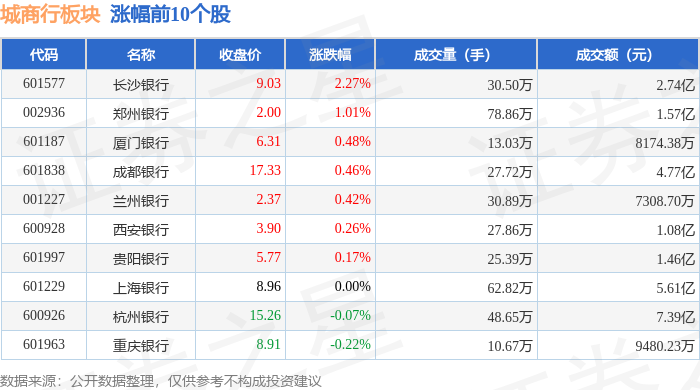
城商行板块10月9日跌0.34%,苏州银行领跌,主力资金净流出7.64亿元
Zheng Xing Xing Ye Ri Bao· 2025-10-09 09:03
Core Insights - The city commercial bank sector experienced a decline of 0.34% on October 9, with Suzhou Bank leading the drop [1] - The Shanghai Composite Index closed at 3933.97, up 1.32%, while the Shenzhen Component Index closed at 13725.56, up 1.47% [1] Stock Performance - Notable gainers included: - Changsha Bank: Closed at 9.03, up 2.27% with a trading volume of 305,000 shares and a turnover of 274 million yuan [1] - Zhengzhou Bank: Closed at 2.00, up 1.01% with a trading volume of 788,600 shares and a turnover of 157 million yuan [1] - Notable decliners included: - Suzhou Bank: Closed at 8.07, down 1.10% with a trading volume of 512,100 shares and a turnover of 413 million yuan [2] - Ningbo Bank: Closed at 26.18, down 0.95% with a trading volume of 391,800 shares and a turnover of 1.024 billion yuan [2] Capital Flow - The city commercial bank sector saw a net outflow of 764 million yuan from institutional investors, while retail investors contributed a net inflow of 230 million yuan [2][3] - Specific stock capital flows indicated: - Ningbo Bank: Institutional net inflow of 25.45 million yuan, retail net inflow of 30.74 million yuan [3] - Qingdao Bank: Institutional net inflow of 21.20 million yuan, but retail net outflow of 32.20 million yuan [3]


苏州银行(002966) - 关于大股东及其一致行动人增持公司股份计划实施进展的公告
2025-10-09 09:02
证券代码:002966 证券简称:苏州银行 公告编号:2025-077 苏州银行股份有限公司 关于大股东及其一致行动人增持公司股份计划 实施进展的公告 本行大股东及其一致行动人保证向本行提供的信息内容真实、准确、完整, 没有虚假记载、误导性陈述或重大遗漏。 本行及董事会全体成员保证公告内容与信息披露义务人提供的信息一致。 重要内容提示: 1. 苏州银行股份有限公司(以下简称"本行"或"公司")大股东苏州国 际发展集团有限公司(以下简称"国发集团")及其一致行动人基于对本行未 来发展前景的信心和长期投资价值的认可,计划自 2025 年 7 月 1 日起的 6 个月 内,通过深圳证券交易所交易系统以集中竞价交易的方式,合计增持不少于 4 亿 元 人 民 币 。 具 体 内 容 详 见 本 行 2025 年 7 月 1 日 于 巨 潮 资 讯 网 (www.cninfo.com.cn)披露的《关于大股东及其一致行动人增持公司股份计划 的公告》(公告编号:2025-064)。 2. 2025 年 7 月 1 日至 2025 年 9 月 30 日,国发集团及其一致行动人东吴证 券股份有限公司(以下简称"东吴证券")以自 ...
苏新睿见量化选股股票型证券投资基金基金份额发售公告
Zhong Guo Zheng Quan Bao - Zhong Zheng Wang· 2025-10-09 04:54
Fund Overview - The fund is named "Suxin Ruijian Quantitative Stock Selection Equity Investment Fund" and has been approved for fundraising by the China Securities Regulatory Commission [1] - The fund will be publicly offered from October 15, 2025, to October 31, 2025, with a maximum fundraising period of three months [2][30] - The fund is categorized as an open-ended equity fund with an indefinite duration and aims to achieve stable asset appreciation while controlling risks [21] Fund Structure - The fund offers two classes of shares: Class A and Class C, with different fee structures for subscription and redemption [1][36] - Class A shares have a code of 025404 and charge subscription fees, while Class C shares (code 025405) do not charge subscription fees [1][21] Investment Strategy - The fund's investment range includes liquid financial instruments such as stocks, depositary receipts, bonds, asset-backed securities, and stock index futures [22][24] - The fund will invest 80%-95% of its assets in stocks and depositary receipts, with a minimum of 5% in cash or short-term government bonds [24] Subscription Details - The minimum initial subscription amount is RMB 10,000, and subsequent subscriptions can be as low as RMB 1,000 [3][40] - Investors can make multiple subscriptions during the fundraising period, but once a subscription application is accepted, it cannot be revoked [4][41] Fund Management - The fund is managed by Suxin Fund Management Co., Ltd., which is responsible for the fund's operations and investment decisions [64] - The fund's custodian is Shanghai Pudong Development Bank Co., Ltd., ensuring the safekeeping of the fund's assets [65] Regulatory Compliance - The fund must meet specific conditions to complete its fundraising, including raising at least 200 million shares and having a minimum of 200 investors [6][31] - If the fundraising conditions are not met by the end of the period, the fundraising will be deemed unsuccessful, and the management company will return the funds to investors [33][63]


晨会纪要:对近期重要经济金融新闻、行业事件、公司公告等进行点评-20251009
Xiangcai Securities· 2025-10-09 00:47
Group 1: Monetary Policy and Economic Outlook - The People's Bank of China emphasized the execution and effectiveness of monetary policy, acknowledging steady economic progress while highlighting domestic demand insufficiency and low price levels as key challenges [3][4] - The focus of future monetary policy will be on ensuring smooth transmission to the real economy, with targeted financial support for small and micro enterprises and stabilizing foreign trade [4] - The banking sector is expected to maintain relatively stable performance due to alleviated asset-side interest rate pressures, declining deposit costs, and narrowing interest margin declines [5] Group 2: Investment Recommendations - The report suggests that bank stocks have become attractive due to increased dividend yields following market adjustments, indicating a strong absolute return investment value [5] - It recommends focusing on state-owned banks for stable high dividend configurations and potential valuation recovery opportunities for joint-stock and regional banks, specifically mentioning CITIC Bank, Jiangsu Bank, Chengdu Bank, Shanghai Rural Commercial Bank, Chongqing Rural Commercial Bank, Changshu Bank, and Suzhou Bank [5] - The overall industry rating is maintained at "overweight" [5]
A股利好来了!130家公司获得大股东增持,49家公司获超千万股买入
Sou Hu Cai Jing· 2025-10-07 23:57
Group 1 - A significant wave of major shareholder buybacks in the A-share market is observed in the second half of 2025, indicating a renewed assessment of market value by industrial capital [1] - A total of 130 listed companies received substantial investments from major shareholders, with 49 companies seeing buybacks exceeding 10 million shares [1] - The top 15 companies in terms of buyback volume each exceeded 40 million shares, showcasing the strong confidence and financial capability of major shareholders [1] Group 2 - The banking, energy, and high-end manufacturing sectors are the main contributors to this buyback trend, with notable actions from executives at Suzhou Bank and Huaxia Bank expressing optimism about their companies' futures [1] - The buyback amounts have significantly increased compared to the same period in 2024, reflecting industrial capital's recognition of the current valuation levels in the A-share market [1] Group 3 - Major shareholder buybacks are often interpreted as a "confidence declaration," with undervaluation being a primary driver for these actions [2] - Enhancing control is another important consideration for major shareholders, as seen with Hengyi Petrochemical increasing its holding percentage to strengthen governance [4] Group 4 - Buybacks that meet certain criteria, such as significant percentage increases and management's personal investments, tend to show more stable subsequent stock price performance [6] - Companies in the energy and chemical sectors that receive buybacks during industry recovery periods often indicate a turning point in performance [6] Group 5 - Investors should focus on companies with low price-to-book ratios and high dividend yields, as these often yield long-term returns post-buyback [8] - Attention should also be given to high-end manufacturing and new energy companies that benefit from policy incentives, as their buybacks align with fundamental improvements [9] Group 6 - The current buyback wave is seen as a potential market bottom indicator, but it also raises questions about the motivations behind these actions, particularly regarding state-owned and private enterprises [9] - The distinction between buybacks as a tool for value discovery versus a means of market value management is crucial for investors to understand [9]


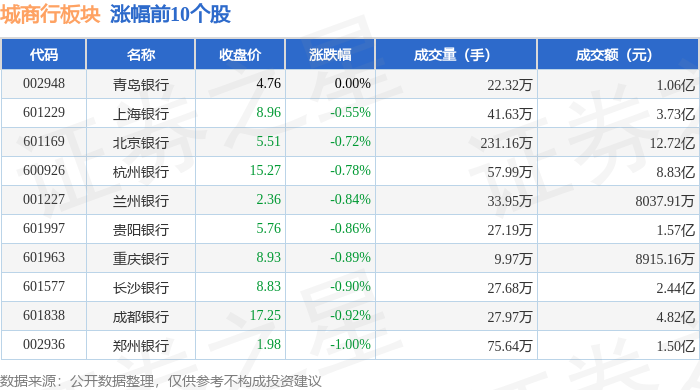
城商行板块9月30日跌1%,苏州银行领跌,主力资金净流出4.62亿元
Zheng Xing Xing Ye Ri Bao· 2025-09-30 08:51
Core Insights - The city commercial bank sector experienced a decline of 1.0% on September 30, with Suzhou Bank leading the drop [1] - The Shanghai Composite Index closed at 3882.78, up 0.52%, while the Shenzhen Component Index closed at 13526.51, up 0.35% [1] Stock Performance Summary - Qingdao Bank: Closed at 4.76, unchanged; trading volume of 223,200 shares, turnover of 106 million [1] - Shanghai Bank: Closed at 8.96, down 0.55%; trading volume of 416,300 shares, turnover of 373 million [1] - Beijing Bank: Closed at 5.51, down 0.72%; trading volume of 2,311,600 shares, turnover of 1.272 billion [1] - Hangzhou Bank: Closed at 15.27, down 0.78%; trading volume of 157,990 shares, turnover of 883 million [1] - Lanzhou Bank: Closed at 2.36, down 0.84%; trading volume of 339,500 shares, turnover of 80.379 million [1] - Guiyang Bank: Closed at 5.76, down 0.86%; trading volume of 271,900 shares, turnover of 157 million [1] - Chongqing Bank: Closed at 8.93, down 0.89%; trading volume of 99,700 shares, turnover of 89.151 million [1] - Changsha Bank: Closed at 8.83, down 0.90%; trading volume of 276,800 shares, turnover of 244 million [1] - Chengdu Bank: Closed at 17.25, down 0.92%; trading volume of 279,700 shares, turnover of 482 million [1] - Zhengzhou Bank: Closed at 1.98, down 1.00%; trading volume of 756,400 shares, turnover of 150 million [1] Capital Flow Analysis - The city commercial bank sector saw a net outflow of 462 million from main funds, while speculative funds had a net inflow of 331 million, and retail investors had a net inflow of 131 million [2] - Suzhou Bank: Main fund net inflow of 55.9396 million, speculative fund net outflow of 11.5337 million, retail net outflow of 44.4059 million [3] - Changsha Bank: Main fund net inflow of 33.8793 million, speculative fund net outflow of 13.6525 million, retail net outflow of 20.2268 million [3] - Qilu Bank: Main fund net inflow of 8.6825 million, speculative fund net outflow of 2.7980 million, retail net outflow of 5.8846 million [3] - Hangzhou Bank: Main fund net inflow of 7.6881 million, speculative fund net inflow of 44.2474 million, retail net outflow of 51.9354 million [3] - Guiyang Bank: Main fund net inflow of 4.8665 million, speculative fund net outflow of 1.6412 million, retail net outflow of 3.2254 million [3]
收盘丨A股三大指数全天窄幅震荡 芯片等科技股表现亮眼
Di Yi Cai Jing· 2025-09-30 08:13
Market Performance - The A-share market experienced narrow fluctuations on September 30, with the Shanghai Composite Index rising by 0.52%, the Shenzhen Component Index increasing by 0.35%, and the ChiNext Index nearly flat [1][2] - For the month, the Shanghai Composite Index has gained 0.64%, the Shenzhen Component Index has increased by 6.54%, and the ChiNext Index has risen by 12.04% [1] Sector Performance - Strong performances were noted in sectors such as storage chips, energy metals, semiconductors, lithium batteries, and military industry, while the liquor and automotive service sectors weakened [2] - Notably, chip-related stocks performed well, with over 10 stocks, including Guolin Technology and Xinle Energy, hitting the daily limit [2] Trading Volume and Stock Movement - The total trading volume in the Shanghai and Shenzhen markets reached 2.18 trillion yuan, an increase of 20 billion yuan compared to the previous trading day, with over 2,600 stocks rising [2] - Major inflows were observed in sectors like non-ferrous metals, power equipment, and electronics, while outflows were noted in communications, non-bank financials, and banking sectors [4] Institutional Insights - Guorong Securities anticipates a stronger market in the fourth quarter, highlighting opportunities in new hotspots and sectors [5] - Zhongtai Securities notes that the market remains in a consolidation phase, with potential upward breakthroughs expected in October [5] - Jinyuan Securities suggests focusing on policy planning directions and sectors with significant future growth potential, such as brokerage, precious metals, small metals, batteries, power equipment, semiconductors, and internet services [5]
