中国建筑

Search documents
研报掘金丨国泰海通:维持中国建筑“增持”评级,目标价7.42元
Ge Long Hui· 2025-11-12 09:08
Core Viewpoint - China State Construction's Q3 net profit attributable to shareholders decreased by 24.1% due to the ongoing deep adjustment in the real estate market and a slowdown in infrastructure investment growth [1] Group 1: Financial Performance - The company's Q3 net profit attributable to shareholders fell by 24.1% [1] - Current dividend yield stands at 5%, indicating a valuation bottom [1] - The dividend payout ratio is 24.3% [1] Group 2: Market Position and Valuation - China State Construction is one of the largest investment and construction groups globally and is included in major indices such as CSI 50, SSE 50, FTSE China A50, and MSCI China A50 Connect Index [1] - The controlling shareholder increased holdings by 620 million yuan, accounting for 0.27% of total share capital [1] - The company maintains a long-term stable dividend policy [1] Group 3: Future Outlook - The company is given a target price of 7.42 yuan based on a 2025 PE of 6.5 times [1] - The current PE of 4.7 times is at the 45th percentile over the past decade, while the PB is 0.47 times, at the 1st percentile over the same period [1] - The company adheres to a market-oriented operational mechanism, gradually enhancing its ability to navigate market rules [1]


房屋建设板块11月12日跌0.02%,重庆建工领跌,主力资金净流入8428.68万元
Zheng Xing Xing Ye Ri Bao· 2025-11-12 08:49
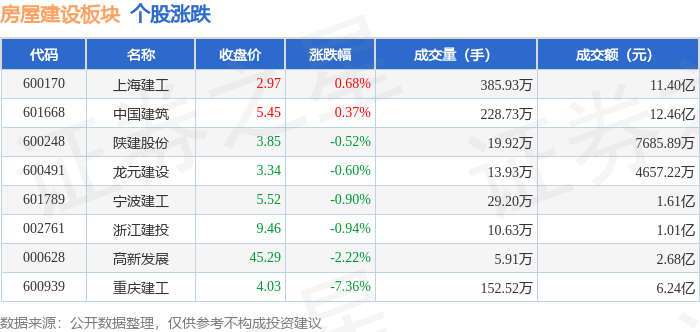
Market Overview - The housing construction sector experienced a slight decline of 0.02% on November 12, with Chongqing Construction leading the drop [1] - The Shanghai Composite Index closed at 4000.14, down 0.07%, while the Shenzhen Component Index closed at 13240.62, down 0.36% [1] Stock Performance - Shanghai Construction (600170) closed at 2.97, up 0.68% with a trading volume of 3.86 million shares and a turnover of 1.14 billion yuan [1] - China State Construction (601668) closed at 5.45, up 0.37% with a trading volume of 2.29 million shares and a turnover of 1.25 billion yuan [1] - Shaanxi Construction (600248) closed at 3.85, down 0.52% with a trading volume of 199,200 shares and a turnover of 76.86 million yuan [1] - Longyuan Construction (600491) closed at 3.34, down 0.60% with a trading volume of 139,300 shares and a turnover of 46.57 million yuan [1] - Ningbo Construction (601789) closed at 5.52, down 0.90% with a trading volume of 292,000 shares and a turnover of 161 million yuan [1] - Zhejiang Construction Investment (002761) closed at 9.46, down 0.94% with a trading volume of 106,300 shares and a turnover of 101 million yuan [1] - High-tech Development (000628) closed at 45.29, down 2.22% with a trading volume of 59,100 shares and a turnover of 268 million yuan [1] - Chongqing Construction (600939) closed at 4.03, down 7.36% with a trading volume of 1.53 million shares and a turnover of 624 million yuan [1] Capital Flow - The housing construction sector saw a net inflow of 84.29 million yuan from main funds, while retail funds experienced a net outflow of 20.67 million yuan [1] - Main funds for China State Construction (601668) had a net inflow of 95.66 million yuan, while retail funds had a net outflow of 48.33 million yuan [2] - Shanghai Construction (600170) had a net inflow of 72.83 million yuan from main funds, with retail funds seeing a net outflow of 40.51 million yuan [2] - Ningbo Construction (601789) had a net inflow of 6.97 million yuan from main funds, while retail funds had a net outflow of 472.74 thousand yuan [2] - Longyuan Construction (600491) experienced a net outflow of 7.63 million yuan from main funds, but retail funds had a net inflow of 607.05 thousand yuan [2] - High-tech Development (000628) faced a significant net outflow of 60.53 million yuan from main funds, while retail funds had a net inflow of 5.12 million yuan [2]


中国建筑(601668):2025三季报点评:Q3归母净利润承压,估值底部分红稳定可观
GUOTAI HAITONG SECURITIES· 2025-11-12 08:40
Investment Rating - The report maintains a rating of "Buy" for the company [3][8]. Core Insights - The company's net profit attributable to shareholders decreased by 24.1% in Q3, impacted by the ongoing adjustment in the real estate market and a slowdown in infrastructure investment growth. The current dividend yield is at 5%, indicating that the company is undervalued as a leading market player in construction [2][4]. Financial Performance Summary - For the first three quarters of 2025, the company's revenue reached 1.56 trillion yuan, a year-on-year decline of 4.2%. The net profit attributable to shareholders was 38.18 billion yuan, down 3.8% year-on-year. The gross profit margin stood at 8.72%, with a net profit margin of 2.45% [4][5]. - The company reported a decrease in operating cash flow, with a net outflow of 69.48 billion yuan for the first three quarters of 2025, although this was an improvement compared to the 77.01 billion yuan outflow in the same period of 2024 [5][6]. Earnings Forecast - The earnings per share (EPS) estimates for 2025-2027 have been revised down to 1.15, 1.20, and 1.25 yuan respectively, reflecting a growth of 2.8%, 4.6%, and 4.2% [3][6]. Valuation Metrics - The company is currently valued at a price-to-earnings (PE) ratio of 6.5 times for 2025, with a target price set at 7.42 yuan. The price-to-book (PB) ratio is at 0.47 times, indicating a significant discount compared to historical averages [3][5][6]. Market Position - As one of the largest investment and construction groups globally, the company is included in major indices such as the CSI 50 and MSCI China A50. The controlling shareholder has increased their stake by 0.27% [5][6].
中国人形机器人:现实与理想差距几何-China Industrials-Humanoids How Far Apart Are Reality and Ideal
2025-11-12 02:20
Summary of Conference Call on Humanoid Robotics Industry Industry Overview - The conference focused on the humanoid robotics industry in China, with expectations of demand exceeding 100,000 units by 2026, driven by industrial, commercial, and companion applications [1][4][11]. Key Insights Demand Projections - Optimistic forecasts suggest the humanoid industry could surpass 100,000 units in 2026, significantly higher than the conservative estimate of 12,000 units [4][11]. - Different companies have varying expectations: - UBTECH anticipates over 100,000 units across various segments [11]. - DroidUp expects 100,000 units solely for commercial services [11]. - Kepler projects nearly 10,000 units for industrial applications [11]. Adoption Challenges - The industry faces significant hurdles, including: - Development challenges related to foundational models and training data [5][10]. - Product development issues such as component design, material consistency, and cost pressures [5][10]. - Initial adoption is expected to focus on specific tasks in structured environments, particularly in commercial services and industrial applications [3][10]. Commercialization Path - The path to commercialization is seen as gradual, with a focus on delivering functional value rather than immediate cost reductions [16]. - Clients expect prices for full-sized humanoid robots to drop to around RMB 100,000 to 200,000 to achieve positive ROI [15]. Competitive Landscape - The humanoid robotics sector is expected to support a diverse range of players due to varied application requirements, leading to a fragmented market in the early stages [17]. - As the industry matures, consolidation may occur, but currently, the market can accommodate numerous specialized integrators [17]. Component and Manufacturing Challenges - There is a disconnect between component suppliers and system integrators, leading to high customization costs and unclear performance specifications [18]. - Suppliers are pushing for integrated and standardized products to improve efficiency and reduce costs [19]. - Quality control issues, such as yield dispersion and variable performance, hinder commercialization efforts [20]. Technological Innovations - Emerging technologies are crucial for the advancement of humanoid robotics, including: - Innovations in materials and sensing technologies [23]. - The need for robust standards for performance and safety to facilitate scaling [22]. - Computing power is identified as a potential bottleneck, with hybrid deployment strategies being proposed to enhance performance [26][27]. Future Outlook - The industry is expected to evolve with advancements in model architecture and data collection protocols, although significant challenges remain in achieving general-purpose robotics capabilities [24][25]. - The next generation of humanoid robots will likely be defined by innovations in control architectures and materials, enhancing their functionality and reliability [23]. Conclusion - The humanoid robotics industry in China is poised for growth, with optimistic demand forecasts and a focus on specific applications. However, significant challenges in technology, commercialization, and component quality must be addressed to realize this potential. The competitive landscape remains fragmented, allowing for diverse players to thrive in the initial stages of market development.

房屋建设板块11月11日跌0.1%,高新发展领跌,主力资金净流出1.11亿元
Zheng Xing Xing Ye Ri Bao· 2025-11-11 08:46
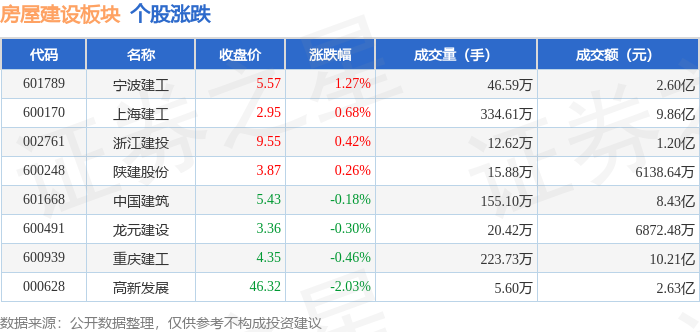
Core Viewpoint - The housing construction sector experienced a slight decline of 0.1% on November 11, with significant losses led by Gaoxin Development, while the overall market indices also fell, with the Shanghai Composite Index down 0.39% and the Shenzhen Component Index down 1.03% [1] Summary by Category Market Performance - The Shanghai Composite Index closed at 4002.76, down 0.39% - The Shenzhen Component Index closed at 13289.0, down 1.03% [1] Sector Performance - The housing construction sector saw a net outflow of 1.11 billion yuan in main funds, with retail investors contributing a net inflow of 1.16 billion yuan [1] Individual Stock Performance - Notable stock performances included: - Ningbo Construction (601789) closed at 5.57, up 1.27% with a trading volume of 465,900 shares and a turnover of 260 million yuan - Yihai Construction (600170) closed at 2.95, up 0.68% with a trading volume of 3,346,100 shares and a turnover of 98.6 million yuan - Gaoxin Development (000628) closed at 46.32, down 2.03% with a trading volume of 56,000 shares and a turnover of 263 million yuan [1]


潍宿高铁至青岛连接线 桃园隧道顺利贯通
Feng Huang Wang Cai Jing· 2025-11-11 03:03
Core Insights - The successful completion of the Taoyuan Tunnel marks a significant milestone in the construction of the Weishui High-Speed Railway to Qingdao connection line, which is crucial for the project's progress [1][2] - The tunnel, measuring 940 meters in length, faces complex geological challenges, including high-pressure environments and proximity to existing infrastructure, necessitating advanced construction techniques [1][2] Group 1: Project Overview - The Weishui High-Speed Railway to Qingdao connection line spans 108.78 kilometers with a designed speed of 350 km/h, serving as an important link in China's high-speed rail network [2] - The project is part of the national "Eight Vertical and Eight Horizontal" high-speed rail framework and is essential for enhancing connectivity between the Jiaodong Peninsula and major economic regions [2] Group 2: Construction Techniques and Achievements - The construction team implemented a "dual-direction tunneling" approach, reducing the planned construction period from 14 months to 11 months, achieving over a 20% increase in efficiency [2] - Strict adherence to a comprehensive construction guideline ensured that ground subsidence was controlled to within 3 millimeters, significantly below regulatory limits, thereby ensuring safety during the tunneling process [2]
中国建筑:公司坚持锚定高质量发展的主题主线
Zheng Quan Ri Bao Wang· 2025-11-10 14:13
Group 1 - The company emphasizes its commitment to high-quality development as a central theme [1] - The company aims to enhance its capabilities to address uncertainties arising from changing circumstances [1] - The company will focus on key annual tasks to achieve its operational goals [1]
中国建筑:公司高度重视降本增效工作
Zheng Quan Ri Bao Wang· 2025-11-10 14:13
Core Viewpoint - China State Construction (601668) emphasizes its commitment to cost reduction and efficiency improvement through various initiatives, including technological innovation and supply chain management [1] Group 1: Cost Management Initiatives - The company is actively implementing a special action plan focused on "practicing thrift and running enterprises diligently" [1] - There is a strong focus on project technological innovation, schedule control, quality management, and supply chain management [1] Group 2: Financial Performance - By the third quarter of 2025, the company aims to reduce management expenses and financial expenses by 4.9% and 4.8%, respectively [1]
市场高低切,建筑买什么
Changjiang Securities· 2025-11-10 13:45
Investment Rating - The report maintains a "Positive" investment rating for the construction and engineering sector [9] Core Views - The construction sector exhibits characteristics such as low valuation, low institutional holdings, large market capitalization, and stable outlook for quality targets. The report identifies four key investment directions within the construction industry: 1) Companies with strong Q3 performance and short-term earnings certainty 2) High dividend yield stocks providing a safety cushion 3) Strong long-term growth potential 4) Large-cap stocks with low absolute valuations [5][6][7] Summary by Sections Valuation Metrics - As of the latest closing, the Jiangsu Construction Index has a PE ratio of 12.83, ranking 28th across all industries, with a 10-year percentile of 68.5%. The PB ratio stands at 0.84, ranking 31st, with a 10-year percentile of 16.22%. Notably, the construction sector and the banking sector are the only indices within the Jiangsu framework that are trading below book value [5][6] Institutional Holdings - The construction sector has historically low institutional holdings, which may reflect a weak outlook for the industry and a lack of attention from investors. This could lead to undervaluation of high-quality construction stocks [6] Market Capitalization - The construction sector has a limited number of listed companies, with eight major state-owned enterprises collectively valued at 941.19 billion, accounting for 47% of the Jiangsu Construction Index's market capitalization. These enterprises play a crucial role in stabilizing economic growth and are likely to be favored in a market shift towards undervalued sectors [6][7] Investment Directions - **Direction One**: Focus on companies with strong Q3 earnings, such as Sichuan Road and Bridge, China Chemical, and others, which show robust growth and sufficient order backlogs [7] - **Direction Two**: Invest in high dividend yield stocks like Jianghe Group (6.2%), Sichuan Road and Bridge (5.6%), and others, which provide a strong holding safety net [7] - **Direction Three**: Target companies with strong long-term growth potential, such as Honglu Steel Structure and others benefiting from semiconductor capital expenditure [7] - **Direction Four**: Invest in large-cap stocks with low absolute valuations, including eight major state-owned enterprises that are all trading below book value [7]




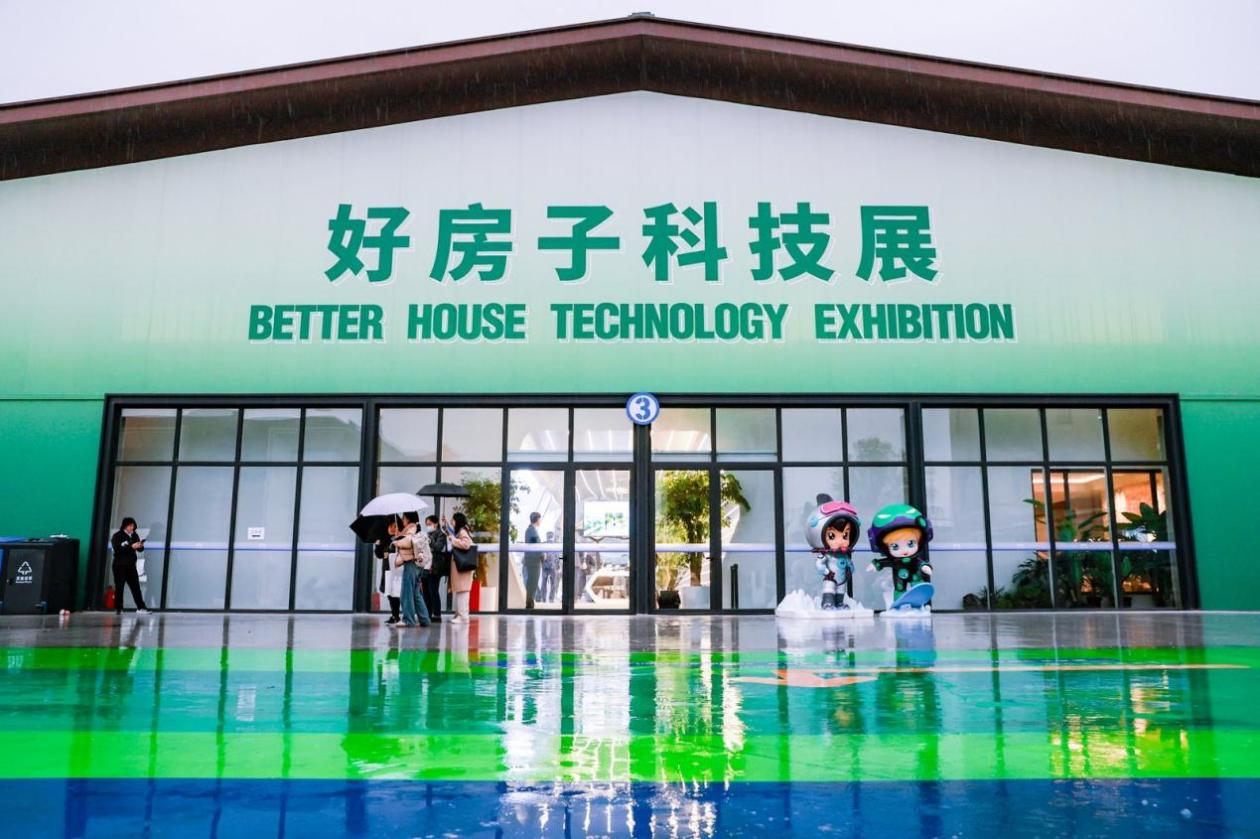
当向往照进现实:好房子科技展解锁都市人居的理想答案
Huan Qiu Wang· 2025-11-10 11:06
Core Insights - The article highlights the gap between the ideal of a quality life and the mundane challenges faced by urban dwellers, emphasizing the potential of smart home technology to bridge this divide [1] - The "Good House Technology Exhibition" in Beijing marks a shift from advocating the concept of "good houses" to a standardized and systematic approach to their development [1][12] - Huawei's HarmonyOS Smart Home is showcased as a key player in providing comprehensive smart solutions across various housing types, illustrating what constitutes a "good house" [1][12] Group 1: Exhibition Highlights - The exhibition features 18 real-life model rooms and ten thematic exhibition areas, showcasing various housing solutions that embody the core standards of safety, comfort, sustainability, and intelligence [3] - Huawei's HarmonyOS Smart Home acts as the "invisible force" behind these solutions, providing a central system for rapid device interaction and local data processing to ensure privacy [3][5] - The technology addresses real pain points, such as instant repair requests and proactive service reminders, exemplifying the essence of a smart lifestyle where technology operates seamlessly in the background [5] Group 2: Targeted Solutions - In the "New Youth Good House" area, Huawei demonstrates how smart technology can enhance small living spaces, catering to the needs of younger generations seeking convenience [6] - The system offers personalized experiences, such as adjusting lighting and ambiance for gaming or studying, showcasing its adaptability to individual lifestyles [8] - For elderly residents, Huawei's solutions provide safety features like fall detection and kitchen monitoring, ensuring a secure living environment while respecting privacy [9][11] Group 3: Evolving Standards - The Ministry of Housing and Urban-Rural Development has integrated "smart" into the core standards of "good houses," indicating a shift in consumer expectations towards smart home technology as a necessity [12] - The concept of a "space as a living entity" is introduced, where homes can intuitively respond to the needs of their inhabitants, enhancing overall quality of life [12][13] - The exhibition reflects a broader consensus among developers and consumers that the competitive edge of housing now lies in its intelligence, health, and emotional resonance rather than just location or layout [15]