沪农商行

Search documents
逆势涨超5%!银行股久违大涨,这次轮到谁了?
Di Yi Cai Jing· 2025-10-13 11:53
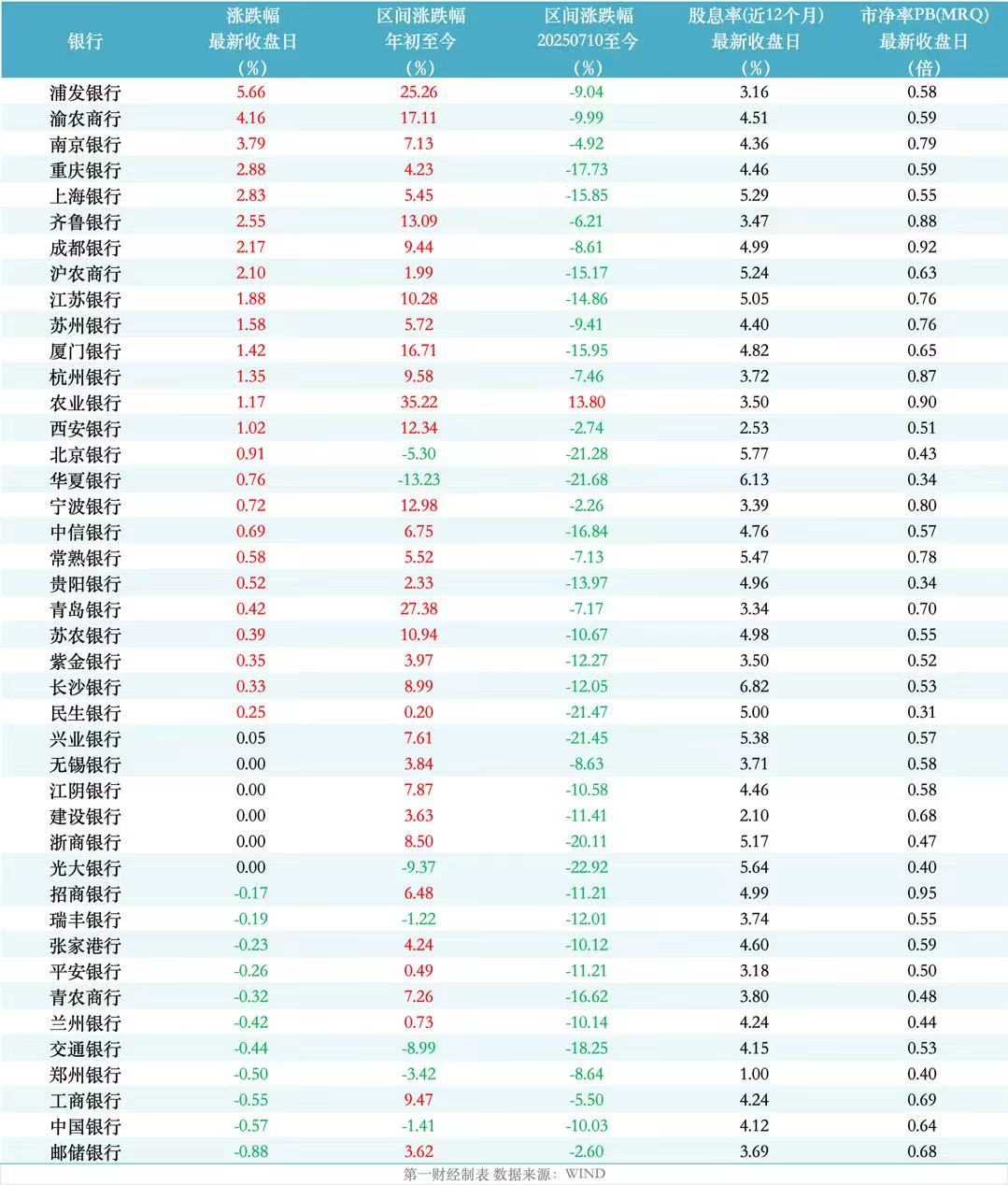
Core Viewpoint - The banking sector has experienced a notable rebound, with regional banks gaining favor, particularly led by Shanghai Pudong Development Bank, which rose by 5.66% on October 13, amidst a broader market correction [1][2]. Summary by Sections Market Performance - The China Securities Banking Index increased by 0.75% on October 13, with Shanghai Pudong Development Bank leading the gains [1][2]. - Other banks such as Chongqing Rural Commercial Bank and Nanjing Bank also saw significant increases of over 4% and 3%, respectively [1][2]. - In contrast, many state-owned banks experienced declines, with Postal Savings Bank down by 0.88% and Industrial and Commercial Bank down by 0.55% [2]. Investment Trends - The recent rally in bank stocks is attributed to a shift in market sentiment, with funds seeking temporary safe havens, leading to a preference for regional banks over larger state-owned banks [1][5]. - The banking sector has seen a cumulative decline of 14% since July, while the Shanghai Composite Index and CSI 300 Index have risen over 11% and 15%, respectively [3]. Economic Impact - The announcement of additional tariffs on Chinese goods by the U.S. is expected to have a controllable impact on banks, particularly affecting regional banks with higher exposure to foreign trade [6]. - The report from Galaxy Securities suggests that while the overall impact on banks is manageable, regional banks reliant on export-oriented businesses may face increased risks [6]. Future Outlook - Analysts predict that the upcoming dividend distribution period and stable bank performance may present opportunities for a rebound in bank stocks if market sentiment stabilizes [7]. - The banking sector's price-to-book (PB) ratio has fallen to 0.67, indicating potential value for investors, especially given the average dividend yield of state-owned banks at 4.11% [7][8].






防御需求再起,银行全天走强,百亿银行ETF(512800)逆市3连阳,7.6亿资金密集涌入
Xin Lang Ji Jin· 2025-10-13 11:49
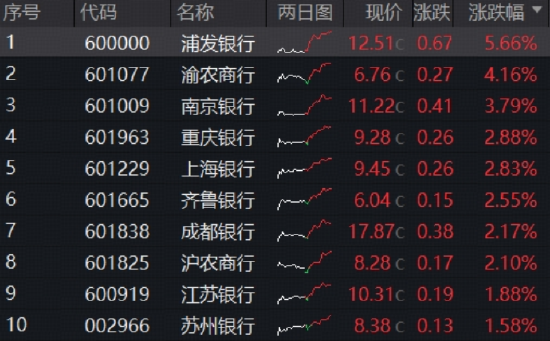
Core Viewpoint - The banking sector in A-shares has shown strong defensive performance amid increasing market volatility, with significant gains in multiple bank stocks [1][3]. Group 1: Stock Performance - A total of 42 bank stocks in A-shares closed in the green, with notable gains including Shanghai Pudong Development Bank up by 5.66%, Chongqing Rural Commercial Bank up over 4%, and Nanjing Bank up over 3% [1][2]. - The Bank ETF (512800) demonstrated resilience, rising by 0.9% after reaching a peak increase of 1.4%, with a total trading volume of 2.187 billion yuan, reflecting a 41% increase in volume compared to the previous period [2][3]. Group 2: Market Dynamics - The reduction in tariff uncertainties has lowered market risk appetite, leading to increased demand for defensive asset allocations, particularly benefiting the banking sector [3]. - The banking sector attracted a net inflow of 3.482 billion yuan from major funds, with the largest bank ETF (512800) seeing a total net inflow of 763 million yuan over the past three days [3]. Group 3: Long-term Outlook - Institutions maintain a stable profit outlook for the banking sector, with expectations for slight positive profit growth in the second half of 2025, driven by improved interest margins and increased impairment contributions [5]. - The banking ETF (512800) tracks the CSI Bank Index, which has a price-to-book ratio (PB) of 0.67, indicating a low valuation compared to historical levels, and a dividend yield of 4.26%, enhancing its attractiveness in a low-interest-rate environment [5][6]. - Recent announcements from listed banks regarding mid-term profit distribution plans indicate a growing trend in cash dividends, with state-owned banks expected to distribute over 200 billion yuan in cash dividends, reflecting their stable profitability and capital adequacy [5][6].
银行股逆势上涨,浦发银行涨超5%
Ge Long Hui· 2025-10-13 06:54
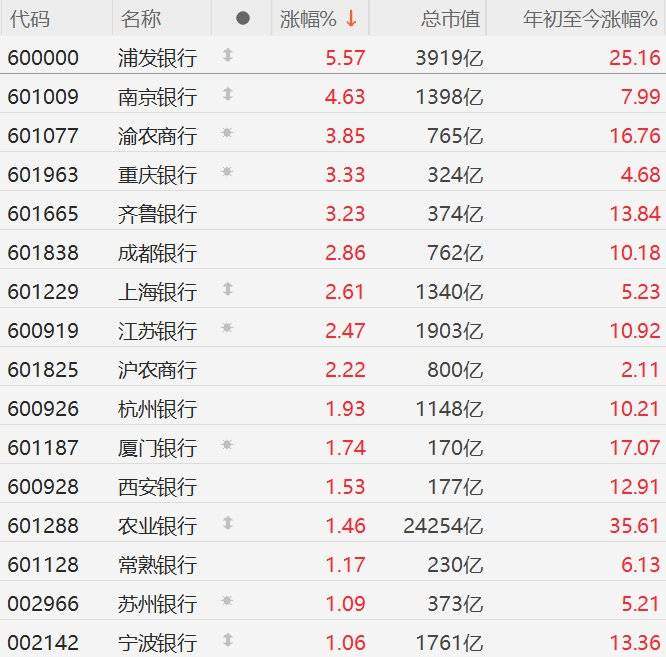
Core Insights - The A-share market saw a rise in bank stocks, with notable increases in shares of Pudong Development Bank and Nanjing Bank ahead of the "Eleventh" holiday [1][2] - Pudong Development Bank announced that Dongfang Asset increased its stake through the secondary market by purchasing common shares and convertible bonds [1] Summary by Category Stock Performance - Pudong Development Bank rose by 5.57%, with a total market capitalization of 391.9 billion and a year-to-date increase of 25.16% [2] - Nanjing Bank increased by 4.63%, with a market cap of 139.8 billion and a year-to-date rise of 7.99% [2] - Other banks such as Chongqing Bank, Qilu Bank, and Chengdu Bank also experienced gains ranging from 2.22% to 3.85% [2] Market Activity - The increase in bank stocks occurred despite broader market trends, indicating a specific interest in the banking sector [1] - The announcement from Pudong Development Bank regarding the stake increase by Dongfang Asset may have contributed to the positive sentiment in the banking stocks [1]

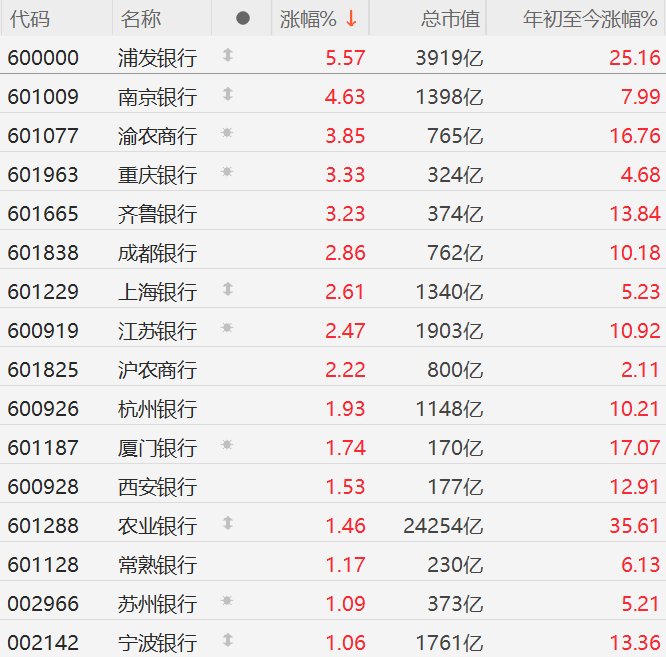
A股银行股逆势上涨,浦发银行涨超5%,南京银行涨超4%,渝农商行、重庆银行、齐鲁银行涨超3%,成都银行、上海银行涨超2%
Ge Long Hui· 2025-10-13 05:57
Core Insights - The A-share market has seen a rise in bank stocks, with notable increases in shares of several banks, particularly Shanghai Pudong Development Bank, which rose over 5% [1] - Shanghai Pudong Development Bank announced that Dongfang Asset Management increased its stake in the bank through the secondary market by purchasing common shares and converting convertible bonds [1] Summary by Category Stock Performance - Shanghai Pudong Development Bank (600000) increased by 5.57%, with a total market capitalization of 391.9 billion and a year-to-date increase of 25.16% [2] - Nanjing Bank (601009) rose by 4.63%, with a market cap of 139.8 billion and a year-to-date increase of 7.99% [2] - Other banks such as Chongqing Bank (601963) and Qilu Bank (601665) also saw increases of 3.33% and 3.23% respectively [2] Market Capitalization - The total market capitalization of major banks includes: - Agricultural Bank of China (601288) at 2,425.4 billion, with a year-to-date increase of 35.61% [2] - Jiangsu Bank (600919) at 190.3 billion, with a year-to-date increase of 10.92% [2] - Chengdu Bank (601838) at 76.2 billion, with a year-to-date increase of 10.18% [2] Investment Activity - Dongfang Asset Management's acquisition of shares in Shanghai Pudong Development Bank indicates a positive outlook and confidence in the bank's future performance [1]

A股银行股逆势上涨,浦发银行涨超5%
Ge Long Hui· 2025-10-13 05:48
格隆汇10月13日|A股市场银行股逆势上涨,其中,浦发银行涨超5%,南京银行涨超4%,渝农商行、 重庆银行、齐鲁银行涨超3%,成都银行、上海银行、江苏银行、沪农商行涨超2%。消息面上, "十 一"假期前,浦发银行发布公告称,东方资产通过二级市场购入普通股及可转债转股的形式增持该银行 股份。 ...
本周聚焦:银行股中期分红阵营扩大,国有大行分红超2000亿元
GOLDEN SUN SECURITIES· 2025-10-12 09:43
Investment Rating - The report indicates a positive outlook for the banking sector, particularly highlighting the increased mid-term dividend distributions from listed banks, with state-owned banks leading the way with over 200 billion yuan in dividends [2][3]. Core Insights - The report emphasizes that the mid-term dividend plans from listed banks reflect their stable profitability and capital adequacy, which is crucial in the current low-interest-rate environment. High dividend policies are expected to boost market confidence and enhance the defensive value of bank stocks for long-term investment [3][4]. - The report suggests that while short-term export impacts may arise from tariff policies, long-term domestic policies aimed at stabilizing the real estate market, promoting consumption, and enhancing social welfare are likely to support economic growth. The banking sector is expected to benefit from these policy catalysts [4]. Summary by Sections Dividend Distribution - Several banks have completed their mid-term dividend plans, with notable distributions including: - Industrial and Commercial Bank of China: 0.1414 yuan per share, totaling 50.396 billion yuan - China Construction Bank: 0.1858 yuan per share, totaling 48.605 billion yuan - Agricultural Bank of China: 0.1195 yuan per share, totaling 41.823 billion yuan - Bank of China: 0.1094 yuan per share, totaling 35.250 billion yuan - Bank of Communications: 0.1563 yuan per share, totaling 13.811 billion yuan - Postal Savings Bank: 0.1230 yuan per share, totaling 14.772 billion yuan [2][3][14]. Sector Performance - The report notes that the banking sector is expected to see a positive performance due to policy support and economic recovery, with specific banks like Ningbo Bank, Jiangsu Bank, Chengdu Bank, Shanghai Bank, and Hu'nong Commercial Bank recommended for investment based on their improving fundamentals [4][8]. Key Data Tracking - The average daily trading volume for stocks reached 26,032.76 billion yuan, an increase of 4,154.20 billion yuan from the previous week [8]. - The balance of margin financing increased by 0.70% to 2.44 trillion yuan [8]. - The issuance of non-monetary funds decreased significantly, with a total of 11.30 billion yuan issued this week, down 56.07 billion yuan from the previous week [8].
十余家银行关停旗下App,功能整合至手机银行
Cai Jing Wang· 2025-10-12 08:18
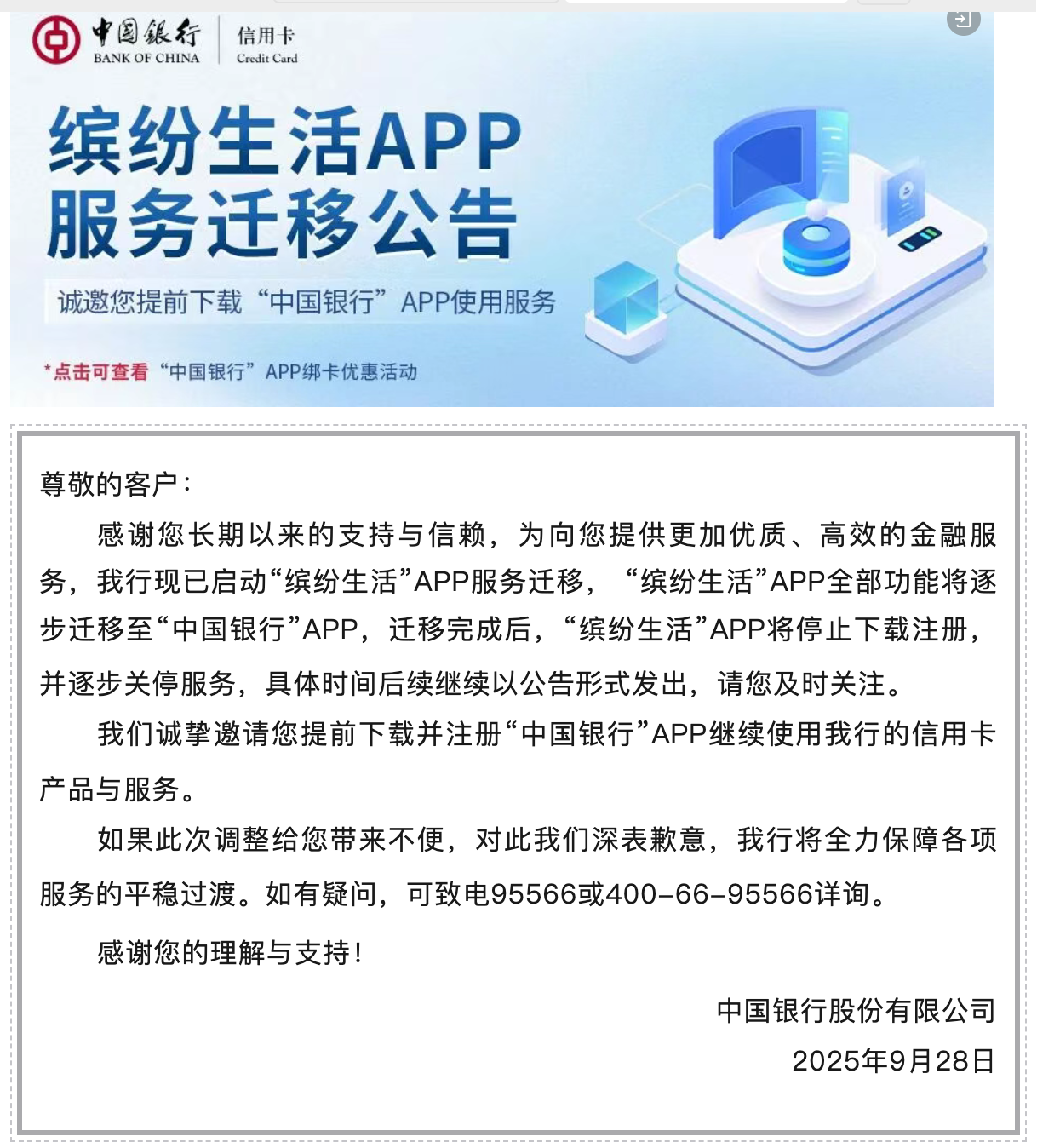
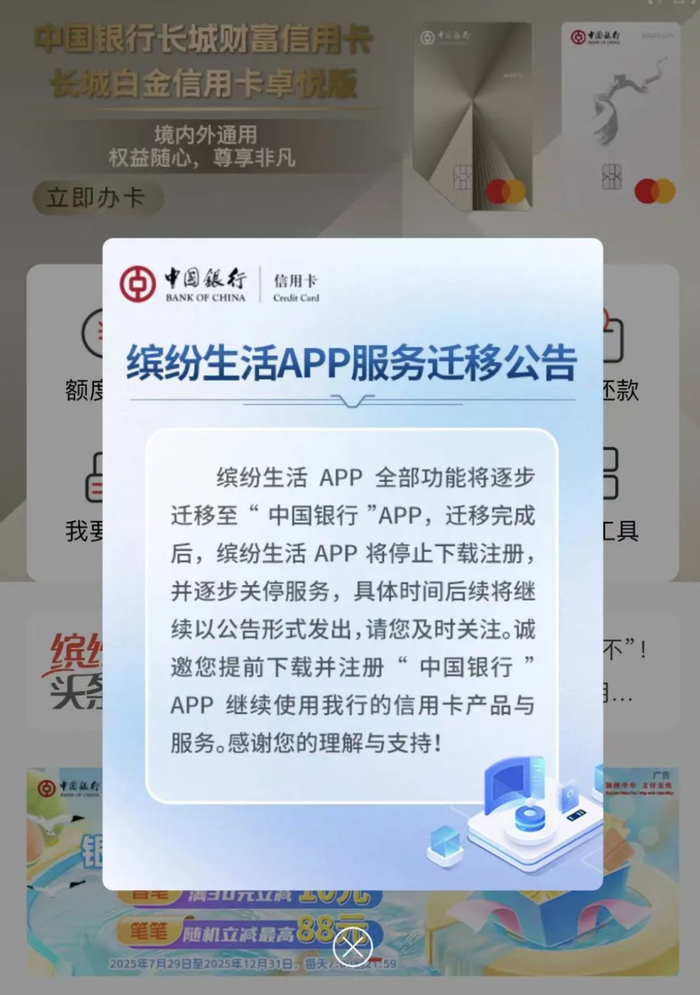
Core Viewpoint - Multiple banks in China are shutting down their mobile applications, particularly credit card and direct banking apps, as part of a trend towards consolidating services into fewer platforms [1][2][3] Group 1: App Shutdowns - Over 10 banks have closed or are in the process of closing various mobile apps this year, including credit card apps and lifestyle service apps [1] - The "缤纷生活" app from China Bank is migrating its services to the main "中国银行" app, with plans to cease operations of the former [1][4] - Other banks, such as Beijing Rural Commercial Bank and Jiangxi Bank, have also migrated their credit card app functionalities to their main banking apps [2] Group 2: Regulatory Environment - The National Financial Regulatory Administration issued a notice in September 2024 emphasizing the need for banks to manage mobile applications more effectively, including maintaining a record of apps and optimizing or terminating those with low user engagement or high risks [3] - As of June 2025, 2,664 mobile financial apps have completed registration, with 75 apps being deregistered in the first half of 2025 [3] Group 3: Industry Analysis - The initial rush to develop multiple banking apps has led to issues such as poor customer experience and redundant internal systems, prompting a need for consolidation [3]
沪两家万亿级银行高管换防:新局开启,挑战重重
Xin Lang Cai Jing· 2025-10-11 05:11
Core Viewpoint - The recent executive changes between Shanghai Bank and Shanghai Rural Commercial Bank reflect a normal personnel rotation within Shanghai's financial state-owned enterprises, with both banks facing industry challenges and internal issues that require strategic responses [1][9]. Group 1: Executive Changes - In August 2023, there was a notable executive swap between Chengdu Bank and Chengdu Rural Commercial Bank, with Wang Hui becoming the chairman of Chengdu Rural Commercial Bank and Huang Jianjun taking over as chairman of Chengdu Bank [1]. - On October 9, 2023, Shanghai Rural Commercial Bank announced the approval of Wang Ming's appointment as chairman, who previously served as the vice president of Shanghai Bank [1][2]. - Gu Jianzhong, the former president of Shanghai Rural Commercial Bank, transitioned to Shanghai Bank as chairman, with his appointment approved on August 1, 2023 [1][2]. Group 2: Performance Metrics - As of June 30, 2025, Shanghai Rural Commercial Bank's total assets reached 1.55 trillion yuan, a 4.14% increase from the end of 2024, while Shanghai Bank's total assets were 3.3 trillion yuan, growing by 2.08% [4]. - In the first half of 2025, Shanghai Bank reported operating income of 27.344 billion yuan, a year-on-year increase of 4.18%, and a net profit attributable to shareholders of 13.231 billion yuan, up 2.02% [5]. - Shanghai Bank's non-performing loan ratio stood at 1.18% as of June 30, 2025, remaining stable compared to the previous year [5]. Group 3: Challenges Faced - Shanghai Bank's asset growth rate of 2.18% in the first half of 2025 lagged behind peers such as Jiangsu Bank, which saw a growth of 26.99% [6]. - Shanghai Rural Commercial Bank experienced a revenue decline of 3.40% in the first half of 2025, marking it as the only bank in the Yangtze River Delta with negative revenue growth [8]. - The net interest margin for Shanghai Rural Commercial Bank decreased to 1.39%, a drop of 17 basis points year-on-year, indicating ongoing pressure on profitability [8].

信用卡App整合:从“规模扩张”到“质量深耕”
Zheng Quan Ri Bao· 2025-10-10 15:52
Core Viewpoint - The Bank of China has initiated the migration of its credit card app "Bountiful Life" to the main "Bank of China" app, marking a significant trend in the banking industry towards consolidating financial services apps [1][2]. Group 1: Industry Trends - The closure of credit card apps has primarily been seen in smaller banks, but now major state-owned banks are following suit, indicating a shift in the industry [2]. - The trend reflects a broader industry movement where banks are responding to regulatory pressures and changing consumer preferences, leading to the closure of inefficient apps [3][4]. Group 2: Digital Transformation - The integration of credit card apps is part of a larger digital transformation in the banking sector, moving from a focus on scale to quality [4]. - The regulatory environment has accelerated this process, with guidelines issued in September 2024 prompting banks to optimize or terminate underperforming apps [4]. Group 3: Future Implications - The migration signifies a shift from a fragmented app ecosystem to a more unified platform approach, enhancing user engagement and operational efficiency [5]. - Recommendations for future digital transformation include optimizing mobile ecosystems, enhancing digital capabilities, exploring diversified services, and ensuring compliance and security during data migration [5].
又一银行公告下架!信用卡APP正在渐次退场
Bei Ke Cai Jing· 2025-10-10 09:55
Core Viewpoint - The independent credit card apps of several banks, including China Bank, are being phased out in favor of integrating credit card services into their main banking apps, reflecting a broader trend in the industry towards consolidation and cost efficiency [2][3][4]. Group 1: Bank Actions - China Bank announced the shutdown of its credit card app "Bountiful Life," with all functions migrating to the main "China Bank" app, leading to the eventual discontinuation of the independent app [2][5]. - Other banks, such as Bohai Bank and Beijing Rural Commercial Bank, have also ceased operations of their independent credit card apps, indicating a collective shift in the banking sector [3][20]. - The trend of merging credit card functionalities into main banking apps is not isolated, as multiple banks have already taken similar actions over the past few years [3][21]. Group 2: Industry Insights - Experts suggest that the initial goal of independent credit card apps was to enhance customer engagement, but the results have been disappointing, leading to increased operational costs without significant user retention [3][22]. - The profitability pressure on credit card businesses has made maintaining independent apps economically unfeasible, prompting banks to consolidate services to reduce costs and improve efficiency [4][27]. - The decline in active users of credit card apps contrasts with the growth in mobile banking app usage, highlighting a shift in consumer behavior towards more comprehensive banking solutions [24][25]. Group 3: Market Trends - The credit card industry is experiencing a downturn, with a reported decrease of 34 million credit cards over the past year, reflecting broader economic challenges [30][34]. - Data from the central bank indicates a decline in the total number of credit cards and combined lending cards, dropping from a peak of 798 million to 715 million [30]. - Banks are now focusing on refining their strategies to retain existing customers and adapt to changing consumer spending habits, moving away from aggressive customer acquisition tactics [34][35].