
欧陆通

Search documents
欧陆通-与美国云服务商的研发合作,2027 年或贡献销售收入
2026-01-21 02:58
Summary of Honor Electronic (300870.SZ) Conference Call Company Overview - **Company**: Honor Electronic (300870.SZ) - **Industry**: Server Power Supply (PSU) Market Key Points R&D Partnership and Sales Outlook - Honor has established an R&D partnership with a US-based Cloud Service Provider (CSP) for next-generation server power supplies, with potential sales contributions expected in 2027 after production tests in 2026 [1] - The company aims for a 10% wallet share in the first-batch order, which is considered optimistic due to its smaller historical sales in GPU/CPU server power supplies compared to incumbents [1] Product Compatibility and Market Position - Most of Honor's products are compatible with mainstream AI accelerators from both global and domestic GPU brands, as well as domestic ASIC makers [1] - The highest power supply currently available in the domestic market is 5.5kW, with most projects deployed in China and some in Southeast Asia [1][5] Capacity Expansion Plans - Honor plans to add approximately Rmb1 billion in capacity in Suzhou, China by the end of 2026 [6] - A factory in Vietnam is also operational, supporting 15-20% of total production [6] - Capacity addition is relatively straightforward, taking about two quarters from equipment purchase to production readiness [6] Pricing and Margins - Current Average Selling Prices (ASP) are Rmb0.7-0.8/W for 5.5kW PSUs and Rmb0.3-0.4/W for 3-4kW PSUs [7] - Gross Profit Margin (GPM) for high-power PSUs (≥2kW) was approximately 28% in the first three quarters of 2025, while low-power PSUs had a GPM of only 10-20% due to intense competition [7] New Product Development - Honor is developing PSUs in the range of 8-19kW, although there is no immediate demand from customers [8] - The company is also preparing for the industry transition towards 800V DC architecture by developing PSUs that support 800V/400V DC input [8] Competitive Landscape - The global server power supply market is seeing an influx of new entrants, but mass production capabilities, especially for high-power products, remain a significant challenge for these new players [6][1] Domestic Market Presence - Honor is a key PSU supplier in the domestic server market, directly supplying major Chinese Original Design Manufacturers (ODMs) such as Inspur and Foxconn [2][5] Strategic Engagements - The company is in early-stage discussions with multiple overseas CSPs and ODMs to expand its customer base [1] Additional Insights - The partnership with the US CSP aims to diversify supplier risk and leverage Honor's product quality, R&D responsiveness, and service capabilities [1] - The company has been supplying adapters to the US CSP for its residential AIoT products since 2023, indicating a growing relationship [1] This summary encapsulates the critical insights from the conference call regarding Honor Electronic's strategic initiatives, market positioning, and future outlook in the server power supply industry.
十五五电网投资观点梳理
2026-01-21 02:57
Summary of Key Points from Conference Call Records Industry Overview - The focus is on the electric power industry, specifically the initiatives and investments by the State Grid Corporation of China (SGCC) to enhance the electric grid infrastructure and support renewable energy projects [1][2]. Core Insights and Arguments - **Investment Plans**: In 2026, SGCC plans to invest 4 trillion yuan in fixed assets, a significant increase from 2.85 trillion yuan during the previous five-year period, marking a new phase of high-intensity construction aimed at building a new power system to adapt to renewable energy and carbon neutrality goals [2]. - **Strengthening the Grid Platform**: SGCC aims to enhance the grid platform by focusing on UHV (Ultra High Voltage) construction to support the development of wind and solar resources in the western regions and hydropower projects in the southwest. Key equipment such as transformers, GIS (Gas Insulated Switchgear), and converters will see increased demand, benefiting companies like Pinggao Electric, China XD Electric, and XJ Electric [1][4]. - **Improving Regulation Capabilities**: SGCC is investing in virtual power plants, energy storage technologies, and digital upgrades of distribution networks, with a focus on smart terminals and automated distribution systems. Companies like Dongfang Electronics and Sifang Co. are expected to benefit from these investments [1][5]. - **Technological Empowerment**: The company is actively investing in technologies such as drone inspections and AI applications to enhance operational capabilities. Companies like Dongfang Electronics and Sifang Co. are positioned to benefit from these technological advancements [1][6][7]. - **Electric IT and Software Development**: A robust software platform is essential for digital transformation in areas like scheduling, marketing, and asset management. Companies like State Grid Information and Yuanguang Software are expected to benefit from these developments [1][8]. Additional Important Insights - **Global Market Opportunities**: There is a strong demand for electric equipment globally, particularly in North America and Southeast Asia, which presents significant growth opportunities for Chinese companies. The focus should be on capturing new cyclical development opportunities in these markets [3][9]. - **Space Photovoltaics Investment Logic**: The investment logic in space photovoltaics includes reduced launch costs due to commercial space advancements, increased power output per satellite, and the application of new technologies. Companies like Junda and Dongfang Risheng are leading in this field [3][10][11]. - **AIDC Power Trends**: The tightening of power supply in North America has led to increased electricity prices, driven by the demand from data centers. This trend is expected to continue, providing growth opportunities for Chinese power supply companies entering the North American market [3][12]. - **Investment Themes**: Current market themes include space photovoltaics, AIDC power, and solid-state batteries, which have clear long-term demand and investment value. The recent electric grid investment plans are likely to boost related equipment markets in the short term [3][13].
趋势研判!2026年中国电源监控行业概述、市场现状、重点企业及行业趋势分析:“双碳”目标与新型电力系统建设持续深化,市场对电源监控需求攀升[图]
Chan Ye Xin Xi Wang· 2026-01-21 01:21
Core Insights - The "dual carbon" goals and the construction of a new power system are accelerating the demand for high-precision and reliable power monitoring systems, driven by the rapid deployment of smart grids, renewable energy generation, and energy storage projects [1][6] - The Chinese power monitoring industry is projected to reach a market size of approximately 1.057 billion yuan in 2024, representing a year-on-year growth of 6.02% [1][7] Industry Overview - Power monitoring is a comprehensive technology system for real-time monitoring, data collection, fault alarm, and remote control of power systems, aimed at ensuring stable power supply and preventing equipment downtime and data loss [2] - The system utilizes sensors, monitoring hosts, and communication networks to collect key parameters such as voltage, current, frequency, power, and temperature, identifying faults like overvoltage, undervoltage, overcurrent, and phase loss [2] Market Size - The market for power monitoring is expected to grow significantly due to the increasing requirements for precision and reliability in power monitoring systems, driven by the integration of AIoT technologies [1][7] - The demand for voltage transformers is also expected to rise, with the market projected to reach approximately 14 billion yuan in 2024, growing by 3.70% year-on-year [6] Key Companies - Major players in the power monitoring industry include Maoshuo Power, Oulutong, Hikvision, Dahua Technology, and others, each specializing in different aspects of power monitoring and control systems [2][8] - Maoshuo Power focuses on high-efficiency and high-stability power monitoring systems, while Hikvision integrates power monitoring into smart city solutions [9] Industry Development Trends 1. **Intelligent Upgrades**: The industry is shifting from passive monitoring to proactive prediction, leveraging AI and IoT technologies for predictive maintenance and operational optimization [10] 2. **Expanded Application Scenarios**: The market is evolving from traditional grid-side monitoring to a comprehensive energy ecosystem, including renewable energy sources and electric vehicle charging stations [10] 3. **Value Transition**: The competition is moving from hardware products to software-defined service platforms, emphasizing integrated solutions that combine smart hardware, analytical software, and cloud services [11][12]




其他电源设备板块1月20日跌1.63%,欧陆通领跌,主力资金净流出12.62亿元
Zheng Xing Xing Ye Ri Bao· 2026-01-20 08:56
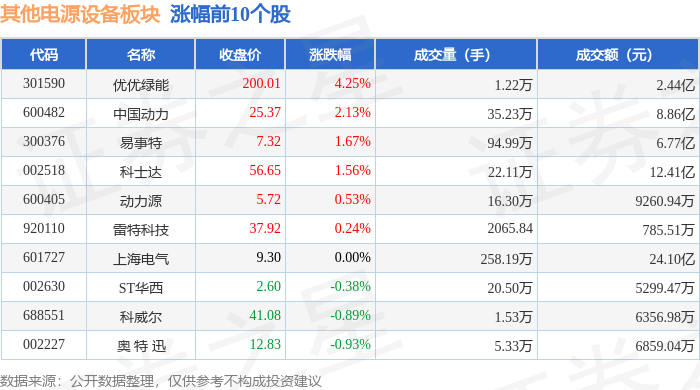
Market Overview - The other power equipment sector declined by 1.63% on January 20, with Oulutong leading the drop [1] - The Shanghai Composite Index closed at 4113.65, down 0.01%, while the Shenzhen Component Index closed at 14155.63, down 0.97% [1] Stock Performance - Yoyo Green Energy (301590) saw a closing price of 200.01, with an increase of 4.25% and a trading volume of 12,200 hands, amounting to 244 million yuan [1] - China Power (600482) closed at 25.37, up 2.13%, with a trading volume of 352,300 hands, totaling 886 million yuan [1] - Other notable stocks include Easy Special (300376) at 7.32 (+1.67%), Keda (002518) at 56.65 (+1.56%), and Power Source (600405) at 5.72 (+0.53%) [1] Capital Flow - The other power equipment sector experienced a net outflow of 1.262 billion yuan from main funds, while retail funds saw a net inflow of 720 million yuan [2] - The main funds' net inflow for China Power was 40.75 million yuan, while retail funds had a net outflow of 62.80 million yuan [3] - Yoyo Green Energy had a net inflow of 18.43 million yuan from main funds, but a net outflow of 18.23 million yuan from retail funds [3]
AIDC电源革命开启-2026从预期到现实
2026-01-20 01:50
Summary of Key Points from the Conference Call Industry Overview - The conference call focuses on the AIDC (Artificial Intelligence Data Center) power supply revolution, highlighting significant advancements in data center chip power consumption and cabinet power density, with expectations for substantial growth in power requirements by 2028 [1][7]. Core Insights and Arguments - **Power Consumption Trends**: Data center chip power consumption has increased dramatically, with NVIDIA's Ruby chip consuming between 1,800 to 3,600 watts, a tenfold increase from the Titan X's 250 watts a decade ago [5]. Similar trends are observed in Google's TPU chips and other major players like Microsoft and Meta [5]. - **Cabinet Power Density**: The power density of data center cabinets has significantly improved, with NVIDIA's cabinets reaching megawatt levels, up from approximately 10 kilowatts in 2020 [6]. Google is also expected to achieve similar advancements with its Super Pod, targeting 10 megawatts by 2025 [6]. - **Future Power Requirements**: By 2028, North America is projected to add around 70 gigawatts of power for AI data centers, with global additions expected to reach 100 gigawatts [7]. - **Power Supply Strategies**: Both NVIDIA and Google have outlined four-step strategies for data center power supply, focusing on transitioning from traditional UPS systems to high-efficiency solutions like medium-voltage rectifiers and solid-state transformers (SST) [8][9]. - **OCP Standards Evolution**: The OCP (Open Compute Project) has iterated its power supply standards, significantly increasing the power capacity of server PSUs and transitioning to external power shelves, enhancing overall efficiency [10]. Investment Opportunities - **AIDC Power Supply Iteration**: Investment opportunities are identified in four main areas: AIDC power supply hosts (PSUs, HVDC, SST), energy storage at the power station level, core components (solid-state circuit breakers, supercapacitors, DCDC converters), and third-generation semiconductors (SiC and GaN) [3]. - **Energy Storage Market**: The U.S. energy storage market for data centers is expected to exceed 100 GWh by 2028, driven by new regulations encouraging self-built generation facilities and energy storage systems [4][25]. - **Core Component Development**: The shift to new technologies is driving the development of core components, such as solid-state circuit breakers, which are expected to see increased adoption due to their rapid response characteristics [4][26]. Additional Important Insights - **Market Dynamics**: The AI chip capacitor market is dominated by Samsung and Murata, with significant demand for high-end capacitors driven by AI technology advancements [16]. The value of inductors in AI applications has also increased significantly, reflecting the rising power requirements [18]. - **Material Requirements**: AI chips have stringent material requirements, with high margins for suppliers who can meet performance specifications [19]. Companies like 博迁新材 (Bojian New Materials) are noted for their advanced capabilities in supplying nano-powders essential for AI applications [20]. - **Regulatory Impact**: New U.S. regulations are pushing data centers to adopt energy storage systems to enhance grid responsiveness, particularly in regions like Texas, where demand response capabilities are becoming critical [23][24]. - **Future Trends in Power Supply**: The PSU market is projected to reach a scale of billions in the next three years, driven by the expansion of IDC facilities and the adoption of HVDC technology [30][32]. - **Domestic Manufacturers' Advantages**: Domestic manufacturers in the power electronics sector are noted for their rapid technological advancements and broad application, positioning them favorably in the market [34]. This summary encapsulates the key points discussed in the conference call, providing insights into the evolving landscape of the AIDC power supply industry and potential investment opportunities.


AIDC供电三重挑战下,SST率军突围
Zhong Guo Neng Yuan Wang· 2026-01-20 01:18
Core Insights - The rapid development of global intelligent computing centers is leading to an explosive growth in energy consumption, with the total computing power in China expected to reach 780,000 Pfops by July 2025, ranking second in the world [2] - The expansion of computing power is causing a significant increase in energy consumption, with data center electricity usage projected to reach between 405.1 billion to 530.1 billion kilowatt-hours from 2024 to 2030, and the AIDC energy consumption expected to be 77.7 billion kilowatt-hours in 2025 [2] Energy Supply Challenges - The power supply system faces three major challenges: 1. Stability of supply: The existing power supply system struggles to adapt to the load fluctuations of intelligent computing centers, which can vary by up to 50% [2] 2. Cost control: Electricity costs account for 57% of operational expenses, significantly surpassing depreciation, rent, and labor costs [2] 3. Carbon emission management: Policies require that over 80% of the electricity for new data centers comes from renewable sources, yet 63% of data centers currently have a PUE above 1.2 [2] Energy Solutions and Innovations - To overcome power constraints, a diversified energy network comprising solar, wind, storage, and nuclear energy is necessary [2] - Dynamic adjustments in GPU frequency and task migration across data centers can enhance computing flexibility, while technologies like liquid cooling and waste heat utilization can reduce PUE and improve energy efficiency [2] Power Supply Architecture Evolution - The power supply architecture is evolving from UPS to high-voltage direct current (HVDC), Panama power systems, and solid-state transformers (SST) [3] - SST solutions can achieve system efficiencies of 98.5%, with a single power cabinet outputting 1 MW, significantly reducing space requirements and aligning with the needs of next-generation intelligent computing centers [3] - The domestic AIDC installed capacity is projected to reach 17.7 GW by 2030, with the SST market space estimated at approximately 13.27 billion yuan, and a compound annual growth rate of 64.9% from 2024 to 2030 [3] Investment Recommendations - Key companies to focus on include: 1. SST technology leaders: Sifang Co., China West Electric, Jinpan Technology, and TBEA [3] 2. 800V HVDC systems: Zhongheng Electric, Kehua Data, and Hewei Electric [3] 3. AI server power supplies: Magpow, Oulu Tong, and Aike Saibo [3] 4. Solid-state circuit breakers: Taiyong Changzheng and Liangxin Co. [3] - Additionally, potential targets include New Special Electric, New Fengguang, Shenghong Co., and companies involved in power semiconductors and upstream materials like Yunlu Co., Sanan Optoelectronics, and Innosec [3]
WiFi 6概念下跌1.79%,11股主力资金净流出超亿元
Zheng Quan Shi Bao Wang· 2026-01-19 09:21
Group 1 - The WiFi 6 concept sector experienced a decline of 1.79%, ranking among the top losers in the concept sector, with Cambridge Technology hitting the limit down [1][2] - Within the WiFi 6 sector, 43 stocks saw net outflows from main funds, with 11 stocks experiencing outflows exceeding 100 million yuan, led by Cambridge Technology with a net outflow of 811 million yuan [2][3] - The top gainers in the WiFi 6 sector included Wanlong Optoelectronics, Guokewi, and Unisplendour, which rose by 5.39%, 4.62%, and 2.77% respectively [1][4] Group 2 - The flexible DC transmission concept led the market with a gain of 5.14%, while the WiFi 6 concept was among the worst performers [2] - Major stocks with significant net outflows included Fenghuo Communication, Xinyi Communication, and Tongyu Communication, with net outflows of 674 million yuan, 668 million yuan, and 270 million yuan respectively [2][3] - The top stocks with net inflows included Unisplendour, Oulutong, and Guokewi, with inflows of 523 million yuan, 62.97 million yuan, and 47.50 million yuan respectively [4]


其他电源设备板块1月19日涨2.8%,海博思创领涨,主力资金净流入3.85亿元
Zheng Xing Xing Ye Ri Bao· 2026-01-19 08:58
Market Performance - The other power equipment sector increased by 2.8% compared to the previous trading day, with Haibo Sichuang leading the gains [1] - The Shanghai Composite Index closed at 4114.0, up 0.29%, while the Shenzhen Component Index closed at 14294.05, up 0.09% [1] Individual Stock Performance - Haibo Sichuang (688411) closed at 278.50, up 11.07% with a trading volume of 77,000 shares and a transaction value of 2.038 billion [1] - Maigemeite (002851) closed at 106.50, up 8.50% with a trading volume of 338,200 shares and a transaction value of 3.537 billion [1] - Yingjie Electric (300820) closed at 59.00, up 8.46% with a trading volume of 125,300 shares and a transaction value of 722 million [1] - Other notable stocks include Dongfang Electric (600875) up 5.91% and Xifeng Energy (300593) up 5.25% [1] Capital Flow Analysis - The other power equipment sector saw a net inflow of 385 million from institutional investors, while retail investors experienced a net outflow of 13.51 million [2] - The main stocks with significant capital inflow include Maigemeite with 254 million and Haibo Sichuang with 168 million [3] - Retail investors showed a net outflow in several stocks, including Maigemeite and Haibo Sichuang, indicating a shift in investor sentiment [3]


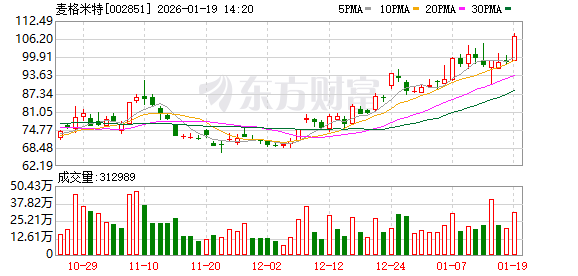
A股电源设备板块午后维持活跃,麦格米特涨停
Mei Ri Jing Ji Xin Wen· 2026-01-19 06:20
Group 1 - The A-share power equipment sector remained active in the afternoon on January 19, with Magpower hitting the daily limit up [2] - Newray Energy, Oulu Tong, Shenghong Shares, and Haibo Sichuang also experienced gains [2]
十五五-国网投资出台-电力设备再迎景气周期
2026-01-19 02:29
Summary of Conference Call Notes Industry Overview - The conference call discusses the investment plans of the State Grid Corporation of China, indicating a significant increase in investment, which is expected to usher in a new high-intensity construction cycle focused on ultra-high voltage (UHV) construction, benefiting core equipment suppliers like Pinggao Electric and China Western Power [1][2]. Key Points and Arguments Investment Goals - The core goal of the State Grid's investment in 2026 is to build a new power system that aligns with renewable energy and carbon neutrality targets. The investment plan amounts to 4 trillion yuan, a significant increase from 2.85 trillion yuan during the previous five-year period, marking the start of a new high-intensity construction cycle [2]. Strengthening the Power Grid Platform - Specific measures to strengthen the power grid platform include UHV construction and investment in main network equipment. UHV construction is crucial for supporting the development of wind and solar resources in the western regions and hydropower projects in the southwest. Key equipment includes transformers, GIS switchgear, and converters, with companies like Pinggao Electric and China Western Power having significant advantages in these areas [3]. Enhancing Regulation Capabilities - Enhancing regulation capabilities focuses on improving source-side and composite-side regulation. This includes attention to energy storage applications and the prediction of unstable renewable energy generation, such as solar power. The demand for power software and virtual power plants is increasing, necessitating customized development [5]. Strengthening Technological Empowerment - The State Grid is actively adopting emerging technologies such as drone inspections and AI to enhance operational efficiency and automation. These technologies are applied in inspection robots and online monitoring systems, with major technological projects promoting the widespread application of new technologies in society [6]. Investment Focus on Distribution Network - Investment in the distribution network emphasizes digital upgrades, including the integration of primary and secondary systems, smart terminals, distribution automation, and smart meters. Companies like Oriental Electronics lead in distribution automation, while Sanxin Medical and Haixing Electric are prominent in the smart meter sector [7]. Development Trends in New Energy Storage Equipment - New energy storage equipment is focused on enhancing peak regulation capabilities, with independent storage business models becoming clearer due to capacity pricing policies. The domestic market is expected to maintain good growth through 2026, with companies like Sungrow, CATL, and EVE Energy being competitive in system integration and battery cell fields [8]. Opportunities in Power IT and Software - The power IT and software sector requires robust software platforms to support digital transformation, including scheduling, marketing, and asset management. Companies like Yuan Guang Software are deeply integrated with State Grid clients and are expected to benefit from future upgrades [9]. Global Market Impact on Chinese Enterprises - The global market significantly impacts Chinese enterprises, as they possess strong global competitiveness in power equipment. The demand for maintenance and construction in North America, Southeast Asia, Europe, and the Americas presents new opportunities for Chinese companies [10]. Investment Logic in Space Photovoltaics - The space photovoltaic sector has three main investment logics: reduced launch costs due to commercial space initiatives, increased power capacity of satellites, and the potential rise of perovskite technology. These factors are expected to drive future demand in space power applications [12]. Companies to Watch in Space Photovoltaics - Investment in space photovoltaics can be categorized into three tiers: - Tier 1 includes companies like Junda, Oriental Sunrise, and Shanghai Port, which have been early movers in the sector. - Tier 2 includes companies like Mingyang Smart Energy and Tianhe Solar, which have existing or potential layouts in space photovoltaics. - Tier 3 consists of membrane companies and potential equipment manufacturers that may benefit from the sector's growth [13]. AIDC Market Outlook - The AIDC market outlook is positive, with the U.S. government promoting technology companies to bid for long-term power supply contracts to address electricity supply issues. The average retail electricity price in the U.S. is expected to rise by 7.4% in 2026, driven by increased demand from data centers [14]. Current Thematic Investment Opportunities - Current market themes include the recent rollout of grid investment plans, which may drive clear market trends. The space photovoltaic sector, AIDC power supply, and solid-state batteries are identified as areas with significant thematic investment opportunities [15].