Synchrony Financial

Search documents
美股异动 | 支付概念板块延续昨日跌势 Visa(V.US)跌超3.8%
智通财经网· 2026-01-13 15:00
Core Viewpoint - The payment sector continues to decline, with significant drops in major companies' stock prices, driven by concerns over potential regulatory changes affecting credit card interest rates [1] Group 1: Stock Performance - Bread Financial (BFH.US) and Synchrony Financial (SYF.US) both fell over 1% [1] - American Express (AXP.UE) declined nearly 1% [1] - Visa (V.US) dropped over 3.8% and Mastercard (MA.US) fell by 3.5% [1] - Affirm Holdings (AFRM.US) experienced a decline of over 5% [1] - Major bank stocks also decreased, with Bank of America (BAC.US) and Citigroup (C.US) down by 0.5%, and JPMorgan Chase (JPM.US) falling over 2.6% [1] Group 2: Market Concerns - President Trump’s call for a 10% cap on credit card interest rates has raised concerns about the profitability of banks and credit card companies [1]

U.S. Stock Market Navigates CPI Data and Kicks Off Earnings Season Amid Geopolitical Tensions
Stock Market News· 2026-01-13 14:07
Market Overview - U.S. stock markets are experiencing volatility as investors react to inflation data and the start of the fourth-quarter earnings season, with major indexes previously closing at record highs [1][5] - Premarket trading showed a mixed trend, with Nasdaq 100 futures down 0.2% to 0.3%, and S&P 500 and Dow Jones futures declining by 0.1% to 0.2% [2] - Following the release of the December Consumer Price Index (CPI), futures for major indexes reversed earlier declines, with Nasdaq 100, S&P 500, and Dow Jones futures rising by 0.2%, 0.2%, and 0.1% respectively [3] Commodities and Currency - Gold futures remained stable near record highs, while silver futures surged to an all-time high of $87.56 per ounce [4] - WTI crude oil futures increased by approximately 2% to $60.70 per barrel, influenced by geopolitical tensions and potential tariffs on countries doing business with Iran [4] - Bitcoin was trading around $92,000, and the U.S. dollar index rose by 0.1% to 98.92 [4] Earnings Reports - The fourth-quarter earnings season commenced, with JPMorgan Chase & Co. reporting a drop in profit due to a one-time charge, but excluding this charge, profits increased [8][13] - Delta Air Lines experienced a premarket decline of 4-5% after releasing profit forecasts that fell short of market expectations [13] - Other companies reporting include Bank of New York Mellon and Concentrix, with Delta's results particularly scrutinized for insights into the travel industry's health [8] Stock Movements - L3Harris Technologies shares surged by 11-12% after announcing plans to spin off its Missile Solutions business, supported by a $1 billion investment from the Defense Department [13] - Chipmakers Intel and AMD saw gains of 3.6% and 2.6% respectively, following an upgrade to "overweight" by KeyBanc due to strong data-center demand [13] - Alphabet's stock rose by 0.68% after achieving a $4 trillion market valuation, bolstered by news of Google Gemini enhancing Apple's Siri [13] Other Corporate News - Xpeng Inc. ADR shares dipped 2.63% despite plans to establish localized supply chain teams in Europe and ASEAN [13] - Travere Therapeutics saw a significant slump of 28% after an FDA request for clarification on its therapy's clinical benefits [13] - Synopsys shares fell 2.3% following a downgrade to "neutral" by Piper Sandler, citing growth headwinds [13] - Credit card companies stabilized in premarket trading after experiencing declines due to proposed caps on interest rates [13] - Walmart gained on news of its inclusion in the Nasdaq 100 index [13]





S&P Futures Muted as Investors Weigh JPMorgan Earnings, U.S. Inflation Data in Focus
Yahoo Finance· 2026-01-13 11:14
Central Banks and Federal Reserve - A group of central banks expressed support for Fed Chair Jerome Powell, emphasizing the importance of central bank independence for economic stability [1] Trade and Tariffs - President Trump announced a 25% tariff on trade with any country doing business with Iran, impacting U.S. trade relations [2] Interest Rates and Economic Outlook - New York Fed President John Williams stated that interest rates are well-positioned to stabilize the labor market and achieve the Fed's 2% inflation target, highlighting the benefits of the Fed's independence [3] - Market expectations indicate a 95% chance of no rate change and a 5% chance of a 25 basis point rate cut at the January FOMC meeting [2] Stock Market Performance - Wall Street's main stock indexes closed higher, with the S&P 500 reaching a new record high, driven by gains in data storage companies like Western Digital and Seagate Technology [4] - Walmart's stock rose 3% after being announced as a new addition to the Nasdaq 100 Index [4] - Credit card companies and bank stocks declined following Trump's proposal for a cap on credit card interest rates [4] Earnings Reports and Market Reactions - JPMorgan Chase reported better-than-expected Q4 results, leading to a 0.5% rise in its stock during pre-market trading [16] - Intel and Advanced Micro Devices saw stock increases after being upgraded by KeyBanc [17] Inflation Data and Economic Indicators - The U.S. consumer inflation report is anticipated to show a December CPI of 2.7% year-over-year, unchanged from November, with core CPI expected to rise slightly to 2.7% [6] - New Home Sales data for October is expected to show sales of 716K, incorporating previously delayed September figures [8] International Market Trends - Asian stock markets showed mixed results, with Japan's Nikkei 225 Index closing sharply higher amid speculation of a snap election [11][13] - China's Shanghai Composite Index retreated from a 10-year high, with significant turnover indicating potential market overheating [12]
World shares are mixed and Tokyo hits a record, tracking fresh highs on Wall Street
ABC News· 2026-01-13 11:01
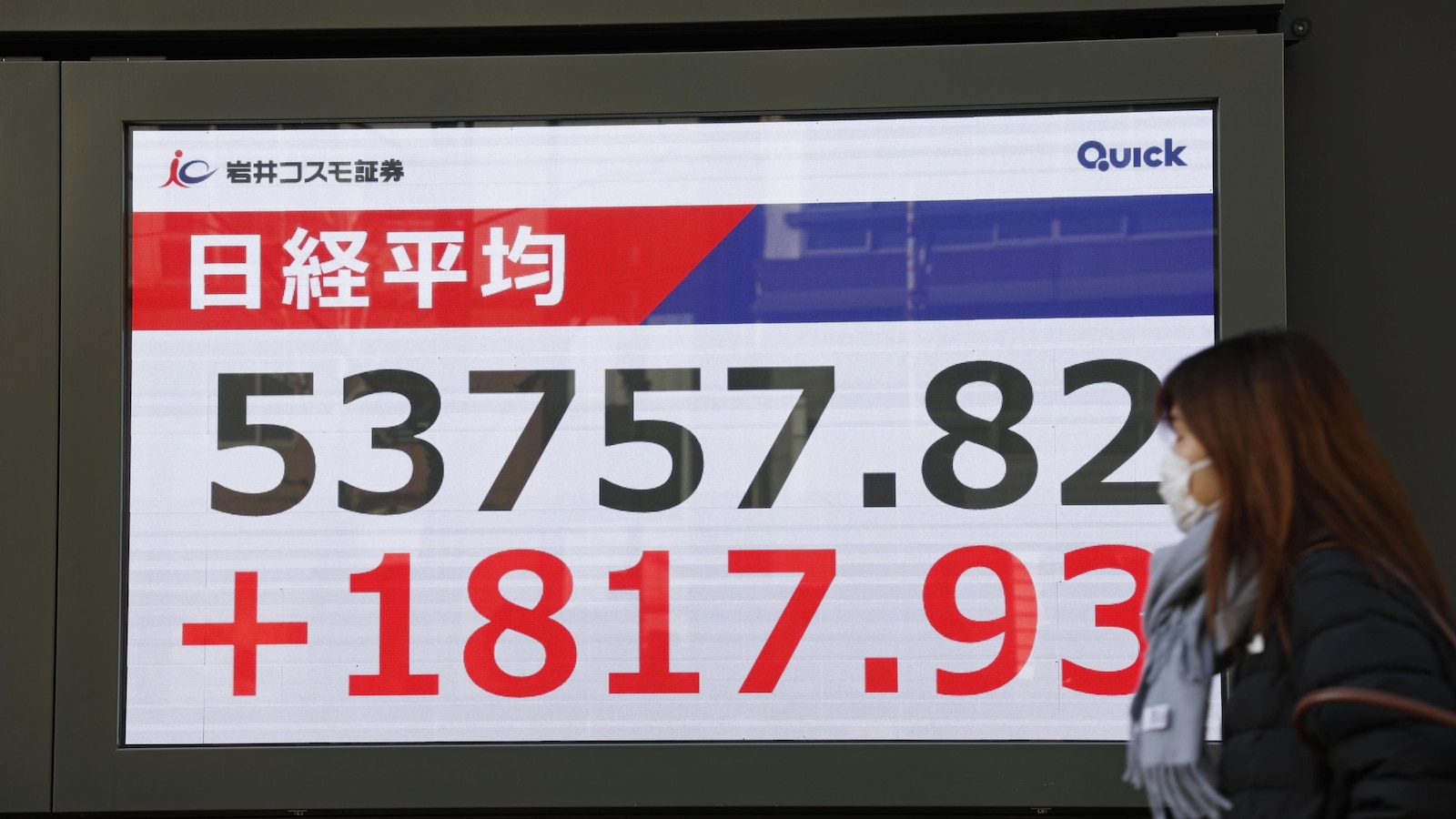
Market Overview - World shares exhibited mixed performance with U.S. futures declining slightly ahead of the U.S. consumer price update [1] - In early European trading, the FTSE 100 rose less than 1% while Germany's DAX and France's CAC 40 fell by 0.2% and 0.5% respectively [2] Inflation and Consumer Prices - U.S. consumer prices are expected to have risen by 2.6% in December compared to the previous year, according to economists' estimates [2] - Inflation pressures are likely to remain high due to increased costs in electricity, groceries, and clothing [3] Regional Market Performance - Asian shares mostly gained, with Japan's Nikkei 225 surging 3.1% to a record close of 53,549.16, driven by technology-related stocks [3] - Hong Kong's Hang Seng index advanced 0.9% to 26,848.47, while shares of GigaDevice Semiconductor jumped 54% in its trading debut [5] - South Korea's Kospi closed 1.5% higher at a record 4,692.64, and Australia's S&P/ASX 200 gained nearly 0.6% [5] U.S. Federal Reserve and Interest Rates - Concerns over the Federal Reserve's independence in setting interest rates were somewhat mitigated by investor expectations of potential rate cuts [6] - Tensions between President Trump and Fed Chair Jerome Powell escalated following a subpoena from the Department of Justice regarding Powell's testimony [7] - Trump has advocated for further interest rate cuts, which could benefit stock prices by lowering borrowing costs [8] Company-Specific Developments - Alphabet, Google's parent company, saw a 1% increase in market value, surpassing $4 trillion, following a deal with Apple to enhance Siri using Google's technology [8] - Credit card companies faced losses after Trump proposed a cap on credit card interest rates, impacting their profit margins [9]
U.S. Stock market indexes S&P 500, Dow Jones set for slow opening on Tuesday after record-highs
The Economic Times· 2026-01-13 09:52
Market Performance - U.S. stock futures fell slightly, with S&P 500 and Dow Jones Industrial Average futures down nearly 0.1% [1][8] - On Monday, the S&P 500 rose 10.99 points (0.2%) to 6,977.27, the Dow Jones increased by 86.13 points (0.2%) to 49,590.20, and the Nasdaq composite gained 62.56 points (0.3%) to 23,733.90 [5][6] - For the year, the S&P 500 is up 131.77 points (1.9%), the Dow Jones is up 1,526.91 points (3.2%), the Nasdaq is up 491.91 points (2.1%), and the Russell 2000 is up 153.79 points (6.2%) [6] Federal Reserve and Regulatory Concerns - Concerns over the potential weakening of the Federal Reserve's independence in setting interest rates have emerged, with investors speculating that President Trump may push for faster rate cuts [1][8] - Tensions between President Trump and Fed Chair Jerome Powell escalated after the Department of Justice subpoenaed the Fed, threatening a criminal indictment related to Powell's testimony on building renovations [1][8] Sector-Specific Developments - Alphabet, Google's parent company, gained 1% in market value, surpassing USD 4 trillion, following a deal with Apple to enhance Siri using Google's Gemini [7] - Credit card companies experienced significant losses after Trump proposed a one-year, 10% cap on credit card interest rates, impacting their profit margins. Synchrony Financial fell 8.4%, Capital One Financial dropped 6.4%, and American Express decreased by 4.3% [8][9]

大摩展望美国消费金融财报季:防御仍是主线,特朗普信用卡限息提议增添不确定性
智通财经网· 2026-01-13 09:33
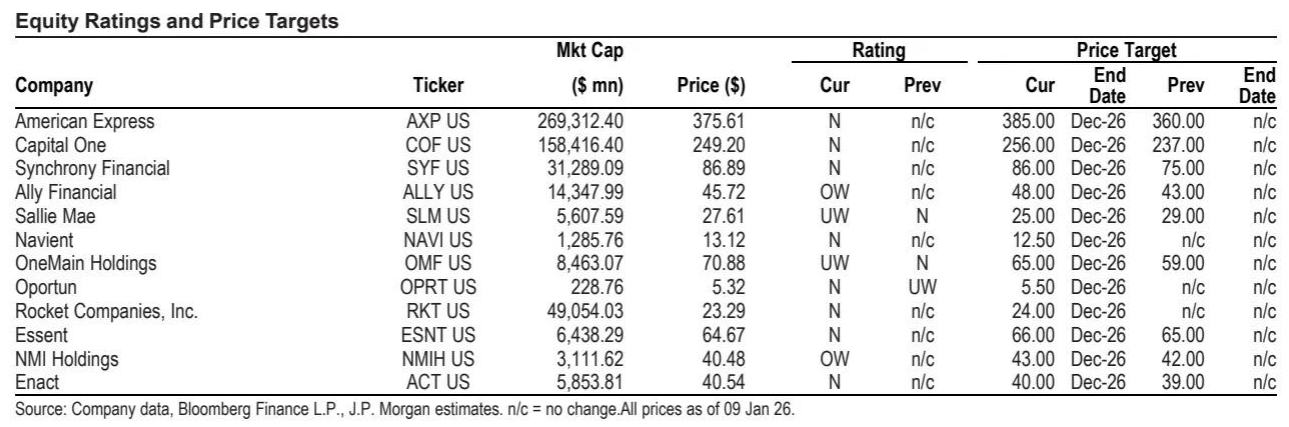
Group 1 - The core viewpoint of the reports indicates that the financial sector is advised to maintain a defensive posture due to anticipated impacts from inflation and labor market dynamics on credit performance and consumer confidence [1] - Morgan Stanley acknowledges that while target stock prices have been steadily raised since the beginning of the year, earnings expectations have largely remained unchanged, reflecting a conservative outlook [1] - The report highlights a significant proposal from Trump to limit credit card interest rates to 10% for one year, which could fundamentally reshape the credit card industry and significantly reduce profitability for issuers [1] Group 2 - In December, U.S. consumer spending growth showed signs of slowing, with a year-over-year increase of 2.4%, down from 3.7% in November, indicating a divergence in spending patterns between high-income and low-income households [2] - The labor market is characterized by low hiring and low layoffs, with non-farm payrolls increasing by only 50,000 in December, which is below expectations, while the unemployment rate decreased from 4.6% to 4.4% [2] - Despite geopolitical news, the direct impact on consumer finance remains limited, with Morgan Stanley expecting inflation and labor market conditions to continue being focal points for investors and operators [3] Group 3 - Morgan Stanley maintains a selective and rigorous approach in evaluating the financial sector, considering factors such as adequate valuations, uneven credit trends, and execution risks within the rating spectrum [3] - The report includes specific ratings and target price adjustments for various financial stocks, reflecting a balanced and differentiated outlook based on current market dynamics [3]
特朗普呼吁设10%信用卡利率上限,瑞银警告:反而会对民众造成负面影响
Feng Huang Wang· 2026-01-13 03:50
Core Viewpoint - UBS warns that President Trump's proposal to cap credit card interest rates at 10% may have counterproductive effects on consumers and the economy [1][2] Group 1: Impact on Financial Institutions - Trump's call for a 10% cap on credit card interest rates has led to a sell-off of major financial stocks, including Capital One, Synchrony Financial, JPMorgan Chase, and Citigroup [1] - Investors are reacting to the potential threat to the profitability of lending institutions due to the proposed interest rate cap [1] Group 2: Consumer Spending and Economic Implications - UBS analysts suggest that the proposed cap could suppress consumer spending and reduce lending to certain borrower groups, particularly low- and middle-income Americans [2] - The Federal Reserve Bank of Boston data indicates that credit card spending across different income groups could face severe impacts, with at least 26% of credit card consumption potentially affected [2] - Consumer spending accounts for approximately 70% of U.S. GDP, and credit card spending constitutes nearly half of Visa's total payment volume and over half of Mastercard's [2]
特朗普利率上限政策“落地存疑”,华尔街预警或触发信贷紧缩与经济涟漪效益
Zhi Tong Cai Jing· 2026-01-13 03:35
Group 1 - The proposed 10% credit card interest rate cap by President Trump could significantly impact the banking sector and extend to consumer-related industries such as airlines and retail, potentially forcing consumers to seek higher-cost borrowing options [1][2] - Issuing banks may adopt multiple strategies to mitigate the pressure from the interest rate cap, including increasing fees, reducing consumer rewards, cutting operational expenses, and tightening credit limits, especially if the policy becomes permanent [1][2] - There is considerable doubt about the feasibility of implementing this cap, as previous attempts have failed, and analysts suggest that legislative action from Congress may be required [2][3] Group 2 - Analysts from Morgan Stanley predict that credit card companies' book values could suffer significant declines, with potential drops of 20% to 40% for certain firms under the temporary cap [3][4] - The impact on earnings per share for major credit card issuers could be severe, with estimates suggesting a 10% decline for Citigroup by 2026, while other banks like JPMorgan Chase and Bank of America may see smaller impacts ranging from -1% to -4% [2][3] - The stock market has already reacted to these risks, with companies that have a higher proportion of low-score borrowers experiencing the largest declines in stock prices [4]



特朗普利率上限政策“落地存疑”!华尔街预警或触发信贷紧缩与经济涟漪效益
Zhi Tong Cai Jing· 2026-01-13 02:39
Core Viewpoint - The proposed 10% cap on credit card interest rates by President Trump could significantly impact the banking sector and extend to consumer-related industries such as airlines and retail, potentially forcing consumers to seek higher-cost borrowing alternatives [1][2] Group 1: Impact on Credit Card Issuers - Credit card issuers may respond to the interest rate cap by increasing fees, reducing consumer rewards, cutting operational costs, and tightening credit limits, especially if the cap becomes permanent [1][2] - Analysts from Morgan Stanley predict that under the temporary cap, the book value of companies like Bread Financial, Synchrony Financial, and American Express could decline by 20% to 40% [3] - The impact on earnings per share for major credit card companies could be severe, with estimates suggesting a reduction of 80% for American Express and 60% for Citigroup [3] Group 2: Broader Economic Implications - The credit card industry is crucial to the U.S. economy, which is approximately 70% driven by consumer spending, with credit card spending accounting for just over 20% [2] - A tightening of credit by issuers could lead consumers to turn to less regulated and more expensive lending options, such as payday loans [1][2] - The potential for reduced credit availability could have a cascading effect on industries reliant on credit card revenue, particularly airlines and retail [2] Group 3: Market Reactions - Stock prices of companies with a higher proportion of low-credit borrowers have already begun to reflect the risks, with significant declines observed in shares of Bread Financial, Synchrony Financial, and others [4] - Major banks like Citigroup and JPMorgan also experienced stock price drops, indicating market concerns over the proposed policy's implications [4] - Analysts note that while the event's impact is broad, the likelihood of the cap being implemented remains low, but uncertainty in the industry has increased significantly [4]
Big Bank Stocks Tumbled After Trump Said This
Investopedia· 2026-01-12 22:53
Core Insights - President Trump proposed capping credit card interest rates at 10% for one year, citing that current rates of 20% to 30% are unfair to consumers [1][5] - The implementation details of this cap remain unclear, raising questions about its feasibility and duration [5] Stock Market Impact - Capital One Financial (COF) shares fell over 6%, American Express (AXP) dropped 4%, and Citigroup (C) decreased by 3% following the announcement [2] - Other major banks like JPMorgan Chase (JPM), Bank of America (BAC), and Wells Fargo (WFC) saw declines of about 1%, while Synchrony Financial (SYF) experienced an over 8% drop [2] Consumer and Industry Implications - Capping interest rates may reduce borrowing costs for consumers but could negatively affect credit card issuers [3] - The upcoming earnings season for major banks, starting with JPMorgan, will provide executives an opportunity to address the potential impacts of this proposed cap [3] Regulatory Context - Financial stocks are also reacting to concerns regarding the Trump administration's pressure on the Federal Reserve, particularly after Fed Chair Jerome Powell mentioned a grand jury investigation into his previous testimony [4] - The investigation is perceived as politically motivated, occurring after the Fed did not lower rates as quickly as the administration desired [4]