TotalEnergies SE

Search documents
炼油利润飙升难抵油气价格寒冬!道达尔(TTE.US)Q4盈利不及预期 宣布缩减股票回购规模
Zhi Tong Cai Jing· 2026-02-11 08:23
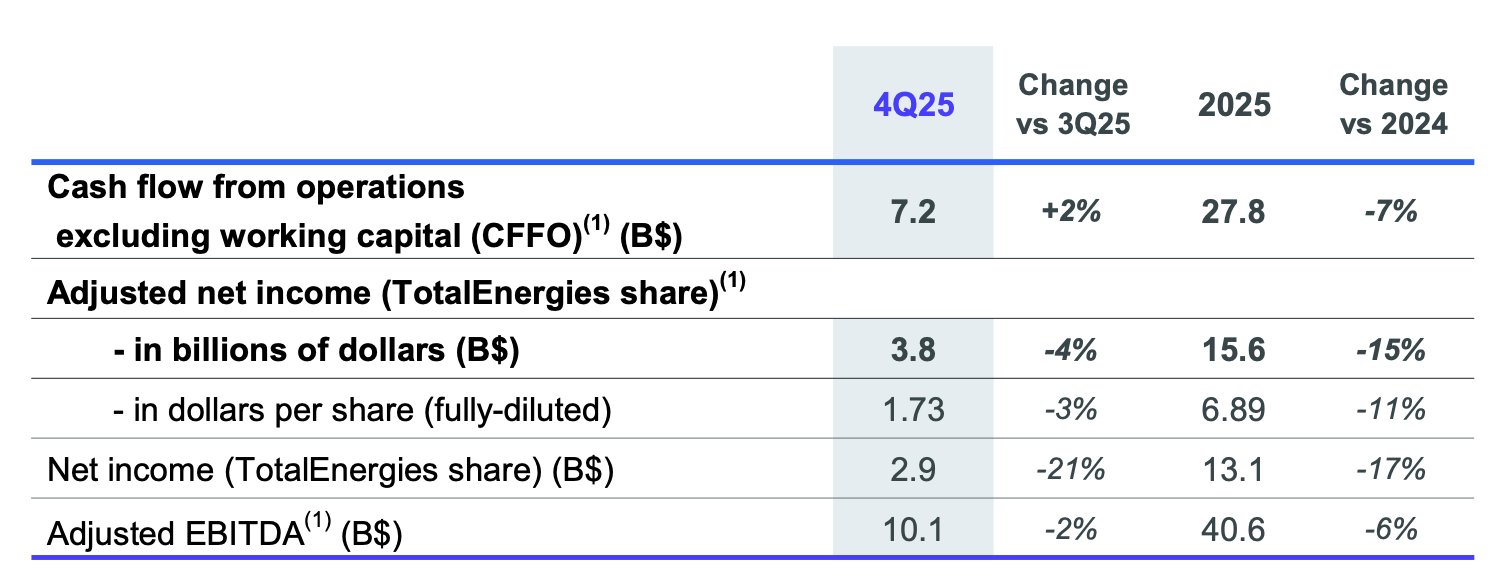
道达尔在第四季度提高了油气产量,以弥补布伦特原油价格下跌15%和液化天然气价格下跌18%的影响。该公司表示,第四季度产量提高了5%,但勘探业务 板块利润仍下降21.6%,至18亿美元。与此同时,炼油和化工业务利润大增215%,达到10亿美元。 道达尔此前曾表示,第四季度欧洲炼油厂的利润率同比飙升231%。该公司首席执行官帕特里克.普亚内将炼油利润率上升归因于美国对俄罗斯石油公司 Rosneft和Lukoil的制裁、以及欧盟对源自俄罗斯原油的燃料实施进口禁令。 法国能源巨头道达尔(TTE.US)公布的2025年第四季度业绩显示,尽管炼油利润率攀升以及出售可再生能源资产股权带来现金流入,但未能抵消石油和天然 气价格下跌带来的负面影响。数据显示,道达尔Q4调整后净利润为38亿美元,较上年同期的44亿美元下降13%,且低于分析师共识预期的39亿美元。 | | 4Q25 | Chan VS 30 | | --- | --- | --- | | Cash flow from operations excluding working capital (CFFO)(1) (B$) | 7.2 | +2% | | Adjust ...


道达尔能源第四季度调整后净利润38.4亿美元,同比下降13%
Jin Rong Jie· 2026-02-11 07:34
本文源自:金融界AI电报 2月11日消息,道达尔能源第四季度调整后净利润为38.4亿美元,同比下降13%;第四季度调整后息税 折旧及摊销前利润为100.7亿美元,同比下降4.4%;第四季度净利润为29.1亿美元,同比下降27%;调整 后每股收益为1.73美元,上年同期1.90美元;第四季度产量255万桶油当量/日,同比增增长4.9%。 ...
TotalEnergies posts 13% drop in fourth-quarter profit on lower oil, gas prices
Reuters· 2026-02-11 07:04
Group 1 - TotalEnergies reported a 13% drop in fourth-quarter earnings, slightly missing expectations [1] - The decline in earnings was attributed to soaring margins on refining fuels and cash from selling stakes in renewable energy [1]

API千万桶大幅累库,伊朗问题悬而未决,油市分歧进一步加大
Xin Lang Cai Jing· 2026-02-10 23:24
热点栏目 自选股 数据中心 行情中心 资金流向 模拟交易 客户端 来源:能源研发中心 | 讲 | | | | 期货主力合约 | | | --- | --- | --- | --- | --- | --- | | सि | | 收盘价 | 涨跌幅% | 持仓量 | 持仓走势 | | 每 | 中国SC原油期货 | 473.50 | 0.21 | 45286 | | | H | 美国WT原油期货 | 63.96 | -0.62 | 144000 | | | 信 | 英国BRENT原油期货 | 68.80 | -0.35 | 553511 | | | 出 | 美国RBOB汽油期货 | 1.9592 | -1.32 | 115000 | | | | 英国ICE柴油期货 | 680.50 | -1.31 | 205206 | | 后市观点 油价的走势在清晰的传达一个观点:原油处于一个偏强的混沌蓄势阶段,地缘当然是最大的不确定性, 根据计划周三以色列总理内塔尼亚胡将于当地时间11日在白宫会见美国总统特朗普,在此之前本周前二 个交易日处于消息真空期,所以油价维持在震荡拉锯节奏中,等待更多消息的指引。特朗普就伊朗问题 表态要么 ...

The Iraqi Megaproject No One Thought Would Happen Is Racing To Completion
Yahoo Finance· 2026-02-10 23:00
Core Viewpoint - Iraq's future crude oil production targets hinge on the successful implementation of the Common Seawater Supply Project (CSSP) by TotalEnergies, which aims to optimize oil reservoir pressure and enhance production longevity [2][3]. Group 1: Project Overview - The CSSP will initially supply approximately six million barrels per day (bpd) of treated seawater to oil production facilities in southern Iraq, with plans for further expansion [2]. - TotalEnergies' four-part project, valued at US$27 billion, is reported to be 80% to 95% complete, with significant progress in various components, including the rehabilitation of the Central Processing Facility and the Artawi-PS1 export pipeline [3]. - The project aims to address Iraq's water injection needs, which are estimated to be around 2% of the combined average flows of the Tigris and Euphrates rivers [1]. Group 2: Historical Context and Challenges - The CSSP faced delays for over a decade due to competition between ExxonMobil and the China National Petroleum Corporation (CNPC) for control, with ExxonMobil eventually withdrawing due to transparency concerns [3]. - Iraq has been ranked among the worst countries for corruption, which has hindered effective project execution and governance [3]. Group 3: Production Potential - The Integrated National Energy Strategy (INES) outlined potential oil production scenarios for Iraq, with the best-case scenario projecting a capacity increase to 13 million bpd by 2023, while current production stands at 4-4.2 million bpd [4]. - The gas component of TotalEnergies' project is crucial for reducing Iraq's dependence on Iranian gas imports, which has historically provided Iran with leverage over Iraq [5][6]. Group 4: Future Outlook - If TotalEnergies maintains its current trajectory, the US$27 billion project could be completed by the target year of 2028, despite potential political interference from Iraqi entities [7]. - The project includes plans to capture and refine associated natural gas, which could significantly reduce gas imports from Iran and support the revival of the Nebras petrochemicals project, potentially generating up to US$100 billion in profits for Iraq [6].
Are These 4 Energy Stocks Set to Beat Q4 Earnings Estimates?
ZACKS· 2026-02-10 14:50
Core Insights - The oil and energy sector is facing significant challenges due to volatile commodity prices and market instability, with oil prices dropping and natural gas prices increasing, leading to a mixed outlook for energy companies [1] - Analysts predict weaker-than-usual results for the fourth-quarter earnings season, but there is potential for some energy stocks to exceed expectations [1] Oil and Natural Gas Pricing Dynamics - In Q4 FY25, West Texas Intermediate crude prices averaged $59.64 per barrel, down from $70.69 in the previous year, primarily due to a global supply surplus [2] - OPEC+ countries began easing production restraints, contributing to increased supply, while non-OPEC sources also expanded production, raising global inventories by up to 2 million barrels per day [2] Demand Conditions - Demand for oil remained soft, influenced by slower economic growth in major markets like China and Europe, alongside long-term trends such as increased electric vehicle adoption and energy efficiency [3] Natural Gas Pricing - Natural gas prices rose in Q4 FY25, with the Henry Hub spot price averaging $3.75 per million British thermal units, up from $2.44 in the prior year, driven by colder winter temperatures and increased LNG exports [4] Earnings Performance - As of now, 47.2% of S&P 500 companies have reported Q4 earnings, with 37.5% of oil and energy companies showing strong growth, with earnings up 40.4% year over year despite a slight revenue decline of 1.4% [5] - The blended outlook for the sector indicates a projected earnings growth of 14% year over year, with a smaller revenue decline of 0.4% and a net margin of 1.11% [6] Company-Specific Insights - Antero Resources Corporation (AR) is expected to report a 10.34% decrease in earnings per share, with a consensus estimate of 52 cents, having missed estimates in three of the last four quarters [11][13] - Nabors Industries Ltd. (NBR) is projected to report a wider loss, with an expected adjusted loss of $2.93 per share, reflecting a 56.07% increase from the previous year [15] - TotalEnergies SE (TTE) is anticipated to earn $1.80 per share, down 5.26% year over year, having missed estimates in three of the last four quarters [17] - Precision Drilling Corporation (PDS) is expected to report earnings of $1.11 per share, indicating a 46.05% increase from the prior year, but has also missed estimates in three of the last four quarters [20]


BP Suspends Share Buyback Amid Overhaul
Yahoo Finance· 2026-02-10 13:54
BP's previous buyback was $750 million, reduced from $1.75 billion in April last year. - arnd wiegmann/Reuters BP suspended its share-buyback program and said it would reduce spending this year, part of a broader plan by the British energy giant to overhaul its business. The London-based company is in the early stages of a turnaround aimed at bringing the business back to its oil-and-gas roots after an ill-timed move into renewables that left it the least profitable of the major oil companies. Most Rea ...

英国石油暂停股票回购,能源巨头转型压力持续加剧
Xin Lang Cai Jing· 2026-02-10 10:28
Core Viewpoint - BP has announced the suspension of its $750 million quarterly stock buyback plan to strengthen its balance sheet amid significant transformation pressures [1][8]. Financial Performance - BP reported a net profit of $1.54 billion for the fourth quarter, aligning closely with analyst expectations of $1.53 billion [5][12]. - The company maintained its Brent crude oil price assumption for this year at $72.9 per barrel, consistent with previous strategic assessments, despite oil futures dropping below $70 from last year's peak of over $80 [6][12]. Strategic Decisions - BP has prioritized repairing its balance sheet over returning cash to shareholders, retracting its guidance to return 30%-40% of operating cash flow [1][8]. - The company plans to keep capital expenditures at the lower end of its guidance range for 2026, indicating a cautious approach to spending [1][8]. - BP's net debt at the end of last year was approximately $22.2 billion, with a maintained target range of $14 billion to $18 billion for the end of 2027 [1][8]. Asset Management - BP is expected to achieve up to $15 billion in cost reductions by 2027, including a $6 billion financing from the sale of its Castrol lubricants business [4][11]. - The company aims for a cumulative asset disposal target of $20 billion over three years, needing to match the $5.3 billion already achieved in 2025 [4][11]. Leadership Changes - The recent leadership changes, including the appointment of new CEO Meg O'Neill, are seen as a move to clear obstacles for a more prudent transformation strategy [1][9]. - O'Neill is anticipated to accelerate the divestment of low-return clean energy projects, a direction welcomed by shareholders [7][13]. Market Position - BP's production growth is lagging behind competitors like Chevron and ExxonMobil, with expectations for slightly lower production in 2026 compared to last year [4][11]. - The company is facing challenges in regaining market trust in its capital allocation, as highlighted by analysts [4][11]. Energy Transition - BP has recorded approximately $4 billion in impairments related to its energy transition business, including significant write-downs on previously acquired low-carbon assets [7][13]. - The cumulative impairments since late 2022 have reached nearly $25 billion, reflecting setbacks in BP's climate ambitions [7][13].
液化天然气追踪 -供应增长仍在轨道上-LNG Tracker_ Supply Wave Still On Track
2026-02-10 03:24
Summary of LNG Market Conference Call Industry Overview - The conference call focused on the global Liquefied Natural Gas (LNG) market, highlighting a significant supply wave expected to last seven years, starting in 2025 and peaking around 2030 [4][25]. Key Points Supply Dynamics - 2025 is projected to be the first year of the largest global LNG supply wave, with supply expected to average 431 million tonnes per annum (mtpa), slightly below the previous expectation of 433 mtpa [4][5]. - The U.S. is anticipated to lead the supply growth, with a notable ramp-up at the Plaquemines facility contributing to the overall supply despite some disruptions and delays in other regions [4][29]. - Global LNG supply growth from 2025 to 2030 is expected to increase by 193 mtpa, which is 45% of the 2025 global supply, significantly outpacing Asia's demand growth of 144 mtpa [4][7]. Price Forecasts - A bearish cycle for European natural gas prices (TTF) and LNG (JKM) is anticipated, with forecasts suggesting prices could drop below $5/mmBtu by 2028/29, more than 50% lower than current prices [4][66]. - The JKM-TTF spread has turned negative, indicating that JKM prices have not fully adjusted to the recent TTF price rally [12][20]. Demand Insights - Asia's LNG demand is expected to rise by 14 mtpa in 2026, driven by a 5 mtpa increase in China and a 7 mtpa rise in Southeast Asia [41][43]. - The demand response to low gas prices is estimated to be over 40 mtpa from China alone, indicating a potential shift in consumption patterns [4]. Regional Supply Challenges - Structural supply losses are anticipated from Algeria and Indonesia due to rising domestic energy demands, with Algeria's export forecast lowered by 1 mtpa for future years [4][34]. - Delays in export capacity starts in the U.S., Canada, Congo, and Australia have led to a slower start for global LNG supply in 2026, although recovery is expected by the second half of the year [4][10]. Future Projects - All but one of the supply projects in the forecast through 2029 have reached a Final Investment Decision (FID), indicating strong commitment to future supply growth [4][3]. - Upcoming liquefaction projects are expected to increase global LNG supply by approximately 50% relative to 2024 by 2030 [4][36]. Additional Insights - The U.S. LNG export contracts are projected to remain profitable only through 2027, with significant implications for future export strategies [22][24]. - The conference highlighted the importance of monitoring the timing of liquefaction projects, as they are critical to balancing supply and demand in the LNG market [4][66]. This summary encapsulates the key insights and projections discussed during the conference call, providing a comprehensive overview of the current and future state of the LNG market.
Petrobras-TotalEnergies Deal Remains Unrecognized by Namibia
ZACKS· 2026-02-09 18:25
Core Insights - Namibia will not recognize the offshore stake acquisition by Petrobras and TotalEnergies until compliance with the country's statutory approval process is achieved [1][2] - The acquisition involves a 42.5% stake in the PEL104 exploration license in the offshore Luderitz Basin, with TotalEnergies set to operate the asset [3] - Petrobras aims to expand its exploration activities in Africa, marking a strategic return to Namibia as part of its 2026–2030 business plan [4][5] Regulatory Concerns - Namibia's Ministry of Industries, Mines and Energy stated that it was not properly notified of the transaction, which is required by law [6] - The ministry emphasized that prior approval from the energy minister is necessary for any transfer or acquisition of petroleum licenses to be legally valid [6] - Both companies acknowledged that the transaction is subject to regulatory approvals and will proceed in accordance with Namibian law [7] Industry Context - The government's response is occurring amid significant regulatory reforms in Namibia's energy sector, including the proposed Petroleum (Exploration and Production) Amendment Bill [8] - The bill aims to modernize the legal framework of the sector, enhance fiscal transparency, and tighten oversight as Namibia approaches oil production [9]