油价低迷

Search documents
特朗普宣布已兑现油气钻探承诺
Xin Lang Cai Jing· 2026-02-25 03:14
Core Viewpoint - The article highlights the significant increase in U.S. oil and natural gas production under the Trump administration, emphasizing the resilience of the U.S. oil industry despite previous market challenges [1] Group 1: Oil Production - U.S. oil production has increased by over 600,000 barrels per day, reaching an average of 13.6 million barrels per day, setting a new record [1] - The Trump administration has gained control over the oil sales from Venezuela, receiving over 80 million barrels of oil from the country [1] Group 2: Natural Gas Production - Natural gas production in the U.S. is expected to continue breaking records in the coming years, according to federal forecasting agencies [1] - The article indicates that the resilience of the U.S. oil industry is a significant advantage for Trump, especially in light of previous low oil prices [1] Group 3: Market Expectations - The increase in production has defied market expectations that suggested a decline due to the dual threats of Trump tariffs and OPEC+ production increases [1]
炼油利润飙升难抵油气价格寒冬!道达尔(TTE.US)Q4盈利不及预期 宣布缩减股票回购规模
Zhi Tong Cai Jing· 2026-02-11 08:23
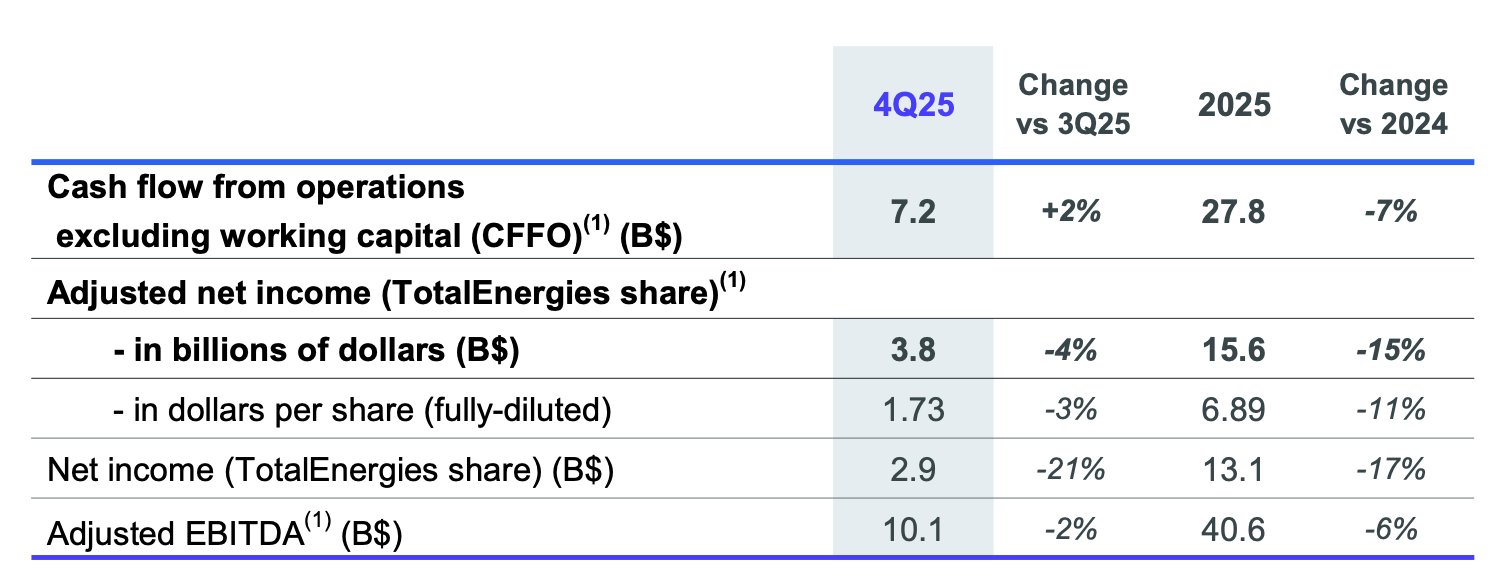
Core Viewpoint - TotalEnergies increased oil and gas production in Q4 to offset declines in Brent crude oil prices by 15% and LNG prices by 18%, despite facing a 21% drop in net income [1][2]. Group 1: Financial Performance - Cash flow from operations excluding working capital (CFFO) was B$7.2 billion, reflecting a 2% increase [1]. - Adjusted net income attributable to TotalEnergies was B$3.8 billion, down 4% [1]. - Net income attributable to TotalEnergies was B$2.9 billion, a decrease of 21% [1]. - Adjusted EBITDA was B$10.1 billion, down 2% [1]. Group 2: Production and Profitability - TotalEnergies reported a 5% increase in production in Q4, but exploration segment profits fell by 21.6% to B$1.8 billion [1]. - Refining and chemicals segment profits surged by 215% to B$1 billion [1][2]. - The profit margin for European refineries soared by 231% year-on-year, attributed to sanctions on Russian oil companies and EU import bans on Russian crude [2]. Group 3: Stock Buyback and Dividends - The company announced a reduction in stock buyback plans, intending to repurchase B$750 million in Q1 2026, down from B$1.5 billion in Q4 2025 [2]. - The quarterly dividend remains unchanged at €0.85 per share [2]. - TotalEnergies' 2026 budget is based on a Brent crude price assumption of $60 per barrel, with potential adjustments based on market conditions [2]. Group 4: Market Context - Despite large oil companies generating substantial profits, an 18% drop in oil prices last year has impacted cash flows, particularly for European firms [3]. - The market anticipates continued oversupply this year due to production increases within and outside the OPEC+ alliance [3]. - Rising debt levels among European energy giants are limiting their ability to return capital to shareholders [3].


多空决战前夜?政策分化油价暴击加元破局信号浮现!
Jin Tou Wang· 2025-12-22 02:39
Core Viewpoint - The USD/CAD exchange rate is experiencing fluctuations due to diverging monetary policies between the US and Canada, alongside low oil prices, mixed economic data, and geopolitical risks, leading to an unclear short-term direction [1][2]. Monetary Policy Divergence - The Bank of Canada maintained its interest rate at 2.25% on December 10, signaling a halt in rate cuts after four reductions this year, with a neutral to hawkish stance supported by a 2.6% annualized GDP growth in Q3 and a drop in unemployment to 6.5% with 53,000 new jobs added in November [1]. - In contrast, the Federal Reserve lowered its rate to 3.6% on December 11, marking its third cut of the year, with a dovish outlook from Chairman Powell and rising risks in the US labor market, leading to market expectations of further easing by 2026 [1]. Economic Data Disparity - US economic indicators show a mixed picture, with existing home sales rising by 0.5% in November, but consumer confidence slightly declining, and inflation expectations increasing to 4.2% [2]. - Canadian economic data is less supportive for the CAD, with retail sales falling by 0.2% in October and core retail sales down by 0.6%, although the CPI rose by 2.2% year-on-year in November, providing some support for the central bank's policy [2]. Commodity Influence on CAD - The CAD is negatively impacted by declining oil prices, which have dropped by 15.2% in 2025, affecting Canadian crude export revenues and consequently pressuring the CAD against the USD [2]. - Geopolitical factors, including US sanctions on Venezuela and Russia, have heightened supply concerns, increasing demand for the USD as a safe haven and further suppressing the CAD [2]. Technical Analysis - The USD/CAD pair is currently in a bearish trend, with the price consistently closing below key moving averages and facing resistance above 1.3800, indicating potential for further declines [2]. - Technical indicators such as MACD and RSI suggest continued bearish momentum, with the possibility of further downside movement [2]. Short-term and Long-term Outlook - Short-term volatility is expected to remain within the range of 1.3740 to 1.3830, with support at 1.3720-1.3680 and resistance at 1.3830 and 1.3890 [3]. - Future movements will depend on the sustainability of policy divergence, oil price recovery, and the economic progress in Canada, with global uncertainties likely to exacerbate volatility [3].
沙特股市表现不佳 2026年油价或仍疲软 今年跌11%
Sou Hu Cai Jing· 2025-12-11 08:22
Group 1 - The core viewpoint of the article indicates that the Saudi stock market has significantly underperformed compared to emerging markets over the past year, and this trend is unlikely to change in the coming year due to low oil prices and predictions of continued oversupply in commodities [1] - Analysts from Citigroup recommend reducing holdings in Saudi stocks, citing poor performance in earnings growth and development momentum [1] - The Swiss bank Julius Baer highlights the strong correlation between the Saudi stock market and oil prices, predicting that oil prices may remain weak through 2026, limiting any potential benefits from a weaker dollar [1] Group 2 - The Saudi stock exchange composite index has declined by 11% this year, marking the largest drop since 2015 [1]
沙特股市遭遇十年来最差一年 2026年前景仍不可乐观
Ge Long Hui A P P· 2025-12-11 07:37
Core Viewpoint - Emerging market stocks have rebounded strongly over the past year, but the Saudi stock market has significantly lagged behind, with expectations for little improvement in the coming year due to low oil prices and potential oversupply in commodities [1] Group 1: Market Performance - The Saudi stock market is expected to remain unattractive for investors, with analysts suggesting a reduction in holdings of Saudi stocks due to poor performance in earnings growth and development momentum [1] - The Saudi stock market has declined by 11% this year, marking the largest drop since 2015 [1] Group 2: Oil Price Dependency - The Saudi stock market remains closely tied to oil prices, which are projected to remain weak through 2026 [1] - Unlike most other emerging markets, the Saudi stock market is not expected to benefit from a weakening US dollar [1] Group 3: Analyst Recommendations - Citigroup analysts recommend investors to reduce their exposure to Saudi stocks, citing underperformance in key financial metrics [1] - Credit Suisse's emerging market equity strategist highlights the lack of attractiveness in Saudi stocks due to their dependence on oil prices and the broader market dynamics [1]
X @外汇交易员
外汇交易员· 2025-06-30 10:54
Geopolitical Implications - The report suggests a potential ceasefire agreement with Russia due to low oil prices [1] - The statement implies a link between oil market conditions and geopolitical negotiations [1] Energy Market - Low oil prices are a key factor influencing international relations [1]
美国总统特朗普:由于油价低迷,预计将可以与俄罗斯达成停火协议。
news flash· 2025-06-30 10:35
Core Viewpoint - The article discusses President Trump's expectation of reaching a ceasefire agreement with Russia due to the current low oil prices [1] Group 1 - The low oil prices are influencing geopolitical negotiations, particularly between the U.S. and Russia [1]
特朗普:因油价低迷,预计(乌克兰)将与俄罗斯达成停火协议。
news flash· 2025-06-30 10:34
Core Viewpoint - Trump predicts that Ukraine will reach a ceasefire agreement with Russia due to low oil prices [1] Group 1 - The current low oil prices are influencing geopolitical dynamics, particularly in the context of the Ukraine-Russia conflict [1] - The expectation of a ceasefire agreement suggests potential shifts in energy markets and geopolitical stability [1]
油价低迷重创沙特阿美!一季度利润缩水近5% 政府财政雪上加霜
Zhi Tong Cai Jing· 2025-05-12 04:10
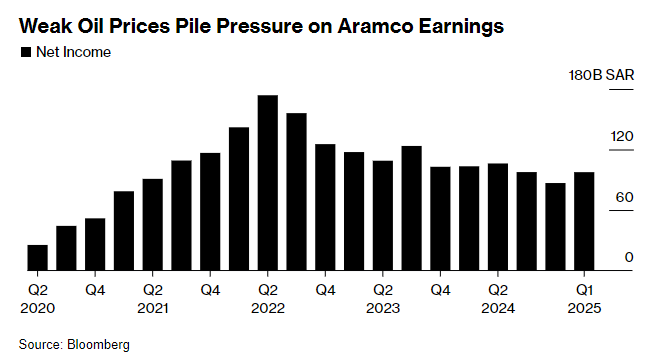
Group 1 - Saudi Aramco reported a 4.6% decline in net profit for Q1, amounting to 97.5 billion Saudi Riyals (approximately $26 billion), primarily due to lower crude oil prices [1][3] - The company's total dividend for the quarter decreased to $21.36 billion, down from $31 billion in the same period last year, largely due to a significant cut in performance-linked dividends [3] - The average selling price of crude oil for Saudi Aramco in Q1 was $76.30 per barrel, lower than $83 per barrel in the previous year [4] Group 2 - The ongoing decline in oil prices, with Brent crude trading around $64 per barrel, is significantly below the $92 per barrel needed for Saudi Arabia's fiscal balance, indicating potential financial strain [4] - Major banks and energy institutions have lowered their oil price forecasts for the year, with the U.S. Energy Information Administration predicting an average Brent crude price of $65.85 per barrel [5] - Saudi Arabia's budget deficit could potentially double if oil prices remain around $62 per barrel, leading to increased borrowing, spending cuts, and asset sales [5]
卖油成了赔本生意,美国钻油商很快就会挺不住!
Jin Shi Shu Ju· 2025-05-06 10:01
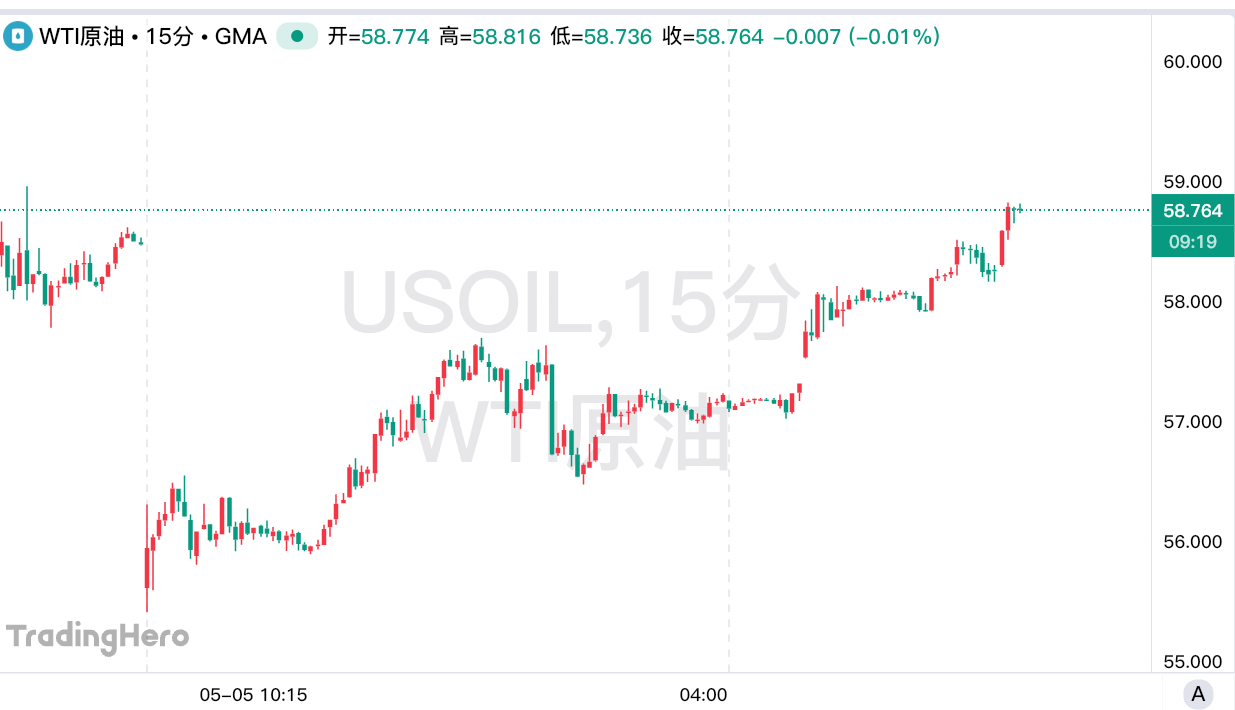
Core Viewpoint - Kpler indicates that the growth rate of U.S. crude oil supply will be slower than expected for the remainder of 2025 and into 2026, with a potential peak in production as early as this year due to low WTI prices testing the breakeven point for shale oil production [1][3] Group 1: Oil Price Dynamics - WTI crude oil prices have dropped over 15% since early April, currently around $58.5 per barrel, which is still below the breakeven point for many shale oil wells [1][3] - OPEC+ recently decided to increase production by 410,000 barrels per day, nearly three times the planned increase, contributing to downward pressure on oil prices [1] Group 2: Production Forecast Adjustments - Kpler has revised its forecast for U.S. crude oil supply growth down by 120,000 barrels per day to 170,000 barrels per day for the remainder of 2025 and into 2026, citing weak prices potentially slowing shale oil production [3] - The company expects U.S. crude oil production to peak in 2025 and then gradually decline [3][4] Group 3: Industry Sensitivity and Response - U.S. shale oil producers are highly sensitive to price changes and are likely to reduce drilling activities as profits decline [3] - The cautious approach of the U.S. oil industry is influenced by OPEC+'s recent actions aimed at capturing market share and constraining U.S. shale oil production [3]