Apptronik

Search documents
X @TechCrunch
TechCrunch· 2025-09-11 15:04
Raquel Urtasun of Waabi, and Jeff Cardenas of Apptronik join the AI Stage at TechCrunch Disrupt 2025 in San Francisco, from October 27-29. Register here. https://t.co/aiqCaJdzmN ...
X @TechCrunch
TechCrunch· 2025-09-10 17:01
Raquel Urtasun of Waabi, and Jeff Cardenas of Apptronik join the AI Stage at TechCrunch Disrupt 2025 in San Francisco, from October 27-29. Register here. https://t.co/RIDIrrMgFB ...
3个月!搞透VLA/VLA+触觉/VLA+RL/具身世界模型等方向!
具身智能之心· 2025-08-22 00:04
Core Viewpoint - The exploration of Artificial General Intelligence (AGI) is increasingly focusing on embodied intelligence, which emphasizes the interaction and adaptation of intelligent agents within physical environments, enabling them to perceive, understand tasks, execute actions, and learn from feedback [1]. Industry Analysis - In the past two years, numerous star teams in the field of embodied intelligence have emerged, establishing valuable companies such as Xinghaitu, Galaxy General, and Zhujidongli, which are advancing the technology of embodied intelligence [3]. - Major domestic companies like Huawei, JD, Tencent, Ant Group, and Xiaomi are actively investing and collaborating to build a robust ecosystem for embodied intelligence, while international firms like Tesla and investment institutions are supporting companies like Wayve and Apptronik in the development of autonomous driving and warehouse robots [5]. Technological Evolution - The development of embodied intelligence has progressed through several stages: - The first stage focused on grasp pose detection, which struggled with complex tasks due to a lack of context modeling [6]. - The second stage involved behavior cloning, allowing robots to learn from expert demonstrations but revealing weaknesses in generalization and performance in multi-target scenarios [6]. - The third stage introduced Diffusion Policy methods, enhancing stability and generalization by modeling action sequences, followed by the Vision-Language-Action (VLA) model phase, which integrates visual perception, language understanding, and action generation [7][8]. - The fourth stage, starting in 2025, aims to integrate VLA models with reinforcement learning, world models, and tactile sensing to overcome current limitations [8]. Product and Market Development - The evolution of embodied intelligence technologies has led to the emergence of various products, including humanoid robots, robotic arms, and quadrupedal robots, serving industries such as manufacturing, home services, dining, and medical rehabilitation [9]. - The demand for engineering and system capabilities is increasing as the industry shifts from research to deployment, necessitating higher engineering skills for training and simulating strategies on platforms like Mujoco, IsaacGym, and Pybullet [23]. Educational Initiatives - A comprehensive curriculum has been developed to cover the entire technology route of embodied "brain + cerebellum," including practical applications and real-world projects, aimed at both beginners and advanced learners [10][20].

开普勒机器人胡德波:下游需求量非常大 预计每年销量增十倍
2 1 Shi Ji Jing Ji Bao Dao· 2025-07-24 21:55
Core Insights - The humanoid robot industry is entering a phase of accelerated business expansion, with significant procurement orders from companies like Zhiyuan and Yuzhu, totaling 120 million yuan and over 90 million yuan respectively [1] - Tesla's project on the Optimus robot has reportedly been paused, indicating potential challenges in production adjustments [1] - The industrial sector is recognized as a primary focus for humanoid robots, with companies launching products aimed at factory training [1] Industry Progress - The company is initiating small-scale production and expects to deliver 100 units this year, with targets of 1,000 units next year and 10,000 units the following year, reflecting a projected annual growth rate of 10 times [2] - The demand from downstream industries is substantial, and the company anticipates that a significant portion of the robots will be deployed in industrial scenarios [2] Strategic Focus - The company has strategically chosen to target industrial environments for early-stage deployment due to their structured nature and lower requirements for generalization compared to home environments [3] - The investment return in industrial scenarios is clear and calculable, making it an attractive area for deployment [4] Economic Viability - A humanoid robot can potentially replace 70% to 80% of a worker's labor efficiency, equating to a labor value of approximately 150,000 yuan per year, given the average labor cost in the Yangtze River Delta [7] - The company aims to price its humanoid robots at around $20,000 per unit, allowing customers to recoup their investment within 1 to 2 years [7] Technological Advancements - The company's humanoid robots are designed for industrial applications, utilizing a unique configuration that allows for long operational hours with low power consumption [9] - The robots employ a hybrid bionic architecture, which enhances energy efficiency and stability [9] Competitive Landscape - The company is positioned competitively with other players like Tesla and Apptronik, focusing on industrial training and pilot applications [13] - Domestic manufacturers are reportedly achieving global leadership in robot body and motion control, while foreign companies lead in advanced cognitive models [13] Challenges and Future Directions - The humanoid robot industry still faces challenges in achieving stability and reliability for industrial applications, with expectations for significant improvements in the next 2 to 3 years [14] - The company is working on establishing a data-driven approach to enhance embodied intelligence, aiming to reduce deployment times from weeks to days or hours [15]

超140亿!2025上半年人形机器人融资盘点图片
机器人圈· 2025-07-10 10:14
Core Insights - The humanoid robot sector continues to experience high levels of investment and activity, with significant funding events indicating a shift towards industrial competition and commercialization [4][20]. Financing Overview - In the first half of 2025, over 83 financing events occurred in the global humanoid robot sector, totaling more than 14 billion RMB, surpassing the previous year's records [4][9]. - The first quarter alone accounted for 37 financing events, with a total amount exceeding 8 billion RMB, representing nearly 60% of the half-year total [6][9]. - The second quarter saw 46 financing events, but the total amount decreased to approximately 6 billion RMB, indicating a more cautious approach from investors [9][12]. Notable Financing Events - Apptronik, a U.S. startup, raised an impressive 403 million USD (about 2.9 billion RMB) in Series A funding, marking the largest single financing event of the first half [6][14]. - The trend of large financing rounds is evident, with 44 events exceeding 100 million RMB, highlighting a rising entry threshold for new projects [12][20]. Investment Trends - Most financing rounds are concentrated in early stages, particularly seed to Series A, reflecting that many companies are still in the technology development and validation phase [16][20]. - There are signs of maturity in the sector, with some companies beginning to secure Series C and above funding, indicating progress towards mass production [16][20]. Geographic Distribution - China leads in the number of financing events and total amount, with approximately 8.4 billion RMB raised, accounting for nearly 60% of the global total [19]. - The U.S. follows with 3.9 billion RMB, showcasing a stronger capital density in head projects [19]. Capital Logic Evolution - The financing landscape has shifted from a "conceptual land grab" to a focus on "industrial landing speed," with capital increasingly directed towards teams with solid technology and mature supply chains [20].
Tesla Optimus robotics vice president Milan Kovac is leaving the company
CNBC· 2025-06-06 23:24
Core Insights - Tesla's vice president of Optimus robotics, Milan Kovac, has announced his departure from the company after an eight-year tenure, expressing gratitude towards CEO Elon Musk and optimism for Tesla's future [1][2]. Company Developments - Tesla is developing the Optimus robot with plans to begin builds on its Fremont pilot production line in 2025, aiming for broader deployment of robots in factory settings [3]. - During the 2024 annual shareholder meeting, Musk projected that humanoid robots could significantly increase Tesla's market capitalization to $25 trillion at an unspecified future date [3]. Technological Advancements - Currently, Tesla is training its Optimus systems to perform basic tasks such as picking up objects, opening doors, and throwing balls, indicating progress in the development of the robot [4]. - Competitors in the robotics space include Boston Dynamics, Agility Robotics, Apptronik, 1X, and Figure, highlighting a competitive landscape for Tesla's Optimus initiative [4].


2025全球人形机器人领域深度报告:人形机器人、具身智能技术、商业化壁垒、产业链公司及投资分析
Robot猎场备忘录· 2025-06-03 14:40
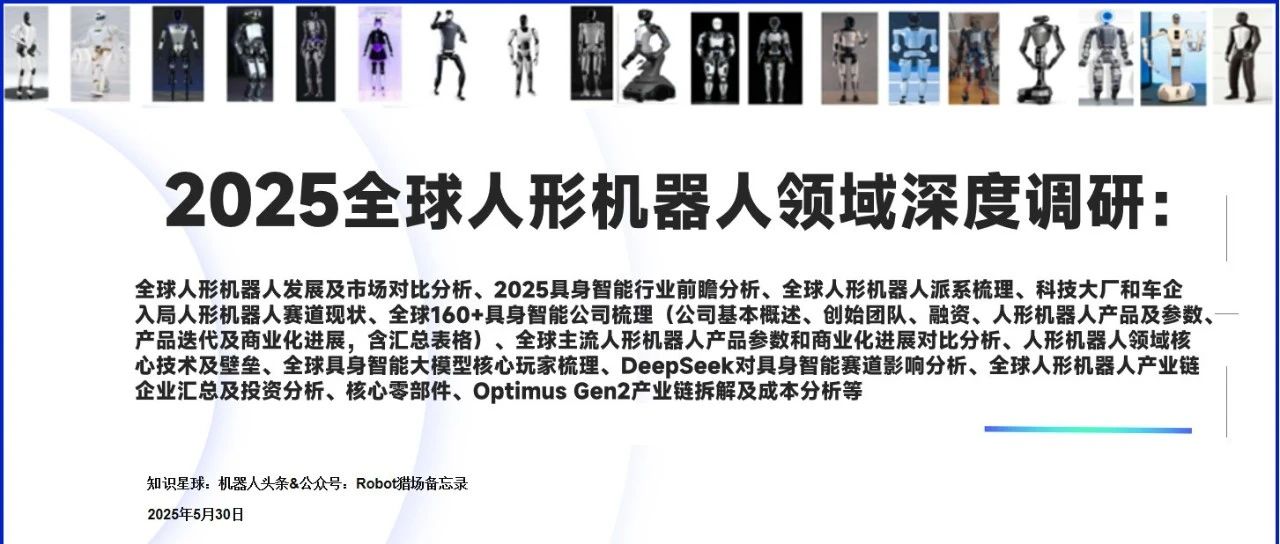
Group 1 - The report provides an overview of the global humanoid robot industry, highlighting significant developments and trends in the market [1][2] - It includes a detailed analysis of over 160 companies in the embodied intelligence sector, covering their product parameters, commercialization progress, and funding status [2][11] - The report emphasizes the increasing involvement of major tech companies and automotive manufacturers in the humanoid robot space, indicating a shift from startups to established industry players [11][13] Group 2 - The report identifies key technological barriers in humanoid robotics, particularly focusing on the development of the "big brain" and "small brain" systems [1][2] - It discusses the emergence of dual-system architecture models, which have become mainstream in the embodied intelligence field since 2025 [18] - The report notes that the financing landscape for humanoid robots remains active, with a noticeable shift towards startups that possess strong AI capabilities [16][17] Group 3 - The report outlines the competitive landscape, indicating that many early-stage humanoid robot startups may struggle with commercialization [11][12] - It highlights the initial commercialization achievements of leading humanoid robot companies, with some expected to deliver small-scale production by 2025 [17] - The report also mentions the growing interest in dexterous hands and multi-modal tactile perception sensors, which are attracting significant investment [19]
关税扰动下美企资本支出意外坚挺 美股短期内或受支撑
智通财经网· 2025-05-27 10:53
Group 1 - The uncertainty brought by President Trump's fluctuating tariff measures has been exaggerated, as many companies continue to push forward with their investment plans despite concerns [1] - Approximately 71% of companies in the Russell 3000 index that provided capital expenditure guidance maintained their 2024 capital expenditure guidance, with 8.5% raising it and only 3% withdrawing it [1] - The industrial sector has the highest number of companies maintaining capital expenditure plans during this earnings season, indicating resilience in investment despite external pressures [1] Group 2 - Economic data shows mixed signals, with manufacturing activity in the U.S. experiencing its largest contraction in five months due to tariffs and reduced orders, reflecting the negative impact of Trump's tariff measures [2] - Companies like Snap-on Inc. are adjusting their supply chains and maintaining capital expenditures, with expectations of a 19% increase in capital spending this year [2] - Tech giants such as Alphabet and Meta have reaffirmed or raised their capital expenditure guidance for the year, indicating continued investment in growth despite market uncertainties [2] Group 3 - Smaller companies are also following the trend of maintaining investment, as seen with Apptronik raising $350 million to expand production of humanoid robots, supported by significant orders from domestic manufacturers [3] - The investment landscape remains vibrant, with strong demand and a sense of optimism among investors, as highlighted by the orders received by Apptronik [3]


New PatentVest Pulse Report Reveals IP Gaps in Billion-Dollar Humanoid Robotics Startups
Globenewswire· 2025-05-14 16:00
Core Insights - The PatentVest Pulse report highlights a significant gap between rising valuations of humanoid robotics startups and their lack of intellectual property protections, indicating potential long-term value risks [1][2] - The report serves as a strategic guide for investors, board members, and CEOs to identify which companies are well-positioned and which are vulnerable in the humanoid robotics sector [1][2] Industry Analysis - The analysis benchmarks the IP portfolios of leading startups such as Figure AI, Sanctuary AI, Apptronik, Tesla Optimus, Neura Robotics, Engineered Arts, 1X Technologies, and Collaborative Robotics, mapping over 11,000 patent families across 794 entities globally [3] - The report emphasizes the importance of IP as a critical factor for scaling, licensing, and capturing long-term value in the humanoid robotics industry [2] Emerging Leaders - Figure AI is gaining attention and capital, while Sanctuary AI is building a defensible platform, with other companies like Neura Robotics, Apptronik, and Agility Robotics also making strides through focused IP strategies [6] - Sanctuary AI is noted as one of the few startups among the top 20 global patent holders, highlighting the rarity of defensible positions in the industry [6] Corporate Landscape - Major industrial players such as Sony, UBTECH, Honda, Toyota, Hyundai, Alphabet, and Samsung hold over 11,000 humanoid robotics patent families, indicating significant corporate consolidation in the IP landscape [6] - University-led innovation is crucial, with institutions like Tsinghua University, AIST, and the University of Tokyo holding key patents that influence core technologies and future commercialization opportunities [6]

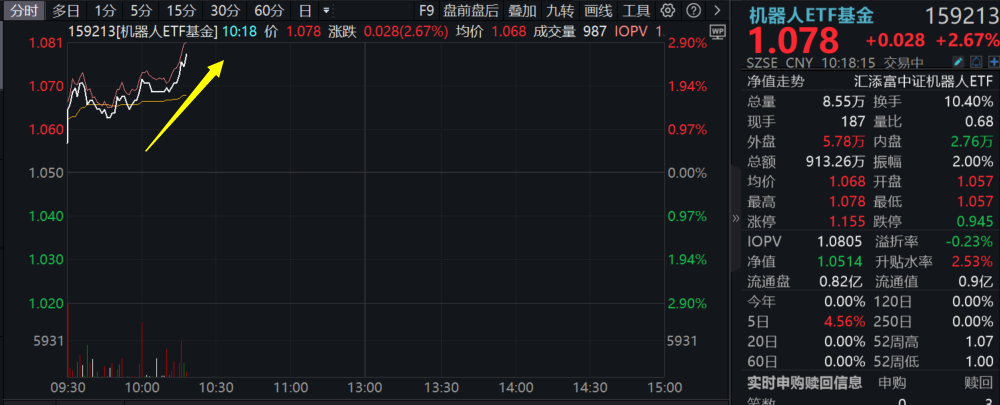
人形机器人企业爆单!宇树机器人最新发声,机器人ETF基金(159213)再度飙涨超2%,全球资管巨头唱多人形机器人!
Xin Lang Cai Jing· 2025-05-12 03:17
Core Viewpoint - The humanoid robot market is experiencing significant growth, driven by favorable government policies and increasing demand across various sectors, with projections indicating a potential market size of over 15 trillion yuan by 2025 [4][9]. Group 1: Market Performance - The A-share market showed an upward trend on May 12, with the robot sector rebounding, particularly the Robot ETF fund (159213), which opened high and rose by 2.67% [1]. - Major components of the Robot ETF fund saw substantial gains, with companies like Tuosida reaching a 20% limit up, and others like Koli'er and Xinjie Electric also experiencing significant increases [3]. Group 2: Industry Advantages - The humanoid robot industry in China benefits from strong policy support, with various national and local initiatives aimed at fostering development, including the inclusion of robots in key work reports and the establishment of industry funds [5][6]. - China's competitive edge in the humanoid robot market is highlighted by its leading position in patent applications, with 5,925 patents filed from 2020 to 2024, significantly outpacing other countries [4][5]. Group 3: Production and Supply Chain - The domestic robot industry is witnessing a rise in localization, with the domestic production rate of key components increasing from 17.5% in 2015 to 35.7% in 2022, indicating a trend towards cost reduction and efficiency [7]. - Major companies are preparing for mass production of humanoid robots, with 2025 expected to be a pivotal year for the industry, as several manufacturers are on the brink of entering small-scale production [7][8]. Group 4: Application Scenarios - The demand for robots is driven by manufacturing upgrades and demographic changes, with the global aging population creating a pressing need for robotic solutions to address labor shortages [9]. - The potential market for humanoid robots is projected to exceed 1 billion units, corresponding to a market space of over 15 trillion yuan, as the industry prepares for widespread adoption across industrial, commercial, and domestic applications [9].