
China Steel

Search documents
科技赋能 智造未来--中国钢铁产业锻造高质量发展新范式观察
Zhong Guo Chan Ye Jing Ji Xin Xi Wang· 2025-08-19 00:13
Group 1: High-end Development - The Chinese steel industry has invested 1.2 trillion yuan in capacity replacement over the past decade, completing nearly 300 million tons of capacity replacement and spending over 1 trillion yuan on R&D to drive high-end product breakthroughs [2][3] - The world's first third-generation thin slab continuous casting and rolling production line has been established, reducing the time from molten steel to steel coil to just 25 minutes, which is 1/8 of the traditional hot continuous rolling process [2] - Ansteel Group has produced hot-formed wheel steel with a strength six times that of aluminum alloy wheels, while maintaining comparable weight and dimensional accuracy, at a cost of only 70% of aluminum alloy wheels [2] Group 2: Intelligent Transformation - The steel industry's intelligent transformation is accelerating, integrating new information technologies such as artificial intelligence and industrial internet into steel manufacturing [4] - Hebei Steel has developed a carbon-neutral digital platform that integrates digital technology with green low-carbon manufacturing, achieving over 75% automation in carbon data collection across 40 processes [4] - China Baowu has initiated the "2526" project to promote the localization of AI applications in the steel industry, aiming to redefine steel production through digitalization and intelligent transformation [5] Group 3: Green Revolution - The Chinese steel industry is advancing a green revolution driven by technological innovation, focusing on ultra-low emissions and low-carbon technology development [6] - By June 2025, 598 million tons of steel production capacity will have undergone ultra-low emission transformation, with an expected 80% coverage by the end of the year, involving an investment of over 300 billion yuan [7] - The industry has developed a low-carbon steel evaluation standard recognized by multiple international organizations, showcasing its commitment to global decarbonization efforts [7]
科技赋能 智造未来——解码中国钢铁产业转型升级新趋势
Xin Hua She· 2025-08-12 07:23
High-end Development - The Chinese steel industry has invested 1.2 trillion yuan in capacity replacement over the past decade, replacing nearly 300 million tons of old capacity and spending over 1 trillion yuan on R&D to drive high-end product breakthroughs [2] - The world's first third-generation thin slab continuous casting and rolling production line has been established, reducing the time from molten steel to steel coil to just 25 minutes, with a minimum product thickness of 0.7 mm, leading globally [2] - Ansteel Group has produced hot-formed wheel steel with a strength six times that of aluminum alloy wheels, while maintaining comparable weight and dimensional accuracy, at 70% of the cost of aluminum wheels [2] Intelligent Transformation - The integration of AI, digital twins, and industrial internet technologies is accelerating the intelligent transformation of the steel industry, pushing the entire industry chain towards "digital intelligence" [4] - The WesCarber carbon neutrality digital platform developed by Hebei Steel focuses on carbon neutrality goals, achieving over 510 million carbon data points collected with an automation coverage rate of over 75%, improving efficiency by 83% [4] - China Baowu has initiated the "2526" project to promote localized applications of AI, aiming to redefine steel production through digital and intelligent transformation [4][6] Green Development - The Chinese steel industry is advancing a green revolution across the entire industry chain, driven by technological innovation and aiming for ultra-low emissions and low-carbon standards [7] - By June 2025, 598 million tons of steel production capacity will have undergone ultra-low emission transformations, with an expected 80% coverage by the end of the year, involving over 300 billion yuan in investments [7] - The development of hydrogen metallurgy and efficient low-cost electric furnace smelting technologies is being pursued to support the green and low-carbon transition in the steel industry [7] Overall Industry Outlook - The transformation driven by innovation is not only crucial for the future of the steel industry but also provides a Chinese solution for global industrial low-carbon development [8]
中国钢铁与铁矿石每周更新-China Steel and Iron Ore Weekly Update
2025-08-11 02:58
Summary of Key Points from the Conference Call Industry Overview - **Industry**: Greater China Materials, specifically focusing on **Steel and Iron Ore** sectors [1][4] Key Metrics and Trends - **Weekly Output**: Increased by **3.7%** week-over-week (WoW) for long products [1] - **Inventory Levels**: - Inventory at mills rose by **0.8%** WoW [1] - Iron ore inventory at ports decreased by **1.1%** [3] - **Utilization Rates**: - Blast furnace utilization dipped by **0.6 percentage points (ppts)** [1] - Electric arc furnace utilization increased by **1.6 ppts** [1] - **Crude Steel Production**: Average daily output of crude steel by key enterprises was **1.982 million tons (mnt)**, a decline of **7.4%** compared to early July [1] Iron Ore Shipments - **Total Shipments**: Combined shipments from Australia and Brazil decreased by **1.00 million tons (Mt)** WoW for the period from July 28 to August 3 [2] - Shipments from Australia increased by **0.71 Mt** [2] - Shipments from Brazil decreased by **1.71 Mt** [2] Consumption and Demand - **Apparent Consumption**: - Long products consumption increased by **3.4%** WoW [4] - Flat products consumption decreased by **2.9%** WoW [4] - **Rebar Output**: Increased by **4.8%** WoW and **31.2%** year-over-year (YoY) [7] Weekly Data Summary - **Steel Inventory**: - Traders' inventory at **9,625 kt**, up **2.1%** [3] - Mills' inventory at **4,129 kt**, up **0.8%** [3] - **Operating Rates**: - Steel operating rate at **62.4%**, down **2.1 ppts** [3] - Average daily output of iron ore at **393.8 kt**, down **3.2%** [3] Analyst Insights - **Industry View**: Rated as **Attractive** by Morgan Stanley [5] - **Analyst Contacts**: Multiple analysts involved, including Rachel Zhang and Hannah Yang [4] Additional Notes - **Potential Conflicts of Interest**: Morgan Stanley may have business relationships with companies covered in the research, which could affect objectivity [5] - **Investment Recommendations**: Ratings include Overweight, Equal-weight, Not-Rated, and Underweight, with no direct Buy, Hold, or Sell ratings [22][25] This summary encapsulates the essential insights and data points from the conference call, providing a comprehensive overview of the current state of the steel and iron ore industries in Greater China.
中国钢铁 - 渠道调研 - 生产大幅放缓 - 是季节性因素还是反内卷政策的首个信号;7 月出口创月度历史新China Steel - Channel checker_ Production slows sharply - seasonality or first signal of anti-involution policy_ Exports at highest on record for month of July
2025-08-11 02:58
Summary of J.P. Morgan's Research on China Steel Industry Industry Overview - **Industry**: China Steel - **Key Findings**: Recent data indicates a significant slowdown in steel production, potentially linked to seasonal trends and government policies aimed at reducing overcapacity in the steel sector. Key Points Production Trends - **Steel Output Decline**: The latest 10-day average crude steel output in China is annualized at 934 million tons (Mt), reflecting a 7% decrease compared to the previous period and a 4% year-over-year (YoY) decline. This is the lowest output for this period since 2018, which recorded 889 Mt [1][10] - **Seasonal Factors**: The slowdown aligns with typical seasonal patterns observed in late July, as steel production generally decelerates in the third and fourth quarters [2][3] - **Anti-Involution Policies**: The production decline may also signal the impact of China's anti-involution policies aimed at curbing overcapacity in the steel industry, marking a potential shift in production velocity beyond mere seasonality [2] Export Dynamics - **Record Exports**: Despite the production slowdown, July steel exports were recorded at 116 Mt, a 1.7% decrease from June but still the highest for July, representing a 26% increase YoY. Year-to-date exports for the first seven months of 2025 are up 11% YoY [3][8] - **Future Projections**: J.P. Morgan forecasts that China's steel exports will remain robust, averaging around 100 Mt per annum for the remainder of the decade, with current exports tracking at approximately 12% of total crude steel production [3] Price Forecasts - **Production Estimates**: J.P. Morgan estimates China's steel production for 2025 to be 990 Mt, a 1.5% decrease from 2024's forecast of 1,005 Mt [4] - **Iron Ore Prices**: Projected iron ore prices are expected to be $95 per ton in Q3 and Q4 of 2025, with a similar forecast for 2026. Recent trends show iron ore prices have increased by 6% over the past month, surpassing $100 per ton [4] Inventory and Margins - **Steel Inventory**: As of August 1, total steel inventory in China is flat compared to the past three months but down 11% YoY, indicating the lowest levels for this time of year in over five years [19] - **Mill Margins**: Steel mill margins in China have strengthened since July, reaching their highest levels since October 2024 [22] Additional Insights - **Sector Impact**: The anti-involution policies are expected to affect various sectors, including Metals & Mining, Chemicals, Automotives, and Capital Goods, indicating broader implications for the economy [2] - **Equity Recommendations**: J.P. Morgan has highlighted Rio Tinto as a key equity exposure in the European Metals & Mining sector, with a fair value estimate of £55 per share, potentially rising to £65-75 per share at current commodity prices [4] This comprehensive analysis provides insights into the current state and future outlook of the China steel industry, highlighting production trends, export dynamics, pricing forecasts, and the impact of government policies.
中国钢铁产业锻造高质量发展新范式观察
Xin Hua Cai Jing· 2025-08-10 23:37
Core Viewpoint - The Chinese steel industry is focusing on innovation-driven high-quality development amidst global economic green recovery and deep industrial chain adjustments, as discussed during the 14th China International Steel Conference and the inaugural China International Steel Week held in Shanghai from August 5 to 10 [1] High-end Development - The Chinese steel industry has invested 1.2 trillion yuan (approximately 1.2 billion) over the past decade for capacity replacement, achieving nearly 300 million tons of capacity reset and spending over 1 trillion yuan on R&D to push product upgrades towards high-end development [2] - The world's first flexible production model third-generation thin slab continuous casting and rolling production line has been established, reducing the time from molten steel to steel coil to just 25 minutes, which is one-eighth of traditional hot continuous rolling processes [2] - Ansteel Group has produced hot-formed wheel steel with a strength six times that of aluminum alloy wheels, while maintaining comparable weight and dimensional accuracy, at a cost of only 70% of aluminum alloy wheels [2] Technological Innovation - The Ministry of Industry and Information Technology has issued the "Steel Industry Normative Conditions (2025 Edition)," emphasizing the need to strengthen technological innovation capabilities, establish research institutions, and increase R&D investment to enhance product innovation and quality brand building [3] - Technological innovation is becoming the core engine for the steel industry's transformation and upgrade, leading to the emergence of internationally competitive high-end products and a leap towards new productive forces [3] Intelligent Transformation - The steel industry's intelligent transformation is accelerating, with the integration of artificial intelligence, digital twins, and industrial internet technologies driving the entire industry chain towards "digital intelligence" [4] - The WesCarber carbon neutrality digital platform developed by Hebei Steel focuses on carbon neutrality goals, achieving over 510 million carbon data collections across 40 processes with an automation coverage rate exceeding 75% [4] - China Baowu has initiated the "2526" project to promote localized applications of DeepSeek, redefining steel production with AI, marking a significant step in its digital and intelligent transformation [4][5] Green Development - The Chinese steel industry is advancing a green revolution driven by technological innovation, focusing on ultra-low emissions transformation, low-carbon technology R&D, and digital empowerment to establish a comprehensive green manufacturing system [7] - By June 2025, 598 million tons of steel production capacity will have undergone ultra-low emissions transformation, with an expected 80% coverage by the end of the year, involving an investment of over 300 billion yuan [7] - The Chinese low-carbon steel emission standards have gained recognition from multiple international professional organizations, aligning with global climate governance and the Paris Agreement [8]
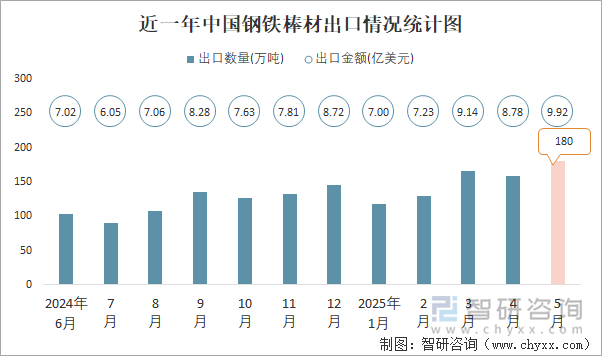
2025年5月中国钢铁棒材出口数量和出口金额分别为180万吨和9.92亿美元
Chan Ye Xin Xi Wang· 2025-08-03 01:56
Group 1 - In May 2025, China's steel bar exports reached 1.8 million tons, representing a year-on-year increase of 53.5% [1] - The export value for the same period was $992 million, which is a year-on-year growth of 27.5% [1] - The data is sourced from China Customs and organized by Zhiyan Consulting [3]

中国金属行业活动追踪-从现在起到 9 月,中国铜库存通常会出现大幅去库存现象。中国钢铁厂的利润空间已有所回升,趋于实现盈利-China Metals Activity Tracker
2025-07-24 05:04
Summary of J.P. Morgan's China Metals Activity Tracker Industry Overview - The report focuses on the metals industry in China, specifically tracking inventory trends for steel, iron ore, copper, aluminum, and zinc as of the week ended July 18, 2025 [1][11]. Key Insights 1. **Copper Inventory Trends** - China typically experiences significant destocking of copper inventories from now until September. However, recent data shows a slowing pace of inventory drawdowns, with copper inventories increasing by 3,000 tons last week [1][12]. - The five-year average indicates a normal destocking of approximately 200,000 tons of copper during this period [1][12]. 2. **Steel Mill Margins** - There has been a notable improvement in China steel mill margins over the last three weeks, leading to a ~10% increase in iron ore prices to $102 per ton. Average hot-rolled coil (HRC) steel mill margins have returned to profitability for the first time since early 2023 [2][9]. - Rebar margins are close to breakeven, marking the strongest profitability since early 2023 [2][9]. 3. **Iron Ore Shipments and Production** - Iron ore shipments to China from Australia and Brazil have shown mixed results, with Australian shipments down by 4.3% week-over-week but up 8.2% year-over-year. Brazilian shipments increased by 23.9% week-over-week but decreased by 11.3% year-over-year [4][2]. - Total iron ore arrivals in China increased by 13.7% week-over-week, indicating a robust demand [4][2]. 4. **Impact of U.S. Tariffs on Copper** - A potential 50% tariff on U.S. copper imports, effective August 1, could reduce U.S. demand by approximately 4%, translating to a 0.2% decline in global copper demand [3][12]. - The U.S. exports around 540,000 to 580,000 tons of copper scrap annually, which could help mitigate a primary deficit of 700,000 to 800,000 tons per annum, although increased recycling capacity may take 2-3 years [3][12]. 5. **Physical Demand Indicators** - Despite recent increases in copper, aluminum, and zinc inventories, overall inventories remain at their lowest levels in over five years for this time of year, indicating tight physical markets [12][13]. - China's copper premium has risen by 70% in the last two weeks, reaching approximately $50 per ton, although it remains significantly below the year-to-date high of $103 per ton [12][13]. Additional Observations - The report highlights that the next ten weeks will be critical for assessing the health of Chinese physical copper consumers, as historical trends suggest a shift towards improved demand during this period [12][13]. - The report also includes detailed tables and figures illustrating inventory levels, shipment data, and price forecasts for various metals, providing a comprehensive view of the current market dynamics [4][9][34]. Conclusion - The J.P. Morgan report provides valuable insights into the current state of the metals industry in China, highlighting trends in inventory, pricing, and the potential impact of U.S. tariffs on copper demand. The data suggests a complex interplay of supply and demand factors that investors should monitor closely.
花旗:中国钢铁_供给侧改革推进_山西省钢厂需减产
花旗· 2025-07-14 00:36
Investment Rating - The report indicates a pecking order for investment ratings: aluminum > lithium > steel > copper > gold > battery > thermal coal > cement [1] Core Insights - Major steel mills in Shanxi Province are mandated to reduce production by 10-30% year-on-year in 2025, resulting in an approximate 6 million tons reduction, which is about 10% year-on-year for the entire province [1] - Shanxi Province accounted for approximately 6% of China's steel market share in 2024 [1] - The supply reform in the steel industry is progressing in a tailored manner rather than a one-size-fits-all approach [1] - The production cuts are expected to support steel prices in the second half of 2025 [1] Summary by Sections - **Production Cuts**: Steel mills in Shanxi Province are required to cut production by 10-30% YoY, leading to a total reduction of around 6 million tons [1] - **Market Share**: Shanxi Province held about 6% of the steel market share in China during 2024 [1] - **Supply Reform**: The ongoing supply reform is being implemented progressively and is not uniform across all mills [1] - **Price Support**: Anticipated production cuts are expected to bolster steel prices in the latter half of 2025 [1]

Jefferies:中国钢铁减产的反直觉后果
2025-07-14 00:36
Summary of Key Points from the Conference Call Industry Overview - The conference call focuses on the **Metals & Mining** industry, particularly the **Chinese steel production** and its implications on global markets [1][2][3]. Core Insights and Arguments - **Chinese Steel Production Cuts**: Chinese officials have mandated the closure of up to **50 million tonnes per annum (mtpa)** of steel capacity to address structural overcapacity issues, which is expected to support finished steel prices globally [1][2]. - **Impact on Exports**: Despite a **0.6% year-over-year (y/y)** increase in steel production in Q1, domestic demand declined by over **1%**. Finished steel exports rose by **9% y/y** through May, indicating a strategy to shift overproduction to foreign markets [2]. - **Trade Barriers**: The steel industry faces challenges from rising trade barriers, with Baowu Steel projecting a **15 million tonne** decline in exports by 2025 due to trade measures, which could lead to a significant downturn in the second half of the year [2]. - **Domestic Demand Decline**: Baowu anticipates a **2% potential decline** in domestic steel demand this year, suggesting that even with stimulus measures, production and demand are likely to decrease [2]. - **Peak Steel**: The analysis suggests that China has reached "peak steel," indicating a potential long-term decline in production levels [2]. Implications for Raw Material Markets - **Seaborne Demand**: The cuts in steel production may initially reduce demand for iron ore and metallurgical coal, as China accounts for approximately **70%** and **20%** of seaborne demand in these markets, respectively [3]. - **Global Steel Production**: Countries like India, South Korea, and Vietnam may benefit from reduced Chinese exports, potentially leading to increased steel production and higher global steel prices [3]. - **Price Recovery**: Lower Chinese steel exports could catalyze a recovery in seaborne metallurgical coal demand and prices, as well as high-grade iron ore prices [4]. Market Outlook - **Neutral Stance**: The outlook for iron ore and metallurgical coal markets is neutral in the near term, with expectations of adequate supply. However, lower Chinese exports could positively impact demand and prices for these commodities [4]. - **Preferred Miners**: Vale and Glencore are identified as preferred major global miners for exposure to potential price upside in metallurgical coal and high-grade iron ore [4]. Additional Important Information - **Financial Metrics**: The conference call includes various financial metrics and forecasts for commodities, including price forecasts for iron ore and coal, as well as company-specific financial data for Vale and Glencore [6][10]. - **Analyst Ratings**: The call features analyst ratings and price targets for companies within the sector, indicating a "Buy" rating for both Vale and Glencore, with specific price targets set for their stocks [8][10]. This summary encapsulates the critical insights and implications discussed during the conference call, providing a comprehensive overview of the current state and future outlook of the Metals & Mining industry, particularly in relation to Chinese steel production and its global impact.

中国钢铁工业协会副会长:中国作为世界最大的钢铁内需市场将长期存在
news flash· 2025-07-12 04:58
Group 1 - The core viewpoint of the article is that the domestic steel demand in China is likely to decline in the second half of 2025, with the construction industry's demand for steel continuing to weaken [1] - The manufacturing sector has been the main driver of steel consumption growth in recent years, but there are potential adverse factors affecting this trend [1] - High steel exports may not be sustainable in the second half of the year due to trade frictions and U.S. tariff policies [1] Group 2 - Long-term projections indicate that China's crude steel production will remain in the range of 800 million to 900 million tons by 2035, and around 800 million tons after 2050 [1] - China is expected to maintain its position as the world's largest steel consumer market for a prolonged period [1]