华熙生物

Search documents
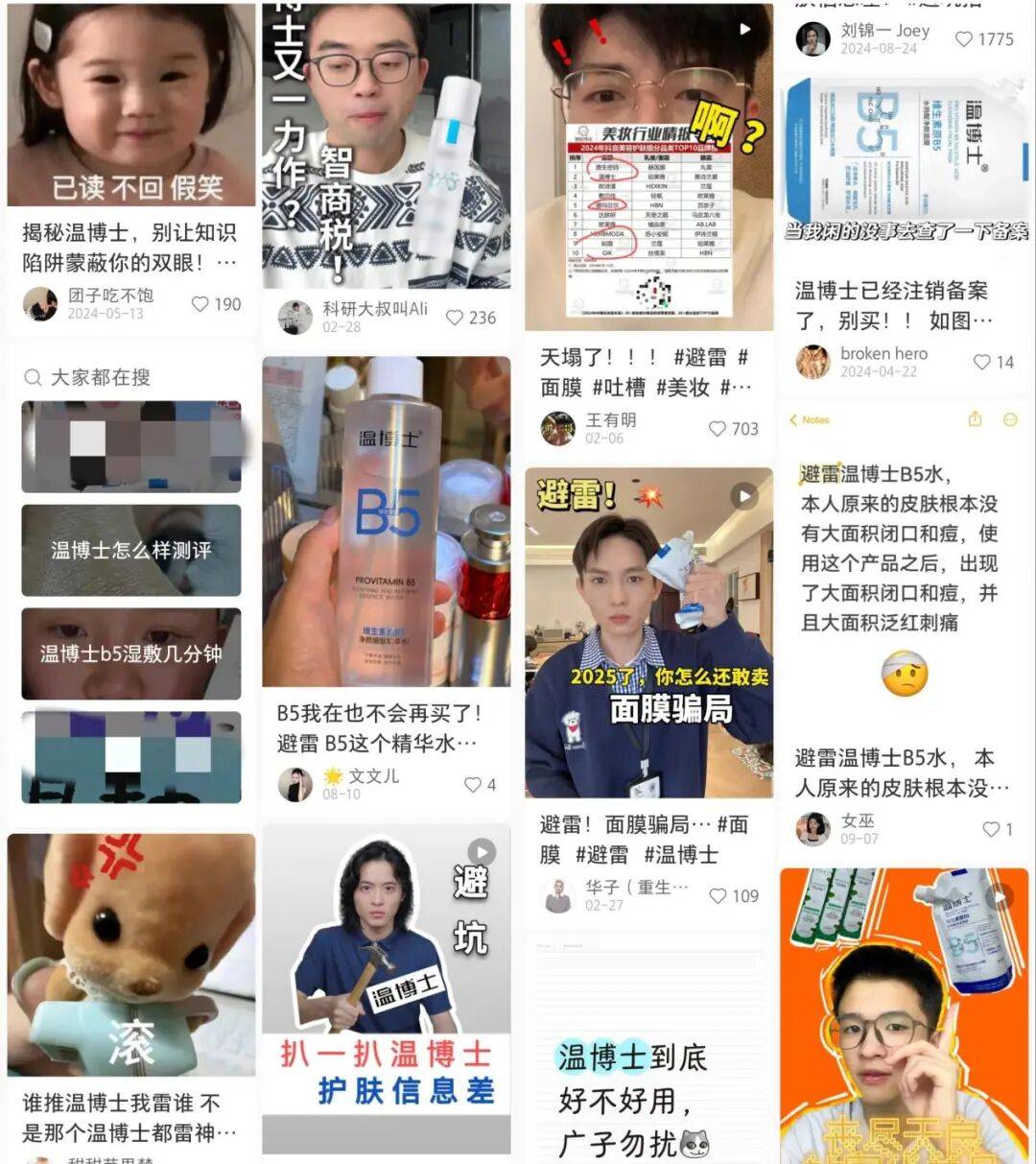
“厦门帮”求生记
Hu Xiu· 2025-10-10 13:58
Core Insights - The "Xiamen Gang" has become a prominent name in the beauty industry, with many brands looking to adopt its strategies for channel and content operation [1][2] - The Xiamen Gang consists of companies deeply rooted in Xiamen, focusing on beauty and health, known for producing high-margin products and creating replicable white-label hits [1][2] - Despite the initial success, many brands attempting to replicate the Xiamen Gang's strategies in other regions have faced challenges and failures [3][4] Group 1: Industry Trends - The beauty industry is experiencing intense competition, prompting both established and emerging brands to learn from the Xiamen Gang's live-streaming e-commerce tactics [2] - The Xiamen Gang's approach has led to significant sales, with brands like 温博士 and VC achieving sales of 5 billion and 3.5 billion respectively in early 2024 [9] - However, rising traffic costs and stricter platform regulations have made it difficult for many white-label brands to maintain profitability [10][11] Group 2: Challenges and Transformations - The Xiamen Gang is undergoing significant changes, with leading companies like 海尼 and 跑红 focusing on brand transformation and reducing reliance on aggressive traffic spending [5][32] - Many workshop-style studios are diversifying into new sectors like education and health, seeking to replicate past successes in less competitive markets [6] - The shift in consumer behavior and increased scrutiny from platforms have led to a decline in the lifecycle of white-label products, with many failing to sustain sales momentum [16][17] Group 3: Brand Development and Strategy - The Xiamen Gang is increasingly prioritizing brand development, hiring brand consultants and reducing reliance on traffic-driven models [5][35] - Companies are investing in product quality and supply chain improvements, with some establishing their own research and development facilities [40][41] - The focus is shifting towards creating compelling content and leveraging KOC (Key Opinion Consumers) to enhance brand visibility and consumer trust [27][31] Group 4: Market Position and Future Outlook - Despite the challenges, there is a strong determination within the Xiamen Gang to establish respected brands, moving away from the "quick profit" mentality [46][47] - The transition to brand-focused operations is seen as a long-term strategy, with companies willing to invest in building a sustainable business model [46][47] - The Xiamen Gang's ability to adapt and innovate in response to market changes may lead to the emergence of successful beauty brands in the future [47]

华熙生物(688363) - 华熙生物关于召开2025年第一次临时股东会的通知
2025-10-10 11:30
证券代码:688363 证券简称:华熙生物 公告编号:2025-039 华熙生物科技股份有限公司 关于召开2025年第一次临时股东会的通知 本公司董事会及全体董事保证公告内容不存在任何虚假记载、误导性陈述或 者重大遗漏,并对其内容的真实性、准确性和完整性依法承担法律责任。 重要内容提示: 一、 召开会议的基本情况 (一) 股东会类型和届次 2025年第一次临时股东会 召开日期时间:2025 年 10 月 27 日 10 点 00 分 召开地点:北京市朝阳区建国门外大街甲六号华熙国际中心 D 座 36 层会议 室 (五) 网络投票的系统、起止日期和投票时间 网络投票系统:上海证券交易所股东会网络投票系统 二、 会议审议事项 网络投票起止时间:自2025 年 10 月 27 日 至2025 年 10 月 27 日 采用上海证券交易所网络投票系统,通过交易系统投票平台的投票时间为股 东会召开当日的交易时间段,即 9:15-9:25,9:30-11:30,13:00-15:00;通过互联 股东会召开日期:2025年10月27日 本次股东会采用的网络投票系统:上海证券交易所股东会网络投票系统 (二) 股东会召集人:董事 ...

华熙生物(688363) - 华熙生物2025年第一次临时股东会会议资料
2025-10-10 11:30
华熙生物科技股份有限公司 2025年第一次临时股东会会议资料 证券代码:688363 证券简称:华熙生物 华熙生物科技股份有限公司 2025年第一次临时股东会会议资料 华熙生物科技股份有限公司 2025 年第一次临时股东会会议资料 2025 年 10 月 华熙生物科技股份有限公司 2025年第一次临时股东会会议资料 2025 年第一次临时股东会会议资料目录 | 华熙生物科技股份有限公司 | | 2025 | 年第一次临时股东会会议须知 | 1 | | --- | --- | --- | --- | --- | | 华熙生物科技股份有限公司 | | 2025 | 年第一次临时股东会会议议程 | 4 | | 议案一 2025 | 关于续聘公司 | 年度审计机构的议案 | | 6 | | 华熙生物科技股份有限公司拟聘任会计师事务所的基本情况 | | | | 7 | 2025 年第一次临时股东会会议须知 为保障华熙生物科技股份有限公司(以下简称"公司")全体股东的合法权 益,维护股东会的正常秩序,保证股东会的议事效率,确保本次股东会如期、顺 利召开,根据《中华人民共和国公司法》《华熙生物科技股份有限公司章程》《华 熙 ...
医疗美容板块10月10日跌0.5%,锦波生物领跌,主力资金净流入1416.39万元
Zheng Xing Xing Ye Ri Bao· 2025-10-10 08:52
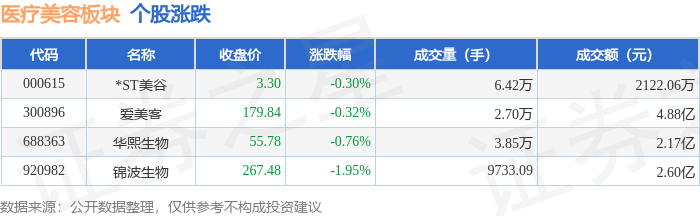
Market Overview - The medical beauty sector experienced a decline of 0.5% on October 10, with Jinbo Biological leading the drop [1] - The Shanghai Composite Index closed at 3897.03, down 0.94%, while the Shenzhen Component Index closed at 13355.42, down 2.7% [1] Stock Performance - The following stocks in the medical beauty sector showed varying performance: - *ST Meigu (000615)*: Closed at 3.30, down 0.30% with a trading volume of 64,200 shares [1] - Aimeike (300896): Closed at 179.84, down 0.32% with a trading volume of 27,000 shares [1] - Huaxi Biological (688363): Closed at 55.78, down 0.76% with a trading volume of 38,500 shares [1] - Jinbo Biological (920982): Closed at 267.48, down 1.95% with a trading volume of 9,733 shares [1] Capital Flow - The medical beauty sector saw a net inflow of 14.16 million yuan from main funds, while retail funds experienced a net outflow of 8.85 million yuan [1] - Detailed capital flow for specific stocks includes: - Aimeike (300896): Net outflow of 11.73 million yuan, down 2.40% [2] - *ST Meigu (000615)*: Net outflow of 1.17 million yuan, down 5.51% [2] - Huaxi Biological (688363): Net outflow of 3.72 million yuan, down 1.72% [2]

医疗美容板块10月9日涨0.18%,华熙生物领涨,主力资金净流出4420.15万元
Zheng Xing Xing Ye Ri Bao· 2025-10-09 09:00
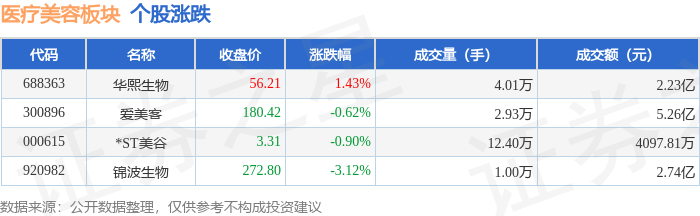
Core Insights - The medical beauty sector experienced a slight increase of 0.18% on October 9, with Huaxi Biological leading the gains [1] - The Shanghai Composite Index closed at 3933.97, up 1.32%, while the Shenzhen Component Index closed at 13725.56, up 1.47% [1] Medical Beauty Sector Performance - Huaxi Biological (688363) closed at 56.21, with a rise of 1.43% and a trading volume of 40,100 shares [1] - Aimeike (300896) closed at 180.42, down 0.62% with a trading volume of 29,300 shares [1] - ST Meigu (000615) closed at 3.31, down 0.90% with a trading volume of 124,000 shares [1] - Jinbo Biological (920982) closed at 272.80, down 3.12% with a trading volume of 10,000 shares [1] Capital Flow Analysis - The medical beauty sector saw a net outflow of 44.2015 million yuan from main funds and a net outflow of 32.526 million yuan from speculative funds, while retail investors had a net inflow of 76.7274 million yuan [1] - Huaxi Biological had a main fund net inflow of 5.4613 million yuan, accounting for 2.45% of its total [2] - Aimeike experienced a significant main fund net outflow of 47.1115 million yuan, representing 8.95% of its total [2] - ST Meigu had a main fund net outflow of 2.5512 million yuan, accounting for -6.23% of its total [2]
华熙生物(688363):2025年中报点评:仍处系统性调整阶段,利润端初见成效
Huachuang Securities· 2025-10-09 05:08
Investment Rating - The report maintains a "Recommendation" rating for Huaxi Biological [2] Core Views - Huaxi Biological is currently undergoing a systematic adjustment phase, with initial positive results on the profit front. The company reported a revenue of 2.261 billion (down 19.57% year-on-year) and a net profit attributable to the parent company of 221 million (down 35.38%) for the first half of 2025. However, the second quarter showed a turning point with a net profit of 119 million, up 20.89% year-on-year [2][3] - The company is focusing on strategic marketing reductions and effective cost control, leading to a recovery in profitability. The gross margin for the first half of 2025 was 70.99% (down 3.53 percentage points), while the net margin was 9.77% (down 2.39 percentage points) [2][3] - The report highlights the resilience of the sales of Class III medical devices, despite a decline in the skin science innovation transformation business, which saw a revenue drop of 33.97% [2][3] Financial Summary - For 2025, the expected total revenue is 4.959 billion (down 7.7% year-on-year), with a projected net profit of 458 million (up 162.9% year-on-year). The earnings per share are expected to be 0.95 yuan, with a price-to-earnings ratio of 58 [4][9] - The company’s total market capitalization is approximately 26.695 billion, with a current share price of 55.42 yuan and a target price of 64.13 yuan [4][5] - The report anticipates a recovery in the core business operations, with projected net profits for 2025, 2026, and 2027 being 458 million, 618 million, and 748 million respectively [2][4]
中产为何迷上“打铁”?有人花费上10万
创业邦· 2025-10-09 03:23
Core Viewpoint - The article discusses the growing popularity of triathlons in China, highlighting the demographic trends, participation costs, and the overall market potential for this sport [5][22][24]. Participation Trends - The demographic of triathlon participants is primarily young to middle-aged adults, with a notable increase in female participants [14][22]. - Participants often include professionals such as business owners, doctors, and lawyers, indicating a trend towards a more affluent and health-conscious demographic [14][22]. Event Statistics - As of September 27, 2025, there are 67 triathlon events scheduled in China, surpassing the total of 64 events held in 2024 [22]. - The IRONMAN brand has re-entered the Chinese market, with the IRONMAN70.3 event attracting significant interest [22][23]. Cost Analysis - The costs associated with participating in a triathlon include registration fees, equipment expenses, and travel costs, with registration fees ranging from hundreds to thousands of yuan depending on the event [13][15][17]. - High-quality triathlon gear, particularly bicycles, can be quite expensive, with some participants investing over 100,000 yuan in equipment [17][18]. Market Growth Potential - The triathlon market in China is experiencing rapid growth, with the China Triathlon Association reporting over 50,000 individual members [22]. - The sport's appeal is expected to attract more participants from younger and older demographics, indicating a potential for further market expansion [14][22]. Sponsorship and Marketing - The triathlon events are increasingly attracting sponsorship from various industries, including automotive, finance, and consumer goods, which enhances the sport's marketability [24]. - The marketing strategy focuses on the core values of challenge, perseverance, and achievement, appealing to a wide range of brands [24].

她,山东女首富,身家500亿,成本15元卖5000元,靠智商税发家?
Sou Hu Cai Jing· 2025-10-08 09:01
Core Insights - Zhao Yan, the richest woman in Shandong, has a net worth of 50 billion, largely attributed to her success in the beauty industry with hyaluronic acid, which has a cost of only 15 yuan but sells for 5000 yuan, highlighting a significant price disparity and consumer willingness to pay for beauty [1][22]. Group 1: Background and Early Career - Zhao Yan graduated from East China Normal University and initially worked as a teacher, a stable job for women at the time, but she sought more adventurous opportunities in business [3]. - In 1987, she decided to leave her teaching position to explore business opportunities in Hainan, which was then a hotspot for entrepreneurs [5]. Group 2: Business Ventures - Zhao Yan's first major business success came from purchasing and repairing faulty refrigerators, which she sold at lower prices, earning 800,000 yuan, a significant amount at the time [9]. - She later ventured into real estate, acquiring land before the property prices surged, and successfully exited the market before the bubble burst, increasing her capital [11]. Group 3: Entry into the Beauty Industry - The pivotal moment in Zhao Yan's career occurred during her MBA studies at Peking University when she learned about hyaluronic acid from a contact at Shandong Pharmaceutical Research Institute [15]. - Recognizing the potential of hyaluronic acid in the beauty market, she invested 12 million yuan for a 50% stake in a company and allocated 200 million yuan for research and marketing, despite skepticism from others [19]. Group 4: Market Impact and Controversies - The rise of the medical beauty trend led to a surge in demand for hyaluronic acid, with 10 million units sold in hospitals across China in 2016, establishing her company as a leading supplier [21]. - Despite her success, Zhao Yan faced criticism for the high markup on her products, with some labeling it as a "tax on intelligence," although the costs involved in production and marketing were substantial [22][24]. - Controversies surrounding her business practices, including allegations of pressuring employees to sell stocks at low prices, have added complexity to her public image [26]. Group 5: Conclusion - Zhao Yan's journey reflects a keen understanding of market demands and the ability to capitalize on emerging trends, transforming a simple raw material into a billion-dollar business [29].
旗帜鲜明地推进中国香妆产业走向“黄金时代”
Sou Hu Cai Jing· 2025-10-05 17:06
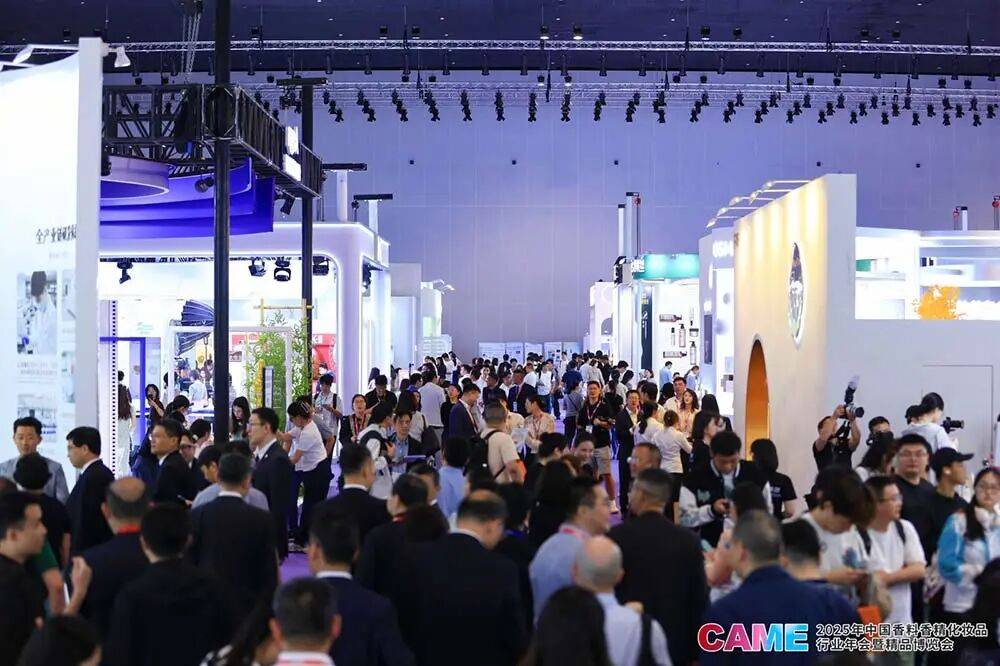
Core Insights - The Chinese fragrance and cosmetics industry is entering a golden era, transitioning from a "cosmetic manufacturing powerhouse" to a "cosmetic manufacturing stronghold" with a focus on high-quality development [2][7] - The total transaction value of cosmetics across all channels reached 702.1 billion yuan from January to August 2025, reflecting a year-on-year growth of 2.53%, indicating a shift towards rational growth and the end of the era of reckless expansion [2] - The industry consensus is shifting from a focus on cash-burning for traffic acquisition to cultivating user value, emphasizing a balanced approach between online and offline channels [2][5] Industry Trends - The 2025 China Fragrance and Cosmetics Industry Annual Conference (2025CAME) highlighted the importance of technology and culture in driving value creation, with a clear shift from marketing-heavy strategies to research and development [4][6] - Domestic brands are increasingly leveraging technology to establish a competitive edge, moving from "ingredient parity" to "patent leadership" [4] - The integration of cultural elements into branding is becoming a key differentiator for Chinese brands in the global market, moving beyond superficial aesthetics to deeper cultural narratives [5] Market Dynamics - The relationship between online and offline channels is evolving into a symbiotic one, where both are essential for success, with a focus on user experience and trust [5] - The industry is facing global competition that emphasizes safety, environmental standards, and ethical considerations, which are becoming the new benchmarks for market entry [6] - The Chinese fragrance and cosmetics industry is transitioning from being a major consumer market to a significant source of innovation and cultural output on the global stage [6][7] Future Outlook - The industry is building a core value system centered on technology, culture, and user value, reflecting a broader shift in the Chinese economy towards innovation-driven growth [7] - Despite challenges such as core technology breakthroughs and international market volatility, the industry is poised for a transformative decade, aiming to showcase Chinese wisdom and Eastern aesthetics globally [7]
2025年第39周:美妆行业周度市场观察
艾瑞咨询· 2025-10-01 00:00
Core Insights - The beauty industry in China is experiencing significant changes, with a focus on high-end fragrance brands, domestic beauty brands' performance, and the integration of science and global strategies in the market [2][3][4][5][6][7]. Industry Environment - Douyin e-commerce has revitalized the perception of "Chinese good ingredients," showcasing natural components from local brands and enhancing consumer trust through expert endorsements and interactive marketing [3]. High-End Fragrance Market - The fragrance category is witnessing growth despite overall market pressures, with projections indicating the Chinese perfume market will reach 24.9 billion yuan by 2025 and exceed 33.9 billion yuan by 2028, reflecting a compound annual growth rate of 8% [4]. Domestic Beauty Brands Performance - In the first half of 2025, the domestic beauty market grew by 3.1%, with leading brands like Proya achieving 5.36 billion yuan in revenue, while others like Huaxi Biological faced challenges [5]. Globalization and Scientific Innovation - The second half of the domestic beauty market is expected to focus on scientific advancements, segmentation of consumer scenarios, and globalization strategies [7]. Medical Beauty and Cosmetic Integration - The medical beauty sector is projected to grow at a compound annual growth rate of 10%-15% from 2024 to 2027, with brands increasingly merging beauty and medical aesthetics to meet consumer demands for comprehensive care [10]. E-commerce and Brand Strategies - E-commerce operators in the beauty sector are facing challenges, with only one company, Ruoyu Chen, showing significant growth amidst a broader industry slowdown [14]. New Product Launches and Brand Collaborations - Major brands like L'Oréal are expanding into the fragrance market with new high-end products, while emerging brands like Huaxizi are innovating in skincare with a focus on traditional Chinese medicine [16][17]. Market Trends and Consumer Behavior - The beauty market is seeing a shift towards affordable and effective products, with brands needing to adapt to changing consumer preferences and the competitive landscape [12][25].