重庆银行

Search documents
风格切换继续,平安上红低波指数A(020456)备受关注
Xin Lang Cai Jing· 2025-10-16 03:13
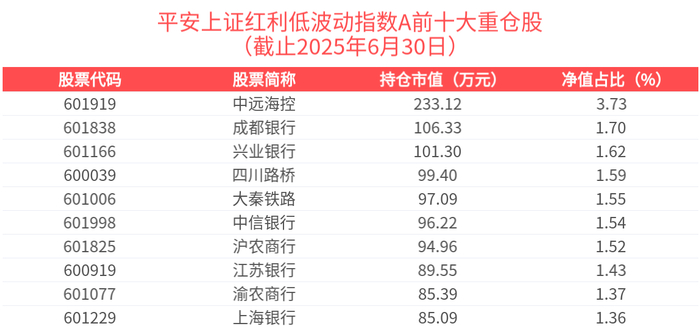
Core Insights - The article highlights the performance and characteristics of the Ping An SSE Dividend Low Volatility Index A (020456), noting its recent gains and strong fund inflows, indicating investor confidence in low volatility strategies [1][2]. Performance Summary - As of October 15, 2025, the Ping An SSE Dividend Low Volatility Index A has achieved a maximum monthly return of 11.16% since its inception, with an average monthly return of 3.53% and a monthly profit probability of 55% [2]. - The index has outperformed its benchmark with an annualized excess return of 5.53% over the past six months, ranking in the top half of comparable funds [2]. - The maximum drawdown over the past year is 6.70%, which is lower than the benchmark's drawdown of 0.98%, indicating lower risk compared to peers [2]. Fund Inflows and Financing - The Ping An SSE Dividend Low Volatility Index has seen significant capital inflows, with a total of 252.92 billion yuan in net purchases over the last five trading days, reflecting strong investor interest [1]. - The financing balance for the index reached 999.65 billion yuan as of October 15, 2025, with a net financing purchase of 10.74 billion yuan over the past month [1]. Fund Characteristics - The fund has a management fee rate of 0.50% and a custody fee rate of 0.10%, totaling a fee rate of 0.60% [4]. - The fund closely tracks the SSE Dividend Low Volatility Index, which selects 50 securities based on liquidity, dividend payment history, and low volatility, aiming to minimize tracking error [4]. Top Holdings - As of June 30, 2025, the top ten holdings of the Ping An SSE Dividend Low Volatility Index A include COSCO Shipping Holdings, Chengdu Bank, and Industrial Bank, with the top ten stocks accounting for 17.41% of the total portfolio [4][6].

中国平安增持招行、邮储,年内耗资千亿港元加仓银行H股!银行AH优选ETF(517900)盘中涨近1%
2 1 Shi Ji Jing Ji Bao Dao· 2025-10-16 03:00
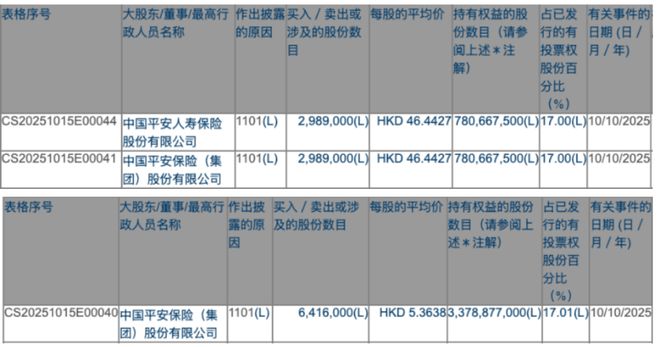
Core Viewpoint - The banking sector is experiencing a rally, with significant increases in stock prices for various banks, driven by insurance capital increasing their holdings in Hong Kong bank stocks, particularly by China Ping An [1][2]. Group 1: Investment Activities - China Ping An's subsidiary, Ping An Life, increased its holdings in China Merchants Bank (CMB) by 2.989 million H-shares, raising its total to 781 million shares, which represents 17% of CMB's H-shares [2]. - On the same day, China Ping An purchased 641,600 H-shares of Postal Savings Bank, increasing its stake to 17.01% [2]. - Since the beginning of the year, China Ping An has significantly increased its investments in H-shares of banks, including Agricultural Bank and Industrial and Commercial Bank, with total expenditures exceeding 100 billion Hong Kong dollars [4]. Group 2: Market Trends - The banking sector has seen a net inflow of nearly 100 million yuan into the Bank AH Preferred ETF (517900) over four consecutive days, indicating strong investor interest [7]. - The insurance sector's stock holdings have increased by 26.69% since the beginning of the year, with banks consistently representing the highest proportion of these holdings, reaching 47.2% by mid-2025 [4][6]. Group 3: Performance Metrics - The China Banking Index has experienced a cumulative decline of 15.21% from July 11 to October 9, while the CSI 300 Index rose by 17.44% during the same period [9]. - Since the launch of the Bank AH Total Return Index on December 6, 2017, it has achieved a cumulative return of 82.26%, outperforming the China Banking Total Return Index by 21.49% [9][11].



银行ETF指数(512730)冲击六连阳,国有六大行分红总额超2000亿
Xin Lang Cai Jing· 2025-10-16 02:39
Group 1 - The China Banking Index (399986) increased by 0.50%, with notable gains from Chongqing Bank (1.69%), Suzhou Bank (1.54%), and others [1] - The Bank ETF Index (512730) rose by 0.60%, marking a six-day consecutive increase, with the latest price at 1.67 yuan [1] - Eight listed banks have implemented mid-term dividends, with the total dividend amount from the six major state-owned banks expected to reach 204.657 billion yuan [1] Group 2 - As of September 30, 2025, the top ten weighted stocks in the China Banking Index accounted for 64.6% of the index, including major banks like China Merchants Bank and Industrial and Commercial Bank of China [2] - The China Banking Index is designed to reflect the overall performance of different industry companies within the China Securities Index [2]
A股、H股红利资产持续活跃,银行ETF天弘(515290)冲击6连阳,港股通央企红利ETF天弘(159281)涨近1%
2 1 Shi Ji Jing Ji Bao Dao· 2025-10-16 02:27
Group 1 - The A-share market showed a rebound on October 16, with the banking sector performing well, as evidenced by the Tianhong Bank ETF (515290) rising by 0.34% and reaching an intraday increase of nearly 0.90%, marking a six-day winning streak [1] - The Tianhong Bank ETF attracted over 110 million yuan in inflows yesterday and has accumulated over 550 million yuan in the past five trading days, indicating strong investor interest [1] - Key stocks within the banking ETF, such as Suzhou Bank, Shanghai Pudong Development Bank, Chongqing Bank, CITIC Bank, and China Construction Bank, saw gains exceeding 1% [1] Group 2 - The Tianhong Central Enterprise Dividend ETF (159281) closely tracks the Central Enterprise Dividend Index (931233), which selects stable dividend-paying central enterprises within the Hong Kong Stock Connect, reflecting the overall performance of high-dividend central enterprises [2] - Market analysts noted a "seesaw effect" between the banking sector and the A-share average price index over the past decade, suggesting that as the A-share index trends downward, banking stocks tend to perform better [2] - According to a report from CITIC Securities, the fourth quarter of 2025 may present a key opportunity for bottom-fishing in dividend stocks, as current pessimistic expectations may have been fully priced in [2] Group 3 - Zhongtai Securities reported that insurance capital is increasingly entering the equity market, with a growing preference for banking stocks due to their high dividend yields [3] - It is anticipated that insurance capital will further increase its holdings in bank stocks in the future, given the current policy and interest rate environment [3]

A股公司破净率超5% 46股业绩好低估值
Zheng Quan Shi Bao· 2025-10-15 18:08
Core Viewpoint - The article discusses the significance of "broken net" stocks in the A-share market, highlighting the current state of these stocks and identifying high-performing, undervalued stocks among them [1] Group 1: Market Overview - As of October 15, there are 287 broken net stocks in the A-share market, accounting for 5.28% of the total [1] - The presence of broken net stocks is often associated with market sentiment, with significant market rallies typically leading to the "elimination" of these stocks [1] Group 2: Stock Screening Criteria - The article outlines specific criteria for selecting high-performing, undervalued stocks: 1. Positive net profit for 2023, with year-on-year growth for 2023 and 2024 2. Positive net profit for the first half of 2025, with year-on-year growth 3. Rolling price-to-earnings ratio below 30 as of October 15 [1] Group 3: Selected Stocks - A total of 46 stocks meet the screening criteria, with the banking sector contributing the most, comprising 28 stocks, over 60% of the total [1] - Other sectors represented include transportation (6 stocks), utilities (3 stocks), and construction decoration (3 stocks) [1] Group 4: Performance Analysis - The selected high-performing, undervalued broken net stocks have averaged an increase of 8.72% year-to-date, underperforming the Shanghai Composite Index by 8 percentage points [1] - Among these, Agricultural Bank of China leads with a year-to-date increase of 42.26%, becoming the market capitalization champion in A-shares [2] Group 5: Dividend Characteristics - The 46 selected stocks generally exhibit high dividend yields, with 33 stocks having a yield exceeding 3%, representing over 70% of the total [2] - Seven stocks have dividend yields above 5%, with Zhangjiagang Bank leading at 6.9% [2] Group 6: Trading Activity - Among the 33 high dividend yield stocks, 19 have seen a more than 10% increase in average daily trading volume since October [3] - Chongqing Bank has the highest increase in average daily trading volume at 138.01%, with significant institutional support reflected in 12 "positive" ratings [3]
重庆银行股价连续4天上涨累计涨幅13.24%,中欧基金旗下2只基金合计持212.57万股,浮盈赚取250.83万元
Xin Lang Cai Jing· 2025-10-15 11:18
Core Viewpoint - Chongqing Bank's stock has experienced a significant increase, rising 1.92% to 10.09 CNY per share, with a total market capitalization of 35.059 billion CNY and a cumulative increase of 13.24% over the past four days [1] Company Overview - Chongqing Bank was established on September 2, 1996, and listed on February 5, 2021. The bank primarily provides corporate and personal banking products and services, as well as money market operations [1] - The bank operates through three business segments: corporate banking, retail banking, and funding operations. The revenue composition is as follows: corporate banking 75.09%, retail banking 16.94%, funding operations 7.72%, and undistributed 0.25% [1] Fund Holdings - Two funds under China Europe Fund have significant holdings in Chongqing Bank, totaling 2.1257 million shares. The estimated floating profit today is approximately 403,900 CNY, with a total floating profit of 2.5083 million CNY over the past four days [2] - The specific funds include: - China Europe Jinquan Flexible Allocation Mixed A (001110) holds 1.9753 million shares, accounting for 2.59% of the fund's net value, with a floating profit of about 375,300 CNY today [2] - China Europe Qifu Mixed A (014759) holds 150,400 shares, accounting for 0.28% of the fund's net value, with a floating profit of approximately 28,600 CNY today [2]
重庆银行股价连续4天上涨累计涨幅13.24%,兴业基金旗下1只基金持26万股,浮盈赚取30.68万元
Xin Lang Cai Jing· 2025-10-15 10:18
Core Viewpoint - Chongqing Bank's stock has seen a significant increase, with a 13.24% rise over the past four days, indicating strong market performance and investor interest [1]. Company Overview - Chongqing Bank was established on September 2, 1996, and listed on February 5, 2021. The bank primarily operates in China, providing corporate and personal banking products and services, as well as capital market operations [1]. - The bank's revenue composition is as follows: corporate banking accounts for 75.09%, personal banking for 16.94%, and capital market operations for 7.72%, with 0.25% remaining undistributed [1]. Fund Holdings - One fund, the Industrial Bank's "Yingye Ju Xiang 6-Month Holding Period Mixed A" (021821), has a significant position in Chongqing Bank, having reduced its holdings by 140,000 shares in the second quarter, now holding 260,000 shares, which represents 1.61% of the fund's net value [2]. - The fund has realized a floating profit of approximately 49,400 yuan today, with a total floating profit of 306,800 yuan during the four-day stock price increase [2]. Fund Manager Performance - The fund manager, Ding Jin, has a tenure of 10 years and 143 days, managing assets totaling 19.674 billion yuan. The best fund return during his tenure is 88.07%, while the worst is 1.18% [3].
城商行板块10月15日涨0.62%,重庆银行领涨,主力资金净流出3.01亿元
Zheng Xing Xing Ye Ri Bao· 2025-10-15 08:37
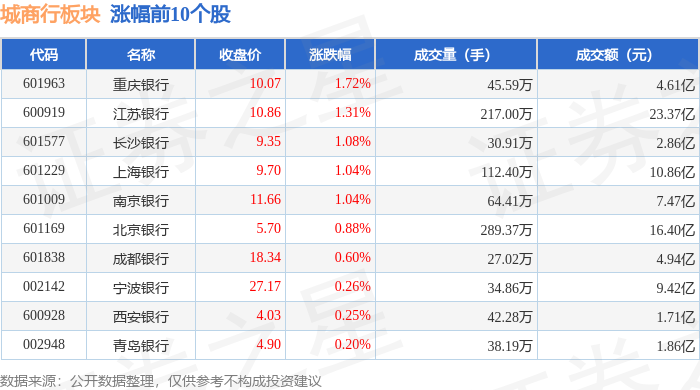
Market Performance - The city commercial bank sector rose by 0.62% on October 15, with Chongqing Bank leading the gains [1] - The Shanghai Composite Index closed at 3912.21, up 1.22%, while the Shenzhen Component Index closed at 13118.75, up 1.73% [1] Individual Stock Performance - Chongqing Bank (601963) closed at 10.07, up 1.72% with a trading volume of 455,900 shares and a transaction value of 461 million [1] - Jiangsu Bank (616009) closed at 10.86, up 1.31% with a trading volume of 2.17 million shares and a transaction value of 2.337 billion [1] - Other notable performers include Changsha Bank (601577) at 9.35 (+1.08%), Shanghai Bank (601229) at 9.70 (+1.04%), and Nanjing Bank (600109) at 11.66 (+1.04%) [1] Capital Flow Analysis - The city commercial bank sector experienced a net outflow of 301 million from institutional investors, while retail investors saw a net inflow of 136 million [2] - The overall capital flow indicates a mixed sentiment, with institutional investors withdrawing funds while retail investors are increasing their positions [2] Detailed Capital Flow for Selected Banks - Qilu Bank (601665) had a net outflow of 38.24 million from institutional investors, while retail investors contributed a net inflow of 3.55 million [3] - Ningbo Bank (002142) saw a net outflow of 18.51 million from institutional investors, with retail investors contributing a net inflow of 1.63 million [3] - Beijing Bank (601169) experienced a net outflow of 6.04 million from institutional investors, but retail investors added 35.47 million [3]

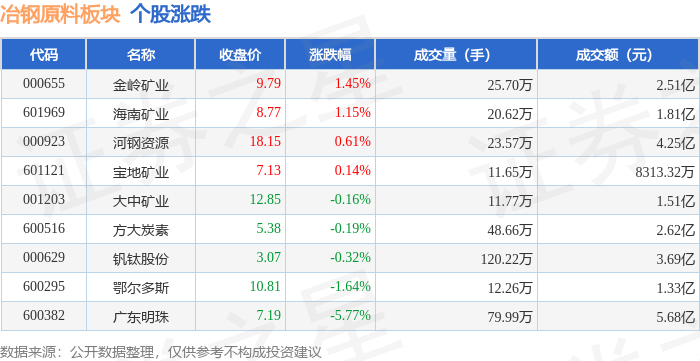
冶钢原料板块10月15日跌0.33%,广东明珠领跌,主力资金净流出2389.12万元
Zheng Xing Xing Ye Ri Bao· 2025-10-15 08:27
Market Overview - The steel raw materials sector experienced a decline of 0.33% on October 15, with Guangdong Mingzhu leading the drop [1] - The Shanghai Composite Index closed at 3912.21, up 1.22%, while the Shenzhen Component Index closed at 13118.75, up 1.73% [1] Stock Performance - Key stocks in the steel raw materials sector showed mixed performance, with Jinling Mining rising by 1.45% to 9.79, while Guangdong Mingzhu fell by 5.77% to 7.19 [1] - The trading volume and turnover for major stocks included: - Jinling Mining: 257,000 shares, turnover of 251 million yuan - Guangdong Mingzhu: 799,900 shares, turnover of 568 million yuan [1] Capital Flow - The steel raw materials sector saw a net outflow of 23.89 million yuan from main funds, while retail investors contributed a net inflow of 23.21 million yuan [1] - Specific stock capital flows indicated: - Hebei Steel Resources had a main fund net inflow of 11.24 million yuan, while Guangdong Mingzhu saw a net outflow of 41.11 million yuan from retail investors [2] - Fangda Carbon experienced a significant main fund net outflow of 23.96 million yuan, but a retail net inflow of 38.14 million yuan [2]

东方证券:预计25Q3银行利润增速预期稳定 板块间分化或有加剧
智通财经网· 2025-10-15 08:17
Core Viewpoint - The report from Dongfang Securities indicates that the recent adjustments in LPR and deposit rates have a neutral to positive impact on banks' net interest margins, with expectations for stable interest income performance in the near term [1][2]. Group 1: Net Interest Margin and Income - The net interest margin is expected to stabilize, supporting stable interest income performance. The LPR and deposit rate adjustments are projected to have a neutral to positive effect on net interest margins, with new loan rates remaining relatively firm [1][2]. - For Q3 2025, the growth rate of interest income for listed banks is forecasted to decline by 0.8% year-on-year, but will increase by 0.5 percentage points quarter-on-quarter, with state-owned banks showing a growth of 0.8 percentage points [2]. Group 2: Non-Interest Income Performance - Non-interest income is expected to show differentiation, with state-owned banks likely performing better due to significant growth in equity fund products and a shift in deposits from general to interbank deposits [3]. - The forecast for Q3 2025 indicates a 3.4% year-on-year growth in net fee income for listed banks, with state-owned banks expected to see a growth of 0.3 percentage points [3]. Group 3: Asset Quality and Credit Costs - Asset quality is anticipated to remain stable, with credit costs potentially returning to a downward trend. Despite a decline in loan growth, the write-off rate remains steady, which may support stable non-performing loan indicators [4]. - For Q3 2025, the forecast for impairment losses is a year-on-year decrease of 1.2%, with net profit growth of 0.7% year-on-year for listed banks [4]. Group 4: Investment Recommendations - The report suggests focusing on two investment themes: high-quality small and medium-sized banks with stable fundamentals, and large state-owned banks with good defensive value [5].