SpaceX

Search documents
From satellites to space data centers: Why low earth orbit is attracting billions in investment
CNBC· 2026-03-22 07:10
Core Insights - Low Earth Orbit (LEO) is rapidly becoming a critical infrastructure for global navigation, telecommunications, defense, and connectivity, with significant investment flowing into the sector [2][3] - The investment in the space economy has surged, with over $45 billion recorded in 2025, a substantial increase from just under $25 billion in 2024 [3] - The shift towards LEO is exemplified by companies like SpaceX, which operates the Starlink constellation and plans to expand its satellite network significantly [6][8] Investment Trends - More than $400 billion has been invested in the space economy since 2009, with the U.S. contributing over half of this amount [13] - The industry is in the early stages of a multi-decade infrastructure cycle, with public market opportunities emerging as more space companies go public [13][14] - The anticipated SpaceX IPO could be a pivotal moment for the space sector, reshaping investor expectations and attracting broader capital [14] Regulatory Landscape - The governance of LEO is fragmented, with existing frameworks deemed inadequate for the complexities of the evolving space environment [15][17] - Current regulations were designed for Geostationary Orbit (GEO) and do not address the higher risks associated with LEO operations [17] - Experts emphasize the need for a new regulatory perspective as commercial operators become the primary users of space [17][18] Strategic Opportunities - Companies like Amazon LEO and Blue Origin are planning extensive satellite deployments, with Amazon aiming to launch over 3,000 satellites and Blue Origin over 5,000 by late 2027 [10][11] - The potential for LEO satellites to connect billions of people is seen as a game changer for bridging the digital divide [18] - The emergence of space computing, as highlighted by Nvidia's new platform, could transform orbital data centers and autonomous space operations [8][9]



马斯克正式启动超级芯片制造工厂
第一财经· 2026-03-22 07:08
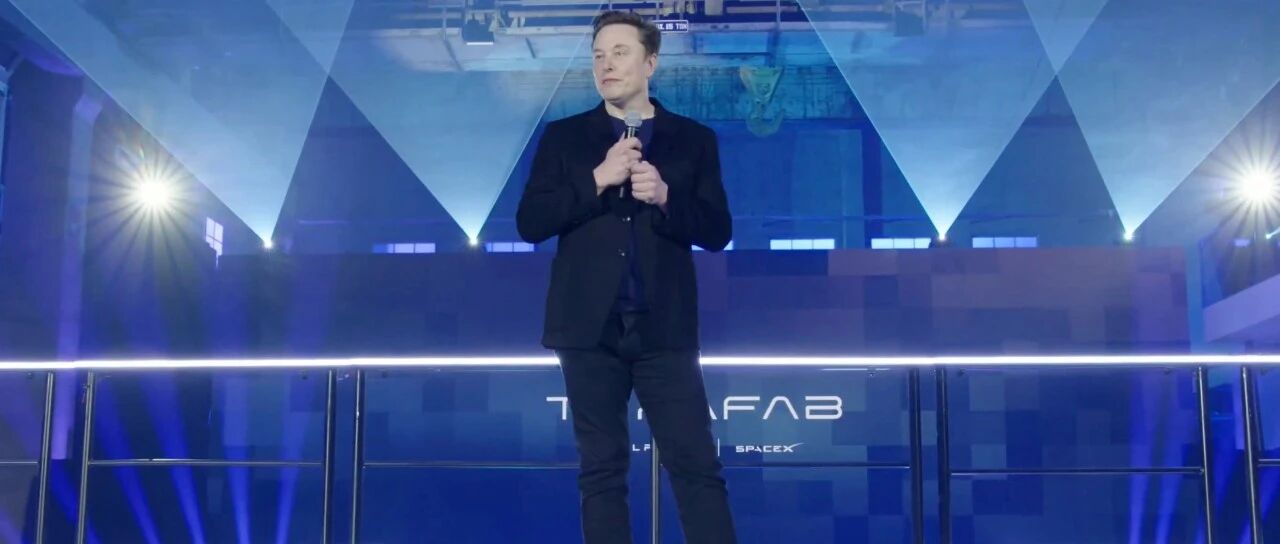
3月22日,特斯拉CEO马斯克表示,他的超级芯片工厂项目Terafab将在美国得克萨斯州的奥斯汀开 工建设,由特斯拉和SpaceX负责运营。Terafab将为机器人、人工智能和太空数据中心制造芯片。 微信编辑 | 小羊 ...

2000亿,一家PE卖身
投中网· 2026-03-22 07:00
Core Insights - Middle Eastern capital is reshaping the global private equity landscape, with significant investments and acquisitions being made by sovereign wealth funds [5][6] - Abu Dhabi International Holding Company (IHC) has made a strategic investment in Alpha Wave, acquiring 50.1% of its shares, which is aimed at building a global asset management platform [4][15] - The total assets under management of IHC's Judan Financial reached approximately $237 billion, indicating its rapid growth since its establishment [4][14] Investment Trends - Middle Eastern sovereign wealth funds invested $127 billion in the past year, a 48% increase from 2024, and now control assets totaling $6 trillion [5] - The seven major Gulf sovereign wealth funds collectively invested $119 billion, marking a 43% increase from 2024, representing 43% of all state investor capital [5] Alpha Wave's Position - Alpha Wave Global focuses on AI-driven companies and has a significant investment portfolio that includes major potential IPOs like SpaceX, OpenAI, and Anthropic, with a combined estimated IPO value exceeding $3 trillion [9][10] - The firm has a dual strategy of investing in both AI-native companies and traditional industries benefiting from AI technology [9] Strategic Partnerships - Alpha Wave has previously collaborated with Chimera Investment and ADQ to establish a technology investment fund, indicating strong ties with Middle Eastern capital [12] - Judan Financial aims to integrate various financial assets under IHC, creating a comprehensive AI-enabled financial services platform [14] Market Dynamics - Middle Eastern capital is transitioning from being passive investors to active players in global financial markets, as evidenced by significant acquisitions and direct investments in private equity firms [17] - The investment preferences of sovereign funds are shifting towards AI and high-tech sectors, with substantial investments made in these areas in 2025 [17] Competitive Landscape - The growing influence of sovereign wealth funds is creating both opportunities and challenges for global general partners (GPs), necessitating a shift in strategies to attract Middle Eastern capital [18] - GPs must enhance their competitive edge through joint investments and value creation, as sovereign funds are increasingly seen as key partners in large-scale mergers and acquisitions [18]

芯片大消息!马斯克,重磅宣布!
是说芯语· 2026-03-22 06:47
Core Viewpoint - The Terafab project, a collaboration between Tesla, SpaceX, and xAI, aims to establish the largest chip manufacturing facility in history, targeting an annual production capacity of over 1 terawatt of computing power, which will significantly reshape the global semiconductor industry [1][2]. Group 1: Terafab Project Overview - The Terafab project aims to produce over 1 terawatt of computing power annually, covering the entire semiconductor supply chain, including logic chips, memory chips, and advanced packaging [2]. - Approximately 80% of the computing power will be allocated to space applications, while the remaining 20% will focus on ground applications, reflecting Musk's strategic vision for future technological competition [2]. - The project plans to utilize 2nm advanced process technology, integrating chip design, manufacturing, and testing within a single facility, which is expected to accelerate chip iteration speed significantly [2]. Group 2: Collaborative Efforts - The project involves deep collaboration among three major companies: SpaceX, Tesla, and xAI, each playing a crucial role in the initiative [3]. - SpaceX will handle 80% of the space computing capacity, providing specialized chips for projects like Starlink and deep space exploration, addressing challenges posed by extreme conditions in space [3]. - Tesla will focus on the 20% of ground computing power for its core businesses, including fully autonomous driving and robotics, ensuring self-sufficiency in chip supply [3]. Group 3: AI Integration - xAI will provide AI algorithms and optimization support for the Terafab chips, enhancing the training and inference capabilities of large AI models [4]. - The integration of space and ground computing will facilitate efficient deployment of AI models in space scenarios, creating a unified AI ecosystem [4]. Group 4: Industry Impact and Challenges - The announcement of the Terafab project is expected to disrupt the traditional semiconductor industry, promoting a shift from specialized manufacturing to vertical integration [8]. - The project aims to resolve computing power shortages in AI, aerospace, and smart automotive sectors, potentially leading to a new era in the space economy [8]. - However, the project faces significant challenges, including a required investment of $25 billion to $40 billion, a lengthy construction period of 3-5 years, and difficulties in acquiring advanced manufacturing equipment and skilled personnel [8][9].
X @Tesla Owners Silicon Valley
Tesla Owners Silicon Valley· 2026-03-22 05:35
RT Tesla Owners Silicon Valley (@teslaownersSV)Grok SummarySpaceX announced TERAFAB, described as “the next step towards becoming a galactic civilization.”This appears to be a major new initiative (likely a joint project involving Tesla, xAI, and SpaceX elements, based on community reactions and context).Key highlights from the post and surrounding discussion:• TERAFAB is presented as the world’s largest AI chip fabrication facility (“fab”), built at Giga Texas.• Goal: Produce billions of chips for massive ...
刚刚,马斯克启动TERAFAB项目:万亿瓦算力工厂,瞄准太空
机器之心· 2026-03-22 05:34
Core Viewpoint - Musk's announcement of the "TERAFAB" project aims to produce over 1 Terawatt (TW) of computing power annually, with 80% allocated for space and 20% for Earth [1][15]. Group 1: Project Overview - The TERAFAB project will be a collaboration between SpaceX and Tesla, focusing on producing a massive scale of AI chips to meet future demands [2][11]. - The project envisions a computing capacity of 1 TW, which is equivalent to 1,000 gigawatts (GW) or 1 million megawatts (MW) [1]. Group 2: Technological Aspirations - Musk's vision includes expanding human civilization to the galaxy, with plans for cities on the Moon and Mars, and utilizing the entire solar system [4][23]. - The Kardashev Scale categorizes civilizations based on their energy consumption capabilities, with Type I being the ability to harness all energy from their home planet [5][6]. Group 3: Infrastructure and Capabilities - SpaceX's Starship is crucial for achieving the goal of transporting approximately 10 million tons of materials to orbit annually, which is necessary for the TW-level computing capacity [11][12]. - The advanced chip factory in Austin will be capable of producing various types of chips and will facilitate rapid iterations in chip design [17]. Group 4: Space vs. Earth - The current annual electricity consumption in the U.S. is only 0.5 TW, while the TERAFAB project aims to produce 1 TW, highlighting the project's scale [15]. - Deploying AI in space may become more cost-effective than on Earth due to the abundance of solar energy and favorable conditions for cooling [19][20]. Group 5: Future Implications - If the TW-level computing capability is realized in space, it could revolutionize AI operations and economic systems, eliminating constraints related to land and cooling systems [24][25]. - The potential for a lunar mass driver could lead to a new economic system that is vastly larger than the current Earth economy [22].
X @Elon Musk
Elon Musk· 2026-03-22 05:02
RT Owen Sparks (@OwenSparks)How could you not be excited about the future! This is what Tesla, SpaceX, and xAI are building, abundance for all! https://t.co/A5NyTcEkDa ...
X @Bloomberg
Bloomberg· 2026-03-22 04:56
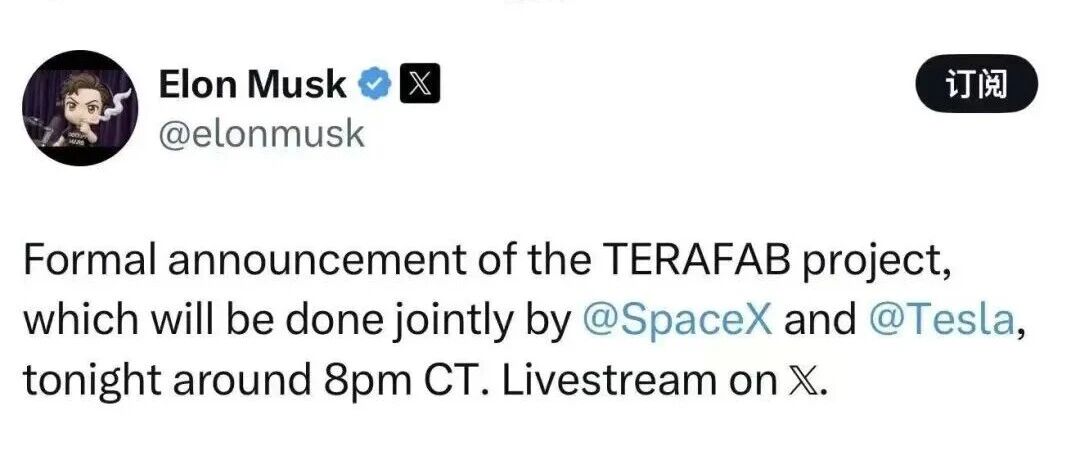
Elon Musk said his Terafab project — a grand plan to eventually manufacture his own chips for robotics, artificial intelligence and space data centers — will be built in Austin and jointly run by Tesla and SpaceX https://t.co/c0bXI7mLZt ...
X @Herbert Ong
Herbert Ong· 2026-03-22 04:48
🚨Elon Just Announced Something Way Bigger Than Tesla (Terafab Announcement Supercut)00:00 Big Announcement Tease00:41 Vision for Galactic Future05:11 Terawatt Project Partners08:40 Terafab Decision and Location10:12 Inside the Advanced Fab13:32 Why AI Compute Goes to Space15:27 Beyond Terafab Moon Mass Driver17:11 Abundance and Sci Fi Future$TSLA @SpaceX @Tesla ...
芯片,突传重磅消息!马斯克,刚刚宣布!
券商中国· 2026-03-22 03:47
Core Viewpoint - Tesla and SpaceX are launching the "Terafab" project, aiming to build the largest chip manufacturing facility in history, targeting an annual production capacity of over 1 terawatt of computing power, with 80% allocated for space applications and 20% for terrestrial use [1][2]. Group 1: Project Overview - The "Terafab" project will integrate logic chips, memory chips, and advanced packaging technologies within a single facility, with a production goal of 100 billion to 200 billion chips annually [4]. - The project is essential for supporting Tesla's ambitious plans, including the deployment of solar energy capturing devices and AI satellites, which require significant chip supplies [2][4]. Group 2: Market Position and Strategy - Tesla aims to lead the artificial intelligence chip sector, with expectations that its AI chip production will surpass that of all other manufacturers combined [3]. - The company is currently reliant on external suppliers like Samsung and TSMC for its Autopilot and FSD systems, but the new facility is intended to reduce this dependency [3][5]. Group 3: Financial Implications - The construction of the chip factory is projected to cost several billion dollars, with Tesla planning to invest $20 billion in new equipment, significantly higher than the previous year's investment [5]. - Analysts suggest that Tesla may not bear the entire cost of the factory alone and could seek partnerships to share the financial burden [5][6].