
沪农商行

Search documents
让金融活水化身民生暖流
Jin Rong Shi Bao· 2025-08-27 02:40
Group 1 - Employment is viewed as a barometer of economic development and a stabilizer for society, with policies focusing on job stability and improving livelihoods [1] - The collaboration between government and banks has created a financial support system for job seekers, enhancing economic resilience [1] Group 2 - The number of delivery riders in China has exceeded 10 million, highlighting the growing demand for gig economy jobs [2] - Delivery riders prioritize timely salary payments, which poses financial challenges for service providers who often need to advance funds [2][3] Group 3 - Financial institutions like Industrial Bank have developed tailored loan products such as "Xing Su Dai" to address the cash flow needs of delivery platforms, with a total of 1 billion yuan disbursed to support over 10,000 riders [3] - Other banks have introduced specialized financial services to alleviate payroll pressures for small and medium enterprises [3] Group 4 - New farmers and young entrepreneurs are crucial for the growth of the private economy, with many returning to rural areas to start businesses [4] - Financial support from banks, such as Jiangsu Bank's customized services, has enabled these entrepreneurs to overcome initial funding challenges [4] Group 5 - Local governments in Ningbo have implemented various support measures, including loans and subsidies, to assist new entrepreneurs [5] - Several banks have launched targeted credit support policies for new farmers and young entrepreneurs, enhancing their access to funding [6] Group 6 - Banks are actively participating in job fairs and providing personalized financing solutions to job seekers, addressing the information gap between employers and potential employees [7] - Initiatives like the "Thousand Jobs, Ten Thousand Families" program by China Bank aim to facilitate employment through various activities and platforms [7]
被00后捧成“打工性价比最高的城市”,它凭什么
Sou Hu Cai Jing· 2025-08-26 23:29
Core Viewpoint - Shanghai has recently been labeled as the "most suitable city for ordinary workers," highlighting its appeal to young professionals seeking a sense of value and purpose in their work and life [1][3][5]. Group 1: Work Environment and Value Perception - Many young workers express that despite the demanding work pace, the experience of working in Shanghai is perceived as worthwhile due to the sense of value it provides [3][5]. - The shift in sentiment from leaving first-tier cities to returning to Shanghai indicates a growing recognition of its high "work value for money" [6]. - Individuals with average educational backgrounds find that working in Shanghai allows them to feel a sense of personal value that they could not achieve in their hometowns [6][10]. Group 2: City Characteristics and Opportunities - Shanghai's emphasis on rules and regulations creates an environment where ordinary workers feel respected and valued, reducing the impact of informal networks and nepotism [10][12]. - The city's diverse industrial structure and robust social support systems provide numerous opportunities for individuals to realize their value across various sectors [13][14]. - Shanghai is recognized for its favorable business environment, which leads to more job opportunities and consumer choices [16][18]. Group 3: Financial Services and Community Support - Shanghai Rural Commercial Bank has been instrumental in providing value to its clients through various financial services, focusing on inclusive finance to enhance the quality of life for ordinary citizens [24][27]. - The bank's initiatives, such as the "Heart Home" public service stations, aim to extend its services to community needs, particularly for the elderly and children, thereby fostering a supportive environment [30].


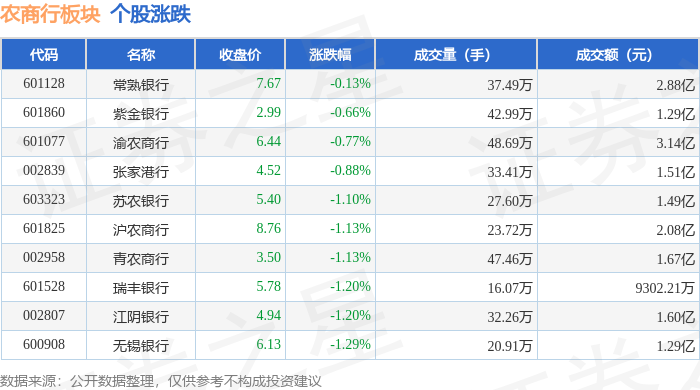
农商行板块8月26日跌0.93%,无锡银行领跌,主力资金净流入2339.3万元
Zheng Xing Xing Ye Ri Bao· 2025-08-26 08:36
Core Viewpoint - The agricultural commercial bank sector experienced a decline of 0.93% on August 26, with Wuxi Bank leading the drop, while the Shanghai Composite Index closed at 3868.38, down 0.39%, and the Shenzhen Component Index closed at 12473.17, up 0.26% [1] Group 1: Stock Performance - Changshu Bank closed at 7.67, down 0.13% with a trading volume of 374,900 shares [1] - Zijin Bank closed at 66, down 0.66% with a trading volume of 429,900 shares [1] - Yunnan Agricultural Commercial Bank closed at 6.44, down 0.77% with a trading volume of 148,690 shares [1] - Zhangjiagang Bank closed at 4.52, down 0.88% with a trading volume of 334,100 shares [1] - Sunong Bank closed at 5.40, down 1.10% with a trading volume of 276,000 shares [1] - Hunan Agricultural Commercial Bank closed at 8.76, down 1.13% with a trading volume of 237,200 shares [1] - Qingnong Bank closed at 3.50, down 1.13% with a trading volume of 474,600 shares [1] - Ruifeng Bank closed at 5.78, down 1.20% with a trading volume of 160,700 shares [1] - Jiangyin Bank closed at 4.94, down 1.20% with a trading volume of 322,600 shares [1] - Wuxi Bank closed at 6.13, down 1.29% with a trading volume of 209,100 shares [1] Group 2: Capital Flow - The agricultural commercial bank sector saw a net inflow of 23.39 million yuan from main funds, while retail investors experienced a net outflow of 84.78 million yuan [1] - Yunnan Agricultural Commercial Bank had a main fund net inflow of 14.96 million yuan, with a retail net outflow of 17.61 million yuan [2] - Sunong Bank had a main fund net inflow of 13.53 million yuan, with a retail net outflow of 11.45 million yuan [2] - Qingnong Bank had a main fund net inflow of 5.03 million yuan, with a retail net outflow of 3.97 million yuan [2] - Jiangyin Bank had a main fund net inflow of 4.35 million yuan, with a retail net outflow of 3.14 million yuan [2] - Zhangjiagang Bank had a main fund net inflow of 4.14 million yuan, with a retail net outflow of 15.27 million yuan [2] - Zijin Bank had a main fund net inflow of 4.11 million yuan, with a retail net outflow of 7.93 million yuan [2] - Ruifeng Bank had a main fund net inflow of 0.97 million yuan, with a retail net outflow of 6.81 million yuan [2] - Wuxi Bank had a main fund net inflow of 0.54 million yuan, with a retail net outflow of 1.53 million yuan [2] - Hunan Agricultural Commercial Bank had a main fund net outflow of 1.67 million yuan, with a retail net outflow of 14.16 million yuan [2] - Changshu Bank had a main fund net outflow of 22.57 million yuan, with a retail net inflow of 2.55 million yuan [2]

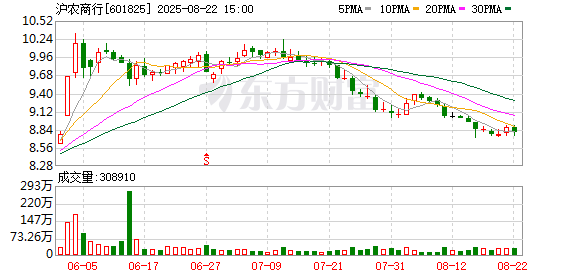
沪农商行8月25日获融资买入1387.08万元,融资余额1.55亿元
Xin Lang Cai Jing· 2025-08-26 01:29
Group 1 - The core viewpoint of the news highlights the trading performance and financial metrics of Shanghai Rural Commercial Bank (沪农商行) as of August 25, 2023, indicating a slight increase in stock price and notable financing activities [1] - On August 25, 2023, the bank's stock price rose by 0.68%, with a trading volume of 243 million yuan. The net financing buy was negative at -10.69 million yuan, with total financing and securities balance at 165 million yuan [1] - The bank's financing balance of 155 million yuan represents 0.19% of its market capitalization, which is below the 40th percentile of the past year, indicating a low level of financing activity [1] Group 2 - As of March 31, 2025, the number of shareholders for the bank was 84,700, a decrease of 6.19% from the previous period, while the average circulating shares per person increased by 6.60% to 109,982 shares [2] - For the first quarter of 2025, the bank reported zero operating income but a net profit attributable to shareholders of 3.564 billion yuan, reflecting a year-on-year growth of 0.34% [2] - The bank has distributed a total of 16.521 billion yuan in dividends since its A-share listing, with 11.120 billion yuan distributed over the past three years [3] Group 3 - As of March 31, 2025, Hong Kong Central Clearing Limited emerged as the tenth largest circulating shareholder, holding 206 million shares as a new shareholder [3]
湘财证券晨会纪要-20250826
Xiangcai Securities· 2025-08-25 23:32
Industry Overview - The public utility sector saw a weekly increase of 1.89%, underperforming the broader market by 2.29 percentage points, ranking 23rd among the primary sectors [2] - The coal price in Qinhuangdao rose to 704 RMB/ton, a weekly increase of 0.86%, while coal inventory increased by 2.46% to 5.84 million tons [3] - Domestic natural gas prices fell by 1.75% to 4099 RMB/ton, and U.S. natural gas futures dropped by 7.9% to 2.69 USD/mmbtu [5] - As of July, the cumulative installed power generation capacity reached 3.67 billion kilowatts, a year-on-year increase of 18.2%, with solar and wind power installations growing by 50.8% and 22.1% respectively [6] Investment Recommendations - The report suggests focusing on three main lines: hydropower assets benefiting from the unified electricity market, thermal power assets with improving performance due to cost reductions, and green energy projects transitioning smoothly to profitability [7][8] - Specific stock recommendations include Yangtze Power, Huaneng Hydropower, Huaneng International, Jingneng Power, and Funiu Co. [8] Banking Sector Insights - Recent adjustments in deposit rates by small and medium banks indicate a continued downward trend in deposit costs, with reductions of 10 to 20 basis points [10] - The net interest margin for commercial banks was reported at 1.42%, with expectations for a further decline in deposit costs by over 20 basis points this year [11][12] - The report recommends focusing on high-dividend and regionally growing bank stocks, including major state-owned banks and select regional banks with growth potential [12] Innovation Drug Sector Analysis - The innovation drug sector is entering a pivotal phase with a shift from capital-driven to profit-driven growth, supported by favorable policies and market conditions [14][16] - Key performance indicators show that several leading overseas pharmaceutical companies reported significant revenue growth, with Eli Lilly's revenue increasing by 38% and Novo Nordisk's by 15% [15] - The report emphasizes the importance of clinical demand, technological platforms, and product strength in stock selection, recommending companies like 3SBio and Aosaikang [17] Medical Consumables Sector Performance - Huatai Medical reported a 21.26% increase in revenue to 1.214 billion RMB, driven by strong performance in electrophysiology products [24] - Maipu Medical achieved a 29.28% revenue growth, benefiting from its competitive position in neurosurgery repair products [25] - The report suggests monitoring companies in the high-value consumables sector for performance recovery and innovation product approvals [27][28] Electronics Sector Developments - The AI industry index saw a significant increase of 14.28%, reflecting strong market performance [30][31] - Google's launch of the Pixel 10 series, featuring advanced AI capabilities, is expected to drive further innovation in edge AI applications [33][34] - Investment opportunities are highlighted in AI infrastructure and edge SOC components, with a recommendation to focus on companies like Cambricon and Rockchip [36]
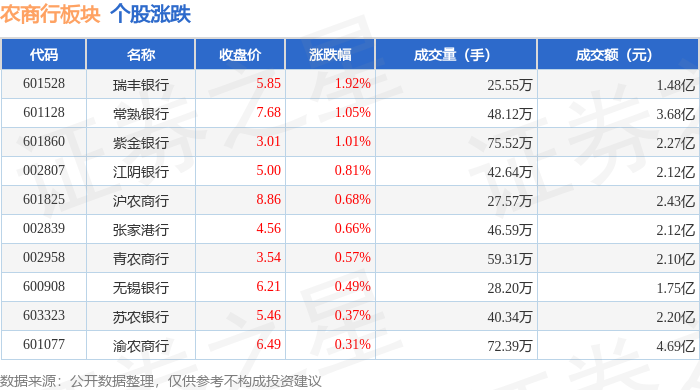
农商行板块8月25日涨0.67%,瑞丰银行领涨,主力资金净流入4194.32万元
Zheng Xing Xing Ye Ri Bao· 2025-08-25 08:47
证券之星消息,8月25日农商行板块较上一交易日上涨0.67%,瑞丰银行领涨。当日上证指数报收于 3883.56,上涨1.51%。深证成指报收于12441.07,上涨2.26%。农商行板块个股涨跌见下表: | 代码 | 名称 | 收盘价 | 涨跌幅 | 成交量(手) | 成交额(元) | | --- | --- | --- | --- | --- | --- | | 601528 | 瑞丰银行 | 5.85 | 1.92% | 25.55万 | 1.48亿 | | 601128 | 常熟银行 | 7.68 | 1.05% | 48.12万 | 3.68亿 | | 601860 | 紫金银行 | 3.01 | 1.01% | 75.52万 | 2.27亿 | | 002807 | 江阴银行 | 5.00 | 0.81% | 42.64万 | 2.12亿 | | 601825 | 沪农商行 | 8.86 | 0.68% | 27.57万 | 2.43亿 | | 002839 | 张家港行 | 4.56 | 0.66% | 46.59万 | 2.12亿 | | 002958 | 青农商行 | 3.54 | 0.57% ...

红利低波ETF(512890)成交5.46亿“霸榜” 险资近30次举牌托底高股息策略
Xin Lang Ji Jin· 2025-08-25 08:21
Market Overview - On August 25, the A-share market experienced a significant upward trend, with the Shanghai Composite Index approaching 3900 points and the ChiNext Index leading in gains [1] - The total trading volume of the two markets reached 3.14 trillion yuan, an increase of 594.4 billion yuan compared to the previous trading day [1] ETF Performance - The Dividend Low Volatility ETF (512890) rose by 0.83% on the same day, closing at 1.219 yuan, with a turnover rate of 2.59% and a trading volume of 546 million yuan, making it the top performer among similar ETFs [2][3] - As of August 22, 2025, the asset size of the ETF was 20.992 billion yuan, with a daily average trading volume of 483 million yuan over the past 20 trading days, indicating sustained market interest [2] Fund Flow Analysis - Recent fund flows indicate short-term outflows and medium to long-term inflows, with a net outflow of 57 million yuan over the past five trading days and 117 million yuan over the past ten days; however, there was a net inflow of 3.298 billion yuan over the past 60 days [2] - The ETF's cumulative return since its establishment in December 2018 has reached 141.74%, significantly outperforming its benchmark and ranking 33rd among 502 similar products [5] Holdings and Sector Focus - The ETF's top holdings are primarily in the banking sector, including Chengdu Bank, Industrial Bank, Sichuan Road and Bridge, and Daqin Railway, which all saw price increases on August 25, aligning with their high dividend and low valuation characteristics [4] - The frequency of insurance capital stake acquisitions has significantly increased in 2025, with nearly 30 instances by August 19, focusing on high-dividend, low-volatility sectors such as banking and utilities, which enhances market attention and capital inflow expectations for the ETF's holdings [4]






上海农商银行:二十载笃行普惠使命全身心为客户创造价值
Shang Hai Zheng Quan Bao· 2025-08-24 17:45
Core Viewpoint - Shanghai Rural Commercial Bank has celebrated its 20th anniversary since its transformation into a modern commercial bank, evolving from a rural credit cooperative to a listed bank with assets exceeding 1.5 trillion yuan, while maintaining its commitment to inclusive finance and serving the agricultural sector [2][3]. Group 1: Historical Development - The bank's roots trace back to 1949 with the establishment of the first rural credit cooperative in Shanghai, which laid the foundation for its mission to serve the agricultural community [3]. - In 2005, Shanghai Rural Commercial Bank became the first provincial-level joint-stock commercial bank established on the basis of rural credit cooperatives [3]. - The bank has continuously expanded its services to cover rural areas, achieving recognition for 282 credit villages and 10 credit towns by the first quarter of 2025 [3][4]. Group 2: Inclusive Finance Strategy - The bank has established a dense network of nearly 360 branches, ensuring coverage of over 1,500 administrative villages in Shanghai's suburban areas [4]. - Since 2019, the bank has committed to the mission of "Inclusive Finance to Enhance People's Quality of Life," focusing on small and micro enterprises with a loan balance exceeding 88 billion yuan and serving over 50,000 clients by the first quarter of 2025 [4][6]. - The bank has developed a progressive financial service model for small businesses, emphasizing a sustainable lending mechanism [4][6]. Group 3: Technological and Innovative Development - The bank has prioritized technology finance as a key area, aligning with national strategies to promote innovation and economic development [6][7]. - Since 2009, the bank has been actively cultivating technology enterprises, providing loans to nearly 4,500 tech companies with a total loan amount exceeding 120 billion yuan by the first quarter of 2025 [8]. - The bank has created a collaborative ecosystem for technology finance, integrating resources from various sectors to support the growth of innovative companies [7][8]. Group 4: Community and Social Responsibility - The bank aims to become a service-oriented institution focused on creating value for customers, moving away from traditional product-centric models [9]. - It has launched the "Heart Garden" public service project, integrating financial and non-financial services to enhance community welfare [9][10]. - The bank emphasizes its role in social governance and community service, aligning its operations with national strategies and local development needs [10][11].
A股银行中报业绩观察:中期分红在路上,息差压力仍存
Mei Ri Jing Ji Xin Wen· 2025-08-24 12:21
Core Viewpoint - The performance of seven A-share listed banks in the first half of 2025 shows steady growth in total assets, operating income, and net profit attributable to shareholders, with a decrease in non-performing loan ratios, indicating ongoing risk improvement [1][2]. Group 1: Financial Performance - Seven banks reported positive growth in total assets compared to the beginning of the year, with Ningbo Bank leading at an 11.04% increase, the only bank exceeding 10% [2]. - All seven banks achieved year-on-year growth in operating income and net profit attributable to shareholders, with Shanghai Pudong Development Bank's total revenue surpassing 90 billion yuan, a 2.62% increase [2]. - Jiangyin Bank reported the highest revenue growth at 10.45%, while Changshu Bank followed closely with a 10.1% increase in revenue [3]. Group 2: Asset Quality - The non-performing loan ratios of Ningbo Bank, Hangzhou Bank, and Jiangyin Bank remained stable compared to the beginning of the year, while the other four banks showed varying degrees of improvement, with Qilu Bank experiencing the largest decline of 10 basis points [2]. Group 3: Dividend Expectations - Several banks have announced expectations for mid-year dividends, with the high dividend yield of bank stocks enhancing their investment value [1][4]. - The total cash dividends of A-share listed banks reached 646.025 billion yuan in 2024, reflecting a year-on-year increase of 5.33%, which has bolstered investor confidence [4]. Group 4: Market Trends - The banking sector has seen a significant upward trend, with the China Securities Banking Index rising by 52.7% since the beginning of 2024 [4]. - The average net interest margin for commercial banks was 1.42% in the first half of the year, down 10 basis points from the end of the previous year, indicating pressure on interest margins [5].
奥浦迈: 奥浦迈:2025年半年度募集资金存放与实际使用情况的专项报告
Zheng Quan Zhi Xing· 2025-08-22 14:17
Key Points - The report details the fundraising and usage of funds by Shanghai Aopumai Biotechnology Co., Ltd. for the first half of 2025, ensuring compliance with relevant regulations [1][2] - The total amount raised from the initial public offering (IPO) was approximately RMB 1.644 billion, with a net amount of RMB 1.637 billion after deducting issuance costs [1] - As of June 30, 2025, the company had spent RMB 318.4048 million on fundraising projects and had a remaining balance of RMB 151.2954 million in the fundraising account [1][2] Fundraising Overview - The actual amount raised was RMB 1,643,705,576.40, with a net amount of RMB 1,637,000,000 after fees [1] - The company utilized RMB 318.4048 million for project expenditures and invested RMB 546 million in financial products [1] - The company generated a net interest income of RMB 48.6477 million from the funds [1] Fund Usage and Management - The company has established a dedicated account for fundraising, with a balance of RMB 151.2954 million as of June 30, 2025 [1][2] - The company has permanently supplemented working capital with surplus funds amounting to RMB 192.8819 million [1] - The company has implemented a cash management strategy for idle funds, allowing for investment in high-security, liquid financial products [2][3] Project Status - The company has completed the fundraising projects "Aopumai CDMO Biopharmaceutical Commercialization Production Platform" and "Aopumai Cell Culture R&D Center," with surplus funds permanently allocated to working capital [1][2] - There were no changes to the fundraising project usage during the reporting period [4] Compliance and Reporting - The company has adhered to the regulations regarding fundraising management and disclosure, ensuring timely and accurate reporting of fundraising activities [4] - There were no violations in the management and disclosure of fundraising [4]
