
东方集团

Search documents
【最全】2025年农业机械行业上市公司全方位对比(附业务布局汇总、业绩对比、业务规划等)
Qian Zhan Wang· 2025-10-27 09:09
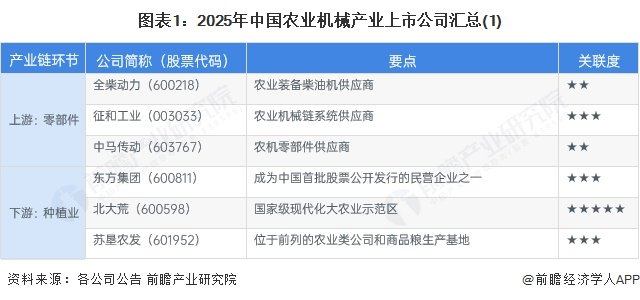
Summary of Key Points Core Viewpoint - The article provides a comprehensive overview of the agricultural machinery industry in China, highlighting key listed companies, their revenue performance, business layouts, and future planning strategies. Group 1: Overview of Listed Companies - The agricultural machinery industry in China includes upstream companies like QuanChai Power and Zhenghe Industrial, midstream companies such as Jifeng Technology and Xinguang Agricultural Machinery, and downstream companies like Dongfang Group and Beidahuang [1][2]. Group 2: Company Revenue and Performance - In 2024, major companies in the agricultural machinery sector include: - Zhonglian Heavy Industry: Revenue of 454.78 billion - Yituo Co., Ltd.: Revenue of 118.56 billion - Jifeng Technology: Revenue of 27.09 billion - Other companies have varying revenues, with the lowest being Xinguang Agricultural Machinery at 2.69 billion [4][16]. Group 3: Business Layout and Focus Areas - Companies like Yituo Co., Ltd. and Jifeng Technology have over 90% of their business focused on agricultural machinery, with a significant emphasis on tractors and harvesters [14]. - Zhonglian Heavy Industry focuses on high-end agricultural machinery, while other companies like Xinguang Agricultural Machinery specialize in specific products like combine harvesters [15]. Group 4: Employee and Patent Information - Zhonglian Heavy Industry employs over 30,000 people, with 10,724 being technical staff, and holds the most patents in the industry at 4,399 [8][9]. - Other companies have varying employee counts and patent holdings, indicating a diverse range of capabilities within the sector [10]. Group 5: Future Business Planning - Companies are focusing on new product development, expanding overseas markets, and enhancing technology. For instance, Yituo Co., Ltd. aims to improve product quality and develop export-oriented products, while Jifeng Technology plans to leverage its network for promoting high-end agricultural machinery [17]




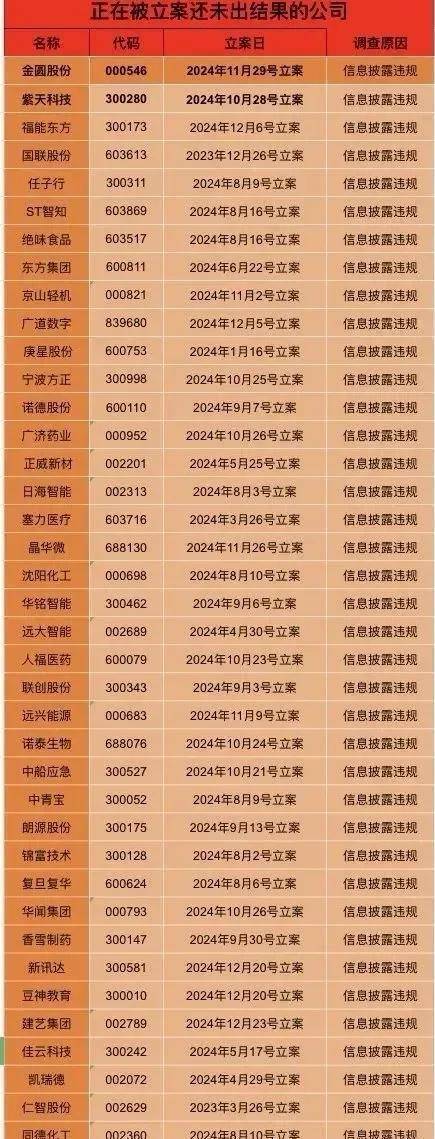
10月16日,证监会发出通报!终止上市,3大消息出炉
Sou Hu Cai Jing· 2025-10-16 16:55
Group 1 - The core point of the news is the increasing severity of regulatory actions against financial fraud in the Chinese stock market, exemplified by the termination of ST Yuancheng's listing due to serious financial misconduct [1] - The new delisting rules implemented in April 2024 allow for companies to be delisted after one year of serious fraud, expanding the scope of delisting [3] - Since the new rules were enacted, over 50 companies have been terminated or entered delisting procedures, indicating a significant increase in delisting efficiency [3] Group 2 - ST Zhuolang's case illustrates the extent of financial fraud, with the company inflating revenue by 1.815 billion yuan through fictitious business operations from 2018 to 2022 [3] - ST Zhongcheng's fraudulent activities spanned six years, with profits inflated by over 1.3 billion yuan through methods such as falsifying project progress [5] - The trend of delisting due to stock prices falling below 1 yuan has become prevalent, with over 60% of delisted companies in 2025 falling into this category [5] Group 3 - Regulatory technology has improved the detection of fraud, with GPS data revealing discrepancies in reported logistics activities [10] - Satellite imagery has been utilized to verify claims made by companies, such as agricultural coverage, effectively curbing asset inflation attempts [11] - The number of regulatory inquiries has increased by 40% in the first half of 2025, with over 60% targeting abnormal financial data [18] Group 4 - The market is experiencing a shift in investor sentiment, with a notable decrease in trading volume coinciding with an increase in delisted companies [13] - Institutional investors are adjusting their strategies, reducing exposure to small-cap and low-liquidity stocks to historic lows [13] - Retail investors face significant challenges, with average losses exceeding 70% for those holding delisted stocks [15] Group 5 - The emergence of innovative drug companies contrasts sharply with the wave of delistings in traditional industries, highlighting a structural shift in market resource allocation [15] - The introduction of supportive policies for the smart terminal industry aims to accelerate capital flow towards emerging sectors [15] - Breakthroughs in nuclear fusion technology showcase the potential of tech-driven companies, contrasting with the fates of fraudulent firms [16]

A股13家退市企业牵连11家券商
2 1 Shi Ji Jing Ji Bao Dao· 2025-10-16 13:47
Core Viewpoint - The A-share market is experiencing an unprecedented wave of delistings due to major violations, with a record number of companies forced to delist as regulatory scrutiny intensifies [1][6][10] Group 1: Delisting Trends - As of October 15, 2023, 13 companies have triggered mandatory delisting indicators due to major violations, marking a historical high [6][10] - Among these, 8 companies have already been delisted, including notable cases like Zhuolang Technology and Dongfang Group [6][10] - The delisting wave has highlighted the role of investment banks as gatekeepers, with 11 brokerage firms involved in the delisted companies [1][6] Group 2: Investment Banks' Responsibilities - Many problematic companies frequently changed their investment banks during periods of financial misconduct, complicating accountability [2][10] - Most involved investment banks issued "no objection" or "no issues found" reports during the supervision period, raising questions about their diligence [2][10] - The regulatory environment is pushing investment banks to reassess their responsibilities and improve their oversight practices [2][15] Group 3: Case Studies of Violations - ST Dongtong, involved in financial fraud from 2019 to 2022, had its investment bank, First Capital, implicated in fraudulent activities during a stock issuance [8][12] - Guohua Securities was the only firm to issue a risk warning regarding Jiuyou Co., while others remained silent despite ongoing fraud investigations [12][13] - Highong Data had the longest duration of fraud (2015-2023) and changed investment banks multiple times, indicating a pattern of evasion [10][11] Group 4: Regulatory Impact on Investment Banks - The shift towards stricter regulations has led to increased scrutiny of investment banks' roles, with many now enhancing their due diligence processes [15] - Investment banks are reportedly increasing their manpower and resources dedicated to ongoing supervision, reflecting a shift in focus due to regulatory pressures [15]


A股13家退市企业牵连11家券商
21世纪经济报道· 2025-10-16 12:54
Core Viewpoint - The article discusses the unprecedented wave of delistings in the A-share market due to major violations, highlighting the challenges faced by brokerage investment banks in fulfilling their role as gatekeepers in the capital market [1][3]. Group 1: Regulatory Changes and Impact - As of October 15, 2023, a record number of 13 companies have triggered mandatory delisting indicators due to major violations, marking a significant increase in regulatory scrutiny [3][4]. - Among the 13 companies, 8 have already been delisted, with the first being Zhuolang Technology in March and the latest being Zitian Technology in October [4]. Group 2: Role of Brokerage Investment Banks - The article emphasizes the complex responsibilities of brokerage investment banks, noting that many of them issued "no objection" or "no issues found" reports during the supervision period for companies later confirmed to have committed fraud [1][5]. - Notably, only Guorong Securities issued a risk warning for Jiuyou Co., while most other involved investment banks failed to identify issues during their oversight [7][8]. Group 3: Case Studies of Fraudulent Companies - ST Dongtong, involved in financial fraud from 2019 to 2022, had First Capital as its sponsor, which was implicated in the fraudulent issuance of shares [5]. - Guangdao Digital, under the sponsorship of Wukuang Securities, inflated its revenue by 1.465 billion yuan through fraudulent contracts and invoices from 2018 to mid-2024 [5][6]. Group 4: Changes in Oversight Practices - The article notes that some investment banks frequently changed during the fraud periods, such as Gaohong Data, which switched its sponsoring banks multiple times, indicating a lack of consistent oversight [6][7]. - Investment banks are reportedly increasing their diligence in due diligence processes, especially during the continuous supervision phase, which had previously received less attention [10].

13家退市企业牵连11家券商,第一创业、五矿证券被重点点名
2 1 Shi Ji Jing Ji Bao Dao· 2025-10-16 07:43
Core Viewpoint - The A-share market is experiencing an unprecedented wave of delistings due to major violations, with a record number of companies forced to delist as regulatory scrutiny intensifies [1][5]. Group 1: Regulatory Environment - The new delisting regulations that came into effect at the beginning of the year have led to a historical high of 13 companies reaching the mandatory delisting criteria for major violations as of October 15 [1][5]. - The regulatory environment is becoming increasingly stringent, with the China Securities Regulatory Commission (CSRC) enforcing stricter oversight on financial fraud and other illegal activities [4][6]. Group 2: Role of Investment Banks - Eleven investment banks are under scrutiny for their roles in the delisted companies, with only two, First Capital and Wumart Securities, currently facing regulatory action [2][7]. - The complexity of the investment banks' responsibilities is highlighted by the fact that many of the involved companies frequently changed their advisory firms during periods of fraud [4][9]. Group 3: Case Studies of Delisted Companies - Notable cases include *ST Dongtong, which was involved in fraudulent activities from 2019 to 2022, leading to warnings issued to its sponsor, First Capital [7][8]. - Guandao Digital inflated its revenue by 1.465 billion yuan through fraudulent contracts and invoices, resulting in penalties for Wumart Securities, which served as its sponsor [8]. Group 4: Investment Banks' Due Diligence - Many investment banks provided "no objection" reports during the supervision periods of companies that were later found to have committed fraud, raising questions about their diligence [4][12]. - National Securities was the only firm to explicitly warn of risks associated with a client, indicating a lack of proactive risk management among other firms [12][13]. Group 5: Changes in Oversight Practices - Investment banks are reportedly increasing their efforts in due diligence, particularly during the ongoing supervision phases, in response to heightened regulatory scrutiny [15]. - Accounting firms are also enhancing their audit processes, adding independent review steps and increasing personnel to ensure thorough examinations [15].


港股钢铁股涨幅居前 中国东方集团涨6.67%
Mei Ri Jing Ji Xin Wen· 2025-10-15 06:33
Group 1 - Hong Kong steel stocks experienced significant gains on October 15, with China Oriental Group rising by 6.67% to HKD 1.44 [1] - Maanshan Iron & Steel Co. saw an increase of 6.92%, reaching HKD 2.78 [1] - Ansteel Company reported a rise of 5.96%, trading at HKD 2.31 [1] - Chongqing Iron & Steel Co. increased by 2.88%, with a price of HKD 1.43 [1]

年内12家公司触及重大违法退市指标
2 1 Shi Ji Jing Ji Bao Dao· 2025-09-29 11:36
Core Viewpoint - The regulatory environment in the capital market has shifted towards a "zero tolerance" approach, with a significant increase in the number of administrative penalties and fines for financial fraud and market manipulation during the "14th Five-Year Plan" period compared to the "13th Five-Year Plan" [1][4][5]. Regulatory Actions - The number of administrative penalties for financial fraud and market manipulation has increased by 58%, while the total fines have risen by 30%, totaling 2,214 penalties and 41.4 billion yuan [4][5]. - A three-pronged punishment mechanism involving administrative, civil, and criminal penalties is being established, with significant fines becoming more common, such as the 1.7 billion yuan fine imposed on Dongxu Group for fraudulent issuance [5][6]. - Since the implementation of new delisting regulations, 12 companies have met the criteria for mandatory delisting due to serious violations, with 8 already delisted [7]. Enforcement Efficiency - The improvement in enforcement efficiency is attributed to the integration of technology and collaborative law enforcement, utilizing AI and big data for comprehensive monitoring and analysis [9][10]. - The number of financial fraud leads transferred for investigation has increased by approximately one-third in 2023, indicating enhanced detection capabilities [9]. Investor Protection - Investor protection measures are being strengthened, with improved legal frameworks and more accessible channels for investors to assert their rights [2][12]. - The 12386 platform has seen a significant increase in accessibility, achieving a connection rate of 99% [12]. - Notable cases, such as those involving Kangmei Pharmaceutical and Zijing Storage, have set precedents for investor rights protection through representative litigation [13].
从五年414亿罚单到常态化退市:透视资本市场严监管新态势
2 1 Shi Ji Jing Ji Bao Dao· 2025-09-29 07:43
Regulatory Environment - The regulatory environment in the capital market has shifted towards a "zero tolerance" approach, with a significant increase in administrative penalties for financial fraud and market manipulation during the "14th Five-Year Plan" period, with penalties rising by 58% and amounts by 30% compared to the "13th Five-Year Plan" [2][3] - A comprehensive punishment mechanism involving administrative, civil, and criminal penalties is being established, with substantial fines becoming common, such as the 1.7 billion yuan fine imposed on Dongxu Group for fraudulent issuance [3][4] Delisting Regulations - The new delisting regulations have led to a notable increase in companies facing mandatory delisting due to major violations, with 12 companies reaching delisting indicators since 2025, of which 8 have completed the delisting process [5] - The emphasis on "delisting does not exempt from liability" is being reinforced, with 67 delisted companies facing investigations for illegal activities as of August 2025 [5] Enforcement Efficiency - The efficiency of law enforcement has improved significantly due to collaborative law enforcement and technological empowerment, with a 33% increase in the transfer of financial fraud clues in 2023 compared to the previous three years [6][7] - The use of AI and big data technologies has enhanced the regulatory framework, allowing for comprehensive monitoring and analysis of potential fraudulent activities, ensuring that violations are detected and addressed promptly [7] Investor Protection - Investor protection mechanisms are being strengthened, with improvements in the legal framework and the establishment of clearer channels for investor rights protection, including the optimization of the 12386 platform, which has achieved a 99% connection rate [9][10] - The development of a diversified dispute resolution mechanism is underway, enhancing the role of mediation and arbitration in resolving securities and futures disputes [10]

穷查理宝典核心逻辑之逆向投资


雪球· 2025-09-21 04:05
↑点击上面图片 加雪球核心交流群 ↑ 作者:只买消费垄断 来源:雪球 逆向思维,就是,反过来想。总是反过来想。芒格认为,研究失败比研究成功更有价值。因为失败往往揭示了根本问题和风险所在。通过逆向思 考,人们可以更好的识别和规避陷阱,避免犯同样的错误。在股市投资中,芒格通过研究失败的公司的共同规律,来规避风险,他认为避免愚蠢比 追求智慧更容易成功,芒格在书中把失败的公司的原因归为四大类。 第一类失败,能力圈之外的无知型失败:不懂的公司坚决不买。 投资者买股票踩雷,本质是公司的失败。公司失败,本质是投资者和管理者,对业务的底层逻辑毫无认知。导致决策脱离现实。比如盲目跨界,盲 目多元化,比如传统制造业去做互联网,消费品公司去投资芯片,缺乏技术积累也不懂新行业规则,最终投入打水漂。比如箭牌口香糖,主业做的 很好,但是为了多元化盲目收购软件公司,因为完全不懂软件的研发,迭代逻辑,最终软件业务持续亏损,拖累了主业。再比如阿里巴巴投资饿了 吗,苏宁易购,大润发,高德地图,基本都是亏损累累。伯克希尔1989年收购美国航空优先股,到1994年亏损75%。芒格后来承认他和巴菲特低估 了航空业密集的资本投入和同质化竞争;再比如贵州 ...

光大期货农产品日报(2025 年9 月19日)-20250919
Guang Da Qi Huo· 2025-09-19 05:21
Report Industry Investment Ratings - Corn: Oscillating downward [1] - Soybean Meal: Oscillating [1] - Palm Oil: Oscillating [1] - Eggs: Oscillating and slightly bullish [1][2] - Pigs: Oscillating and slightly bearish [2] Core Viewpoints - Corn futures' November contract shows a technical rebound after continuous decline, with the spot market facing increased pressure from new corn listings. Short - term attention is on whether the contract can break through the price low in mid - August, and the medium - term operation follows a bearish idea [1]. - CBOT soybean meal and soybean prices decline due to a stronger dollar and US harvest pressure. Domestic two - meal prices continue to fall, and the strategy is to participate in the short - term [1]. - BMD palm oil falls following the surrounding market. The domestic oil market is weak, and the strategy is to bet on increased volatility [1]. - The egg futures' 2511 contract oscillates with a slight rebound at the end of the session. The spot price corrects after a continuous rebound. The supply - side pressure on egg prices may ease in the future, and it is recommended to wait and see or participate with a light position [1][2]. - The pig futures' 2511 contract continues to decline. The spot price also drops, and the demand is weak. In the short term, the pig price may remain weak, but it may be supported by increased demand as the temperature drops [2]. Summary by Directory Research Views - **Corn**: The November contract rebounds technically after a continuous decline. The spot market in the production area expects an increase in new corn listings after mid - September, and the price in the Liaoning production area weakens. In the North China region, the price continues to be weak, and the price in the sales area is temporarily stable. The short - term is to beware of a rebound after a sharp decline, and the medium - term is bearish [1]. - **Soybean Meal**: CBOT soybeans fall due to a stronger dollar and harvest pressure. The export sales of US soybeans meet expectations, and domestic two - meal prices reach a one - and - a - half - month low. The strategy is short - term participation [1]. - **Palm Oil**: BMD palm oil falls following the surrounding market. High - frequency data shows a decrease in exports. The domestic oil market is weak, and the strategy is to bet on increased volatility [1]. - **Eggs**: The 2511 contract oscillates with a slight rebound, and the spot price corrects after a continuous rebound. The supply - side pressure on egg prices may ease in the future, and it is recommended to wait and see or participate with a light position [1][2]. - **Pigs**: The 2511 contract continues to decline, and the spot price drops. The demand is weak, and the short - term pig price may remain weak. It may be supported by increased demand as the temperature drops [2]. Market Information - From September 14th to 17th, Liu Huanxin led a team to investigate grain and material reserve work in Heilongjiang, emphasizing the importance of grain storage and logistics facilities projects [3]. - Zhengshang Institute cancels the designated delivery warehouse qualification of Orient Group Grain and Oil Food Co., Ltd. for rapeseed oil and rapeseed meal [3]. - In August, China's palm oil imports were 340,000 tons, a year - on - year increase of 16.5%; soybean oil imports were 100,000 tons, a year - on - year increase of 113.9%; rapeseed oil and mustard oil imports were 140,000 tons, a year - on - year increase of 18.7% [4]. Variety Spreads - **Contract Spreads**: It includes the 1 - 5 spreads of corn, corn starch, soybean, soybean meal, soybean oil, palm oil, eggs, and pigs [5][6][7][11][15] - **Contract Basis**: It includes the basis of corn, corn starch, soybean, soybean meal, soybean oil, palm oil, eggs, and pigs [13][14][17][18][24] Introduction of the Agricultural Product Research Team - Wang Na is the director of the agricultural product research at Everbright Futures Research Institute, with multiple honors and achievements [26]. - Hou Xueling is an analyst of soybeans at Everbright Futures, with rich experience and many honors [26]. - Kong Hailan is a researcher of eggs and pigs at Everbright Futures Research Institute, with relevant experience and honors [26].