浦发银行

Search documents
股份制银行板块12月31日跌0.01%,平安银行领跌,主力资金净流入1.77亿元
Zheng Xing Xing Ye Ri Bao· 2025-12-31 09:07
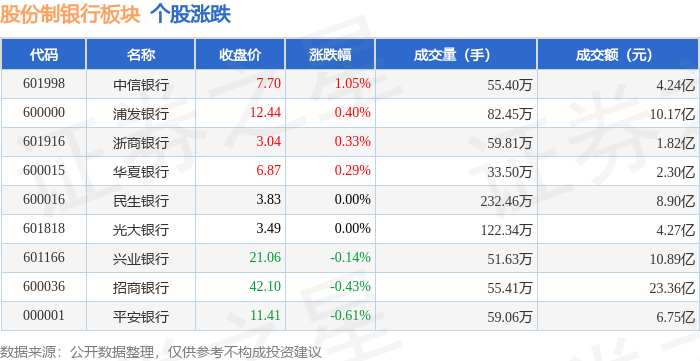
Group 1 - The banking sector experienced a slight decline of 0.01% on December 31, with Ping An Bank leading the drop [1] - The Shanghai Composite Index closed at 3968.84, up 0.09%, while the Shenzhen Component Index closed at 13525.02, down 0.58% [1] - Major banks such as CITIC Bank and Shanghai Pudong Development Bank saw positive price movements, with CITIC Bank increasing by 1.05% to 7.70 and Shanghai Pudong Development Bank rising by 0.40% to 12.44 [1] Group 2 - The net inflow of main funds in the banking sector was 177 million yuan, while retail funds saw a net inflow of 25.68 million yuan [1] - Retail investors showed a mixed response, with significant outflows from major banks like Ping An Bank and Minsheng Bank, while some smaller banks attracted retail inflows [2] - The data indicates that institutional investors favored certain banks, as seen in the net inflow percentages for banks like CITIC Bank and Shanghai Pudong Development Bank [2]







2025年A股月度财富盛宴,1万本金月月擒牛,年度斩获3600000000!
Jin Rong Jie· 2025-12-31 08:59
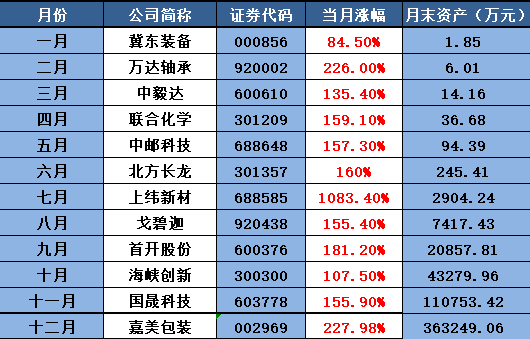
Market Overview - In 2025, the A-share market experienced a "policy-driven, technology-led, and structurally differentiated" growth, achieving a total market value exceeding 109 trillion yuan and an annual trading volume surpassing 400 trillion yuan [1] - The ChiNext Index led global major indices with an annual increase of nearly 50%, while the Shanghai Composite Index rose by 18.41%, surpassing the 4000-point mark for the first time since 2015 [1] - Significant sector rotation occurred, with strong performances in computing hardware, non-ferrous metals, banking, battery supply chains, innovative pharmaceuticals, commercial aerospace, and robotics, while traditional sectors like real estate and steel showed weak growth [1] Individual Stock Performance - A total of 4,073 stocks in the market had positive annual returns, with several stocks achieving remarkable monthly gains [2] - Notable monthly performances included: - January: Jidong Equipment with a 84.50% increase [4] - February: Wanda Bearings with a 226.00% increase [7] - March: Zhongyida with a 135.40% increase [9] - April: United Chemical with a 159.10% increase [12] - May: Zhongyou Technology with a 157.30% increase [14] - June: Beifang Changlong with a 160.00% increase [16] - July: Shangwei New Materials with a staggering 1083.40% increase [19] - August: Gebijia with a 155.40% increase [22] - September: Shoukai Shares with a 181.20% increase [25] - October: Haixia Innovation with a 107.50% increase [27] - November: Guosheng Technology with a 155.90% increase [29] - December: Jiamei Packaging with a 227.98% increase [31] Sector Highlights - The AI computing sector saw explosive growth due to increased demand for computing power, with related companies experiencing a surge in orders and stock prices [34] - The humanoid robotics sector gained traction following government support and advancements in technology, attracting significant capital investment [34] - The controlled nuclear fusion sector emerged as a promising future energy source, with stock prices responding positively to technological breakthroughs and policy support [34] - Mergers and acquisitions became a trend, with companies optimizing resources and achieving significant stock price increases through strategic consolidations [34]
中信银行少帅转战邮储,国有行股份行间高管流动折射何种变化
Nan Fang Du Shi Bao· 2025-12-31 04:36
Core Viewpoint - The recent appointment of Lu Wei as the president of Postal Savings Bank after his resignation from CITIC Bank highlights the increasing trend of executive mobility between state-owned and joint-stock banks in China, reflecting a shift towards breaking down institutional barriers and fostering financial innovation [2][9][12]. Group 1: Executive Changes - Lu Wei resigned from his positions at CITIC Bank, including president and executive director, due to work adjustments, and has been appointed as the president of Postal Savings Bank [3][5]. - Lu Wei has over 20 years of experience at CITIC Bank, having held various significant roles, including vice president and secretary of the board [3][4]. - Following Lu Wei's departure, CITIC Bank's chairman, Fang Heying, will temporarily assume the role of president [8]. Group 2: Industry Trends - The movement of executives between state-owned and joint-stock banks has become increasingly common, with several high-profile cases in recent years, indicating a trend towards more fluid talent mobility in the banking sector [9][10]. - Experts suggest that this trend is part of a broader strategy to enhance capital and talent flow, shift performance metrics from "loan scale" to "ecological value," and stimulate financial innovation [10][11]. - The transition of executives like Lu Wei poses challenges, as they must adapt their skills and experiences to different banking environments, particularly in rural contexts [11][12].

浦发银行(600000)12月30日主力资金净买入1.64亿元
Sou Hu Cai Jing· 2025-12-31 00:28
证券之星消息,截至2025年12月30日收盘,浦发银行(600000)报收于12.39元,上涨1.81%,换手率 0.22%,成交量74.05万手,成交额9.1亿元。 12月30日的资金流向数据方面,主力资金净流入1.64亿元,占总成交额18.05%,游资资金净流出 7083.85万元,占总成交额7.78%,散户资金净流出9350.14万元,占总成交额10.27%。 近5日资金流向一览见下表: 浦发银行融资融券信息显示,融资方面,当日融资买入1790.16万元,融资偿还4442.55万元,融资净偿 还2652.38万元。融券方面,融券卖出13.66万股,融券偿还12.83万股,融券余量96.4万股,融券余额 1194.4万元。融资融券余额28.14亿元。 近5日融资融券数据一览见下表: 以上内容为证券之星据公开信息整理,由AI算法生成(网信算备310104345710301240019号),不构成 投资建议。 该股主要指标及行业内排名如下: 浦发银行2025年三季报显示,前三季度公司主营收入1322.8亿元,同比上升1.88%;归母净利润388.19 亿元,同比上升10.21%;扣非净利润389.0亿元,同比 ...

欧克科技股份有限公司关于新增募集资金专户并签订募集资金三方监管协议的公告
Shang Hai Zheng Quan Bao· 2025-12-30 23:34
Group 1 - The company has established a special account for the management of raised funds to protect investor rights, in compliance with relevant laws and regulations [3][4] - The company raised a total of RMB 1,093.87 million from its initial public offering, with a net amount of RMB 1,011.06 million after deducting issuance costs [2] - The company signed tripartite supervision agreements with multiple banks and its sponsor to ensure proper management and usage of the raised funds [3][4] Group 2 - A new special account has been opened at China Postal Savings Bank for the "Intelligent Equipment Production Project for Daily Paper" and "Technology Research and Development Center Construction Project" [4] - The tripartite supervision agreement includes provisions for the bank to provide monthly account statements and for the sponsor to supervise the usage of funds [5][8] - The agreement stipulates that if the company withdraws more than RMB 50 million or 20% of the net raised funds within a 12-month period, the bank must notify the sponsor [5][9]
运行近30年的银行监事会制度正走向终章
Xin Lang Cai Jing· 2025-12-30 22:39
根据中国证监会安排,上市公司需在2026年前取消监事会。兴业银行、兰州银行、浦发银行等十余家银 行已于12月密集公告不再设立监事会。这一系列变动源于顶层法制重塑。随着新公司法及金融监管总 局、证监会配套制度落地,银行业的公司治理效能改革,正从纸面走向现实。以往与董事长、行长并 称"三长"的监事长逐步"消失",监督职能由董事会下设的审计委员会接棒。(上证报) ...
平安港股医疗优选股票型证券投资基金(QDII)基金份额发售公告
Shang Hai Zheng Quan Bao· 2025-12-30 20:01
Fund Overview - The fund is named "Ping An Hong Kong Medical Preferred Stock Investment Fund (QDII)" and is categorized as an equity fund [14][23] - The fund aims to primarily invest in Hong Kong stocks related to the medical theme, striving for long-term stable asset appreciation while strictly controlling risks [14][18] Fund Management and Custody - The fund is managed by Ping An Fund Management Co., Ltd., with Shanghai Pudong Development Bank Co., Ltd. serving as the custodian [14][60] - The fund's operation is contract-based and open-ended, with no fixed duration [14][18] Fund Offering Details - The fund will be publicly offered from January 5, 2026, to January 27, 2026, with a maximum fundraising limit of 2 billion RMB [18][19] - The initial fundraising cap is set at 2 billion RMB, excluding interest accrued during the fundraising period [19][20] Subscription Process - Investors can subscribe through designated sales institutions, with minimum subscription amounts varying based on the method of subscription [3][8] - The fund allows multiple subscriptions during the fundraising period, with fees calculated separately for each application [10][31] Investor Eligibility - The fund is open to individual investors, institutional investors, qualified foreign investors, and other investors permitted by laws and regulations [16][18] - There is currently no upper limit on the number of shares a single investor can hold, but if an investor's holdings exceed 50% of the total shares, the fund manager may impose restrictions [4][13] Fund Subscription Fees - The fund has two classes of shares: Class A, which charges subscription fees, and Class C, which does not charge subscription fees but deducts service fees from the fund's assets [22][26] - Subscription fees for Class A shares are used for marketing, sales, and registration expenses incurred during the fundraising period [26][27] Fund Management Rights - The fund manager reserves the right to adjust subscription limits and other terms based on market conditions, in compliance with relevant laws and regulations [4][6] - The fund manager may also employ foreign investment advisors for overseas stock investments, with associated risks detailed in the fund's prospectus [11][60]
“消失”的银行监事长
Shang Hai Zheng Quan Bao· 2025-12-30 19:26
Core Viewpoint - The bank supervisory board system, in operation for nearly 30 years, is approaching its end as banks begin to abolish this structure in favor of audit committees, following new regulations from the China Securities Regulatory Commission (CSRC) and the Financial Regulatory Bureau [2][3][4]. Regulatory Framework for Reform - The new Company Law, effective from July 2024, allows financial institutions to replace supervisory boards with audit committees, fundamentally changing the requirement for supervisory boards as mandatory entities [3][4]. - The Financial Regulatory Bureau has issued policies that support the transition, allowing financial institutions to choose between retaining supervisory boards or establishing audit committees to perform supervisory functions [3][4]. Differences in Implementation - There is a differentiation in the approach to abolishing supervisory boards between listed and non-listed banks, with listed banks required to eliminate supervisory boards by 2026, while non-listed banks have the option to retain them [4][5]. - Major state-owned banks have already initiated the process of abolishing supervisory boards, with the five largest banks voting to remove them in April 2025 [5]. Effectiveness and Challenges of Supervisory Boards - The supervisory board has been criticized for its lack of independence, professionalism, and efficiency, often leading to overlapping functions and ineffective oversight [6][7]. - The costs associated with maintaining a supervisory board are significant, with estimates suggesting that listed banks could save millions annually by abolishing this structure [7]. Transition Paths for Supervisory Board Members - Former supervisory board members may transition to roles within the audit committee, take on positions in other financial institutions, or retire from the industry [8]. - The governance mechanism is expected to become more efficient, with fewer decision-making layers and a more direct oversight structure through audit committees [8].



上证深一度 | “消失”的银行监事长
Shang Hai Zheng Quan Bao· 2025-12-30 19:16
运行近30年的银行监事会制度,正走向终章。 国浩律师(上海)事务所合伙人黄江东告诉上海证券报记者,新公司法作为改革的纲领性文件,确立了 全新的公司治理框架。它推动了内部监督机制的优化,允许股份有限公司转向更高效的"单层监督"。 紧随其后的是,金融监管部门出台配套政策,与新公司法共同构成了一套旨在平稳推进金融机构治理改 革、确保市场有序衔接的政策体系。 2024年12月,金融监管总局印发的《关于公司治理监管规定与公司法衔接有关事项的通知》明确,金融 机构可以选择继续保留监事会,也可选择由董事会下设的审计委员会行使监事会职权。 当月,证监会发布关于新公司法配套制度规则实施相关过渡期安排明确,2026年1月1日前,上市公司应 当在董事会中设审计委员会,行使监事会的职权,不设监事会或者监事。 从配套政策来看,银行监事会的存废呈现上市与非上市差异化特征。针对金融机构的特殊性,金融监管 总局的通知并未强制要求所有机构转换模式。而根据证监会安排,上市公司需在2026年前取消监事会。 近日,浙商银行公告称,郭定方辞去监事长、职工监事等职务。同期,杭州银行公告称,王立雄辞去监 事长等职务。辞任后,他将继续担任杭州银行党委委员, ...
国有大行唯一直销银行吸收合并获批!独立法人直销银行仅剩一家
Sou Hu Cai Jing· 2025-12-30 14:44
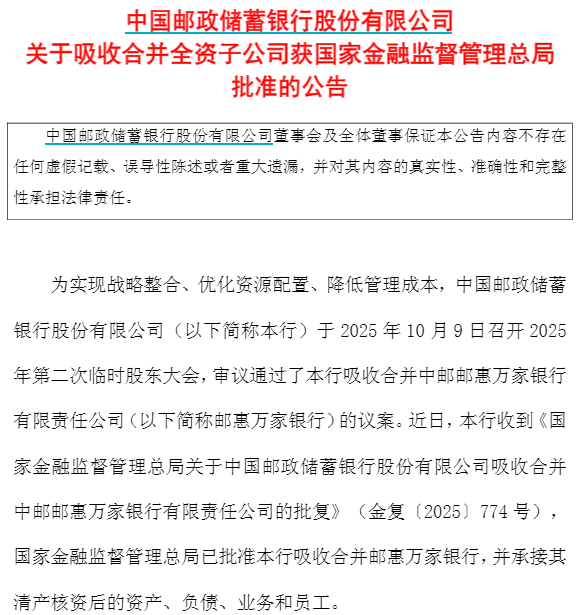
Group 1 - The core point of the news is that China Postal Savings Bank has received approval to absorb and merge its wholly-owned subsidiary, Postal Huinong Bank, which will leave only Citic Baixin Bank as the remaining independent legal direct bank in China [1][3]. - The merger is expected to optimize management and business structure, enhance digital transformation effectiveness, improve operational efficiency, and reduce management costs for China Postal Savings Bank [3]. - Postal Huinong Bank, established in 2022 with a registered capital of 5 billion yuan, was intended as a testing ground for the digital transformation of China Postal Savings Bank [3]. Group 2 - In 2024, Postal Huinong Bank reported a revenue of 243 million yuan and a net loss of 415 million yuan, with total assets of 12.828 billion yuan and total liabilities of 8.669 billion yuan by the end of 2024 [3]. - The non-performing loan ratio for Postal Huinong Bank was 6.66%, with a provision coverage ratio of 239.55% [3]. - The trend of merging or shutting down direct banking operations has been observed across multiple banks since 2017, with several banks like Ping An Bank and Shanghai Pudong Development Bank closing or integrating their direct banking channels [4]. Group 3 - Regulatory tightening is a significant reason for the decline in direct banking operations, with increased scrutiny on financial institutions to return to core operations and maintain risk isolation [4]. - The tightening of regulations regarding data security, personal information protection, and internet loans has limited the business models that direct banks previously relied on, making innovation more challenging [4]. - The once-prominent role of direct banks as a key tool for traditional banks to counter the impact of internet finance has diminished significantly [4].